


Manufacturing & Industrial Plant Security Trailers
Manufacturing and industrial facilities carry a lot of value outside the four walls of the plant—yard inventory, loaded trailers, finished goods, critical spares, and employee vehicles. When the perimeter is weak, all of that is exposed.
Hawk Surveillance provides manufacturing and industrial plant security trailers across Southern California to strengthen perimeter lines, secure shipping and receiving, and cover remote corners that fixed cameras and guards often miss. Our mobile units are designed to plug into your existing security program, not replace it.
Whether you manage a single facility or a network of plants and yards, we help you close coverage gaps with flexible, mobile, and industrial-grade surveillance.
Industrial Plant Risk Profile
Industrial and manufacturing sites face a distinct mix of security and operational risk:
- Perimeter breaches and fence-line intrusions
Back fences, rail spurs, and rarely used access roads are common entry points for theft and trespassing. - Theft from outdoor storage and yards
Raw materials, finished goods, pallets, spares, and parts stored outside are high-value targets—especially after hours. - Unauthorized vehicle and personnel access
Unlogged truck movements, tailgating through gates, and unbadged visitors can expose the plant to theft, safety incidents, and compliance issues.
Incidents in remote corners of the property
Areas far from the main building—overflow lots, laydown yards, storage pens—are hard to monitor with fixed cameras alone.

The impact is more than just missing inventory:
- Production delays while losses are investigated or materials are reordered
- Insurance and regulatory implications for repeated incidents
- Time spent by supervisors and EHS teams chasing footage or witnesses
- Pressure from corporate, auditors, and customers to “tighten up the yard”
Static poles and roof cameras can only see so far. Guards can only be in one place at a time. Mobile industrial security trailers let you push eyes, lights, and deterrence where you actually have risk—today, not months from now.
How Security Trailers Support Industrial Sites
Our industrial plant security trailers are designed around the realities of large footprints, heavy vehicle traffic, and evolving operations.
Common use cases:
- Back-of-plant yards and storage zones
- Overwatch for raw materials, finished goods, and high-value spare parts.
- Coverage for employee and contractor parking in remote corners.
- Shipping, receiving, and dock areas
- Monitor truck staging lanes, dock doors, and cross-dock operations.
- Support incident review and chain-of-custody investigations.
- Remote corners and secondary lots
- Cover remote storage pens, rail spurs, tank areas, or satellite yards.
- Add visibility where trenching for new poles or fiber is impractical.
- Temporary projects and site changes
- Extra coverage during remodels, expansions, shutdowns, or turnarounds.
- Flexible industrial security trailer deployments that move as layouts change.
With mobile manufacturing facility surveillance trailers, you can:
- Extend your perimeter without building permanent infrastructure.
- Reposition coverage as operations or risk change.
- Capture incident-quality video around the plant, not just at the front gate.

Recommended Products for Manufacturing & Industrial Plants
Different industrial sites require different hardware. Most deployments rely on two core platforms, often with accessories tuned to your operations.
Heavy-Duty Industrial Surveillance Trailer
Best for:
- Large, mixed-surface yards with truck and equipment traffic
- Plants with uneven ground, gravel, or dirt perimeters
- Sites requiring multiple cameras, lighting, and deterrence on a single platform
Why it fits:
- Rugged chassis and stabilizers built for industrial environments
- Mast height and payload capacity suited for broad yard coverage
- Ideal as your primary industrial security trailer for long-term deployments
Flagship Solar Surveillance Trailer
Best for:
- Remote plant edges or secondary yards with limited power
- Overflow storage or satellite lots
- Utility or energy assets tied to a manufacturing footprint
Why it fits:
- Off-grid solar and battery design reduces dependence on grid power
- Strong option for plant perimeter security away from main buildings
- Operates where running power for fixed poles is cost-prohibitive
Accessories & Analytics
Many industrial sites enhance trailers with:
- Audio deterrence — loudspeakers for live talk-down and sirens for alarm events
- Lighting — floodlights for work areas and yard illumination; strobes for high-risk zones
- Analytics and license plate capture for better visibility around gates and driveways
Explore options on Accessories & Upgrades →
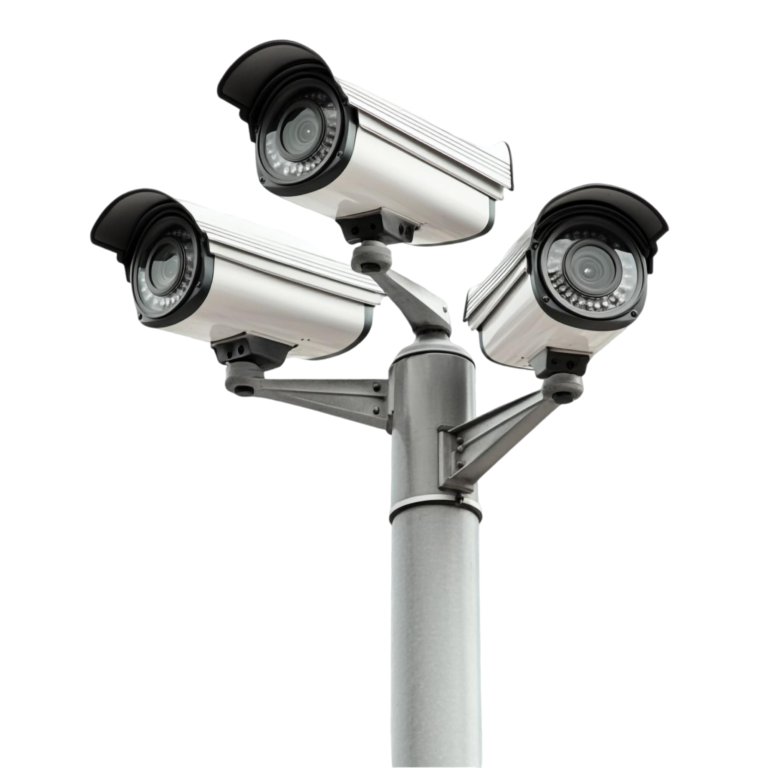
Integrating with Existing Plant Security
Most facilities already have some mix of cameras, access control, and guard presence. Our industrial security camera trailer deployments are built to layer into what you have—not replace everything.
Extend Your Current VMS Footprint
Stream video from manufacturing facility surveillance trailers into your existing VMS or SOC. Trailers are treated like another camera node inside your current environment, keeping workflows familiar for your teams.
Complement Guards & Fixed Cameras
Use trailers to watch remote corners, yards, and approaches so guards can focus on checkpoints and interior patrols. Elevated views help reduce time-consuming roving patrol patterns by covering problem areas directly.
Choose Your Monitoring Model
Select 24/7 remote monitoring and response through Hawk’s monitoring partner, or deploy self-monitored surveillance trailers managed by your own SOC or security integrator—whichever best fits your operational model.
Deployment for Plant Environments
Industrial sites are busy, regulated environments. Deployment has to respect safety, traffic, and production schedules.

Plant Walk-Through & Risk Review
Review site maps, traffic flow, and critical assets with plant and security leaders. Identify perimeter gaps, blind spots, and high-risk zones before deployment.

Placement Aligned to Operations
Choose trailer locations that maximize coverage without blocking dock doors, aisles, or emergency routes. Views are planned for gates, docks, yards, and remote corners.

Safety-Compliant Setup
Coordinate delivery to avoid peak traffic and deploy under site safety rules. Verify camera views, recording, connectivity, and lighting during day and night.

Repositions for Projects & Seasonal Changes
Move industrial security trailers as you add new storage zones, shift operations, or support shutdowns, turnarounds, and major capital projects.

Decommissioning or Long-Term Placement
Remove trailers at project completion or transition them into long-term positions as part of your permanent security and risk-management design.
For program-level support, see: Deployment & Project Services , Our Process
Manufacturing & Industrial Plant Security FAQs
Can trailers operate safely around heavy equipment and truck traffic?
Yes. Our industrial plant security trailers are designed for active yards with truck and equipment movement. We work with your team to select locations that maintain sightlines, respect traffic flows, and avoid backing/turning conflict points. Stabilizers and masts are deployed inside defined safety zones per your site rules.
How do you handle plant safety rules and inductions?
We treat manufacturing and industrial sites as controlled environments. Before deployment, our team aligns with your EHS and security requirements—PPE standards, induction or orientation, escorts, and any hot work or permit processes related to placement. Trailer setup is coordinated like any other contractor activity on site.
Can trailers be placed inside fenced areas, or only outside the perimeter?
Both are possible. Many industrial security trailers go inside the fence to watch yards, staging areas, and internal roads; others can be positioned just inside or outside perimeter lines to monitor approaches. Placement is planned with your security team to balance visibility, risk, and practical access for towing and maintenance.
Can you integrate with our existing security integrator or VMS?
Yes. We frequently work alongside existing integrators and security teams. Trailers can stream video to common VMS platforms or be monitored through your control room, while Hawk provides hardware, deployment, and support. If you prefer a turnkey option, we can also provide surveillance trailer monitoring services on top.
Are these trailers suitable for long-term, continuous deployments?
Yes. Our industrial security camera trailer platforms are built for long-duration, 24/7 use. Many manufacturing and industrial clients keep units on site for months or years at a time, with periodic maintenance and repositioning as facility needs evolve.
Close the Gaps in Your Plant Security
Perimeter blind spots, unmonitored yards, and remote corners are where industrial losses and incidents tend to happen. Manufacturing and industrial plant security trailers from Hawk Surveillance give you a flexible, fast way to extend coverage—without waiting on new poles, power runs, or construction projects.
If you are looking to reduce incidents, support compliance, and give your plant team better visibility on the ground, we can help design a practical, trailer-based security plan.