

Data Security & Privacy for NorCal Surveillance Trailers
Hawk protects surveillance trailer video and data with encryption in transit and at rest, role-based access controls, unique user accounts, and configurable retention policies. Data handling is treated as part of the security solution, not an add-on, and the deployment model is aligned to your IT, cybersecurity, and legal requirements.
If your organization has specific IT, cybersecurity, or legal requirements, we can align the deployment and operating model to your policies and approval process.
Last updated: June 2026
How We Protect Video & Data
Our approach is end-to-end: secure capture → secure transmission → secure storage → controlled access. The objective is to reduce risk in the same practical way we reduce physical security risk on-site, by using clear controls, repeatable procedures, and appropriate documentation for stakeholders.
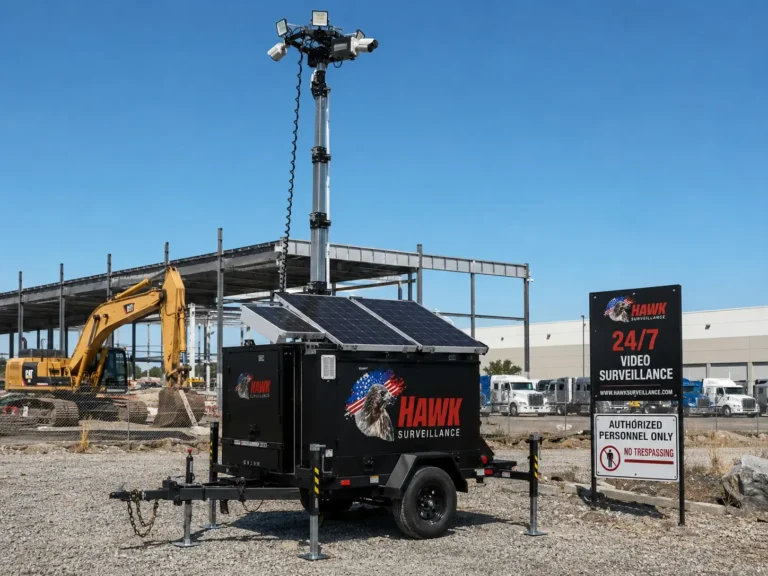
From a high level, protection includes:
- Limiting who can view live video and recorded footage
- Keeping video streams protected while traveling across public networks
- Setting retention windows that match operational and legal needs
- Maintaining clear expectations for who administers access in each service model
This is the core of surveillance trailer data security and privacy, not a single feature, but a coordinated set of controls designed to match real-world deployment conditions.
Access Control & Authentication
Access control is one of the most effective ways to reduce misuse, errors, and accidental exposure. Strong controls ensure users only see and do what their role requires. Nothing more.
Role-Based Access
Permissions are assigned by role so users only access what they need, such as live viewing, playback, exporting, or administrative functions.
Unique User Accounts
Accounts are assigned to individuals rather than shared logins wherever feasible, improving accountability and audit clarity.
Authentication Standards
Platforms support password hygiene requirements and, where available, multi-factor authentication to strengthen account security.
Administrative Oversight & Activity Visibility
Defined processes exist for adding or removing users, reviewing permissions, and monitoring high-level access activity such as logins and key configuration changes.
Important Operating Note
Responsibilities vary by solution model:
- In a Live Professional Monitored deployment, your team administers users and permissions within your own platform.
- In a monitored deployment, access is governed under defined operating procedures aligned with the monitoring workflow.
Encryption & Secure Transmission
Mobile deployments frequently rely on LTE/5G connectivity, which is common for temporary sites and remote environments. Because public networks introduce additional exposure, secure transmission matters.
At a practical level, secure transmission and storage typically involves:
- Encrypted connections for video/data streams between the trailer and the platform receiving the video (e.g., encrypted sessions over the network rather than open streams)
- Secure remote access practices to reduce exposure of management interfaces
- Encrypted storage where applicable depending on the storage layer and platform configuration (for example, protected storage volumes and controlled keys/credentials under the platform model in use)
We avoid making rigid “one-size-fits-all” claims because configurations can vary across rentals, client-owned fleets, and client platforms. Instead, the right approach is to align the deployment model to your risk posture and ensure the controls are documented and testable, especially when the trailer is connected over LTE/5G.
Retention, Export & Deletion
Retention is where operational needs intersect with legal and compliance requirements. Some organizations prefer shorter retention to minimize exposure, while others require longer retention to support investigations, claims, or regulatory workflows.
Retention Windows
- Retention periods can be configured based on project duration, site risk, and client policy.
- Different sites or programs may operate under different retention settings (for example, public-facing locations versus private jobsites).
- Configurations are established during onboarding to align with operational and compliance expectations.
Export for Investigations
- Incident footage can be exported to support operational reviews, insurance claims, or coordination with law enforcement.
- Exports follow your organization’s internal procedures and approval paths.
- When required, handling can align with documented chain-of-custody expectations.
Deletion & End-of-Service Handling
- Footage is typically deleted or overwritten automatically according to the agreed retention configuration.
- At project closeout or service termination, data handling follows the operating model established with the client.
- Additional care is applied for regulated, municipal, or compliance-sensitive environments.
If your legal or compliance team has specific retention, export, or deletion requirements, we recommend addressing them during intake so the operating model supports those needs from day one.
Privacy by Design for Public & Private Sites
Privacy risk differs significantly between a fenced jobsite and a public parking lot or city location. Our goal is to deliver effective coverage while minimizing unnecessary capture.
Key practical considerations include:
- Signage and notifications: where required or appropriate for the site type and jurisdiction, signage can be part of the deployment plan
- Field-of-view discipline: cameras should be oriented toward the risk zones and operational areas, avoiding unnecessary capture of unrelated spaces where feasible
- Public-facing sensitivity: deployments in retail and municipal environments should consider customer/public perception and privacy expectations
- Audio considerations: if audio deterrence features are enabled, they should follow clear rules for when and how they are used
On-site professionalism and conduct also matters for privacy-sensitive environments: Operational Safety & QHSE →
Working with Your IT, Security & Legal Teams
Enterprise and municipal buyers often need more than a sales conversation. They need a reviewable, defensible plan. Hawk Surveillance can support that process with practical information and cooperation during due diligence.
For environments where formal compliance expectations are a major factor:
Certifications & Compliance →
Data Security & Privacy
Understanding how data is handled in monitored vs Live Professional Monitored deployments.
Monitored Deployments
- Operators view video under defined SOPs aligned to incident response.
- Access is limited to what is required for monitoring and escalation.
- Activity logging and visibility are managed according to platform configuration and operating procedures.
Learn more → Monitoring & Response
Live Professional Monitored Deployments
- Your SOC or security team is the primary viewer and administrator.
- Your organization manages day-to-day access control, user provisioning, and internal policy enforcement.
- Hawk focuses on deployment, configuration support, and ensuring the trailer integrates cleanly into your environment.
Learn more → Live Professional Monitored Systems
Data Security & Privacy FAQs
Who owns and controls the video collected by surveillance trailers?
Ownership and control depend on the solution model and contract structure. In general, access and handling are governed by agreed operating procedures, including who can view, export, and retain footage.
Where is our video stored, and in what region?
Storage location depends on the platform model and configuration used for your deployment (monitored vs Live Professional Monitored, client platform vs managed platform). We can review storage region expectations during intake.
How long is footage retained by default, and can we change that?
Retention is configurable based on project needs and policy requirements. Many clients set retention in consultation with security and legal stakeholders.
How do you secure data when using LTE/5G networks?
Mobile deployments rely on protected connections and controlled access to reduce exposure on public networks. The exact configuration is aligned to the platform and your security requirements.
Can you follow our internal privacy policy and data handling rules?
Yes. We can align operating procedures to your requirements and document responsibilities, especially important for municipal, retail, and regulated environments.
What happens to our data when we end a project or contract?
Data handling follows the agreed retention and export requirements and the operating model in place. End-of-service expectations should be confirmed during intake to avoid ambiguity.