

Environmental Responsibility in Northern California
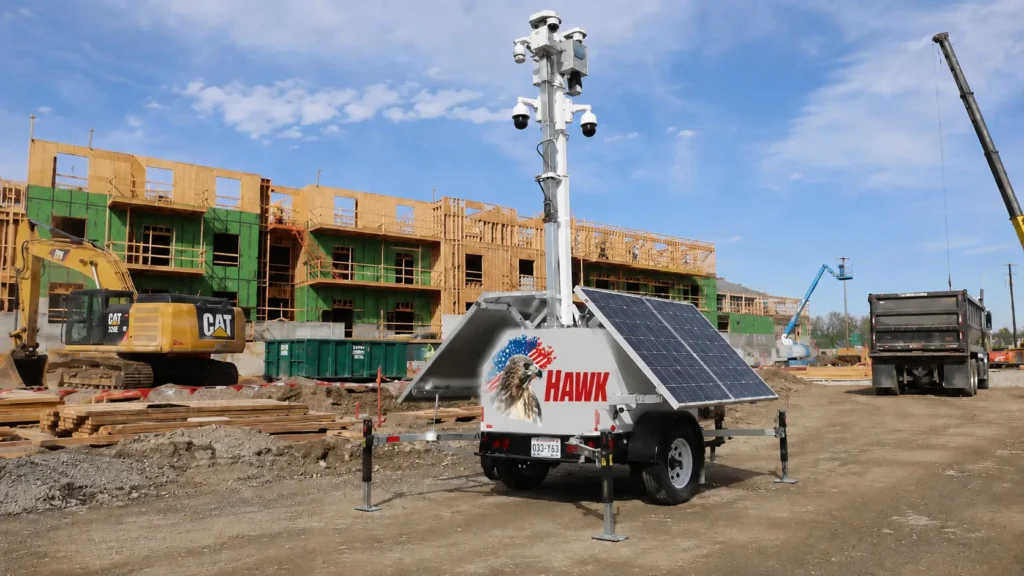
Hawk Surveillance deploys solar-first mobile surveillance trailers across Northern California, using solar generation paired with battery storage as the default power source. This approach reduces generator runtime, lowers fuel consumption, and minimizes noise, so sites stay secure without creating avoidable emissions or community disruption.
Our trailers are designed to meet the emissions and operational expectations set by the California Air Resources Board (CARB) and the Bay Area Air Quality Management District (BAAQMD). These standards shape how we configure power systems and plan deployments throughout the region.
Our goal is straightforward: provide strong coverage while reducing generator runtime, fuel logistics, and community impact.
Why Environmental Responsibility Matters in Mobile Security
Traditional mobile security often relies on constant generator use, frequent refueling, or vehicle-based patrols. Those approaches can introduce issues that clients increasingly want to avoid:
- Persistent noise (especially after-hours)
- Higher fuel consumption and emissions
- More vehicle traffic on and around the site
- Increased friction with neighbors, tenants, and public stakeholders
Many organizations now operate with ESG objectives, sustainability targets, or community-impact requirements, particularly utilities, municipalities, and large contractors. Security still has to work, but it also needs to align with how a project is expected to run in the real world.
That is the practical foundation behind our environmental focus: reduce avoidable impact while keeping sites protected.
Solar-First Power Strategy
Where site conditions allow, we use a solar-first power architecture: solar generation paired with battery storage as the baseline approach. This is especially valuable on remote and power-limited sites, but it also helps on urban deployments where noise and emissions are sensitive.
Solar-first does not mean “solar only” in every scenario. Some environments require additional resilience, so we can design hybrid configurations (solar + battery with generator backup capability) to maintain uptime while still reducing generator runtime versus generator-dependent solutions.
Key operational benefits of a solar-first approach:
- Reduced refueling demand and fuel logistics
- Lower emissions profile compared to generator-heavy operation
- Quieter overnight security coverage
- Better fit for residential-adjacent or customer-facing sites

Fuel, Emissions & Noise Reductions
Environmental impact in mobile security typically comes down to three practical inputs: fuel consumption, engine runtime, and noise levels at quiet sites. Solar-first surveillance trailers reduce generator usage while maintaining security coverage.
Reduced Generator Runtime
Fewer Refueling Visits
Quieter Operations
Smarter Deployment and Fleet Optimization
Environmental responsibility is not only a power decision. Deployment planning also reduces impact by improving efficiency.
- Right-sizing coverage: deploying the correct number of trailers rather than over-deploying “just to be safe”
- Maximizing coverage per unit: placement and camera configuration can often reduce the number of trailers required
- Reducing unnecessary moves: coordinated scheduling reduces extra transport trips and site disruption
- Reusing assets across projects: a professionally managed fleet can be redeployed and optimized over time rather than treated as disposable or ad-hoc
Smarter deployment is not just operationally cleaner. It can also improve security outcomes by placing coverage where it is actually needed rather than where it is easiest to drop a trailer.
This is why our project approach matters:
Equipment Lifecycle, Maintenance
& Responsible Handling
Lower-impact security also means extending equipment life and minimizing waste. Hawk Surveillance emphasizes thoughtful lifecycle management to keep systems effective, reliable, and responsibly maintained over time.
Preventive maintenance
Serviceable, upgradeable components
Responsible end-of-life handling
Keeping platforms current
Environmental Responsibility FAQs
How do solar surveillance trailers reduce fuel and emissions compared to generator-only units?
Solar-first designs reduce generator runtime in many conditions by using solar generation and battery storage as the primary power source, with backup options available when required for resilience
Are your trailers suitable for sites with strict noise limits?
Yes. Solar-first and hybrid configurations are commonly used where after-hours noise is sensitive, such as retail corridors, residential-adjacent construction, municipal sites, and events. The final configuration should match the site’s operating expectations.
Can you help us document environmental benefits for ESG reporting?
We can provide qualitative inputs and deployment summaries suitable for internal reporting (e.g., solar-first configuration, reduced generator reliance, low-noise operation). Quantitative metrics depend on your reporting framework and what data you track.
What happens to batteries and electronics at end of service life?
Batteries and electronics should be handled through appropriate recycling and disposal processes aligned to local requirements and vendor programs. We design systems with maintainability in mind to extend lifecycle and reduce unnecessary replacement.
Secure Your Site and Reduce Environmental Impact
Hawk Surveillance is built for real-world deployments: reliable coverage, practical logistics, and a power strategy designed to reduce avoidable fuel use and noise where feasible. If you need a security plan that supports lower-impact operations, we can recommend an approach tailored to your site and stakeholder requirements.
Last updated: June 2025