

Certifications & Compliance
Hawk Surveillance works with organizations that need mobile security to pass real internal review—procurement, safety, IT, and legal—before anything is deployed. This page summarizes our approach to surveillance trailer certifications and compliance, how we support due diligence, and how we help clients document requirements for RFP/RFQ workflows.
Because compliance expectations vary by industry and agency, our approach is structured but collaborative: we align the equipment, deployment plan, and monitoring model to your policies and operational constraints.
In short: Hawk Surveillance helps procurement, IT, legal, and safety teams approve mobile surveillance trailers by providing documentation across equipment specs, QHSE/operational safety, data security and privacy, and monitoring workflows—aligned with CalOSHA, CPUC, and Bay Area AQMD requirements.
Hawk Surveillance Systems is a California-licensed security company (regulated by the California Bureau of Security and Investigative Services), serving Northern California. Reviewed by the Hawk Surveillance compliance team. Last updated May 2026.
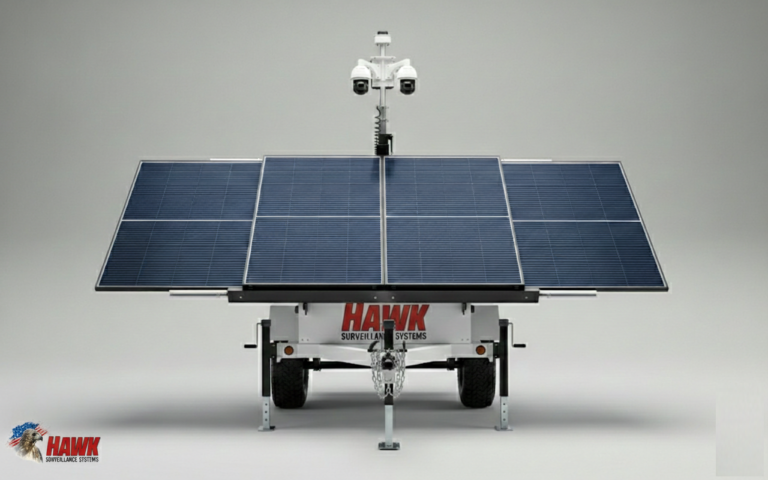
How We Approach Surveillance Trailer Certifications & Compliance
Compliance is not a one-time checklist item. It affects:
- How trailers are built and configured
- How they are deployed and operated on active sites
- How video and access are managed (especially in public-facing environments)
- How documentation is produced for procurement and vendor risk review
We treat surveillance trailer compliance as part of the solution design. That means we plan for the full lifecycle—deployment, operation, reporting, and decommissioning—so your team can evaluate the security program with fewer surprises.
Where requirements are client-specific (for example, municipal privacy rules or critical-infrastructure policies), we work directly with stakeholders to document controls, limitations, and responsibilities.
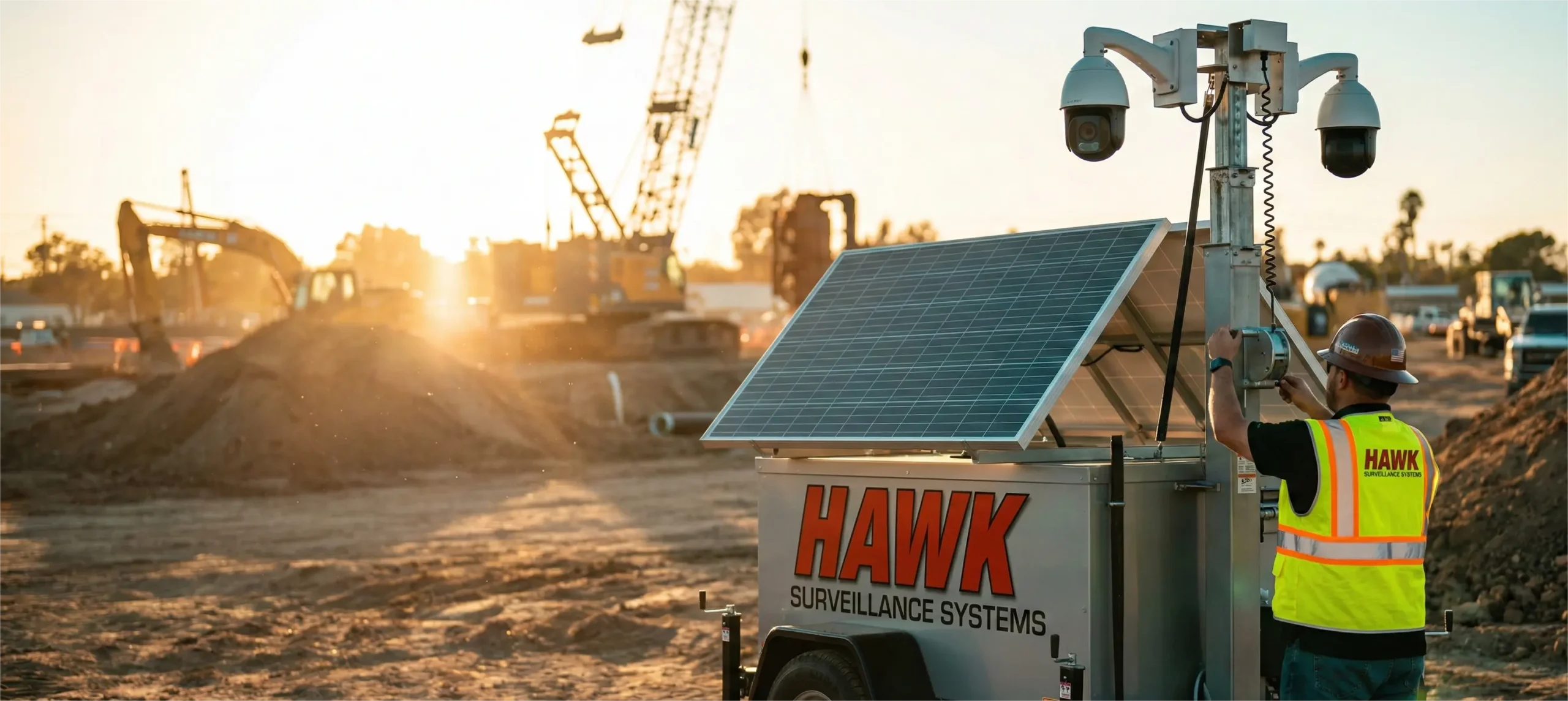
Surveillance Trailer Equipment & Safety Standards
Mobile surveillance trailers combine electrical systems, mechanical structures, elevated masts, and camera payloads—so safe design and safe operation are inseparable.
Covers power systems, enclosures, connectors, and grounding practices designed to align with UL and NEC electrical guidelines where applicable.
Includes mast operation, stabilization, and load management consistent with DOT trailer and structural load practices to ensure safe performance under all conditions.
Placement, visibility, and traffic/pedestrian considerations follow MUTCD and Cal/OSHA work-zone guidance to keep both operators and the public safe.
On-site safety practices are governed through our QHSE approach and deployment procedures: Operational Safety & QHSE →
If your organization requires specific documentation for contractor prequalification or jobsite onboarding, we can provide deployment summaries and safety process descriptions aligned to your program.
Surveillance Data, Privacy & Monitoring Compliance
Video security can create compliance risk if access, retention, and privacy expectations are unclear. Our approach emphasizes practical controls, transparent responsibility boundaries, and documentation support.
Access Control
– Who can view video and under what authorization. Ensures only authorized personnel access footage.
Retention & Deletion
– How long footage is kept and how it is securely disposed of when no longer needed.
Transmission & Storage
– Reasonable safeguards for video moving over public networks and at rest.
Privacy Practices
– Includes signage, field-of-view decisions, and policy alignment for public spaces or customer-facing environments.
Relevant pages: Data Security & Privacy → | 24/7 Remote Monitoring & Response → | Live Professional Monitored Systems →
Compliance expectations differ depending on whether video is monitored by an external team or managed internally by the client’s SOC. We document those divisions of responsibility as part of solution design.
Industry & Client-Specific Requirements
Different industries evaluate risk, compliance, and deployment constraints differently. We support a wide range of operational requirements without forcing a one-size-fits-all approach.
Utilities, Energy & Infrastructure
- High reliability expectations for continuous operations
- Controlled change management and deployment approvals
- Documentation practices suitable for regulated or critical environments
- Related: Utilities & Infrastructure Security
Municipal & Public Safety Environments
- Public perception and privacy considerations
- Signage, notification, and transparency requirements
- Stakeholder review involving city, legal, police, and public works departments
- Related: Municipal & Government Security
Construction & Industrial Operations
- Contractor onboarding and site access controls
- Alignment with jobsite rules, traffic plans, and hazard controls
- Coordination with EHS and safety management programs
- Related: Construction Jobsite Security and Industrial Plant Security
Stakeholder-Driven Discovery
- Used when requirements are strict, evolving, or not fully defined
- Identification of what must be documented and approved
- Clarification of decision-makers and deployment authority
- Definition of how compliance will be evaluated during the project lifecycle
Supporting RFPs, RFQs & Vendor Approval
Procurement teams often need more than a quote. They require content and documentation that makes vendor review easier—especially in municipal and utility environments.
Product & Configuration Summaries
Model selection, power approach, connectivity approach, and other technical details to simplify evaluation.
Deployment & QHSE Summaries
How trailers are delivered, set up, moved, and removed safely in compliance with operational safety standards.
Data Security & Privacy
Clear responsibilities for access, retention, and privacy, with distinctions between monitored vs Live Professional Monitored deployments.
Monitoring Workflow Summaries
Clear documentation for how monitoring is handled when included as part of the project.
Compliance Questionnaire Support
Answers provided to security and compliance questions within reasonable scope, ensuring alignment with procurement requirements.
If your organization has an approved vendor process, we can work with procurement to structure the requested documentation and align the project plan to internal review timelines.
Documentation & Audit Trail
Compliance reviews often require clear evidence that controls are understood, repeatable, and consistently applied. While final documentation depends on the solution selected, we support audits with practical, defensible materials aligned to real-world operations.
Common Documentation We Can Support
Model-level and configuration-specific summaries covering trailers, cameras, power systems, and supporting hardware.
High-level overviews of site survey, placement, commissioning, repositioning, and decommissioning workflows.
Summaries of safety practices, crew procedures, and site coordination relevant to deployment and service activities.
SOP-style descriptions of alert handling, escalation paths, and response coordination when monitoring services are included.
High-level explanations of access controls, retention expectations, and role-based responsibilities.
For organizations that conduct periodic audits, inspections, or internal reviews, we can support reasonable validation requests related to our equipment configurations and service workflows—helping teams demonstrate consistency without unnecessary friction.
Certifications & Compliance FAQs
What certifications do your surveillance trailers and components carry?
Yes. Our surveillance trailers and components carry manufacturer-level certifications—such as UL listings for electrical components, FCC compliance for wireless/transmission equipment, and CE marking where applicable—with the available documentation provided per the equipment configuration specified in your build. For projects that require documented certifications, we confirm the exact requirements during scoping and supply the relevant documentation for the specified build.
Can you provide written documentation on safety, data security, and privacy practices?
Yes. We can provide written overviews covering operational safety/QHSE practices, data security and privacy approach, and monitored vs Live Professional Monitored responsibility boundaries. See: /safety-sustainability/safety-standards/ and /safety-sustainability/data-security-privacy/.
How do you support RFP/RFQ compliance questions from legal and procurement teams?
We support RFP/RFQ compliance questions directly with written documentation. We provide structured responses and supporting summaries—equipment specs, deployment procedures, monitoring workflow descriptions (if applicable), and data handling narratives—so stakeholders can complete vendor review efficiently.
Are you able to align with our existing safety, data, or critical infrastructure policies?
In most cases, yes—by designing the deployment and operational plan to match your requirements, and clearly documenting responsibilities. For highly specific requirements, we validate feasibility early during discovery.
Can you participate in vendor risk reviews or security assessments?
Yes, within reasonable scope. We routinely support stakeholder discussions involving procurement, IT/security, EHS, and operations to resolve requirements before deployment.