
Last updated: June 2026
Reviewed by Noah Williams, Security Systems Specialist
Substation Copper Theft Prevention: A 2026 Checklist for Northern California Utilities
California DOJ has publicly identified a statewide surge in copper wire theft and infrastructure vandalism, while copper traded above $6 per pound in mid-June 2026. For Northern California utilities, that makes substation copper theft prevention a practical reliability, safety and asset-protection issue, not only a property-loss issue. The checklist below prioritizes ground mats, ground conductors, conductor marking, perimeter gaps, after-hours visibility, mobile surveillance and incident reporting. For sub-CIP-014 distribution substations, the goal is a disciplined security stack that can move quickly, operate without permanent installs where needed, and support the utility SOC, law enforcement and CPUC-facing documentation. Use surveillance trailer rental when a site needs rapid coverage while permanent work is scoped, procured or installed.
Why copper theft at NorCal substations is at a 2026 high
In brief: Copper theft risk is being pushed by high resale value, accessible exterior components and repeated after-hours opportunities around unmanned utility assets.
By May 2026, FRED listed the global copper price at $13,483.75154 per metric ton, and CME showed copper futures above $6 per pound on June 13, 2026. Those price levels raise the thief economics behind copper wire, grounding conductors and scrapable copper assets. (FRED)
Substation copper theft prevention is the operational practice of reducing theft opportunity, improving detection and preserving documentation around copper-bearing electrical infrastructure. In a substation context, the highest-priority targets are usually grounding mats, visible ground conductors, bonding conductors and staged equipment that contains recoverable copper. Prevention work must protect life-safety grounding, asset uptime and evidence quality without creating new energized-equipment hazards.
California DOJ’s 2025 bulletin states that copper wire theft has surged throughout the state and has caused outages, public-safety impacts and higher repair costs for public agencies, utilities and businesses. (oag.ca.gov) That statewide pattern matters for PG&E, SMUD, MID, TID and NorCal co-ops because substations often sit in industrial edges, agricultural corridors, remote easements, rail-adjacent zones and transitional land uses where after-hours activity is harder to distinguish from legitimate maintenance.
For utilities planning utilities and infrastructure security, the immediate risk question is not whether copper is valuable. It is whether a specific substation has the perimeter gaps, access routes and low-visibility zones that make copper removal feasible before a patrol, alarm or operator notices. Related Bay Area copper-wire theft patterns show how infrastructure-adjacent copper theft can move across asset classes when sites are unmanned and resale value stays high.
The 12-item substation copper theft prevention checklist
In brief: A usable copper-theft checklist assigns each control to an owner, a cost order and a risk scenario instead of treating “security” as one broad line item.
This 12-item checklist separates low-cost procedural controls, medium-cost detection controls and higher-cost physical hardening so utility teams can sequence work without waiting for a full capital project.
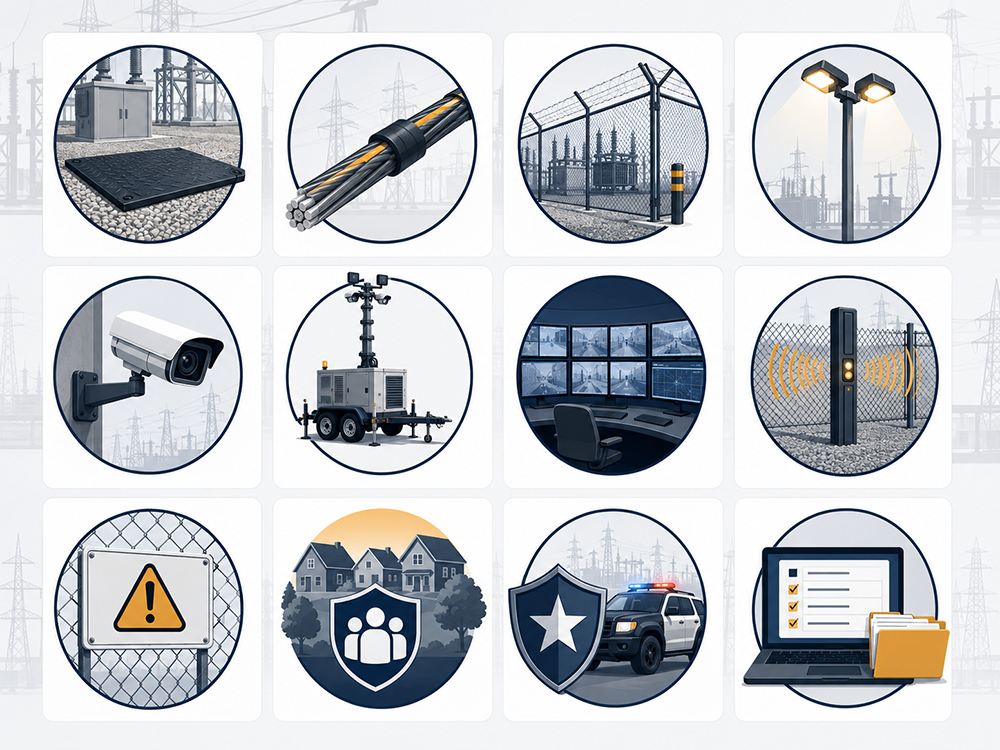
The objective is not to make every distribution substation look like a transmission bunker. The objective is to close the perimeter gaps thieves use, preserve grounding integrity, document each attempt and shift coverage as risk areas move.
| Checklist item | What it covers | Primary owner | Rough cost order | Priority use case |
|---|---|---|---|---|
| Ground mat covers | Harden exposed grounding access points and reduce easy removal | Substation maintenance | Medium to high | Repeated ground-mat tampering |
| Anti-theft conductor compounds | Mark, tag or treat conductors to reduce resale value | Asset protection and maintenance | Low to medium | Sites near scrap-theft corridors |
| Fence repair and mesh upgrades | Close cuts, climb points and gate weaknesses | Facilities or civil maintenance | Medium to high | Visible perimeter gaps |
| Lighting review | Improve after-hours visibility without glare into neighbors | Facilities and safety | Medium | Dark approaches and gate zones |
| Fixed cameras | Provide continuous view of stable entry points | Security technology | Medium to high | Sites with available power and network |
| Mobile surveillance | Add rapid, visible camera coverage without permanent installs | Security operations | Operating expense | Temporary or shifting hotspots |
| Active monitoring | Escalate verified events to the SOC or dispatch path | SOC or monitoring partner | Operating expense | After-hours intrusion attempts |
| Perimeter sensors | Detect fence disturbance, gate movement or interior movement | Security technology | Medium to high | Larger unmanned footprints |
| Signage | Set legal notice, deterrence and trespass clarity | Legal and facilities | Low | Public-facing fence lines |
| Neighbor coordination | Build observation channels with adjacent operators | Asset protection | Low | Industrial parks, farms and yards |
| Law-enforcement coordination | Pre-plan dispatch access, reporting and evidence format | Security and legal | Low | Repeat-theft areas |
| Incident tracking | Log time, entry point, component, loss and repair impact | Operations and asset protection | Low | Budget justification and trend analysis |
The first three controls protect the copper itself. Ground mat covers, conductor hardening and fence repairs reduce easy access to the metal. Those controls are most useful when a site has repeated tampering, known cuts or visible conductor exposure.
The next five controls improve detection. Lighting, fixed cameras, mobile surveillance, active monitoring and perimeter sensors reduce time on site. For many NorCal substations, the right sequence is not “guards or cameras.” It is trailers versus guards versus fixed cameras by risk window. Guards add human presence but can be expensive to scale across many small sites. Fixed cameras are strong for permanent coverage but need installation, power, connectivity and design time. Mobile surveillance fills the interim and shifting-risk gap.
The final four controls make the program repeatable. Signage, neighbor coordination, law-enforcement coordination and incident tracking help turn isolated theft responses into a managed prevention program. California DOJ’s copper-theft bulletin also reinforces why recycler documentation and law-enforcement coordination matter after an incident. (oag.ca.gov)
Where mobile surveillance fits in the checklist
In brief: Mobile surveillance fits where a utility needs rapid, flexible coverage before permanent infrastructure is installed or while theft hotspots shift across the site.
A mobile surveillance trailer is most valuable when the cost of waiting is higher than the cost of temporary coverage. Fencing, walls and fixed-camera infrastructure may be the right long-term controls, but they often require design review, trenching, power, network paths and procurement time. A heavy-duty industrial surveillance trailer can cover gates, ground-mat approaches, material staging areas and perimeter gaps without permanent installs.
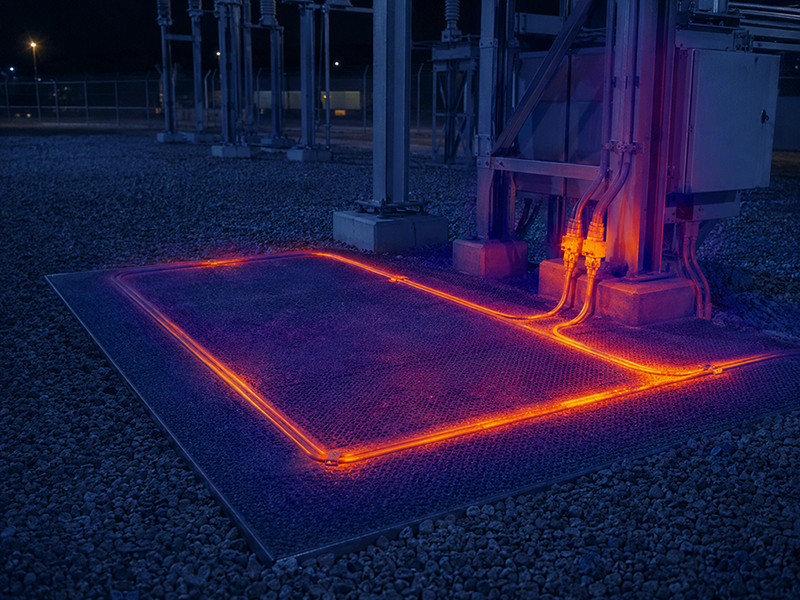
The main operational advantage is repositioning. If thieves cut the north fence one week and test a rural access road the next, a trailer can be moved to match the current risk areas. That matters for utilities managing many substations across mixed urban, agricultural and rural footprints. It also gives the SOC a visible camera point while civil or electrical teams decide whether permanent fencing, lighting or fixed cameras are justified.
Off-grid operation is another utility fit. A solar surveillance trailer can maintain coverage in locations where utility power is unavailable, intentionally isolated or not worth extending for temporary security. For active response, 24/7 remote monitoring lets a monitoring team verify after-hours activity before escalation, reducing noise for utility dispatch and law enforcement.
Compared with national surveillance providers such as WCCTV, Pelco, SentraCam or Joint Power Security, Hawk’s wedge is NorCal-specific deployment support for trailers versus guards versus fixed cameras. The point is not to replace every permanent control. It is to give utilities rapid and flexible coverage where substation theft risk is current, shifting or not yet capital-funded.
Building a sub-CIP-014 substation copper prevention budget
In brief: Most copper-theft prevention budgets should separate permanent capital hardening from operating-expense coverage that can move as the risk map changes.
For sub-CIP-014 distribution substations, the budget decision is usually a layered control plan, not one large security purchase. FERC’s CIP-014-3 page describes the physical security standard as focused on transmission stations, transmission substations and associated primary control centers that, if rendered inoperable or damaged, could cause instability, uncontrolled separation or cascading conditions. (Federal Energy Regulatory Commission)
That scope distinction matters. A distribution substation may be critical to local reliability, public safety and customer impact even if it does not meet CIP-014 applicability. Copper-theft prevention at those sites is often justified through repair cost, outage risk, crew safety, repeat incident pattern and documentation for management review.
Budget categories should be kept clean. Ground mat covers, fencing, lighting upgrades, permanent cameras and fixed sensors usually sit closer to capital planning. Monitoring, patrol augmentation, mobile surveillance and temporary deployment are more often operating-expense tools. Anti-theft compounds, signage and incident tracking sit in between because they are lower-cost controls that may be bundled with maintenance.
Prioritize by incident pattern. A site with a recent cut fence and visible ground-conductor tampering should not wait for a systemwide camera refresh. A site with no recent activity but poor fence condition may belong in the next maintenance cycle. A site with repeated after-hours approaches may need mobile coverage and monitoring first, then permanent hardening after the pattern is confirmed.
Coordination with PG&E, sheriffs, and CPUC reporting
In brief: Copper theft response works best when incident logging, law-enforcement access and regulatory reporting paths are defined before the next event.
Coordination starts with a standard internal incident workflow. The field crew should document the entry point, component affected, grounding impact, repair action, restoration time, evidence retained and whether law enforcement was contacted. The SOC or operations center should preserve alarm logs, video clips, monitoring notes and dispatch decisions.
CPUC General Order 174 requires California electric utilities under CPUC jurisdiction to establish and follow substation inspection programs, with annual reports summarizing inspection-program changes, completed inspections and past-due inspections. (webtraining.cpuc.ca.gov) Copper theft is not only a security issue in that context. If grounding, fencing, access control or inspection findings are affected, the event should be recorded in a way that operations, compliance and asset protection can reconcile later.
For larger electric emergency events, DOE Form OE-417 is the mandatory emergency form used by specific electric power industry actors when qualifying criteria are met. (doe417.pnnl.gov) CAISO’s significant-event reporting guide also notes that DOE, NERC and WECC have reporting requirements for certain electric emergency incidents and disturbances, including workflows tied to DOE Form OE-417 and NERC event reporting. (caiso.com)
At the local level, sheriff and police coordination should be practical. Provide the site name convention, legal access route, gate protocol, utility contact, evidence format and hazards. Do not publish substation diagrams or sensitive layouts in public-facing materials. Give law enforcement what they need to respond and investigate without exposing unnecessary asset details.
Deployment workflow when mobile surveillance is on the checklist
In brief: Mobile surveillance deployment should be treated as an operations workflow: site walk, placement, commissioning, monitoring rules and rollout sequence.
The deployment starts with a site walk. The utility and Hawk review access route, safe trailer placement, line of sight, solar exposure if applicable, cellular path, gate swing, grounding-mat areas, nearby public roads and no-go zones near energized equipment. The placement plan should cover the highest-risk approach without blocking crew movement or emergency access.
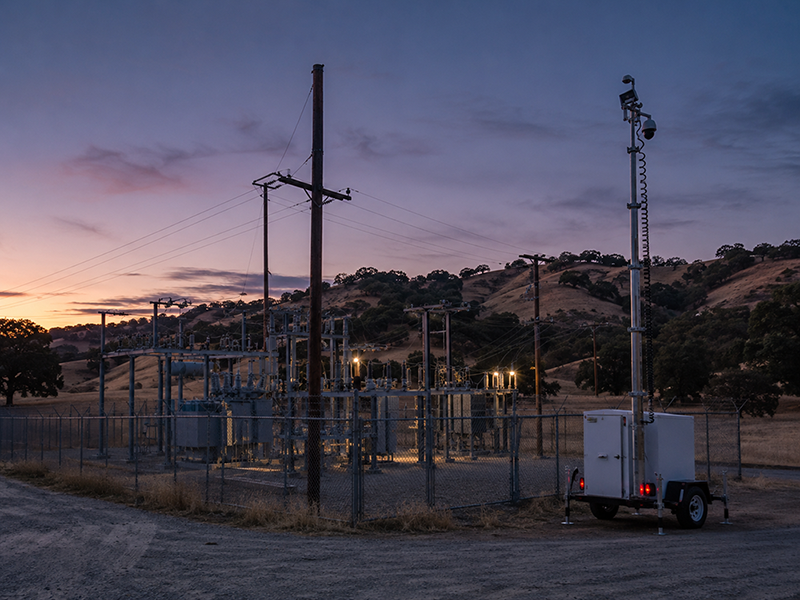
Commissioning should confirm camera views, analytics settings, lighting behavior, monitoring schedule, escalation path and clip-retention process. If the site is prepared, Hawk’s target is under 24-hour commissioning after placement and access readiness. For larger programs, multi-substation rollout should be phased by incident pattern: active theft sites first, recent tampering sites second, and preventive coverage for exposed remote sites third.
Monitoring tier selection should match the event type. A low-risk site may need scheduled review and event clips. A higher-risk site may need active after-hours monitoring, live audio deterrence and SOC escalation. Use how we deploy to plan the workflow before the trailer arrives, not after the first alert.
For utilities comparing guards, fixed cameras and trailers, the decision should be functional. Guards can help during known work windows or high-touch incidents. Fixed cameras are good for stable, permanent coverage. Mobile trailers are the rapid and flexible option when the risk window is immediate, the site is temporary or the perimeter gap is likely to move.
Frequently asked questions
In brief: The most useful FAQ answers for utility teams are direct, operational and scoped to substation copper theft rather than general crime prevention.