
Last updated: June 2026
Reviewed by the Hawk Surveillance Systems security team
Mining and Quarry Site Surveillance in Northern California: Protecting Equipment, Fuel, and Materials in 2026
NorCal mining and quarry sites face equipment theft, fuel theft, and remote-area vandalism, making mobile surveillance trailers a practical way to protect remote operations without permanent installs. A good mining and quarry surveillance plan starts with the assets most likely to be hit after-hours: heavy equipment, fuel tanks, copper-bearing materials, batteries, GPS units, hydraulic components, and stockpile areas. In Northern California, the challenge is not just the value of the assets. It is the operating environment: remote pits, long access roads, dust, limited grid power, cellular dead spots, moving faces, and equipment laydowns that change as production moves. Hawk Surveillance supports these conditions with surveillance trailer rental built around rapid deployment, elevated cameras, off-grid power, and monitoring options.
What’s getting stolen at NorCal mining and quarry sites in 2026
In brief: The main loss points are equipment parts, diesel, materials, and remote access routes that are hard to watch continuously after-hours.
Mining and quarry site surveillance in Northern California is the use of cameras, mobile trailers, monitoring workflows, and placement planning to protect remote extraction and aggregate operations. It covers the parts of a site where production value concentrates: the pit, face, equipment laydown, fuel pad, access road, maintenance yard, crusher area, conveyor routes, and stockpile zones.
The operating context matters. California consumes an average of approximately 145 million tons of construction aggregate per year, and the California Geological Survey also documents 13,500 historic gold mines across the state. That does not mean every NorCal site faces the same security profile. A sand-and-gravel operation near the Central Valley, a Sierra foothills quarry, and a remote gold-mining support yard all need different camera placement, but they share the same after-hours problem: high-value assets sit in open, low-infrastructure areas.
The most common risk areas include:
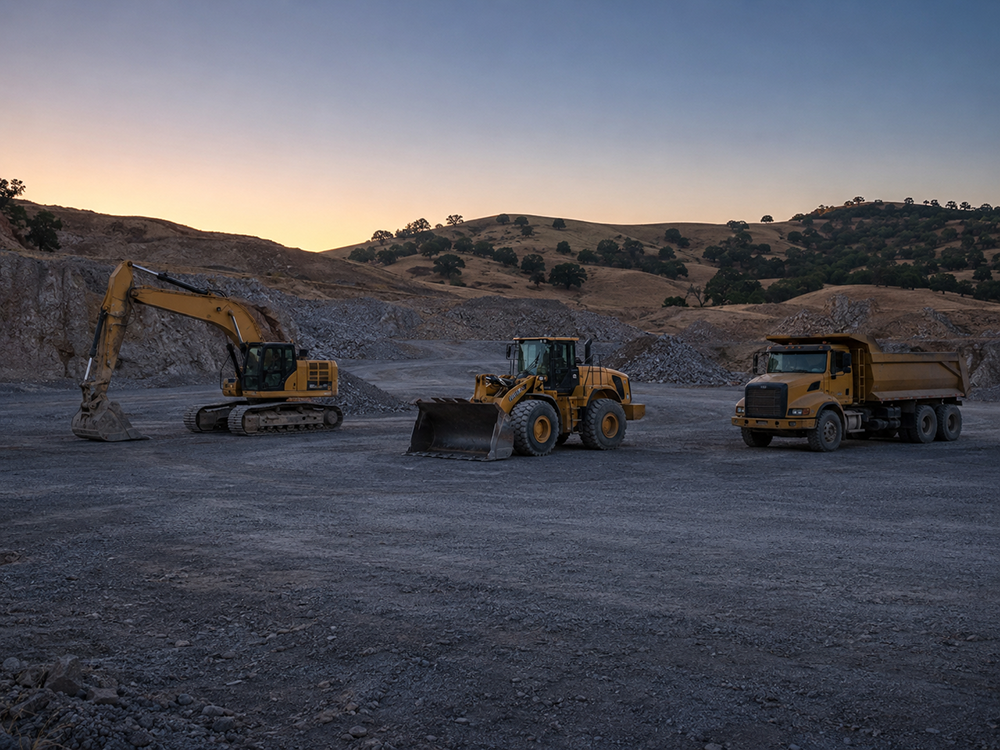
Heavy equipment parked in laydown yards, including loaders, excavators, haul trucks, graders, dozers, screeners, and crushers.
Removable equipment components, including GPS units, copper wiring, batteries, catalytic components where present, hydraulic parts, pumps, hoses, and control boxes.
Fuel tanks, fuel trailers, pumps, nozzles, hoses, and cardlock-style access points.
Stockpiles, including aggregate, sand, specialty rock, scrap metal, copper-bearing ore, pipe, and reusable materials.
Access points, including haul roads, back gates, easements, perimeter gaps, and informal entry paths.
A practical plan for mining operations security starts by ranking those risk areas by exposure, not by where it is easiest to install a camera. The fuel pad may deserve the first trailer. The laydown yard may need the second. A long access road may need a camera only after the asset clusters are covered.
Remote-area access patterns also matter. A quarry may be quiet after shift change, but a single approach road, cattle gate, levee road, utility easement, or old service entrance can become the real security problem. A fixed camera on the office building does not help much if the highest-risk activity happens near a back fuel tank half a mile away.
Why typical mine security doesn’t fit the threat profile
In brief: Remote mining and quarry sites usually need flexible visibility, not only guards or fixed cameras, because the risk areas move and the infrastructure is limited.
Compared with a fenced warehouse or retail lot, a quarry is a moving industrial site. The face advances, the pit changes, stockpiles shift, maintenance work moves equipment around, and laydown yards expand during busy production cycles. That makes traditional security harder to match to the actual threat profile.
A remote quarry does not need one more passive camera pointed at the wrong gate. It needs coverage that can move with the pit, watch the fuel pad after-hours, and close perimeter gaps without trenching power across the site.
Guard coverage can help with access control, gate presence, safety observation, and incident response. The limitation is distribution. One guard in a pickup can only be in one place at a time, and patrol gaps become longer on large remote sites. If the site has multiple risk areas, such as a fuel pad, equipment park, crusher area, and rear haul road, a guard route leaves each area unwatched for long intervals.
Fixed cameras solve some problems but create others. A pole-mounted camera near the office may work where permanent power and network backhaul already exist. It becomes less practical when the camera needs to watch a remote fuel tank, a temporary laydown yard, or a face that will move again next quarter. Trenching conduit, extending fiber, pulling power, and engineering poles can make sense for a permanent plant. It is slower for high-tempo sites where the risk area changes.
Security option | Where it fits | Main limitation at remote mines and quarries |
|---|---|---|
Guards | Gate control, escorted access, safety observation, response support | Thin coverage across large sites and long patrol gaps |
Fixed cameras | Offices, permanent gates, scale houses, processing plants | Power, network, trenching, pole work, and relocation friction |
Mobile surveillance trailers | Fuel pads, laydown yards, back roads, temporary stockpiles, moving risk areas | Needs placement planning, communications testing, and power sizing |
Compared with national surveillance providers like WCCTV, Pelco, SentraCam, or Joint Power Security, Hawk’s wedge is NorCal-specific deployment for trailers vs. guards vs. fixed cameras. The value is local coverage, off-grid placement, and repositioning around the way Northern California industrial sites actually operate.
What off-grid mobile surveillance covers at a mining/quarry site
In brief: Off-grid mobile surveillance covers the site areas where fixed infrastructure is too slow, too costly, or too permanent for changing mining conditions.
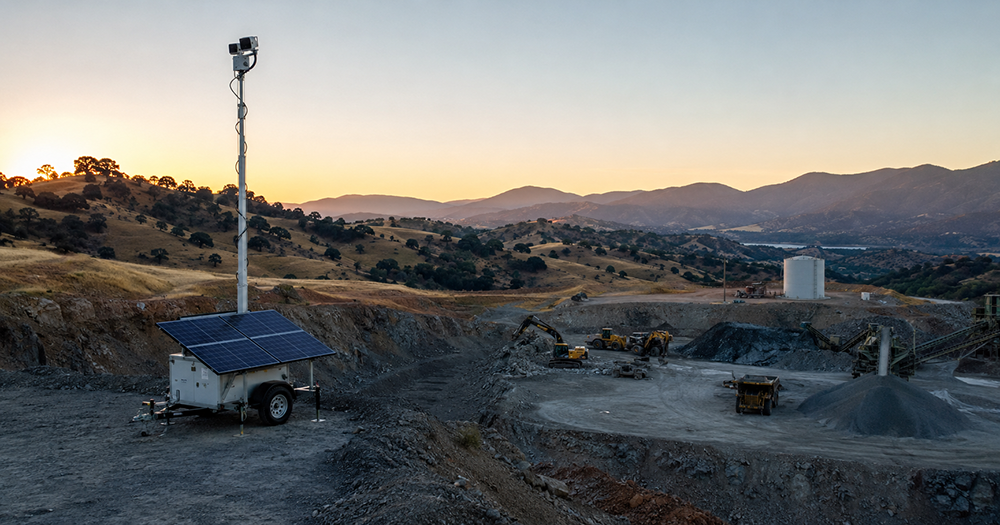
An off-grid solar surveillance trailer is a self-contained mobile security platform that combines solar generation, battery storage, elevated cameras, communications, and optional monitoring. Hawk’s solar trailer page describes the platform as built for off-grid or limited-power environments, using solar power, battery storage, camera hardware, and 24/7 monitoring options for remote jobsites and infrastructure sites.
For mining and quarry use, that matters because the asset cluster is not always near the scale house. The trailer can be positioned near the actual risk area:
A fuel tank pad on the far side of the site.
A row of loaders, excavators, and haul trucks in a laydown yard.
A crusher or conveyor transition point.
A temporary stockpile or pipe storage area.
A remote access road or gate that does not justify permanent construction.
A pit edge or high point where mast height improves line of sight.
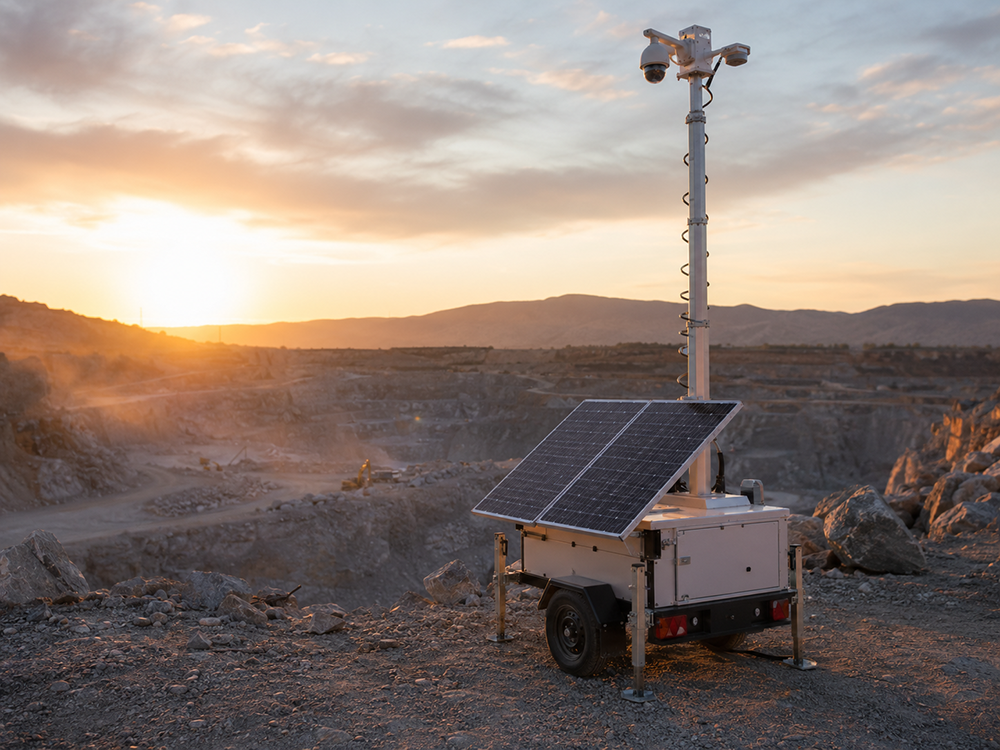
Dust and weather tolerance are part of the deployment conversation. Quarry conditions can include dust from crushing, haul-road traffic, wind, fog, rain, heat, and vibration from nearby industrial activity. Camera placement should consider prevailing wind, road dust, glare, lens contamination, mast stability, and service access. The best spot on a map is not always the best spot after seeing haul routes and dust plumes.
A heavy-duty industrial surveillance trailer fits rougher industrial conditions where payload, chassis durability, terrain, or hybrid power are higher priorities than a pure solar-first setup. The practical choice is not solar vs. industrial as a generic product question. It is placement-specific: solar for off-grid runtime, industrial for rugged access and heavier-duty site conditions.
A site may also need multiple trailer types. A solar-first trailer can watch a remote fuel tank. An industrial unit can sit near a rough laydown area or plant edge. As the pit or face moves, the coverage plan should move too. That is the core advantage over fixed cameras: the surveillance layout follows production instead of forcing production to fit the camera layout.
Fuel-tank surveillance – the highest-ROI single placement
In brief: Fuel-tank surveillance often gives the best first placement because it covers diesel, pumps, hoses, approach routes, and after-hours activity in one concentrated zone.
A fuel pad is usually the highest-value first camera zone because it concentrates movable fuel, pumps, hoses, access behavior, and vehicle movement in a small area. EIA’s California table shows weekly California diesel prices in dollars per gallon, which is why even a limited fuel loss can become a material operating issue when diesel is stored on site.
Fuel-tank surveillance is not just about pointing a camera at a tank. It is about understanding how someone would approach it after-hours. The trailer should be placed to see the tank, pump face, access road, vehicle stopping area, hose path, and any perimeter gap that feeds the pad. Thermal cameras can help detect approach activity in low-light conditions, while visible cameras provide identification context and recorded evidence.
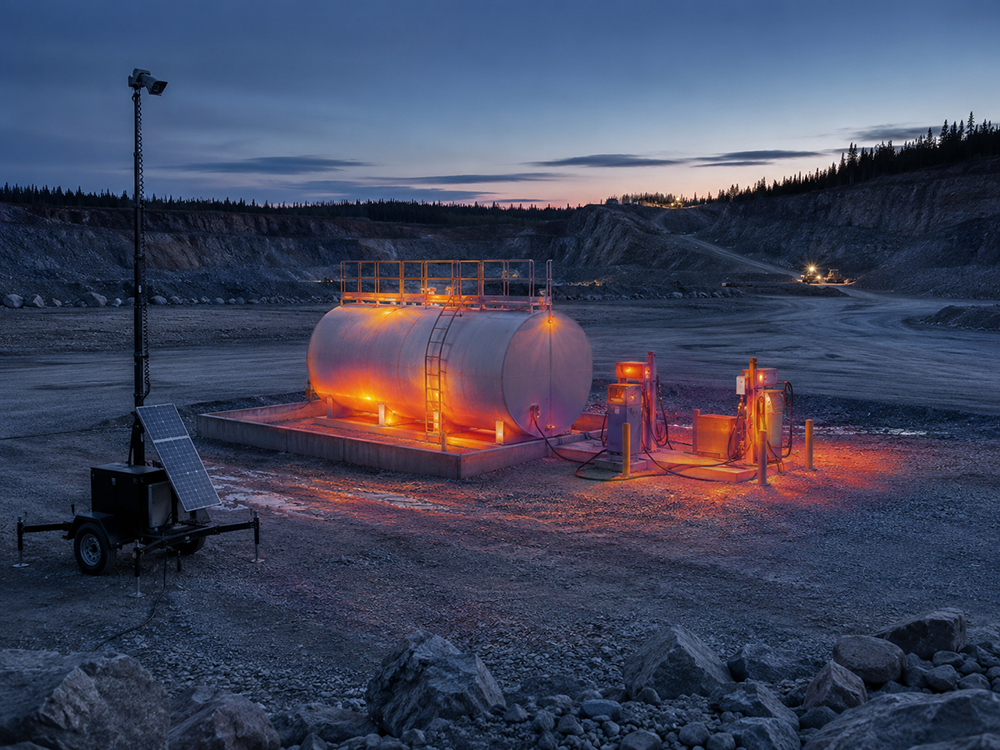
The monitoring workflow matters as much as the lens. With 24/7 remote monitoring, detection events can be reviewed in real time, filtered against approved activity, and escalated according to the site’s response plan. For some operators, that means contacting an internal supervisor first. For others, it means calling a guard service, sheriff’s office, or designated site lead depending on the event.
A good fuel-pad plan should define:
Normal fuel delivery windows.
Authorized after-hours users.
Camera views needed for the tank, pump, and approach lane.
Voice-down rules, if audio deterrence is used.
Who receives alerts.
What qualifies as a dispatch event.
How footage is retained for insurance, internal review, or law enforcement follow-up.
This keeps fuel-tank surveillance operational, not theatrical. The goal is simple: know when someone approaches the fuel pad after-hours, verify what is happening, and coordinate the right response without sending people to the site for every false alarm.
Regulatory and reporting context (MSHA, CalOSHA, county)
In brief: MSHA and Cal/OSHA primarily regulate safety, not prescriptive asset security, but reporting, evidence preservation, and incident documentation still shape the site security plan.
For surface metal and nonmetal mines, MSHA’s Part 56 standards set mandatory safety and health requirements for surface metal or nonmetal mines, including open pit mines. These rules are not written as a prescriptive security-camera checklist, but they do shape the operating environment where surveillance equipment is placed. Cameras and trailers must not create haul-road hazards, block access, interfere with equipment movement, or compromise site safety.
MSHA reporting also matters when an event crosses from property loss into a reportable accident or hazardous condition. Under 30 CFR Part 50, mine operators must contact MSHA within 15 minutes once they know or should know that certain accidents have occurred. Security video may support internal review, but it should never interfere with accident response, evidence preservation, or required reporting.
In California, Cal/OSHA’s Title 8 Mine Safety Orders cover mining operations through sections addressing accident prevention, ground control, illumination, mining equipment and practices, loading, hauling, dumping, fire prevention, emergency planning, and related topics. Again, this is safety regulation, not a camera placement mandate. The right way to plan surveillance is to coordinate with the safety officer so trailer placement, mast height, lighting, and service routes fit the mine’s traffic control and safety rules.
County reporting may also apply after theft, vandalism, trespass, fire, fuel release, environmental incident, or damage to equipment. A quarry in Shasta County, a sand-and-gravel operation near the Sacramento region, and a coastal aggregate site may all have different sheriff, environmental health, fire, and planning contacts. Surveillance planning should include a simple incident packet: who to call, what video clip to preserve, what photos to take, what internal report to complete, and what insurer or broker needs notice.
Deployment workflow for remote NorCal sites
In brief: A remote NorCal deployment should start with a site walk, map-based placement plan, communications check, power plan, and a repositioning workflow for changing production areas.
A remote deployment is won or lost before the trailer arrives. Hawk’s how we deploy process starts with site details, risk areas, access restrictions, gate hours, truck paths, load-bearing limits, and practical placement constraints. That matters at mines and quarries because the best camera view may sit near a haul route, slope, drainage area, easement, or dust-heavy road.
The site walk should identify:
The face, pit edge, or high ground that improves visibility.
Fuel tanks, pumps, and delivery routes.
Equipment laydown and maintenance zones.
Stockpile areas and material storage.
Primary and secondary access roads.
Cellular signal quality and carrier options.
Solar exposure, seasonal shade, fog, dust, and wind exposure.
Safe service access for trailer maintenance and repositioning.
After the site walk, the deployment plan should convert those observations into a placement map. This does not need to be overcomplicated. A useful plan shows trailer position, camera direction, mast considerations, risk areas covered, blind spots, access limitations, and alert routing.
The commissioning timeline depends on site conditions and is confirmed in the site-specific quote. The brief notes a rapid, flexible deployment model, but any exact hour claim should be confirmed against trailer availability, travel distance, site access, communications testing, and customer scheduling.
For larger sites, deployment & project services should be phased. A first trailer may cover the fuel pad and main laydown. A second may cover a rear access road or crusher area. A third may be added during seasonal production, shutdown work, or material staging. This is where trailers outperform permanent installs: they can be repositioned as pits move, yards expand, or risk areas change.
The ongoing workflow should answer four questions: who requests a move, who approves the move, how the new camera view is tested, and how monitoring rules are updated after repositioning. Without that workflow, a trailer can sit in last month’s perfect spot while this month’s risk has moved.
Frequently asked questions
In brief: The most common buyer questions involve threats, off-grid power, fuel tanks, compliance, deployment speed, and real-time video review.