
Quick answer: Northern California dealerships lose vehicles, catalytic converters, wheels, and parts to lot theft that guards and fixed cameras often miss. A solar mobile surveillance trailer gives the whole lot continuous, elevated, monitored coverage, deters intruders before losses happen, and can be repositioned as inventory moves. Hawk Surveillance deploys trailers for dealerships across Northern California, matched to lot size and risk. This guide covers what dealership lots actually lose, where guards and fixed cameras leave gaps, how a mobile surveillance trailer closes them, which Hawk trailer fits your lot, and what the cost comparison looks like.
Large dealership lots create unique security challenges because hundreds of vehicles remain outdoors after business hours with multiple access points that are difficult to monitor continuously. Mobile surveillance trailers provide 24 hour coverage with live remote monitoring, visible deterrence, and flexible deployment without permanent infrastructure. Compared with traditional security guards or permanently mounted camera systems, a mobile surveillance trailer can protect changing inventory layouts, cover perimeter gaps, and move wherever risk changes. Hawk Surveillance deploys both solar and compact surveillance trailers across Northern California in hours, helping dealerships strengthen the active outer layer of a concentric security strategy while maintaining normal business operations.
What dealerships in Northern California are actually losing
In brief: Car dealerships face multiple types of after-hours losses, not simply vehicle theft. Modern dealership security must address inventory protection, parts theft, vandalism, unauthorized access, and perimeter monitoring across large outdoor lots.
A dealership lot contains far more than parked vehicles. Every vehicle represents valuable inventory, while catalytic converters, wheels, tires, batteries, electronics, and dealership equipment create additional opportunities for theft. Large outdoor lots also experience unauthorized entry, vandalism, attempted break-ins, and occasional joyriding involving accessible inventory.
Unlike warehouses or office buildings, dealership inventory is spread across acres of open pavement. Even well-lit lots often contain blind spots between inventory rows, perimeter fencing, customer parking, service departments, and vehicle storage areas.
Common after-hours risks include:
- Whole vehicle theft
- Catalytic converter theft
- Wheel and tire theft
- Vehicle break-ins
- Vandalism
- Unauthorized lot access
- Test-drive vehicle misuse
- Service department intrusion
California continues to report some of the nation’s highest vehicle theft volumes, although individual dealership-specific losses vary significantly by location and operating practices.
Catalytic converter theft has also remained an operational concern for dealerships because inventory often sits outdoors overnight.
Rather than relying on a single security measure, many dealerships now combine fencing, lighting, access control, alarms, fixed cameras, and active mobile surveillance into multiple concentric layers of protection.
This layered approach allows each security component to compensate for the limitations of the others instead of expecting one solution to protect an entire property.
Why guards and fixed cameras leave gaps on a dealership lot
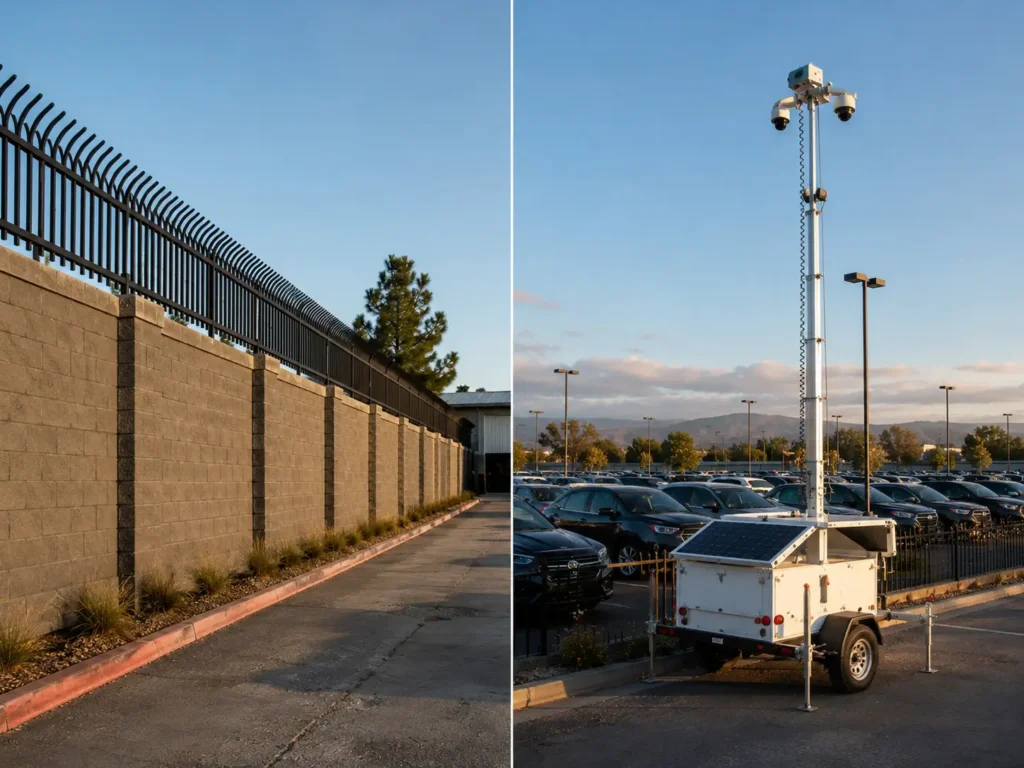
In brief: Physical guards and fixed cameras both provide value, but neither alone typically delivers complete dealership lot coverage. Mobile surveillance trailers fill the operational gap between the two by combining mobility, elevated visibility, active deterrence, and continuous monitoring.
A dealership security program generally relies on one of three approaches:
- Physical security guards
- Permanently installed camera systems
- Mobile surveillance trailers
Each solves different operational problems.
Physical guards
Security officers provide an important human presence and can perform patrols, verify alarms, and respond to unusual activity.
However, one officer can only observe one location at a time.
Large dealership properties may include:
- Customer parking
- New inventory
- Used inventory
- Overflow storage
- Service entrances
- Parts departments
- Multiple vehicle gates
Moving continuously between these areas takes time, creating unavoidable observation gaps.
Guard coverage also depends on staffing schedules, shift changes, weather conditions, and visibility throughout the property.
Fixed surveillance cameras
Permanent cameras remain an important component of dealership security.
They document activity, support investigations, and monitor entrances and buildings.
Their limitations become more noticeable across large outdoor vehicle lots.
Permanent cameras generally:
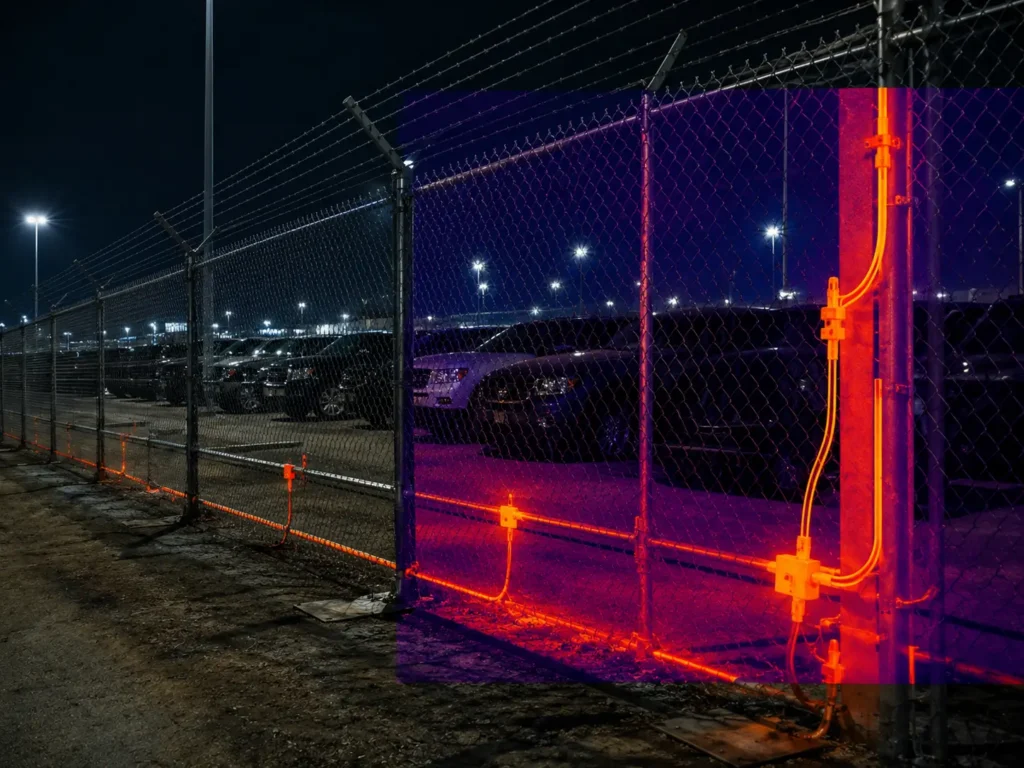
- Observe only installed viewpoints
- Require power and communications infrastructure
- Cannot easily move when inventory layouts change
- May leave perimeter blind spots as the dealership expands
If inventory storage shifts to another section of the property, the camera system remains fixed unless additional infrastructure is installed.
That makes adapting to seasonal inventory changes more expensive and time consuming.
For many Northern California dealerships, the most practical approach is not replacing guards or cameras altogether. It is adding an active, mobile outer layer that complements both.
This is where mobile surveillance trailers create a meaningful operational advantage.
How a mobile surveillance trailer protects a car lot
In brief: A mobile surveillance trailer provides elevated, full-lot visibility with live remote monitoring, active deterrence, and flexible deployment. Unlike fixed cameras, it can be repositioned as inventory changes, and unlike guards, it monitors multiple areas continuously without interruption.
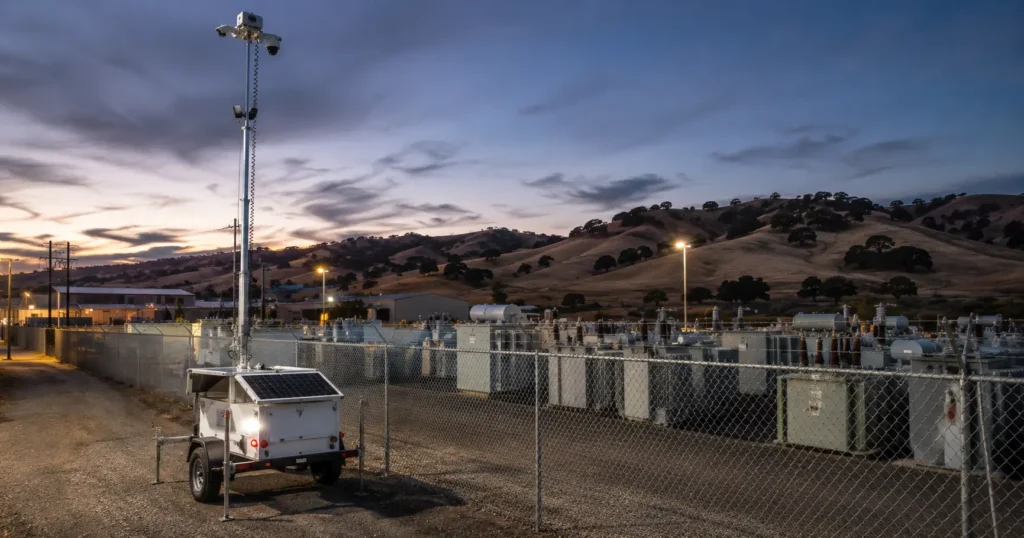
A mobile surveillance trailer is a self-contained security platform designed to monitor large outdoor spaces without permanent infrastructure. Mounted on a telescoping mast, multiple cameras provide wide visibility across inventory rows, entrances, exits, and perimeter fencing. Solar-powered operation allows deployment in locations where permanent electrical service is unavailable or impractical.
For dealerships, flexibility is one of the biggest operational advantages.
Inventory layouts change throughout the year. Seasonal sales, manufacturer deliveries, overflow inventory, construction projects, and temporary storage areas can all shift where the greatest security risks exist.
Instead of installing additional permanent cameras every time the layout changes, a trailer can simply be repositioned.
Typical dealership trailer capabilities include:
- Elevated PTZ cameras
- Fixed overview cameras
- Infrared night vision
- AI-assisted person detection
- Vehicle detection
- License plate monitoring capabilities
- Live video verification
- LED warning strobes
- Two-way audio speakers
- Solar power with battery backup
- Remote health monitoring
Unlike passive recording systems, professionally monitored trailers support real-time intervention.
When suspicious activity is detected, monitoring personnel can evaluate the situation immediately and escalate appropriately. Depending on the situation, this may include activating warning strobes, broadcasting live voice messages through onboard speakers, documenting activity, or contacting local law enforcement when necessary.
This active response often interrupts unauthorized activity before property damage or theft occurs.
Another operational advantage is deployment flexibility.
Because trailers do not require trenching, permanent poles, or new utility connections, dealerships can add protection to expanding inventory areas, overflow lots, or temporary storage locations without beginning a construction project.
This makes them particularly useful during:
- Inventory expansion
- Facility renovations
- Seasonal vehicle storage
- New dealership construction
- Temporary overflow parking
- High-value inventory deliveries
Rather than replacing existing security systems, the trailer becomes the active outer layer within Hawk’s concentric security approach, strengthening perimeter awareness while complementing fixed cameras, access control, fencing, lighting, and alarm systems.
Which Hawk trailer fits a dealership?
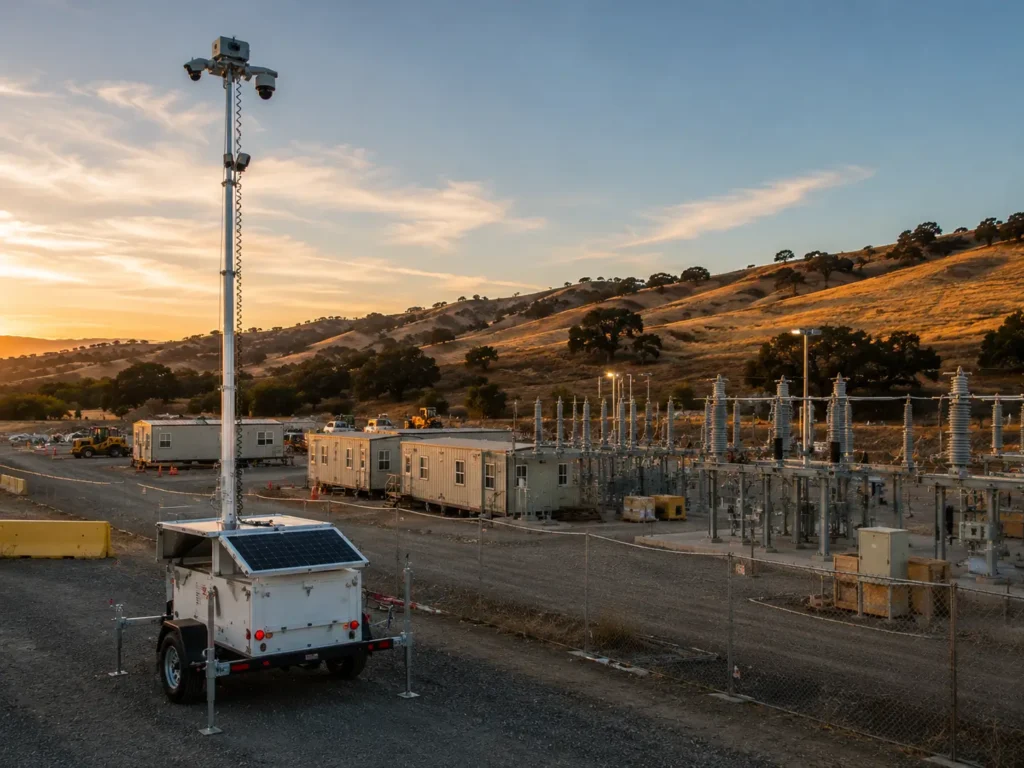
In brief: The right trailer depends primarily on lot size, available space, and operational layout. Large suburban dealerships often benefit from solar surveillance trailers, while tighter urban locations typically fit compact trailer platforms.
No two dealerships are identical.
Some occupy several acres with hundreds of vehicles spread across multiple inventory sections. Others operate from smaller urban properties where space is limited and every parking row matters.
Hawk offers mobile surveillance platforms that accommodate both environments without requiring permanent infrastructure.
Solar surveillance trailer
For larger dealership campuses, the solar surveillance trailer provides broad visibility while operating independently of permanent electrical infrastructure.
Its elevated mast allows cameras to monitor large portions of the property from a single location, making it well suited for:
- Large outdoor vehicle inventories
- Overflow storage lots
- Dealer auction facilities
- Fleet vehicle compounds
- Rural or suburban dealerships
- Areas without nearby utility access
Because the trailer operates independently, it can be positioned wherever visibility is needed most rather than wherever power is available.
The system also remains easy to relocate as dealership operations evolve throughout the year.
The solar surveillance trailer is particularly effective where long sightlines allow elevated cameras to oversee multiple inventory rows simultaneously.
Compact urban surveillance trailer
Urban dealerships often have different constraints.
Lots are tighter, vehicles are parked closer together, and nearby public streets create additional visibility and access considerations.
The compact urban surveillance trailer is designed for these environments.
Its smaller footprint makes it appropriate for:
- Downtown dealerships
- Street-facing vehicle displays
- Narrow parking configurations
- Multi-building campuses
- Limited staging areas
Despite its compact size, it continues to provide elevated monitoring, live remote oversight, and visible deterrence while fitting into locations where larger trailer platforms may be impractical.
Many dealerships also use compact units temporarily during remodeling projects or inventory expansions where flexibility is especially valuable.
Whether protecting a suburban auto mall or an urban dealership, Hawk focuses on matching the trailer configuration to operational needs rather than applying a one-size-fits-all solution.
Trailer vs guard vs fixed cameras for a dealership, cost and coverage
In brief: Mobile surveillance trailers occupy the practical middle ground between security guards and fixed camera systems. They combine continuous monitoring, active deterrence, rapid deployment, and flexible coverage without the ongoing staffing requirements of full-time guard services.
For most dealerships, the question is not whether guards or cameras have value.
The better question is which combination provides the strongest protection for the available budget.
Security guards deliver a visible presence but typically represent the highest recurring operating expense.
Fixed cameras provide excellent documentation but cannot move as dealership layouts change.
Mobile surveillance trailers combine many of the strengths of both while reducing several operational limitations.
Feature | Mobile Surveillance Trailer | Security Guard | Fixed Camera System |
Coverage | Large outdoor areas from elevated mast | Limited to patrol route | Fixed viewing angles |
Active deterrence | Yes, live monitoring, speakers, strobes | Yes | Generally no |
Mobility | Easily relocated | Patrol only | Permanent installation |
Permanent infrastructure | No | No | Yes |
Deployment speed | Hours | Staffing dependent | Days or weeks |
After-hours monitoring | Continuous | Shift dependent | Recording dependent |
Expansion flexibility | High | Moderate | Low |
Cost profile | Middle | Highest recurring cost | High installation cost |
Specific monthly costs vary by deployment size, monitoring level, equipment selection, and rental duration.
Compared with national providers such as WCCTV, LiveView Technologies (LVT), SentraCam, and traditional security guard companies, Hawk differentiates itself through Northern California deployment experience, flexible trailer configurations, fast regional deployment, and concierge-level monitoring designed around local commercial properties rather than standardized national programs.
The result is a solution that strengthens dealership security while remaining adaptable as inventory, property layouts, and operational priorities change.
Deployment and monitoring: what setup looks like
In brief: Hawk deploys mobile surveillance trailers in hours, not days. Every deployment begins with a site assessment, followed by strategic placement, live monitoring, and ongoing support so the system adapts as dealership operations change.
A successful dealership surveillance program starts long before the trailer arrives.
Hawk works with dealership management to understand how vehicles move through the property, where inventory changes most frequently, and which areas experience the greatest operational risk after business hours.
Typical evaluation points include:
- Primary customer entrances
- Employee entrances
- Vehicle delivery areas
- Overflow inventory lots
- Service department access
- Perimeter fencing
- Public street visibility
- Existing lighting
- Existing security cameras
- Blind spots between inventory rows
Rather than placing equipment wherever power is available, mobile surveillance trailers are positioned where they provide the greatest visibility across the property.
Because Hawk’s systems operate independently of permanent infrastructure, placement decisions focus on security performance instead of construction limitations.
After deployment, the elevated mast provides broad visibility across vehicle inventory while multiple camera views monitor entrances, perimeter gaps, and high-value parking areas.
Professional monitoring becomes another important layer of protection.
Instead of simply recording video for later review, Hawk’s 24/7 remote monitoring allows trained operators to evaluate activity in real time.
When suspicious activity occurs, monitoring personnel can:
- Verify whether activity appears legitimate
- Activate visible warning strobes
- Broadcast live audio warnings through onboard speakers
- Continue monitoring the situation
- Contact emergency responders when appropriate
- Preserve video evidence for investigation
This measured escalation helps reduce unnecessary dispatches while providing immediate attention when intervention becomes appropriate.
Unlike permanent installations that remain fixed for years, mobile trailers continue to evolve alongside dealership operations.
As inventory expands, seasonal sales events occur, construction projects begin, or overflow storage locations change, the trailer can be repositioned without new trenching, wiring, or construction work.
This flexibility is particularly valuable for dealerships that regularly receive large manufacturer shipments or temporarily store additional inventory during seasonal sales periods.
The result is an active security layer that continues adapting as dealership operations evolve.
Frequently asked questions
How do car dealerships stop after-hours lot theft in California?
Mobile surveillance trailers combined with professional remote monitoring provide dealerships with continuous visibility across outdoor inventory areas after business hours. Rather than relying only on recorded footage, monitored systems can detect activity, verify potential threats, activate visible deterrents, and notify authorities when appropriate while complementing existing fencing, lighting, alarms, and fixed cameras.
Is a surveillance trailer cheaper than security guards for a dealership?
In many situations, yes. Security guards provide valuable on-site presence but represent one of the highest recurring operating expenses for large outdoor properties. Mobile surveillance trailers deliver continuous monitoring across much larger areas while reducing the need for constant physical patrols. Actual pricing depends on property size, monitoring requirements, and deployment duration.
Can a mobile trailer cover a whole dealership lot?
One trailer can often monitor a significant portion of a dealership depending on property size, terrain, vehicle placement, and sightlines. Larger campuses may benefit from multiple trailers positioned to eliminate blind spots and strengthen perimeter coverage. Hawk evaluates each property individually to determine the most effective deployment strategy.
Do surveillance trailers deter catalytic converter and wheel theft?
Visible surveillance equipment, elevated cameras, warning strobes, live audio communication, and professional monitoring create multiple opportunities to interrupt unauthorized activity before property is removed. While no security solution can guarantee prevention, active monitored systems provide substantially greater deterrence than passive recording alone.
How fast can Hawk deploy a trailer to a Northern California dealership?
Most deployments can be completed in hours rather than days because mobile surveillance trailers do not require permanent poles, trenching, or electrical construction. Timing depends on equipment availability, scheduling, and site requirements, but dealerships can typically begin improving coverage much faster than with permanent infrastructure projects.
Trailer or fixed cameras for a car lot: which is better?
The strongest dealership security programs usually combine both. Fixed cameras provide continuous coverage of buildings and entrances, while mobile surveillance trailers protect changing inventory areas, temporary storage locations, and perimeter gaps. Together they create multiple concentric layers of protection that adapt as dealership operations change.
Get dealership lot security pricing in Northern California
Every dealership has a different layout, inventory profile, and operational schedule.
Some need temporary protection during expansion projects. Others require long-term coverage for large outdoor inventory lots. Many are looking for a practical alternative to expanding guard services without investing in permanent infrastructure.
Hawk Surveillance works with dealerships throughout Northern California to design flexible mobile security deployments that complement existing cameras, lighting, fencing, and access control systems.
Whether you operate a single rooftop dealership or a multi-acre automotive campus, Hawk can recommend the right combination of surveillance technology, monitoring, and deployment strategy for your property.
Talk with a security specialist to discuss your dealership’s operational needs, compare trailer options, and receive customized mobile surveillance trailer rental pricing based on your location, lot size, and monitoring requirements.
You can also learn more about retail and parking lot security, explore Hawk’s solar surveillance trailer and compact urban surveillance trailer solutions, review trailer vs guard cost, or request information about 24/7 remote monitoring for dealerships throughout Northern California.