
Last updated: June 2026
TLDR: Trailer vs Guard at a Glance
A 24/7 security guard post in Northern California typically costs $18,000 to $32,000 per month. Trailer costs depend on the equipment, monitoring, and deployment requirements, so request a site-specific quote to compare the two. Cost is the starting point for most security budget decisions, but it is not the whole story.
Guards still make sense when you need physical presence, access control, regulated personnel, or immediate on-site intervention. Surveillance trailers make sense for large, open sites where coverage consistency, cost control, and documentation matter more than physical interaction. Many sites use a hybrid model that combines both.
This guide explains the cost drivers, the coverage trade-offs, and three Northern California scenarios so you can decide what works for your site, your timeline, and your budget.
Why This Comparison Matters in 2026
Rising Guard Wages in California
Security guard costs are shaped by wages, overhead, and contract terms. When you factor in benefits, insurance, supervision, and company margin, bill rates climb substantially higher than the wage itself.
State-level wage pressure is not slowing. California minimum wage increases and sector-specific wage legislation continue to push labor costs upward (see California minimum wage data). Guard companies pass those increases directly to clients in the form of higher hourly bill rates.
Confirm current bill rates with your provider rather than assuming last year’s figures still apply.
The Coverage Gap Problem
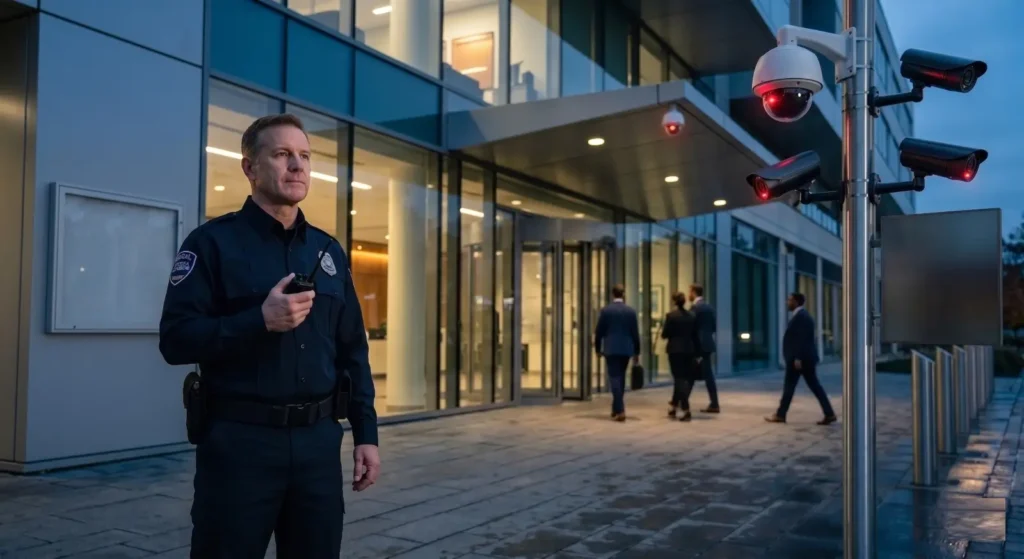
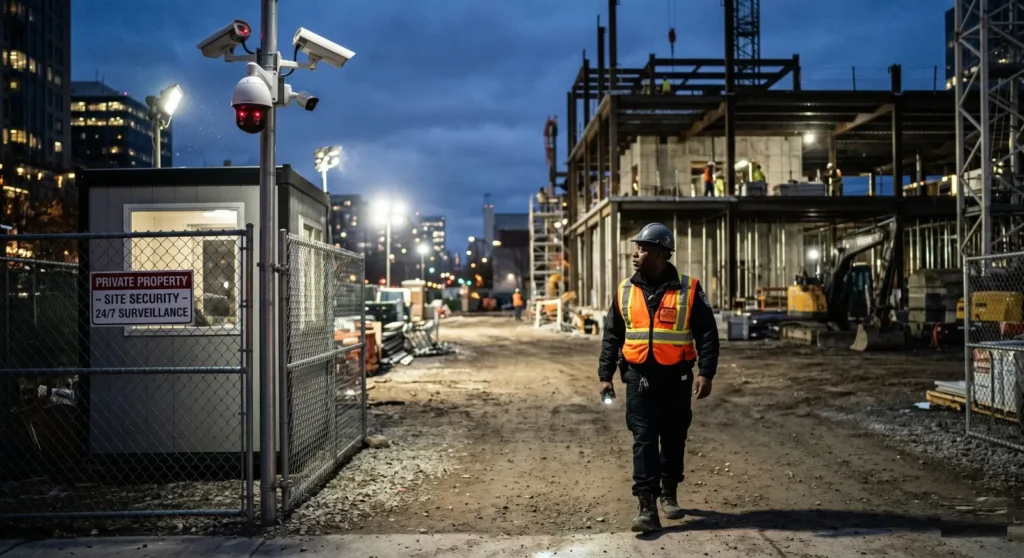
A single guard cannot monitor an entire jobsite at once. Even on a three to five acre site, coverage depends on patrol patterns, line of sight, and timing. Breaks, weather, and shift fatigue create predictable gaps in coverage, and those gaps are often observed and exploited.
Theft crews rarely act randomly. They study patterns, time patrols, and wait for the predictable window when the guard is on the far side of the site. This is where technology changes the math. Cameras do not blink, step away, or get pulled off-site for another assignment, and they do not have a patrol pattern to study.
What Northern California Buyers Are Asking
Across construction, logistics, and retail, buyers are asking the same question: can we reduce security spend without increasing risk? The rise in copper theft, catalytic converter theft, and equipment theft continues to drive that conversation. The National Insurance Crime Bureau tracks ongoing increases in construction and equipment theft across the United States (see NICB theft trends).
Locally, Bay Area catalytic converter theft has forced property managers to rethink parking lot security strategies entirely (see catalytic converter theft in the Bay Area). The result is a market-wide shift: buyers are now comparing guards against surveillance systems through a cost-first lens, with coverage and documentation weighed alongside.
Security Guard Cost in Northern California (2026)
Hourly Wage vs Billed Rate
Guard wages are the base that bill rates are built on.
Guard companies bill clients well above the wage itself. The markup covers payroll taxes, workers compensation insurance, supervision, training, equipment, and company margin. In Northern California, typical bill rates run $28 to $42 per hour, with higher rates concentrated in the Bay Area and lower rates in the Central Valley.
Monthly Cost for 24/7 Guard Coverage
A full-time guard post running 24/7 requires roughly 728 hours of coverage per month (24 hours × 7 days × 4.33 weeks). At $28 per hour, that comes to about $20,384 per month. At $42 per hour, it comes to about $30,576 per month. The separate $18,000 to $32,000 monthly planning range is broader than these two calculations. Confirm the applicable bill rate and coverage hours with the guard provider.
That is for one position. Many sites require two or more posts to cover an entry gate, perimeter, and equipment yard simultaneously. A two-post site can easily exceed $50,000 per month in pure guard spend, before any overtime or coverage gaps get filled.
Hidden Costs: Overtime, Turnover, and Liability
The hourly bill rate does not capture the full cost of guard coverage. Confirm whether your guard contract includes overtime, holiday premiums, and replacement coverage, and which circumstances create additional client charges. Turnover in the security guard industry is exceptionally high, with industry sources citing annual turnover rates above 100% for entry-level posts (see ASIS International industry insights). That turnover means inconsistent coverage, repeated training cycles, and unfamiliar guards on your site at any given moment.
Liability is another hidden cost. Guards introduce risk tied to use-of-force incidents, on-site injuries, or workers compensation claims. A no-show shift on a high-risk weekend can cost far more than the guard itself, in the form of stolen equipment, halted work, or insurance claim escalation. Together, these variables make guard costs unpredictable from one month to the next.
Hawk Insight: Start with the contracted guard bill. Add only charges your agreement excludes, such as approved overtime or extra coverage. Assess potential theft losses separately, and avoid counting overhead already included in the bill rate twice.
Mobile Surveillance Trailer Cost (2026)
Rental Pricing in NorCal
A typical mobile surveillance trailer rental in Northern California is quoted per site. Rental quotes depend on camera count, camera type (fixed versus PTZ), thermal imaging capability, mast height, and whether monitoring is included in the package.
A basic configuration might include two fixed cameras and basic monitoring. A more fully equipped unit might include multiple cameras, PTZ, thermal imaging, analytics, and 24/7 live monitoring. For a deeper breakdown of what drives pricing across NorCal, see surveillance trailer rental cost in Northern California.
Purchase Considerations
For longer projects or year-round operations, consider whether ownership fits your needs. Request a purchase quote for the required configuration, then compare acquisition, operating, and maintenance costs with rental over the same period.
Hawk’s models include the heavy-duty industrial trailer and the compact urban surveillance trailer. Ask Hawk which available model suits the site’s exposure, access restrictions, and available space.
Add-On Costs: Monitoring, Connectivity, Repositioning
Most deployments include several add-ons beyond the trailer itself. The monitoring quote depends on the response tier. Ask the provider to identify any connectivity charges. Repositioning fees apply when site layouts change mid-project, which is common on multi-phase construction work.
Ask for the add-ons to be itemised in the quote, so the monthly total you compare against a guard post is the complete one.
Side-by-Side: Cost and Coverage Comparison
Comparison Factor | Security Guard (24/7) | Surveillance Trailer + Monitoring |
Monthly cost | $18,000 to $32,000 | By quote |
Annual cost | $216,000 to $384,000 | By quote |
Operational start date | Confirm licensed staff and site induction | Confirm equipment, access, connectivity, and monitoring activation |
Coverage area | Limited, rotating | Configured camera zones |
False alarm handling | Human dependent | Filtered by monitoring |
Evidence | Written reports | HD video with timestamps within camera views |
Scaling | Add more guards | Add more units |
Continuity planning | Confirm relief staffing and absence cover | Confirm equipment uptime and monitoring continuity |
Weather and outages | Confirm site-specific operating arrangements | Confirm power, connectivity, and equipment limits |
Risk allocation | Review guard-service responsibilities and insurance | Review equipment, monitoring, and response responsibilities and insurance |
Physical intervention | Yes | No |
Compare the same coverage period, and include monitoring, deployment, and any retained guard duties.
Get a Quote for Your Site
Tell us your site size, timeline, and risk profile. We will send back a custom configuration and a cost projection.
Coverage Comparison: What Each Solution Actually Sees
Single Guard Coverage in Practice
Guard coverage depends on the route, sightlines, duties, and time spent at each location. While the guard is in one area, other parts of the site may be unwatched.
On a typical multi-acre site with multiple zones (entry, equipment yard, lay-down area, perimeter), a single guard will cycle through each zone with predictable timing. A predictable route can make coverage gaps easier to anticipate.
Single Trailer Coverage in Practice
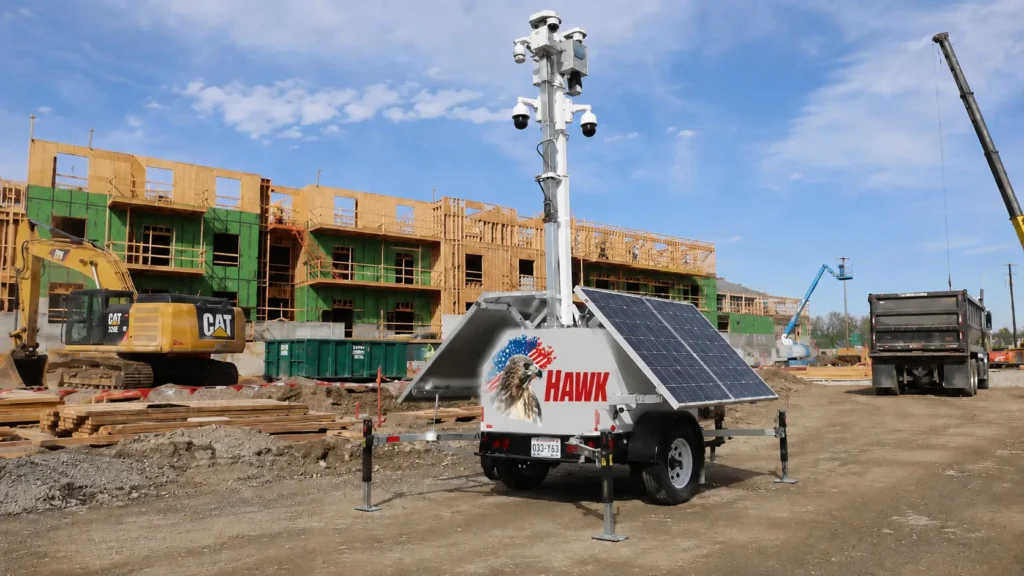
A solar surveillance trailer uses elevated cameras mounted 18 to 25 feet high on a telescoping mast. The mast height extends line of sight, reduces occlusions from stacked materials and vehicles, and gives the cameras a depression angle that improves identification at distance.
Camera coverage depends on placement, lenses, lighting, obstructions, and configuration. During the site assessment, ask the provider to identify monitored zones and verify any required license-plate capture under expected operating conditions. Thermal imaging can extend detection in low light. Unlike a guard, a trailer does not rely on a patrol route or shift schedule.
What Each Misses (and How They Complement Each Other)
Guards cannot be everywhere at once, and trailers cannot physically intervene. Honest comparison: guards win on physical presence, access control, and the ability to detain or escort. Trailers win on consistency, documentation, and scalability.
This is why many sites adopt a hybrid model. They assign camera coverage to specified zones, then deploy guards where physical presence is genuinely required, like an entry gate or executive area.
Hawk Insight: Confirm which zones are covered and how a verified incident is escalated.
Deterrence and Response: Beyond Just Watching
Visible Deterrence
A trailer with a raised mast, lighting, and signage creates immediate, unmistakable visibility. It signals to anyone approaching the site that the area is monitored and recorded. Visible deterrence works by preventing incidents before they become claims, schedule delays, or police reports.
A guard provides visible deterrence too, but only in the zone where the guard is physically located. A trailer’s deterrence is constant and omnidirectional within its coverage area.
Active Response Through Remote Monitoring
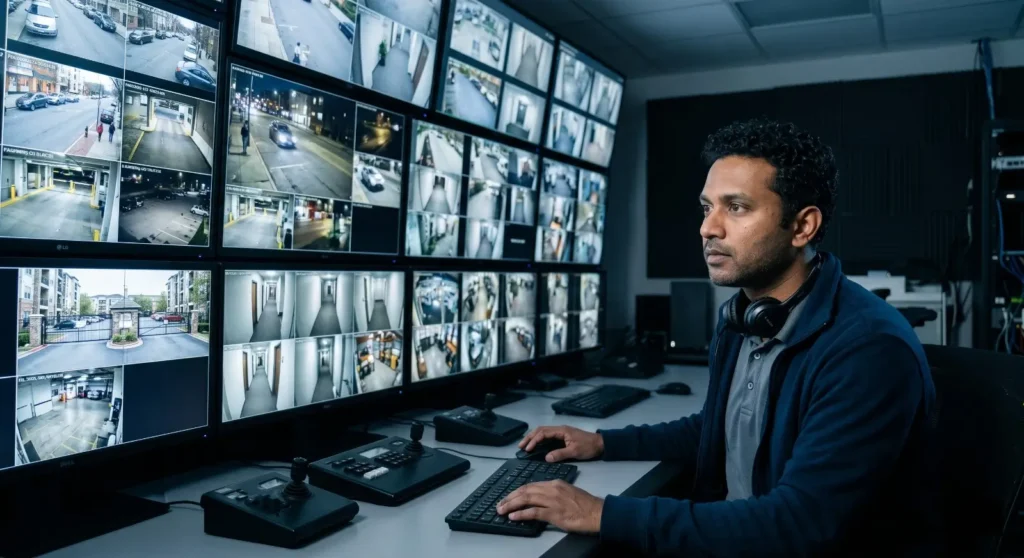
With 24/7 remote monitoring, operators can issue warnings and escalate incidents under the agreed response protocol. Confirm detection zones, monitoring hours, and escalation arrangements. A typical voice-down message, delivered through the trailer’s speaker system, sounds like: “You are being recorded. Law enforcement has been notified. Leave the property immediately.”
Documentation and Evidence Quality
Video can provide a timestamped record of activity within camera views. Specify retention, export access, and image-quality requirements. Clips can be downloaded and shared with police or attached to insurance claims. Guard incident reports, by contrast, rely on memory and written notes filed after the fact, often with gaps in detail or timing.
Ask your insurer what documentation it requires for claims.
Three Site Scenarios: What to Include in a Quote
Scenario 1: Bay Area Construction Jobsite (10-Acre, 18-Month Build)
These three scenarios are illustrative planning examples, not completed case studies. Take an 18-month ground-up project on a 10-acre site currently paying for one overnight guard, seven nights per week, at roughly $8,400 per month.
Request a combined quote for two trailers, 24/7 monitoring, and deployment. The decision point is whether both the entry gate and the lay-down area need continuous coverage, instead of one guard patrolling between them.
Related reading: construction jobsite security for Bay Area sites.
Scenario 2: Central Valley Logistics Yard (5-Acre, Year-Round)
Take a 5-acre yard in Stockton running a 24/7 guard post at one entry point, with a billed cost of about $26,000 per month, or $312,000 annually.
Ask Hawk to assess whether one trailer can cover the required zones, and to quote monitoring and on-call response. The decision point is which entry-control duties still need a person on site, and how a verified incident gets escalated.
Related reading: logistics yards and warehouses for Central Valley sites.
Scenario 3: Sacramento Retail Center (3-Acre, Seasonal Peak)
For this illustrative 3-acre retail-site example, assume a two-guard arrangement costing about $28,000 over 60 days.
Obtain a trailer rental quote for the same 60-day period and coverage hours before comparing totals. Licence plate capture at the lot entrances is a requirement to specify and verify rather than a given, and it is what supports catalytic converter incident follow-up.
This is the retail and parking lot security use case.
Run the Math for My Site
Send your current security spend and site details. Hawk will return a side-by-side comparison within one business day.
Deployment: Confirm the Operational Start Date
Ask each provider to confirm the earliest operational start date for your site. For guards, confirm available licensed staff and site induction, including background checks, BSIS guard card verification, and training. See California guard licensing requirements. For a trailer, confirm equipment availability, access, placement, connectivity, and monitoring activation.
For urgent situations, like a recent theft or a project that just broke ground, that start date is the number that matters. See our deployment process for what a typical deployment looks like.
When Guards Are Still the Right Answer
Guards remain the right choice in specific scenarios. Sites that require physical intervention, like executive protection, retail with frequent shoplifter detentions, or high-risk public events, need licensed personnel on the ground. Sites that need active visitor management and access control at a single entry point are also better served by a guard than a camera.
Some scenarios are determined by regulation or insurance. Sites with regulatory requirements that name licensed personnel, or sites where the insurance policy explicitly requires manned guarding, do not have the option to substitute technology. In those cases, the conversation is about how to make the guard coverage more effective, not how to replace it.
When a Surveillance Trailer Is the Right Answer
Trailers are the better choice for most large, open sites where the security goal is coverage, deterrence, and documentation rather than physical interaction. The strongest fits include construction jobsites (especially overnight and weekend coverage), equipment yards, logistics and lay-down areas, retail and parking lot peak-season coverage, remote utility and infrastructure sites, municipal facilities and public works yards, and event venues with large open footprints.
Hawk deploys trailers across Northern California, including San Francisco surveillance trailer rentals for Bay Area construction and Sacramento surveillance trailer rentals for Central Valley logistics and infrastructure.
The Hybrid Model: Trailer + On-Call Response
The most sophisticated buyers do not pick one or the other. A hybrid plan assigns camera coverage to specified zones and retains guards where physical presence is required.
Voice-down through remote monitoring can address incidents before any physical response is needed. On-call response is dispatched only when monitoring operators confirm a real incident. Ask Hawk whether the site needs continuous staffed duties, on-call response, or both.
Hawk Insight: The hybrid model keeps guards for the duties that need them, while giving you a documentation chain on the insurance side.
Frequently Asked Questions
How do surveillance trailer and security guard costs compare?
Guard costs depend on staffed hours and bill rates: 24/7 guard coverage typically runs $18,000 to $32,000 per month per post. Trailer costs depend on equipment, monitoring, and deployment. Compare complete quotes for the same site requirements.
How much does a security guard cost per hour in California?
Security guards in California are typically billed at $28 to $42 per hour, depending on region and shift. The markup over wages covers insurance, payroll taxes, supervision, training, and company margin. Bay Area rates trend toward the higher end of that range, while Central Valley rates trend lower.
What drives the monthly cost of a mobile surveillance trailer?
A mobile surveillance trailer in Northern California is quoted per site, with monitoring and connectivity quoted alongside it. Total monthly costs depend on camera count, PTZ versus fixed configuration, thermal capability, and monitoring tier.
Can a surveillance trailer fully replace a security guard?
A surveillance trailer cannot fully replace a guard in every scenario. Trailers provide visibility, deterrence, and documentation, but they cannot physically intervene, control access at an entry point, or escort an unauthorized person off-site. For sites that need those functions, the right answer is a hybrid model that uses trailers for coverage and a smaller guard footprint or on-call response for physical presence.
Do surveillance trailers lower insurance premiums?
Ask your insurer whether the proposed surveillance and monitoring arrangement affects your premium or policy requirements. Obtain written confirmation before including any insurance saving in your comparison.
How fast can a surveillance trailer be deployed compared to hiring guards?
Ask each provider to confirm the earliest operational start date for your site. For a trailer, confirm equipment availability, access, placement, connectivity, and monitoring activation. For guards, confirm available licensed staff and site induction, including background checks, BSIS licensing verification, training, and scheduling.
Are surveillance trailers effective at deterring theft?
Surveillance trailers are effective deterrents to most opportunistic theft. Visible cameras, a raised mast, lighting, and clear signage signal that the site is monitored and recorded. Where active monitoring and voice-down are included, operators can issue a warning and escalate under the agreed response protocol. Confirm detection zones, monitoring hours, and escalation arrangements.
What are the limitations of using only a security guard?
A single guard cannot monitor a large site continuously, and patrol patterns create predictable coverage gaps. Guards introduce variability through breaks, illness, turnover, and shift fatigue. They also cannot generate the same level of documentation as video. For sites larger than three to five acres, relying on a single guard usually means accepting blind spots that thieves can study and exploit.
Should I combine surveillance trailers with security guards?
Combining trailers and guards suits many medium and large sites, because it splits the work by what each one is good at. A hybrid plan can assign cameras to agreed monitoring zones and guards to access control or duties requiring physical presence. Specify any areas outside camera coverage and include both services and response charges in the comparison.
What is the ROI on a surveillance trailer for a construction site?
Compare your current guard cost over the project term against the full quoted replacement cost, including deployment, monitoring, and any guard coverage you keep. That comparison shows whether direct security spending falls. Assess theft reduction, incident documentation, and insurance outcomes separately.
Key Takeaways
- 24/7 guard coverage in Northern California costs $18,000 to $32,000 per month per post, while a trailer with monitoring is quoted per site
- Trailers provide wider, more consistent coverage than a single guard on a multi-acre site
- Guards remain necessary when physical intervention, access control, or regulatory requirements apply
- Confirm the earliest operational start date with each provider
- Hidden guard costs (overtime, turnover, no-show shifts, liability) often determine what a guard post really costs
- Hybrid models (trailers plus on-call response) assign cameras to monitoring and guards to duties requiring physical presence
- Documentation and evidence quality are stronger with video than with written guard reports
- For most large, open Northern California sites, a trailer-led deployment is worth pricing against your current guard plan
Get a Site-Specific Cost Comparison from Hawk Surveillance
Every site is different. The right configuration depends on your layout, risk profile, timeline, and existing security posture. A 10-acre Bay Area construction project, a 5-acre Stockton logistics yard, and a 3-acre Sacramento retail center all need different answers, even when the cost question is the same.
Site survey, configuration recommendation, and cost projection. No pressure, no obligation.
Tell us your site, your timeline, and your current security spend. Hawk will send back a configuration and a side-by-side cost projection within one business day.