
By Hawk Surveillance Operations Team. California construction site security. Last updated: May 4, 2026
Editorial note: Camera ranges, mast height effects, and per-acre coverage estimates in this guide are typical industry bands and Hawk operational rules of thumb based on common trailer configurations. Actual coverage on your site depends on the specific trailer model, camera package, lighting conditions, weather, and obstructions. Treat the numbers below as planning guidelines rather than guaranteed performance specifications. For a site-specific coverage map, send Hawk your site plan or aerial.
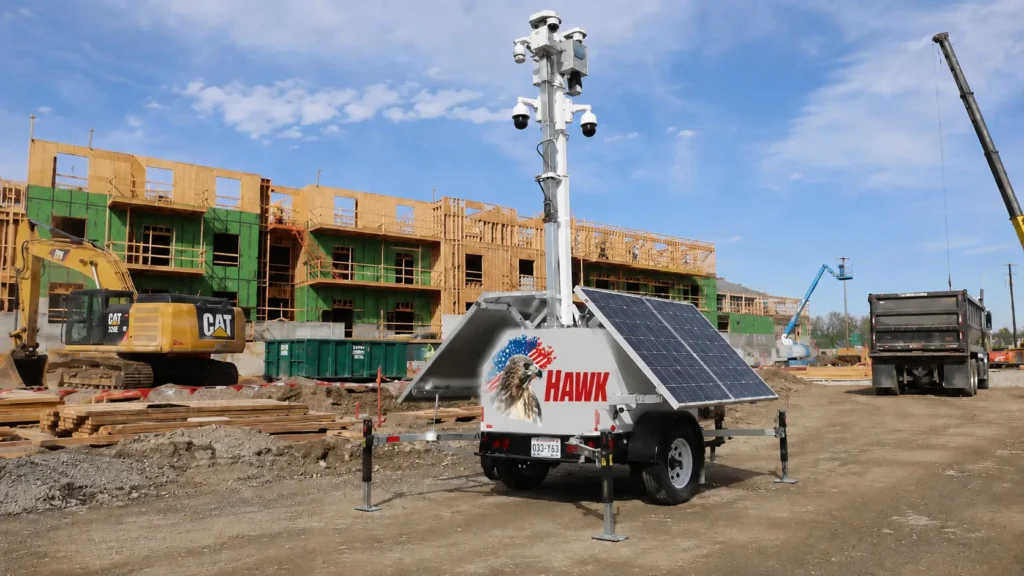
Quick answer: Most jobsites need one mobile surveillance trailer per 5 acres of open ground with clear sight lines. A 10–12 acre mixed site typically needs 2–3 trailers, and a 25-acre industrial site usually needs 4–5. Add trailers for obstructions, after-dark coverage, or any P1 zones beyond 300 ft.
| Site type | Acreage | Typical trailers |
|---|---|---|
| Urban infill lot | 1 acre | 1 |
| Logistics yard | 5 acres | 2 |
| Mixed-phase build | 10–12 acres | 2–3 |
| Industrial / solar farm | 25 acres | 4–5 |
| Retail parking lot | ~3 acres | 1 |
TLDR: The 1-Trailer-Per-5-Acre Rule (and Why It’s Only a Starting Point)
Start with a simple rule: one mobile surveillance trailer per 5 acres of relatively open ground with clear line of sight. That gets you close enough to budget and compare vendors.
It is only a starting point. Obstructions, high-value zones, and after-dark performance will push the number up. Open sites with clean sight lines can push it down, though placement always matters more than raw count.
This guide gives you a practical way to size your deployment. You will see how camera ranges really work, how mast height changes coverage, and how to apply a five-step method on your own site plan. We also walk through sample layouts at 1, 5, and 25 acres, plus a retail parking lot.
Use the math below to size your deployment. Or send your site map to Hawk and we will return a coverage map at no cost. See our mobile surveillance trailer rental overview for deployment options.
What a Single Surveillance Trailer Actually Covers
The Camera Range Question: Detection vs Recognition vs Identification
When someone says a camera “sees 1,500 ft,” they are usually talking about detection, not identification. The industry standard that defines the four levels of camera observation is IEC EN 62676-4, commonly called DORI (Detection, Observation, Recognition, Identification):
- Detection: something is present. Typical PTZ: ~600 to 1,500+ ft (~183 to 457+ m) depending on zoom, sensor, and light
- Observation / Recognition: you can tell it is a person, not an animal. Typical PTZ: ~300 to 600 ft (~91 to 183 m)
- Identification: you can identify a specific person. Typical PTZ: ~100 to 300 ft (~30 to 91 m). Fixed cameras: ~30 to 50 ft (~9 to 15 m)
Range generally depends on focal length, sensor size, compression, lighting, and weather. Treat ranges as bands, not single numbers. Hawk’s actual specifications depend on the trailer model and camera package selected.
💬 Hawk Insight: Most losses happen at night and at the edges of your site. If your P1 zones need identification, plan your trailer spacing so your PTZ can hit 100 to 300 ft identification on those zones, not just detect movement at long range.
PTZ vs Fixed Cameras: What Each Sees
Camera Type | Strength | Limitation | Best Use |
PTZ (pan-tilt-zoom) | Long reach, flexible zoom | Sees one direction at a time | Active sweeps, zoom to incidents |
Fixed | Continuous coverage, no blind moments | Shorter effective range | Perimeter, gates, storage zones |
Best practice is generally one PTZ for active sweep plus 2 to 4 fixed cameras for continuous coverage. The PTZ delivers reach and zoom flexibility, while the fixed cameras maintain continuous coverage on the zones the PTZ isn’t currently watching.
Mast Height: Why 22 ft Beats 18 ft (and 25 ft Sometimes Beats 22 ft) Height generally increases coverage because it improves line of sight and the viewing angle over obstacles.
Mast Height | Practical Impact |
18 ft | Works on open lots, limited clearance over stacked materials |
22 ft | Typically clears 8 ft stacks at moderate distance, better angles into yards |
25 ft | Best for complex sites, diminishing returns beyond this |
A 22 ft mast often clears common obstructions like pallets, equipment, and temporary fencing, depending on stack distance and camera tilt. A 25 ft mast helps on multi-phase builds or yards with tall stacks. Above 25 ft, wind load, transport, and deployment complexity generally increase.
Thermal, IR, and Low-Light: Coverage After Dark
After dark, your effective range typically drops unless you plan for it.
IR (infrared) illumination: extends usable night coverage roughly 100 to 300 ft depending on lens and IR power
Low-light sensors: improve color images at dusk and under site lighting
Thermal cameras: detect heat, not light. Useful in fog, smoke, and total darkness. Range varies widely by sensor and lens
Thermal upgrades add cost, but they solve specific problems. Fog-prone corridors and high-value yards generally benefit the most. See options under accessories and upgrades.
💬 Hawk Insight: If your loss risk is highest between 10 pm and 4 am, design for night first. Daytime conditions are easier to plan for and easier to verify.
The Five-Step Method to Size Your Deployment
Step 1: Map Your Site and Identify Priority Zones
Start with a site plan or an aerial. A quick pass in Google Earth works.
Mark:
Entry and exit points
Equipment yard and contractor parking
Lay-down areas
Fuel and generator storage
Finished materials
Perimeter weak points and access roads
Then rank the zones:
P1: needs identification-grade coverage
P2: recognition is sufficient
P3: detection is enough
If a contractor is sizing a 12-acre warehouse build, the P1 zones are typically the tool crib, copper storage, and the main gate.
Step 2: Measure the Longest Required Line of Sight
From each likely trailer position, measure the distance to the farthest point in its assigned zone.
If your farthest P1 point is 260 ft away, you are within typical PTZ identification range. If it is 400 ft, you either move the trailer closer, add another trailer, or add fixed cameras closer to that zone.
Use rough measurements. You are not drafting a survey. You are checking if your distances fit within 100 to 300 ft identification for P1 zones.
Step 3: Match Camera Type to Detection Requirement
Map your zones to camera behavior:
P1: PTZ must reach identification at the measured distance. Add fixed cameras for continuous coverage on the same zone
P2: PTZ sweep is fine. Recognition at ~300 to 600 ft is generally acceptable
P3: fixed wide-angle cameras can cover these at distance for detection
This is where the PTZ plus fixed mix earns its keep. One device cannot do everything well at once.
Step 4: Apply the Per-Acre Sizing Rule and Adjust for Obstructions
Start with 1 trailer per 5 acres of clear ground.
Then add trailers for:
Major line-of-sight breaks such as buildings under construction, stacks above 8 ft, or retained earth
Clusters of P1 zones that sit beyond a single trailer’s identification range
Isolated gates or access roads that a perimeter trailer cannot cover
Site Condition | Adjustment |
Open 5 acres, clear sight lines | 1 trailer |
5 acres with heavy equipment yard | 2 trailers |
10 to 12 acres, mixed phases | 2 to 3 trailers |
25 acres, multiple zones | 4 to 5 trailers |
Step 5: Plan Placement and Verify with a Test Deployment
Place trailers where priority zones and weak perimeter points intersect. Favor high points to maximize line of sight.
After install, verify at night:
Walk each P1 zone
Confirm you can identify a person at the expected distance
Adjust PTZ presets and fixed camera angles
Hawk’s teams handle this as part of deployment and project services and follow a repeatable method documented in our deployment process.
💬 Hawk Insight: The first night walk-through finds issues you will not see on a daytime plan. Fix them early.
Send us your site plan or an aerial. Hawk will return a recommended trailer count, placement, and camera configuration within two business days.
Sample Layouts: 1-Acre, 5-Acre, 25-Acre, and Parking Lot
The following are illustrative layouts based on typical site conditions. Actual placement and trailer count for your project depend on site-specific obstructions, P1 zone locations, and operational needs.
1-Acre Construction Lot (Single Trailer)
Site: Dense infill build in a tight urban area like San Francisco or Oakland, tight boundaries, one gate
Trailer: Compact Urban Surveillance Trailer is typically the best fit for tight infill sites; Heavy-Duty Industrial Surveillance Trailer is an alternative when the project also needs sustained power and rougher conditions
Placement: Back corner, angled across the lot
Coverage: PTZ sweeps the perimeter. Fixed cameras lock on the gate and material storage
Rationale: Under 5 acres with short distances. One trailer can typically deliver identification across most P1 zones
5-Acre Logistics Yard (Two Trailers)
Site: Active logistics yard in the Central Valley near Stockton or Fresno, with parked equipment and stacked materials
Trailers: One Heavy-Duty Industrial Surveillance Trailer for the yard, one Solar Surveillance Trailer for the access road
Placement: Opposite corners with overlap at the entry
Coverage: PTZ overlap at the gate. Fixed cameras cover parking lanes and storage rows
Rationale: At 5 acres with obstructions, one trailer typically leaves blind spots. Two trailers create overlap and redundancy
25-Acre Industrial Site (Four Trailers)
Site: Large industrial project or solar farm, common in the Central Valley near Sacramento
Trailers: Four Solar Surveillance Trailers
Placement: Perimeter cardinal points, covering quadrants
Coverage: Each trailer owns a quadrant. PTZ sweeps overlap toward the center
Rationale: The 1-per-5-acre rule applies. Solar avoids generator logistics on large footprints
Retail Parking Lot (Compact Urban Trailer)
Site: ~3-acre retail parking lot with vehicle theft risk, common in suburban Bay Area markets like San Jose or Concord
Trailer: Compact Urban Surveillance Trailer
Placement: Back corner with long sight lines across rows
Coverage: PTZ covers central lanes for identification. Fixed cameras cover entry and exit for plate capture
Rationale: Open layout with minimal occlusion. One well-placed trailer can typically cover P1 zones
Hawk returns a recommended trailer count, placement, and camera configuration within two business days at no cost.
When You Need More Trailers Than the Rule Suggests
Heavy Obstructions and Line-of-Sight Breaks
Stacks above 8 ft, large vehicles, scaffolding, and partial structures block sight lines. Each major break can justify another trailer or a relocation.
High-Value Zones That Need Identification-Grade Coverage
Copper spools, tool cribs, fuel tanks, and generator banks generally need identification. That compresses your effective distance to 100 to 300 ft and can increase trailer count.
Multi-Phase Sites Where the Layout Changes
As steel goes up, sight lines change. Repositioning every 4 to 8 weeks is typical. Some phases need extra trailers to avoid gaps.
After-Dark and Bad-Weather Coverage Requirements
Night and fog reduce range. If risk is overnight, tighten spacing or add thermal. Solar power options are detailed on the Solar Surveillance Trailer page.
When You Need Fewer Trailers Than the Rule Suggests
Open sites with clear edge-to-edge sight lines
Risk concentrated in one area that a single trailer can cover
Existing fixed cameras on buildings covering part of the footprint
Secondary layers like guarded entry or physical barriers
Right-sizing means you do not pay for coverage you cannot use.
Placement Mistakes That Waste Coverage
Too low: placing in a dip or behind equipment kills line of sight
Too close to the fence: PTZ range is wasted beyond the perimeter
Facing the sun: glare reduces usable hours in the afternoon
Ignoring wind: high winds can force mast retraction
Static PTZ patterns: predictable sweeps are easy to game
No night verification: lighting conditions change your effective range
Coverage and Active Response: Why Cameras Alone Are Not Enough
Cameras handle detection, but people handle response. Without active monitoring, you’ll have a record of every incident but you won’t have stopped any of them.
With 24/7 remote monitoring, voice-down and live operators can interrupt activity in real time. Coverage math sets the floor for what’s possible on your site, while active response is what determines whether incidents get interrupted in real time.
Frequently Asked Questions
How many surveillance trailers do I need for my site?
One mobile surveillance trailer typically covers up to 5 acres of open ground with clear sight lines. A 10 to 12-acre mixed site typically needs 2 to 3 trailers. Add trailers for obstructions, priority zones beyond 300 ft, or broken sight lines. If P1 zones sit beyond a single trailer’s identification range, reposition or add a second trailer to maintain coverage.
How far can a surveillance trailer camera see?
PTZ cameras can typically detect at roughly 600 to 1,500+ ft, recognize at 300 to 600 ft, and identify at 100 to 300 ft depending on lens, sensor, and light. Fixed cameras typically identify at 30 to 50 ft. Night, fog, and glare reduce these ranges.
How much area does one surveillance trailer cover?
One trailer commonly covers up to 5 acres of open ground, but coverage depends on line of sight and required detail. If you need identification at 200 to 300 ft across key zones, you may need tighter spacing or additional trailers even on smaller sites.
How many cameras do I need per acre?
There is no fixed camera-per-acre number. A typical trailer uses one PTZ plus 2 to 4 fixed cameras. Coverage is generally driven by distances and obstructions, not acreage alone. Focus on meeting identification range in P1 zones.
What is the difference between PTZ and fixed cameras for site coverage?
PTZ cameras provide long-range, flexible views but only look one direction at a time. Fixed cameras provide continuous coverage with shorter range. Combining one PTZ with several fixed cameras typically balances reach and constant visibility.
How tall is a surveillance trailer mast and why does it matter?
Masts are commonly 18 to 25 ft. A 22 ft mast often clears 8 ft obstructions at moderate distance, improving line of sight and reducing blind spots. Taller masts increase coverage but add wind load and deployment considerations.
Do I need thermal cameras on my surveillance trailer?
Thermal is not required for every site, but it generally helps in total darkness, fog, and smoke. It improves detection where visible light is limited. Sites with high overnight risk or poor lighting benefit most from thermal upgrades.
Where should I place a surveillance trailer on a jobsite?
Place trailers where priority zones and weak perimeter points intersect, preferably on higher ground. Keep key P1 zones within 100 to 300 ft for identification and verify coverage at night after installation.
Can one surveillance trailer cover an entire construction site?
Yes for small, open sites under about 5 acres with clear sight lines. Larger or obstructed sites typically need multiple trailers to maintain identification coverage and avoid blind spots.
How do I get a coverage map for my specific site?
Send a site plan, aerial, or address and acreage to Hawk. You will receive a coverage map with recommended trailer count, placement, and camera configuration, typically within two business days at no cost.
Key Takeaways
Start with 1 trailer per 5 acres, then adjust based on site conditions
Design for DORI ranges, not marketing range claims
Use PTZ plus fixed cameras for reach and continuous coverage
22 ft masts often outperform 18 ft in real sites
Apply the five-step method on your specific plan
Add trailers for obstructions and P1 zones
Reduce trailer count on open, simple footprints
Placement beats quantity
Pair coverage with monitoring to stop incidents in progress
Get a Free Coverage Map for Your Site
Send a site plan, aerial, or just an address and acreage. Hawk returns a written coverage map at no cost, with no obligation.
This guide reflects Hawk Surveillance Systems’ operational experience deploying mobile surveillance trailers across California construction, industrial, and logistics sites. Hawk follows the operational safety practices documented in our QHSE framework, and our deployment specialists conduct site-specific coverage planning before any installation.
This guide is educational and intended to help site owners and project managers think through surveillance deployment planning. Camera ranges, mast height effects, and per-acre estimates are typical bands and may vary based on equipment configuration, site conditions, weather, and lighting. Always verify specific coverage requirements with a qualified security provider before relying on any planning guidance in this article.
About the Author
The Hawk Surveillance Operations Team designs, deploys, and manages mobile surveillance trailers across Northern California, including San Francisco, Sacramento, San Jose, Oakland, Fresno, Stockton, Concord, and Hayward. The team operates the Solar, Compact Urban, and Heavy-Duty Industrial trailer lines, and follows the operational safety standards documented in Hawk’s QHSE framework.
To request a site-specific coverage plan or speak with a deployment specialist