
At a glance
A wildfire surveillance trailer in California is a property-level layer that keeps thermal detection, cameras, alerts, and evidence capture running on your job site, where AlertCalifornia and Cal Fire watch the wider landscape but cannot see your gate, equipment, or fire-prone edges. Because it runs off-grid on solar and cellular, it keeps monitoring through PSPS power shutoffs, and it does double duty for both early-fire awareness and theft prevention. It supplements, and never replaces, a required human fire watch.
Last updated: June 8, 2026 · Reviewed by: Noah Williams, Hawk Surveillance Systems
- →What AlertCalifornia covers, and what it doesn’t
- →How a surveillance trailer detects early-stage fire
- →Why PSPS makes off-grid surveillance non-negotiable
- →Dual-use for construction sites: fire watch + theft
- →Trailer placement on fire-prone NorCal sites
- →When the alert fires: escalation, response, evidence
- →Frequently asked questions
AlertCalifornia covers landscapes; you need site-level coverage. For Northern California construction sites, solar farms, ranches, utility yards, and remote properties, a wildfire surveillance trailer in California is not a replacement for Cal Fire, AlertCalifornia, or a required human fire watch. It is a property-level layer that keeps cameras, thermal detection, alerts, and evidence capture running where fixed infrastructure may not exist. AlertCalifornia’s statewide network gives emergency managers wide-area visibility, while a surveillance trailer rental gives a site manager eyes on gates, staging areas, dry grass edges, laydown yards, and after-hours activity. The strongest use case is dual-use: one deployable trailer can support early-fire awareness, intrusion detection, documentation, and escalation during fire season.
California’s 2026 fire-detection stack: what AlertCalifornia covers and what it doesn’t
AlertCalifornia lists more than 1,200 high-definition PTZ cameras deployed across California as of February 2026, with 24-hour backcountry monitoring, near-infrared night vision, 360-degree sweeps about every two minutes, and long-range visibility under clear conditions on the official AlertCalifornia camera network page. (ALERTCalifornia)
That matters because California’s fire-detection stack is no longer one tool. It is a layered system: public camera networks, dispatch centers, aircraft, satellite products, local agencies, utility monitoring, private cameras, and people on the ground. AlertCalifornia is one of the most important public layers because it gives emergency managers wide-area visibility across forests, ridgelines, canyons, and remote terrain.
But the same strength creates the gap. AlertCalifornia is built for landscape-scale awareness. It is not designed to watch whether a subcontractor left a hot-work zone unsecured, whether dry brush is building near your laydown yard, whether a trespasser entered a ranch access road, or whether a small heat anomaly is forming behind your equipment enclosure.
The verified public record is strong: AlertCalifornia says its AI platform detected over 1,200 fires in its first season and beat 911 reporting more than 30 percent of the time on its official About page. (ALERTCalifornia)
Layer | What it watches | What it does well | What it does not solve |
AlertCalifornia | Regional landscapes, ridgelines, backcountry, fire behavior | Early smoke confirmation and situational awareness for agencies | Your gate, jobsite edge, stored materials, fuel area, or property-specific incident |
Fixed site cameras | Buildings, permanent yards, fixed entrances | Long-term monitoring where power and network exist | Temporary projects, remote parcels, PSPS exposure, changing site layouts |
Guard patrols | Human-visible activity during scheduled coverage | Access control, judgment, immediate on-site presence | Continuous camera evidence, wide thermal view, off-grid uptime |
Mobile surveillance trailer | Site perimeter, equipment zones, dry edges, road access, hot spots | Deployable, off-grid, camera-based detection and escalation | It does not replace Cal Fire, mandatory human fire watch, or evacuation planning |
AlertCalifornia watches the landscape. Hawk watches your site.
For NorCal job sites, solar farms, ranches, and remote properties, the practical answer is both layers doing different jobs.
Explore surveillance trailer rentals →How a surveillance trailer detects early-stage fire
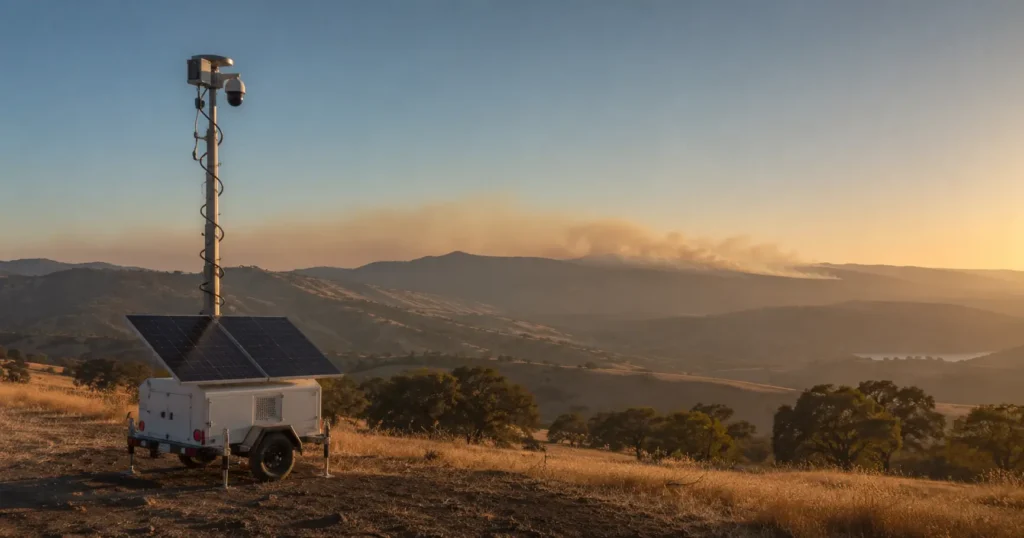
A wildfire surveillance trailer is a towable, off-grid camera platform configured to monitor outdoor sites for fire-relevant anomalies and security events. In wildfire use, the trailer usually combines visible cameras, thermal-capable cameras, solar power, battery storage, cellular connectivity, and alert routing. It is best understood as a site-specific detection and documentation layer, not a fire suppression system.
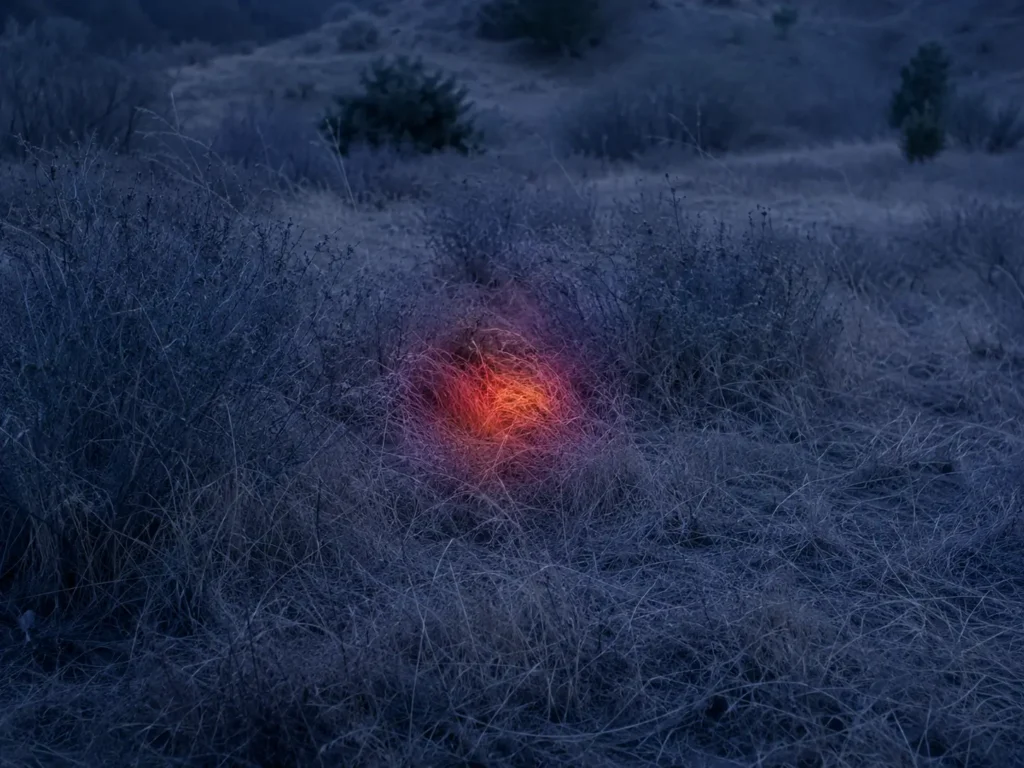
The detection stack usually starts with thermal. A thermal camera looks for heat patterns instead of relying only on visible smoke or flame. NASA’s 2026 Compact Fire Imager project, for example, describes wildfire sensing around heat signatures across multiple infrared bands, which is the same principle that makes thermal detection useful for early anomaly awareness in ground-level systems like trailers. (NASA Earth Science and Technology Office)
AI optical smoke detection can add a second lane where the camera and analytics package support it. Optical smoke analytics are useful when the view is clear, the horizon is visible, and the camera can distinguish smoke movement from dust, fog, exhaust, or lighting changes. Thermal and optical detection are strongest together because they are looking for different signals.
“By the time you see smoke from a fixed camera, a thermal camera has already been watching the heat signature for minutes.”
The alert path is just as important as the camera. A good trailer configuration does not simply record footage for later. It pushes alerts by cellular connection to a site contact, a property manager, or a monitoring center. With 24/7 remote monitoring, operators can verify the scene, review live and recorded clips, follow the approved call tree, and escalate according to the site’s instructions.
This is also where Hawk’s wedge is different from national surveillance providers like WCCTV, Pelco, SentraCam, and Joint Power Security. Hawk’s value is not just hardware. It is NorCal-specific placement, trailer deployment, off-grid power planning, and the trailers-vs-guards-vs-fixed-cameras decision for construction, utility, and remote property environments.
Why PSPS makes off-grid surveillance non-negotiable
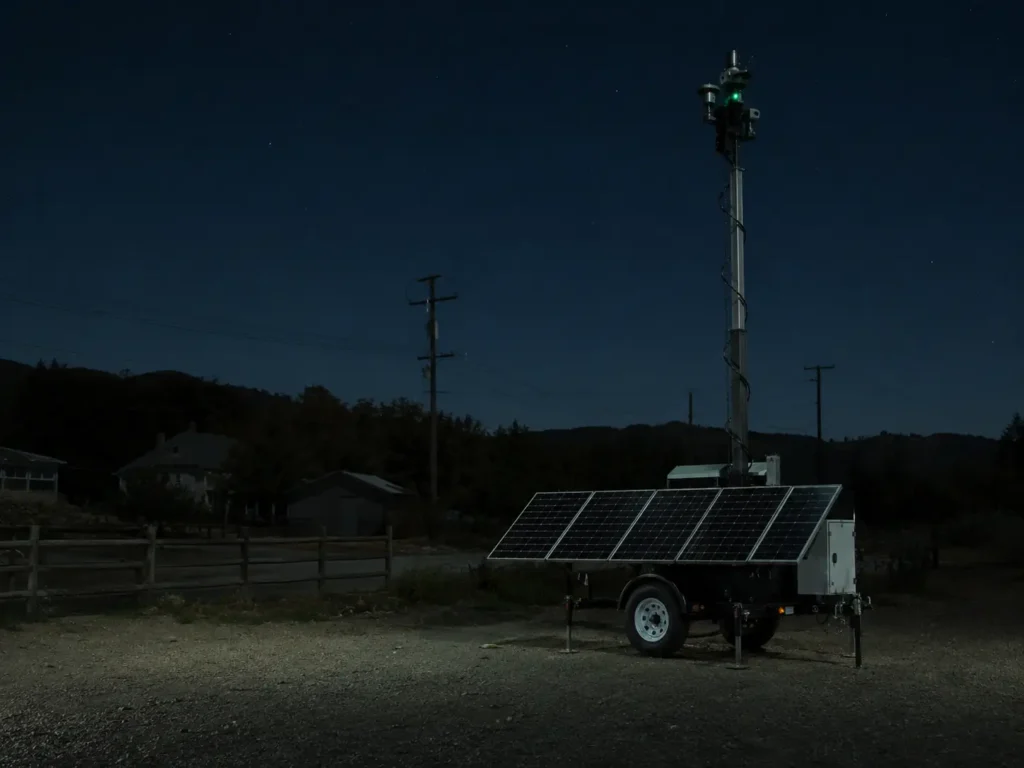
PG&E describes Public Safety Power Shutoffs as planned safety outages used to help prevent wildfires, and its PSPS materials explain that utilities may turn off power during severe weather because high winds can push trees or debris into energized lines on PG&E’s official PSPS page. (pge.com)
That timing is the operational issue. PSPS is most likely when fire risk is already elevated. A grid-tied camera at a remote yard, ranch, or early-phase construction site can lose power during the exact window when managers most need situational awareness.
An off-grid solar surveillance trailer solves that infrastructure problem by bringing its own power profile. Solar panels charge onboard batteries. Cellular connectivity removes the dependency on site Wi-Fi. The trailer can keep recording, alerting, and supporting remote review when the building power, temporary pole, or site office connection is down.
This does not mean every PSPS event will leave every fixed system blind. Some sites have backup power, hardened networks, or generator support. But many rural and temporary sites do not. For those sites, the off-grid trailer is not a luxury feature. It is the difference between “we hope someone sees it” and “we have a camera, alert path, and video record still operating.”
Dual-use for construction sites: when fire watch and theft prevention become the same job
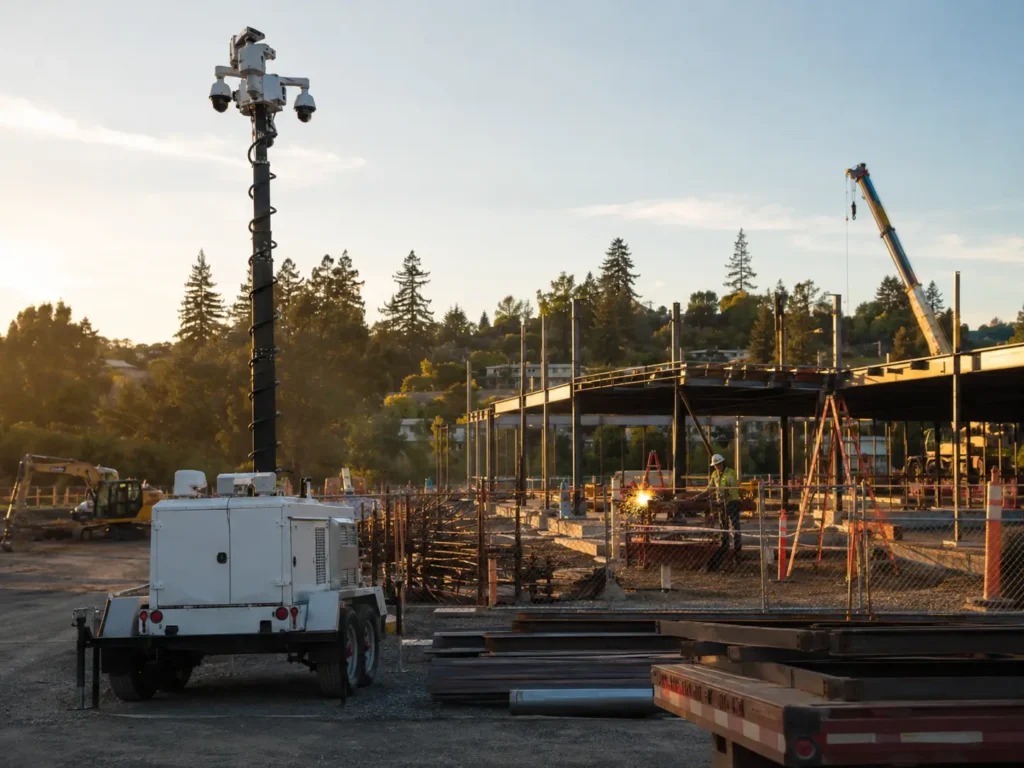
On a construction site, fire and security often share the same weak points: open access, dry vegetation, stored materials, temporary power, fuel, equipment, and after-hours gaps. One trailer can use the same mast, power, connectivity, thermal view, visible cameras, and monitoring workflow for both intrusion detection and early-fire awareness.
Cal/OSHA Title 8 Section 6777 covers hot-work procedures and permits, including required precautions to protect employees from fire and explosion hazards associated with hot work. The rule also says a hot-work permit can include special precautions, including the need for fire watch, on the California DIR Title 8 Section 6777 page. (dir.ca.gov)
Cal/OSHA Title 8 Section 8397.15 is more specific about fire watches. It requires written policy, identifies conditions where a fire watch must be posted, and says the employer must not assign other duties to a fire watch while hot work is in progress. It also requires that assigned employees have clear view and immediate access to covered areas, can communicate with exposed workers, and remain in the hot-work area for at least 30 minutes after completion unless the employer determines no further fire hazard remains. (dir.ca.gov)
That is why a trailer should never be sold as a replacement for a required human fire watch. It is a supplement. During certified hot-work windows, the human requirement controls. Outside those windows, especially overnight, weekends, and shutdown periods, a trailer can extend visibility beyond what a person can continuously patrol.
For general contractors and site owners, this makes construction-jobsite security more efficient. Instead of buying one security layer for theft and a separate awareness layer for fire season, the site can use one mobile platform for deterrence, detection, documentation, and escalation.
Trailer placement on fire-prone NorCal sites: what changes vs. theft-only deployment
A theft-only trailer is usually aimed at access points, tools, containers, equipment, copper, fuel, or parking areas. A wildfire-aware deployment still watches those zones, but it also needs to see the edges where heat, smoke, vegetation, or unauthorized activity can start small and move fast.
Hawk’s how we deploy process should start with a site map, access routes, known hazards, vegetation edges, slopes, stored combustibles, and cellular signal checks. Placement changes by site type.
Scenario card 1: remote construction pad
Put the trailer where it can see the work zone, temporary power, material storage, and the dry edge outside the fence. Do not bury the mast inside the site if the fire exposure is coming from the surrounding grass or slope.
Scenario card 2: solar farm or battery storage site
Use elevated sightlines across inverter pads, perimeter roads, access gates, and vegetation breaks. For larger acreage, multi-trailer planning may be needed so the blind spot behind one array row does not become the risk zone.
Scenario card 3: rural ranch or vineyard
Prioritize road access, equipment barns, fuel areas, defensible-space boundaries, and ridge-facing views. The goal is not to monitor every acre. The goal is to catch the first visible or thermal signal near critical assets.
Scenario card 4: utility or infrastructure yard
Aim for transformer areas, laydown zones, fence lines, and roads used by contractors. Keep emergency access clear and avoid placing the trailer where it creates a turning hazard for apparatus or service vehicles.
Scenario card 5: seasonal event or temporary camp
Use the trailer to cover parking edges, generator areas, vendor rows, grass lots, and overnight staging. Make sure alert contacts are not only event staff, but also the person with authority to shut down equipment or open access.
Placement should also account for solar panel angle during late-summer and early-fall sun, dust, wind exposure, and the safe distance from combustible materials. The trailer cannot become the hazard it is meant to help monitor.
When the alert fires: escalation, response, evidence
A trailer alert should move through a simple chain: detect, verify, notify, escalate, document. That sequence keeps the system operational instead of noisy.
First, the camera or analytics rule identifies a possible event. Second, the monitoring workflow verifies whether it is a real concern, a false trigger, dust, fog, vehicle exhaust, routine work, or visible smoke. Third, the system notifies the designated site contact. Fourth, it escalates according to the approved call tree. Fifth, video clips and event notes are preserved for internal review, insurer documentation, or agency handoff.
For fire events, the handoff should be Cal Fire-friendly: site name, address or GPS coordinates, nearest access gate, visible direction of smoke or heat, camera view, whether people are on site, and any known fuel, battery, propane, or equipment hazards.
Video evidence matters after the event too. It can show when smoke or heat first appeared, who was on site, whether a gate was opened, whether hot work had ended, and whether the trailer continued operating during a power outage. That helps operations teams, claims teams, safety managers, and public responders reconstruct the timeline without relying only on memory.
For Hawk, the deliverable is not just a camera feed. It is an operational record: clips, timestamps, escalation notes, and a defensible monitoring workflow.
Build your detection and escalation plan before fire season
Get an off-grid surveillance trailer placed for your NorCal site, with thermal detection, 24/7 monitoring, and a Cal Fire-friendly evidence workflow.
Request a site assessment →See deployment servicesFrequently asked questions
Can a mobile surveillance trailer detect a wildfire on my property?
Yes, trailers equipped with thermal cameras can detect heat anomalies before visible flames appear, and AI-equipped optical cameras can recognize smoke patterns in real time where the camera package supports it. Detection alerts route via cellular to the property manager and, if subscribed, to a monitoring center that can escalate under the approved call tree. This makes trailers useful for both site security and early-fire warning.
What's the difference between AlertCalifornia and a mobile surveillance trailer?
AlertCalifornia is a statewide network of fixed cameras that monitor landscapes for smoke and early fire signals across California. A mobile surveillance trailer is a site-specific unit that monitors a single property’s perimeter and immediate area. The two are complementary: AlertCalifornia catches landscape-scale fires, while trailers catch what is happening on your property.
How does an off-grid surveillance trailer keep working during a PSPS event?
Off-grid trailers carry their own solar panels and battery storage, so they do not depend on grid power. When PG&E or another utility cuts grid power during a Public Safety Power Shutoff, the trailer can keep recording, monitoring, and alerting through cellular connectivity. That is exactly when fire risk and property risk are often highest.
Are surveillance cameras with audio legal in California?
California has strict consent rules under Penal Code Section 632, which prohibits intentionally recording a confidential communication without the consent of all parties. Most mobile surveillance trailers should operate in video-only mode by default for that reason. For more detail, review Hawk’s guide to California audio surveillance laws and confirm your configuration with counsel for your specific use case. (leginfo.legislature.ca.gov)
Does a mobile surveillance trailer replace a human fire watch?
No, it supplements. Cal/OSHA Title 8 fire-watch requirements during hot work, welding, and certain construction operations specify human fire watch with defined duties. Mobile trailers with thermal cameras add coverage outside of those required watch windows and during overnight, weekend, or remote periods when no human watch is assigned.
How fast can a wildfire-capable surveillance trailer be deployed in Northern California?
In most cases, Hawk says it can deliver, position, and activate a mobile surveillance trailer within 24 to 48 hours, depending on availability, access, site conditions, and scope. (Hawk Surveillance Systems) Multi-trailer rollouts across large rural properties should be confirmed during scoping.