
PG&E manages more than 900 transmission and distribution substations across its 70,000-square-mile Northern and Central California service area. For Northern California substation-security teams, the central problem is not just top-tier critical assets. NERC CIP-014 focuses on transmission stations and substations whose loss could cause instability; CPUC and SB 699 add state-level scrutiny over electric distribution security; daily operations still need a flexible layer for gates, blind corners, copper-theft zones, and projects in transition. A mobile surveillance trailer should not be treated as a substitute for ballistic walls, anti-climb fencing, fixed cameras, or utility security planning. It is a deployable monitoring layer that can be placed before hardening, during EPC commissioning, or after nearby incidents, without permanent installs.
TL;DR: NorCal substations face copper theft, vandalism, and physical-attack risk, and mobile surveillance trailers complement PG&E’s hardening and NERC CIP-014 by covering the out-of-scope distribution substations those frameworks leave behind. NERC CIP-014 only applies to high-impact transmission stations, while most distribution sites depend on utility-discretion budgets. Trailers add a deployable detection layer with thermal and PTZ cameras, solar power, and 24/7 monitoring across gates, blind corners, and copper-theft zones, with no trenching or permanent installs. They fit three windows best: interim coverage before hardening, the EPC commissioning handover, and rapid response after a nearby incident, complementing rather than replacing fencing, lighting, and access control.
Why substation security is back on every NorCal utility’s docket in 2026
In brief: Northern California substation security is no longer just a compliance topic. It is an operational-resilience issue that touches transmission assets, distribution sites, EPC handovers, copper-theft exposure, and after-hours response.
The 2013 sniper attack on PG&E’s Metcalf substation near San Jose is still the anchor event for modern substation physical-security planning in California. CPUC’s January 2018 physical-security white paper described the Metcalf incident as a wake-up call and connected it to scrutiny of both federally regulated high-voltage assets and state-jurisdiction distribution assets. (California Public Utilities Commission)
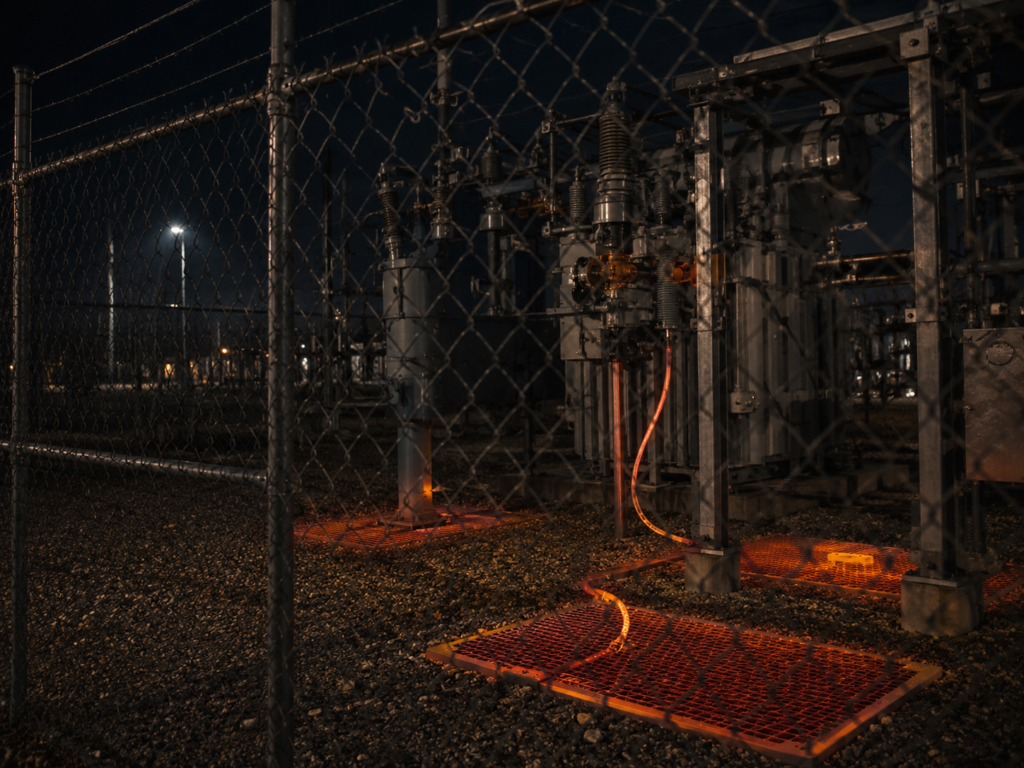
The 2026 threat picture is broader than one historical attack. NorCal utilities have to plan around vandalism, copper theft, unauthorized access, drone overflights, and occasional targeted physical threats while keeping crews, contractors, and switching operations moving. PG&E’s footprint alone runs from Eureka to Bakersfield and from the Pacific Ocean to the Sierra Nevada, with 106,681 circuit miles of distribution lines and 18,466 circuit miles of transmission lines tied back to substations. (PG&E)
That geography matters. A substation near Oakland or San Francisco has a different access profile than a rural site outside Stockton, a Central Valley upgrade near Fresno, a Sacramento-area utility yard, or an industrial corridor site near Concord or Hayward. PG&E, SMUD, Modesto Irrigation District, Turlock Irrigation District, and co-ops all face the same core question: which assets get permanent hardening first, and what protects the risk areas before that capital work lands?
That is where utilities and infrastructure security becomes operational, not theoretical. Mobile surveillance is not the whole answer. It is the rapid, flexible monitoring layer that fits the gap between a fence-only site and a fully hardened facility.
NERC CIP-014, CPUC, CA SB 699, what actually applies to your substation
In brief: NERC CIP-014 is selective by design, CPUC and SB 699 expand state-level attention, and many day-to-day substations still depend on utility-defined risk tolerance.
NERC CIP-014-3 applies to transmission owners with transmission stations or transmission substations that meet defined applicability criteria, including certain facilities operated at 500 kV or higher and certain 200 kV to 499 kV facilities. Its purpose is to identify and protect transmission stations, transmission substations, and associated primary control centers that, if damaged or rendered inoperable by a physical attack, could cause instability, uncontrolled separation, or cascading within an interconnection.
CPUC’s physical-security proceeding R.15-06-009 was initiated in June 2015 after SB 699, and CPUC says California became the first state to adopt rules to safeguard its electric distribution grid against terrorist attack through D.19-01-018 in January 2019. CPUC also states that SB 699 clarified its broad authority over physical security standards for the California electric distribution grid. (California Public Utilities Commission)
| Framework | Scope | What it requires | Gap it leaves |
|---|---|---|---|
| NERC CIP-014 | High-impact BPS transmission stations and substations | Risk assessment, physical security plan, third-party verification | Most distribution substations are out of scope |
| CPUC general safety mandate | Regulated California utilities | Vulnerability assessments, security planning, grid resilience reporting | Does not prescribe a specific monitoring technology |
| CA SB 699 | State-level physical-security alignment | Reinforces California review of physical security risks to electric distribution systems | No new device-level requirements |
| Local and utility-discretion | All other substations | Utility-defined risk tolerance and budget prioritization | Highest variance, where mobile surveillance plays |
Which substations are most at risk in 2026?
“The substations most at risk in 2026 are not necessarily the ones on the NERC CIP-014 list. They are often the ones below it, on quiet rural corridors, where the security spend stops at a fence.”
The practical takeaway is simple: do not treat compliance status as a full security posture. A site can be outside CIP-014 and still matter to local reliability, emergency response, crew safety, and customer continuity.
What mobile surveillance trailers actually do at a substation
In brief: Mobile surveillance trailers add a deployable detection layer for perimeter blind spots, gates, contractor handoffs, copper-theft hot zones, and temporary risk areas.
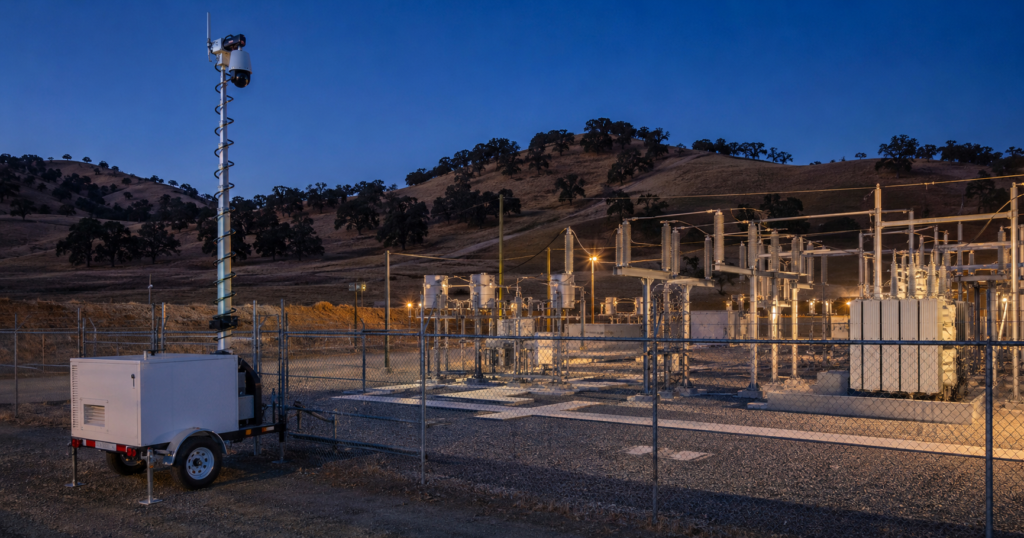
A mobile surveillance trailer is a portable camera, power, communications, and monitoring platform designed to create temporary or semi-temporary visibility without trenching, pole work, or permanent building modifications. At a substation, its job is to supplement the physical-security stack by improving detection, verification, and response around the perimeter.
NERC’s March 2026 voluntary physical-security guidance describes risk reduction as a layered approach that balances threat, vulnerability, and consequence, and that includes deter, detect, delay, and respond functions. It also cautions that criticality is context dependent and should not be confused with CIP-014 definitions. (nerc.com)
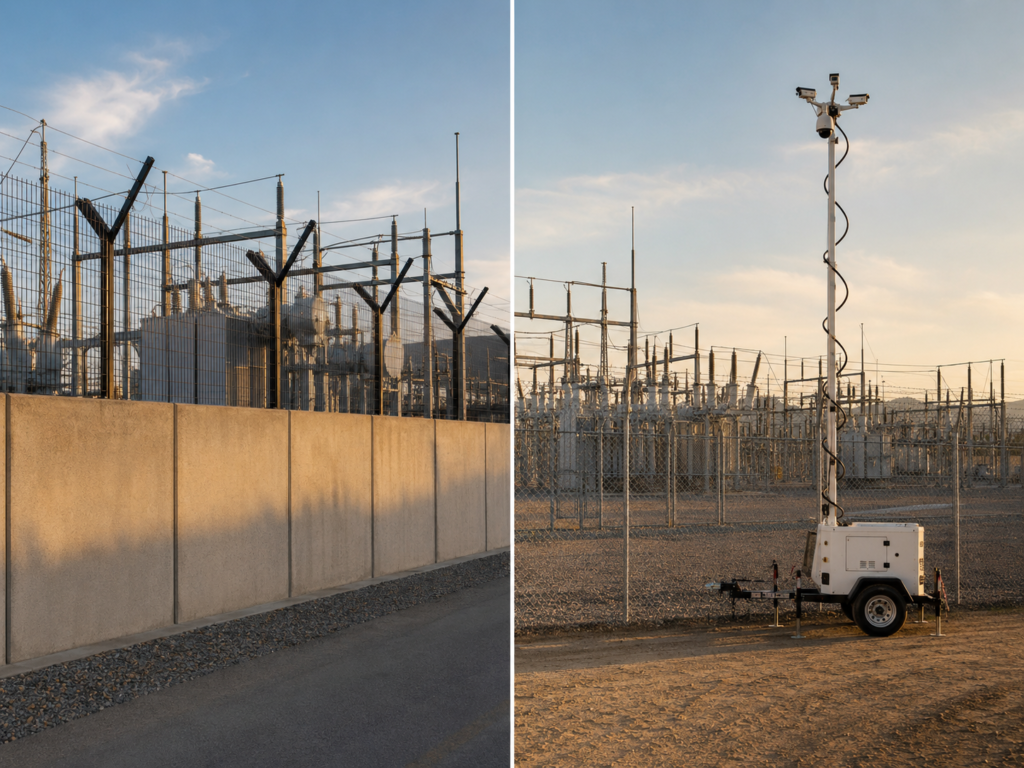
That is exactly the lane for mobile surveillance. A heavy-duty industrial surveillance trailer can sit outside the fence line, near a gate, at a laydown area, or in an equipment staging zone and provide elevated camera views over long perimeters. Thermal cameras help operators detect movement at night without flooding a site with light. PTZ and fixed cameras can be aimed at chokepoints, fence gaps, access roads, and areas where copper grounding conductors or spare materials are exposed.
A solar-powered surveillance trailer also reduces dependence on site power. That matters for substations because temporary security hardware should not complicate switching, commissioning, or energized-work coordination. Where appropriate, the trailer can operate with solar, battery, generator, or hybrid power, and connectivity can be configured around cellular, private networks, or the utility’s own security architecture.
For after-hours operations, 24/7 remote monitoring turns footage into response. The value is not just recording what happened. It is verifying an event, issuing voice-down deterrence where appropriate, escalating to a dispatcher or guard force, and preserving footage for incident review.
Compared with national surveillance providers such as WCCTV, Pelco, SentraCam, or guard-first firms, Hawk’s wedge is NorCal-specific deployment logic: trailers versus guards versus fixed cameras, matched to local utility corridors, construction phases, and remote substations rather than a generic national security package. WCCTV and Pelco both describe substation surveillance use cases, but Hawk’s value is the field deployment model, especially where the site needs rapid coverage without permanent installs. (wcctv.com)
Three deployment scenarios where mobile surveillance pays back fastest
In brief: The fastest wins are interim hardening coverage, commissioning coverage, and temporary response after nearby incidents.
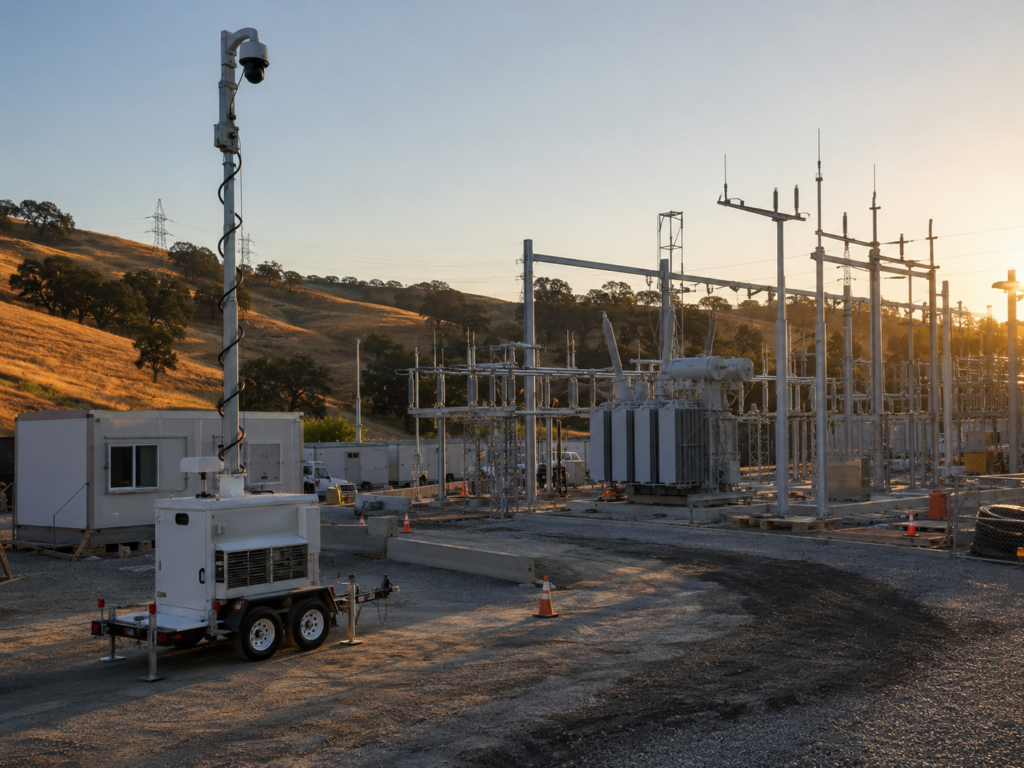
Scenario A: Pre-hardening interim
A substation has been flagged for a wall, fencing, lighting, or access-control upgrade, but the capital project is still in design, procurement, or construction sequencing. A trailer covers the interim. The utility, owner’s representative, or approved security vendor usually owns the contract. The trailer covers gate activity, blind corners, access roads, and exposed work areas. It does not replace the planned hardening project, and it should not be represented as equivalent to ballistic protection.
Scenario B: Commissioning and post-build
An EPC contractor finishes a new build, rebuild, or expansion, and the site moves from contractor control to utility operations. That handover period is a classic visibility gap. Temporary security has to follow the punch list, crew demobilization, spare-material storage, and late-stage testing. A surveillance trailer rental gives the construction manager a defined coverage period without buying permanent equipment that may not belong in the final security architecture.
Scenario C: Active-threat response
A nearby yard, utility corridor, construction site, or unmanned asset sees theft, trespass, or suspicious activity. A trailer can be positioned at the highest-risk perimeter while law enforcement, utility security, and field operations coordinate next steps. This is where how we deploy matters: placement, mast height, camera aim, power, connectivity, escalation rules, and site-access constraints all have to be defined before the system is considered live.
In all three scenarios, the right framing is complement, not replacement. A trailer covers visibility, deterrence, event verification, and escalation. It does not eliminate the need for fencing, lock control, access procedures, lighting design, asset classification, security plans, or utility engineering review.
How this integrates with PG&E / SMUD / co-op security operations
In brief: Trailer integration is possible, but the workflow depends on the utility’s VMS, SOC, network rules, and escalation authority.
Most larger NorCal utilities already run some combination of security operations center, dispatcher, access-control system, camera platform, field response, and mutual-aid coordination. A mobile surveillance trailer has to fit that workflow rather than create a parallel stream nobody owns.
The cleanest model is role clarity. Who receives alerts? Who verifies the event? Who calls law enforcement? Who notifies the switching center or control room? Who has authority to move a trailer if a work zone changes? Who keeps incident footage, and for how long? Those questions are often more important than the camera model.
For PG&E-style operations, this can mean a trailer feed into an approved VMS or monitored dashboard, with event escalation routed through utility security or an approved third-party monitoring center. For municipal utilities, irrigation districts, and co-ops, it may mean a simpler workflow: after-hours alert, verified video, designated call tree, and documented incident report.
WECC-region coordination and mutual aid can matter during storm, wildfire, or multi-site response periods, but mobile surveillance should not be described as a grid-operations system. It is a physical-security monitoring layer. Integration depends on the utility’s VMS, SOC platform, cybersecurity rules, and site-access policy.
Cost framing, what drives substation security pricing
In brief: Substation pricing is driven by site conditions, camera count, monitoring level, contract length, and response workflow, not by a one-size-fits-all trailer rate.
One continuous guard post equals 168 guard-hours per week before backup coverage, supervision, vehicle, and overtime assumptions are added.
That is the cleanest way to compare guard-heavy coverage against a trailer-plus-monitoring model. A guard can walk, interact, inspect, and apply judgment on site. A trailer can cover elevated views, record continuously, trigger analytics, support remote monitoring, and stay in place after-hours without scaling one-for-one with guard hours. The right mix depends on the site.
Key pricing variables include:
- Site size and perimeter length
- Number of cameras and camera types
- Thermal, PTZ, fixed, lighting, speaker, and sensor requirements
- Monitoring tier, self-monitored versus active video monitoring
- Site access, road conditions, gate restrictions, and escort requirements
- Power model, solar, battery, generator, shore power, or hybrid
- Contract length and redeployment expectations
- Reporting, evidence retention, and SOC integration needs
Because these variables differ so widely from site to site, there is no single published “going rate” for NorCal substation security. The most reliable cost figure comes from a site-specific quote that accounts for perimeter length, camera and monitoring requirements, access constraints, and contract length.
Copper theft belongs in this cost conversation because the loss is rarely just the scrap value of copper. At a substation or utility construction site, the real exposure can include repair labor, equipment testing, outage coordination, grounding integrity review, delayed commissioning, and emergency response. For related construction-side context, see Hawk’s guide to construction-site copper theft.
Why is substation security a focus in Northern California?
The 2013 sniper attack on PG&E’s Metcalf substation near San Jose put NorCal substation security under federal and state scrutiny, and it has stayed there. NERC CIP-014, CPUC oversight, and California SB 699 together created a stronger review environment, but many distribution substations still rely on utility-discretion budgets.
Does NERC CIP-014 apply to all substations?
No, NERC CIP-014 applies only to selected bulk power system transmission stations and substations whose loss could cause cascading regional instability. Many NorCal distribution substations are outside that federal standard, which means their security posture is shaped by utility risk tolerance, CPUC-related obligations, local conditions, and budget priority.
Can mobile surveillance trailers protect a substation?
Yes, as a complement to permanent hardening, not as a replacement for it. Mobile trailers add thermal-camera coverage of perimeter blind spots, gate areas, contractor access points, and copper-theft hot zones, and they can be redeployed as risk shifts before, during, or after permanent hardening upgrades.
What's the difference between substation hardening and substation monitoring?
Hardening is permanent infrastructure such as ballistic walls, anti-climb fencing, CPTED layout, access control, and fixed cameras. Monitoring is the active layer on top: live video, alarm verification, escalation, and incident documentation. NorCal utilities typically need both, especially where permanent hardening is planned but not yet complete.
How fast can a mobile surveillance trailer deploy at a substation?
A prepared site can often be covered quickly once trailer availability, access, placement, and monitoring scope are confirmed. The main variables are gated easements, escort requirements, energized-asset restrictions, communications testing, and weather. Multi-site utility rollouts need more planning because each site has different access and safety conditions.
What's the role of copper theft in NorCal substation security?
Copper theft is a recurring utility-security concern because it can compromise grounding conductors, ground mats, and equipment connections, then trigger repair work and outage risk. In Northern California, it belongs in the same operational risk file as vandalism, access control failures, and targeted physical attacks, especially at sites outside NERC CIP-014 scope.
Substation security in Northern California is not solved by one fence, one guard, one camera, or one standard. It is a layered operational program. If your utility, EPC team, or infrastructure site needs temporary coverage before hardening, during commissioning, or after a local incident, Request a quote or talk to a Security Specialist at Hawk Surveillance.
Protect Your Solar Farm Before the Next Copper Theft Hits
Get a site-specific coverage plan with off-grid surveillance trailers, 24/7 monitoring, and fire-season support, no trenching, no permanent install.