
Last updated: July 2026
What self-storage facilities are actually losing
In brief: California storage facilities need to manage several distinct exposures, including forced unit access, cut locks, theft from vehicles or drive aisles, after-hours trespassing, vandalism, gate damage, and incidents at unmanned properties, rather than treating every loss as a single perimeter-security problem.
Self-storage facility security is the coordinated protection of tenant units, buildings, gates, drive aisles, offices, vehicles, and property boundaries. It combines access control, physical barriers, lighting, video surveillance, operating procedures, and monitored response to reduce unauthorized activity and create usable incident records.
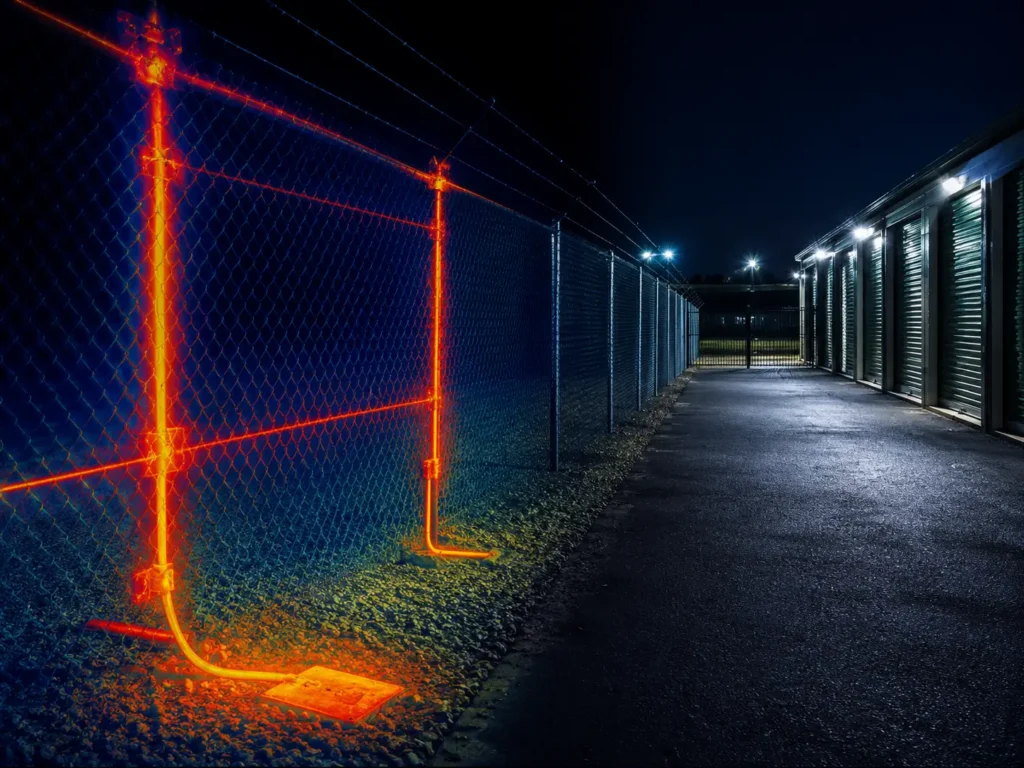
The most important operational distinction is where an incident begins. A person may enter through a damaged fence, follow an authorized vehicle through the gate, remain on site after access hours, approach from an adjoining parcel, or exploit a camera blind spot. The loss may then occur at a unit door, parked vehicle, loading area, payment kiosk, utility enclosure, or management office.
California’s statewide property-crime rate fell 14.3 percent between 2024 and 2025, from 2,082.7 to 1,785.8 reported offenses per 100,000 residents, according to the California Department of Justice’s July 1, 2026 statistical release. The same release warns that not every agency submitted a complete year of 2025 data, so statewide figures should guide context rather than substitute for a facility-level assessment. (California Attorney General)
Operators should review their own gate logs, lock-cut reports, tenant complaints, police calls, lighting deficiencies, damaged fence sections, and camera downtime. Those records identify the facility’s real risk areas more accurately than a broad crime headline.
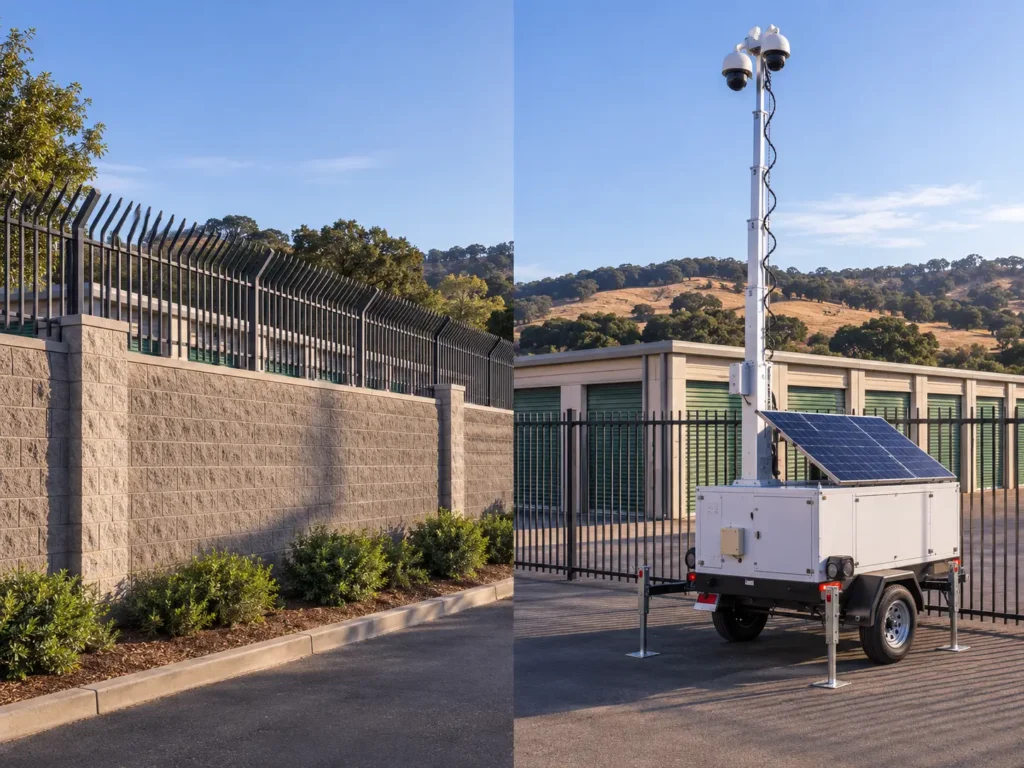
A multi-layered program can then place access control at the gate, quality locking hardware at the unit, fixed cameras inside permanent structures, and a mobile active layer along the outer perimeter. Hawk uses this concentric approach to reinforce retail and commercial-site security where open lots, traffic lanes, gates, and changing risk areas require wider visibility.
Why guards and fixed cameras leave gaps at a storage facility
In brief: Guards and fixed cameras remain useful, but neither automatically provides continuous coverage of every drive aisle, gate, fence line, and remote corner; a mobile trailer fills the outer gaps by combining elevated cameras, visible deterrence, live monitoring, and flexible placement.
A physical guard is strongest when the assignment requires judgment, direct interaction, credential checks, tenant assistance, gate management, or a visible person at an office. The limitation is geographic. One guard can observe only the area within sight or the route being patrolled at that moment. Broader coverage generally requires additional posts, patrols, vehicles, supervision, and relief staffing.
Fixed cameras are usually the right long-term choice for hallways, elevators, indoor unit corridors, reception areas, cash-handling points, and permanent choke points. They operate continuously when correctly installed and maintained. However, a conventional installation may require poles, trenching, conduit, utility power, network infrastructure, permits, and a stable site plan. Cameras can also record an event without producing a live intervention when no one is actively watching alerts.
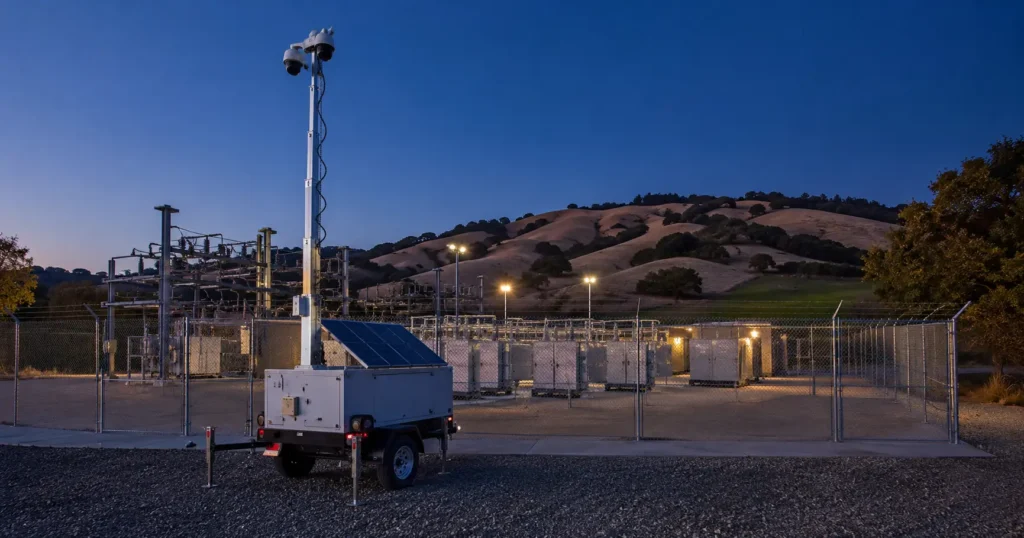
A mobile trailer sits between those models. It does not replace every guard or every camera. It adds an elevated, monitored layer at the gate, perimeter, remote drive aisle, expansion parcel, temporary construction area, or recurring after-hours hotspot.
National providers such as WCCTV, LVT, SentraCam, and Joint Power Security also market mobile monitoring systems. Hawk’s distinction is its Northern California operating focus, local placement support, solar and compact trailer options, and a trailers-versus-guards-versus-fixed-cameras assessment tied to the individual property. The goal is not to displace a useful security layer. It is to cover the space that layer does not reach.
For a closer operating-cost framework, review Hawk’s trailer vs guard cost comparison.
How a mobile surveillance trailer protects a storage facility
In brief: A mobile surveillance trailer protects a storage property by placing elevated fixed and PTZ cameras, independent power, cellular connectivity, live monitoring, and real-time speaker or strobe response at the facility’s most exposed outdoor area without waiting for permanent poles, cabling, or utility work.
A trailer can be positioned to observe a gate approach, primary drive aisle, rear fence, vehicle turnaround, loading area, or adjoining access point. Elevation improves the line of sight across parked vehicles, walls, landscaping, and rows of storage buildings, although actual coverage depends on terrain, building height, aisle geometry, camera selection, and obstructions.
Solar generation and battery storage allow the unit to operate where permanent power is unavailable or impractical. Cellular communications can transmit video and alerts without relying on the facility’s internal network. Hawk’s current solar trailer specifications describe a towable platform with solar power, battery storage, PTZ, fixed and low-light camera options, communications, recording, and monitored operation. (Hawk Surveillance Systems)
With 24/7 remote monitoring, trained personnel can review configured alerts, assess activity, use a speaker or light-based warning when appropriate, follow the escalation plan, and contact the designated site representative or emergency services when the verified situation requires it. Monitoring rules should distinguish normal tenant movement, staff activity, deliveries, animals, weather, and unauthorized behavior.
This model is especially useful at unmanned facilities, remote properties, expansion sites, and lease-up projects where the permanent security system is incomplete. It can also cover a damaged fence section, failed camera zone, temporary access road, or construction phase until repairs or fixed infrastructure are ready.
California operators must configure audio carefully. California Penal Code Section 632 restricts intentional recording of confidential communications without the consent of all parties. Facility owners should keep audio recording disabled unless their legal counsel confirms that the proposed use, notices, consent process, and operating configuration comply with applicable law. (Legislative Information)
Hawk’s guide to trailer privacy and audio law provides additional California deployment considerations.
Which Hawk trailer fits
In brief: The Compact Urban Surveillance Trailer generally fits constrained gates, narrow drive aisles, and customer-facing properties, while the Solar Surveillance Trailer is better suited to large, power-limited, remote, or developing facilities that need longer-range, off-grid outdoor coverage.
Compact Urban Surveillance Trailer
The compact urban surveillance trailer has a smaller footprint for locations where maneuverability, visual appearance, and traffic flow matter. Hawk positions the unit for tight lots, retail centers, municipal locations, and small yards, making it a practical candidate for a storage entrance, office-adjacent lane, compact urban property, or constrained gate area. (Hawk Surveillance Systems)
Its placement must preserve fire access, tenant turning space, accessible routes, emergency egress, and gate operation. Camera views should be tuned around the actual aisle and entry geometry rather than assuming the mast can see through buildings.
Solar Surveillance Trailer
The solar surveillance trailer is the stronger fit for larger properties, remote fence lines, unpowered expansion parcels, construction zones, and facilities where trenching or utility service would delay coverage. Its solar and battery architecture supports operation away from permanent electrical infrastructure. (Hawk Surveillance Systems)
A site assessment should confirm sunlight, seasonal shading, cellular service, mast clearance, ground conditions, wind exposure, and the camera views needed for the operating plan.
Trailer vs guard vs fixed cameras: cost and coverage
In brief: A monitored trailer is generally the middle path between labor-intensive guard coverage and permanent fixed-camera infrastructure, offering active outdoor deterrence and broad redeployable visibility while preserving guards for human interaction and fixed cameras for permanent indoor or highly defined zones.
Verified self-storage-specific monthly cost comparisons were not located in authoritative public sources, so exact guard, trailer, and fixed-installation prices require site-specific quotations.
Security option | Coverage | Active deterrence | Cost profile | Deployment | After-hours operation | Best fit |
Mobile surveillance trailer | Elevated view across selected outdoor zones, gates, aisles, and perimeter gaps | Monitored speaker, strobe, visible mast, live escalation | Rental or service-based operating expense; | Can be delivered and configured without permanent construction | Strong when paired with monitored alerts and an escalation plan | Outdoor facilities, temporary gaps, unmanned sites, expansion phases, changing risk areas |
Physical guard | Direct observation around the assigned post or patrol route | Immediate human presence, judgment, communication, and intervention within policy | Recurring labor, supervision, relief, insurance, and vendor expense; | Staffing depends on vendor availability, post orders, licensing, and onboarding | Strong at the staffed location, but broader coverage may require more personnel | Customer-facing access control, tenant assistance, credential checks, staffed gates |
Fixed cameras | Continuous views at permanently selected locations | Depends on visibility, analytics, speakers, and whether alerts are actively monitored | Capital installation plus network, power, maintenance, and monitoring; | Slower when poles, trenching, cabling, permits, or network work are required | Strong for continuous recording and monitored permanent zones | Indoor corridors, offices, elevators, permanent entrances, stable long-term layouts |
The phrase “guard-level deterrence at camera-level cost” is a positioning concept, not a universal price guarantee. The correct comparison must include the required number of guard posts, monitoring scope, trailer count, installation work, contract duration, maintenance, connectivity, and response procedures.
A trailer often creates value when a facility needs active exterior coverage now but does not need a person performing customer service. A guard wins when direct human interaction is central to the post. Fixed cameras win when the location and coverage need will remain stable for years.
Deployment and monitoring
In brief: Effective deployment starts with a site walk and written escalation plan, followed by trailer placement at the highest-priority entrance, drive aisle, perimeter gap, or remote zone; Hawk then raises the mast, tunes cameras, checks connectivity, tests alerts, and activates monitoring.
The site walk should identify:
- Primary and secondary vehicle entrances
- Pedestrian access points and fence transitions
- Rear alleys, adjoining parcels, drainage channels, and dark approaches
- Buildings or landscaping that obstruct elevated views
- Areas used for loading, parking, dumpsters, utilities, and equipment
- Tenant access hours and legitimate after-hours activity
- Current cameras, lights, alarms, gate logs, and response contacts
Hawk’s published deployment information states that delivery, positioning, mast raising, camera tuning, connectivity checks, and alert testing are part of activation. Its website currently describes many standard Northern California deployments as occurring within 24 to 48 hours, subject to trailer availability, location, access, and site complexity. (Hawk Surveillance Systems)
Once on site, the physical setup itself can be completed in hours. The trailer should be positioned outside normal vehicle paths, stabilized, aimed, connected, and tested before monitoring begins. The operating plan must identify who receives calls, what counts as authorized activity, when speakers may be used, when police or fire services should be contacted, and how video is retained.
Facilities in the Central Valley can review Hawk’s Sacramento-area surveillance trailer support, while Bay Area operators can use the San Jose mobile security service area as a geographic starting point. These location pages support local deployment planning without replacing a property-specific assessment.
Frequently asked questions
How do self-storage facilities stop unit break-ins, drive-aisle and cut-lock theft, after-hours trespassing, and vandalism in California?
A mobile surveillance trailer paired with live remote monitoring can strengthen a California storage facility’s outer security layer by watching selected gates, drive aisles, perimeter gaps, and after-hours risk areas while enabling a trained operator to assess alerts and initiate an approved response. It should support, not replace, controlled gate access, fencing, lighting, quality locks, tenant procedures, indoor cameras, incident reporting, and prompt repairs to damaged barriers.
Is a surveillance trailer cheaper than hiring security guards for a storage facility?
A surveillance trailer can cost less than staffing enough guard posts to observe several outdoor zones continuously, but the result depends on the property layout, operating hours, monitoring scope, trailer count, guard duties, contract term, and local labor rates. A guard may still be the better purchase when the facility needs tenant assistance, credential checks, conflict management, or a staffed gate.
Can one mobile trailer cover a storage facility?
One trailer may cover the principal gate, a long drive aisle, or several connected outdoor zones when the property has clear sightlines, but no responsible provider should promise complete facility coverage without reviewing the site. Building rows, corners, elevation changes, trees, parked vehicles, walls, and camera resolution affect the design. Larger or irregular properties may require multiple trailers, existing fixed cameras, or repositioning to maintain useful coverage.
Do surveillance trailers actually deter break-ins?
A visible surveillance trailer can contribute to deterrence through elevated cameras, lighting, speakers, strobes, signage, and the prospect of monitored intervention, but no security measure can guarantee that an incident will not occur. Its strongest operational advantage is the combination of visibility, detection, live assessment, and response. Operators should judge performance through documented alerts, verified interventions, incident trends, camera uptime, response quality, and coverage of previously unobserved areas.
How fast can Hawk deploy a trailer in California?
Hawk can set up a trailer in hours after it reaches the property and the required placement, access, power strategy, connectivity, and monitoring scope have been confirmed. Hawk’s current website states that many Northern California deliveries and activations occur within 24 to 48 hours, although availability, travel, site conditions, permitting constraints, and deployment complexity can change the schedule. The final timeline should be confirmed in the written proposal. (Hawk Surveillance Systems)
Trailer or fixed cameras for a storage facility: which is better?
A trailer is usually better for outdoor perimeter gaps, temporary risk areas, remote zones, lease-up phases, and properties that need monitored coverage without permanent installation, while fixed cameras are generally better for indoor corridors, offices, elevators, permanent entrances, and stable long-term layouts. Many facilities benefit from both: fixed cameras form the permanent interior layer, and a trailer provides the flexible active outer layer where conditions or coverage priorities change.
Get self-storage security pricing
In brief: California self-storage operators can request a site-specific rental proposal based on property size, drive-aisle layout, gate locations, existing cameras, monitoring hours, response requirements, deployment duration, and the number of outdoor risk areas that need coverage.
Generic package pricing can be misleading because two facilities with the same unit count may have very different sightlines, boundaries, traffic patterns, power access, and monitoring requirements. Hawk begins with the operating problem, then recommends the appropriate trailer, placement, camera package, monitoring workflow, and rental term.
Exploremobile surveillance trailer rental options for Northern California facilities, or get California rental pricing from a Security Specialist.