
Last updated: July 22, 2026
At a glance: A mobile surveillance trailer paired with live monitoring is the most practical security layer for remote Central Valley farms, ranches, equipment yards, pump sites, and seasonal storage areas that lack permanent power or full-time staff. These sites can face organized tractor and heavy-equipment theft, fuel and battery loss, copper and wiring theft, and crop or product theft across dispersed acreage. Guards remain valuable for access control and physical intervention, while fixed cameras are strong for permanent buildings and stable indoor zones. A solar trailer fills the space between them by providing elevated coverage, visible deterrence, real-time audio response, and redeployment without permanent installation. Hawk deploys solar and compact units across the Central Valley, sets them up in hours, and can pair them with monitored response. Talk to a Security Specialist for a site-specific placement and rental plan. (Hawk Surveillance Systems)
What Central Valley farms are actually losing
In brief: Central Valley farms are losing tractors, backhoes, excavators, fuel, batteries, copper wiring, irrigation components, chemicals, crops, and other products, with Operation Tractor Pull alone tying 24 stolen machines worth more than $2.25 million to an organized network operating across the San Joaquin Valley.
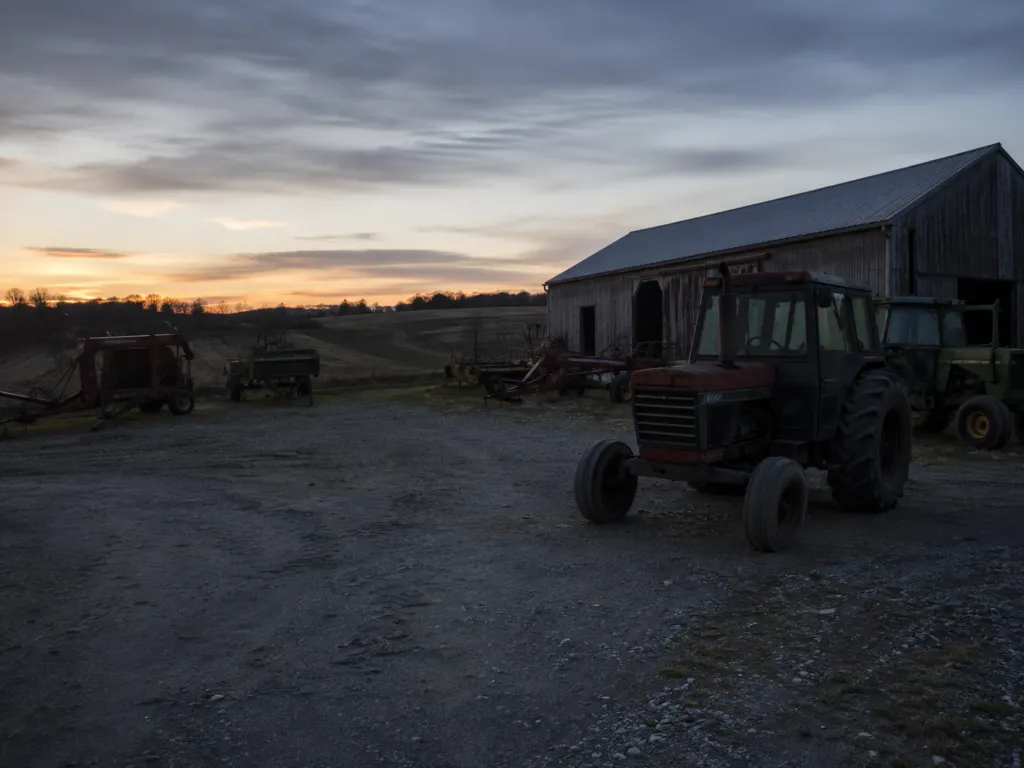
Agricultural theft ranges from fuel and batteries taken overnight to machinery loaded onto trucks, copper removed from pump sites, and product taken from isolated storage. The operating issue is distance: assets sit across fields, yards, roads, sheds, pumps, and fence lines that one building camera cannot cover.
The California Farm Bureau’s Ag Alert report from November 13, 2024 said Operation Tractor Pull identified 24 stolen pieces of equipment valued above $2.25 million. Authorities recovered $1.3 million, arrested seven suspects, and said five remained at large when the report was published. The investigation involved agencies from eight California counties. (Ag Alert)
A National Association of Counties account reported 11 alleged suspects and identified diesel, bee, and copper wire theft among current agricultural crime concerns. (National Association of Counties)
Statewide vehicle data provides context, although it does not isolate farms. The California Highway Patrol’s fiscal year 2021 to 2022 report grouped recreational vehicles, construction and farm equipment, and special construction equipment into a category representing 3.2 percent of reported vehicle thefts. (California Highway Patrol)
Why guards and fixed cameras leave gaps at a farm or equipment yard
In brief: Guards are strongest where a farm needs identity checks, gate control, escorts, or physical intervention, while fixed cameras are strongest on permanent buildings and stable chokepoints; neither option alone efficiently covers changing, powerless, open acreage with multiple after-hours perimeter gaps.
A guard can verify drivers, control a gate, issue passes, and respond physically. A camera cannot do those jobs. The tradeoff is that one person occupies one place at a time, so wider coverage requires more labor or intermittent patrols.
Labor creates the highest recurring cost profile. The U.S. Bureau of Labor Statistics reported a national median annual wage of $38,370 for security guards in May 2024, before supervision, insurance, overtime, and provider margin. Farms should request current local bids. (Bureau of Labor Statistics)
Fixed cameras are often right for packing houses, offices, barns, and stable entrances with power and networking. Adding coverage to a remote pump, leased parcel, or seasonal yard may require poles, trenching, cabling, and installation for a risk zone that later moves.
The answer is layered. Use guards where people must be managed, fixed cameras where infrastructure is permanent, and a mobile trailer as the active outer layer over access roads, perimeter gaps, fuel areas, and machinery clusters.
How a mobile surveillance trailer protects a farm or equipment yard
In brief: A mobile surveillance trailer is a self-contained, elevated camera and deterrence platform that can operate with solar power, cellular connectivity, live monitoring, lighting, speakers, and strobes, giving remote agricultural sites active after-hours coverage without poles, trenching, permanent cabling, or a staffed post.
The trailer supports a concentric security model. Locks, fencing, key control, lighting, GPS, and asset identification protect machinery directly. The trailer watches approaches, gates, perimeter openings, and equipment clusters so activity can be addressed earlier.
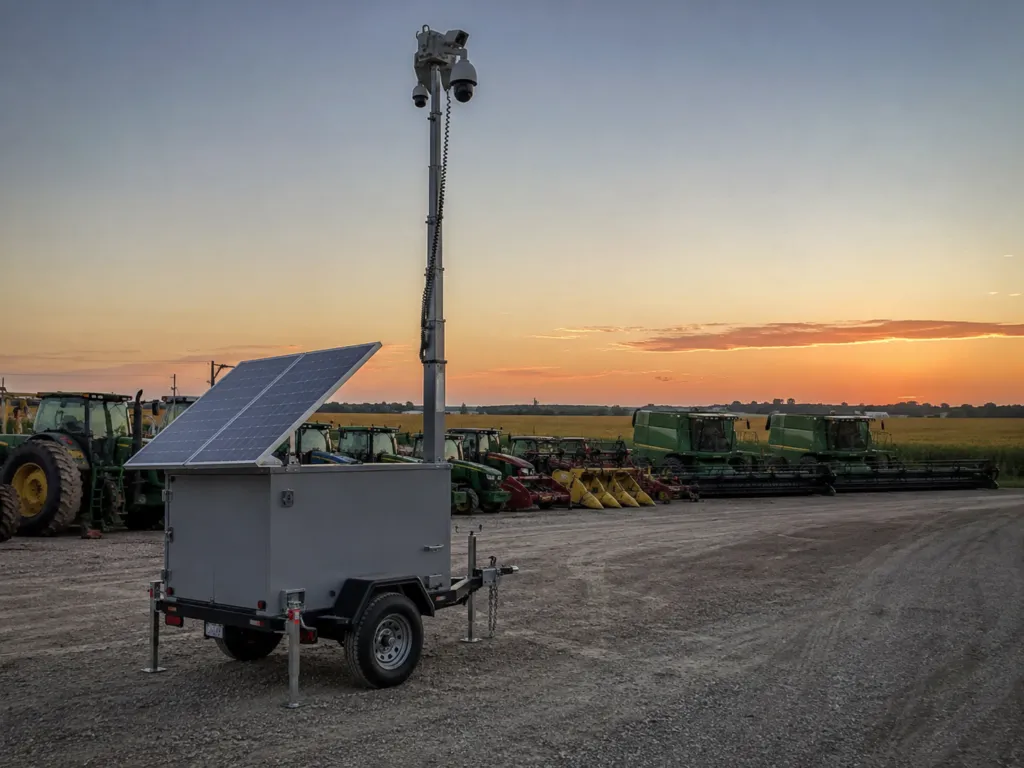
Elevated PTZ and fixed cameras provide overlapping views. Fixed cameras stay on gates or fuel tanks, while PTZ cameras scan wider ground. Low-light capability supports after-hours visibility, and monitored audio allows a live warning under an agreed protocol. (Hawk Surveillance Systems)
Solar power suits fields, pumps, orchard edges, and overflow yards without convenient electrical service. The trailer can move when planting, harvesting, or storage priorities change. Hawk uses the same logic for utilities and remote infrastructure security, where dispersed assets make permanent coverage difficult. (Hawk Surveillance Systems)
Technology should reinforce controls. The Fresno County Sheriff’s Agricultural Crime Task Force investigates theft involving crops, livestock, equipment, irrigation systems, chemicals, and metals, and supports Owner Applied Numbers for property marking. (Fresno County Sheriff-Coroner’s Office)
The Sheriff’s rural crime prevention guidance specifically recommends marking tractors, implements, pumps, motors, tools, machinery, chemical containers, utility trailers, and equipment with a traceable Owner Applied Number. Pairing that identification layer with cameras, rekeying, locked storage, and access control improves both prevention and recovery workflows. (Fresno County Sheriff-Coroner’s Office)
Which Hawk trailer fits
In brief: Choose the solar model for remote fields, orchards, pump sites, and equipment yards where off-grid runtime matters most; choose the industrial model for dusty, uneven, heavy-duty sites that need a reinforced platform, a tall mast, broader payload capacity, and sustained operation.
The solar surveillance trailer is the default fit for remote agricultural zones with little or no permanent power. Its self-contained solar and battery architecture supports cameras, communications, recording, and optional lighting while avoiding generator-only logistics. (Hawk Surveillance Systems)
The heavy-duty industrial surveillance trailer fits rough yards, dust, vibration, demanding power loads, and larger equipment zones, especially where repeated towing and repositioning are expected. (Hawk Surveillance Systems)
Hawk’s Fresno rental coverage and Stockton deployment support provide local starting points. Related guidance covers mining and quarry surveillance for remote equipment and copper wire theft prevention for exposed material. (Hawk Surveillance Systems)
National providers such as WCCTV and LVT also publish off-grid mobile surveillance options for remote agricultural or energy sites. Hawk’s distinction is Northern California deployment support, local site placement, a trailer-versus-guard-versus-fixed-camera analysis, and monitoring configured around the farm’s actual operating windows rather than a one-size program. (WCCTV)
Trailer vs guard vs fixed cameras (cost and coverage)
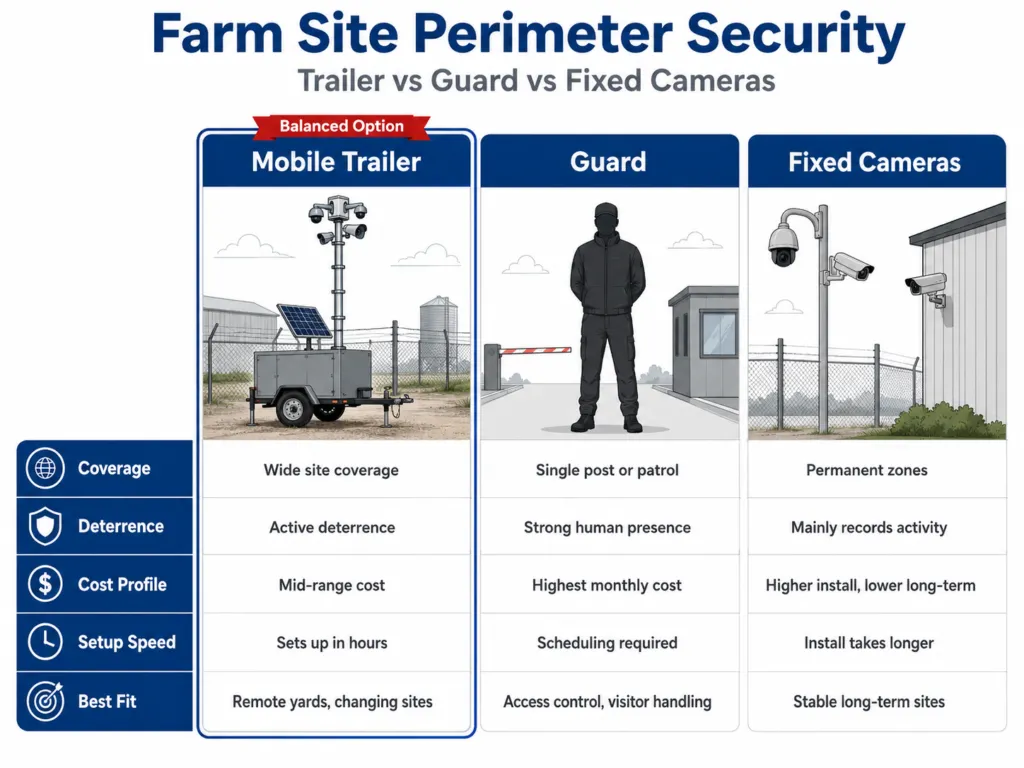
In brief: A monitored trailer is the middle path between a guard and fixed cameras, offering broad, visible, redeployable after-hours coverage and live intervention without the highest labor profile of a staffed post or the permanent infrastructure required by a complete fixed-camera buildout.
Factor | Mobile surveillance trailer | Physical guard | Fixed cameras |
|---|---|---|---|
Coverage | Elevated views across gates, yards, approaches, and open perimeter zones | Strong at one post or along a patrol route | Strong where cameras are permanently placed |
Deterrence | Visible mast, lighting, strobe, speaker, and live voice response | Visible human presence and physical intervention | Visible cameras, usually passive unless actively monitored |
Cost profile | Rental or service cost, site-specific pricing required | Highest recurring labor profile, local bid required | Higher installation cost, lower long-term cost on stable sites |
Deployment speed | Sets up in hours after planning and access are confirmed | Depends on provider staffing, licensing, training, and scheduling | Depends on design, power, networking, permits, and installation |
After-hours use | Consistent monitoring across programmed zones | Effective but affected by post location and patrol timing | Continuous recording where power and network remain available |
Best fit | Remote, changing, temporary, seasonal, or powerless risk areas | Access control, escorts, visitor management, physical response | Permanent buildings, indoor areas, stable gates, long-term layouts |
Hawk’s comparison places monitored trailer rental below a continuously staffed guard post, but farm pricing depends on cameras, monitoring, connectivity, placement, and duration. Compare a current mobile surveillance trailer rental quote with a current guard bid. (Hawk Surveillance Systems)
A packing operation may keep fixed cameras inside, use a guard at the truck gate during active hours, and place a trailer at the equipment yard after hours.
Deployment and monitoring
In brief: Effective deployment starts with a site walk and a risk map, then places the trailer where one elevated position can watch an entrance, access road, equipment cluster, fuel point, or perimeter gap while preserving safe towing access, solar exposure, cellular connectivity, and unobstructed camera views.
Hawk reviews schedules, assets, approach paths, lighting, fences, gates, existing cameras, and response expectations. The plan defines what must be detected, identified, or watched continuously.
Delivery includes positioning, stabilization, mast raising, camera aiming, connectivity checks, recording verification, analytic-zone setup, and response testing. Standard configurations set up in hours, subject to availability, access, ground conditions, and connectivity. (Hawk Surveillance Systems)
With 24/7 remote monitoring, operators review alerts, verify activity, use strobe or speaker tools when the protocol allows, document the event, and escalate to the farm contact, mobile response, or law enforcement according to the approved plan. Farms with an internal security team can also integrate live feeds into their existing workflow. (Hawk Surveillance Systems)
Frequently asked questions
In brief: The right farm site security plan for remote operations combines mobile monitored coverage with locks, lighting, asset marking, key control, fencing, and clear response procedures, then assigns guards or fixed cameras only where their specific strengths justify the added labor or infrastructure.
How do farms and ranches stop organized tractor and heavy-equipment theft, fuel and copper theft, and crop/product theft on remote sites in Central Valley?
Is a surveillance trailer cheaper than hiring security guards for a farm or equipment yard?
Can one mobile trailer cover a farm or equipment yard?
Do surveillance trailers actually deter tractor and heavy-equipment theft?
How fast can Hawk deploy a trailer in Central Valley?
Trailer or fixed cameras for a farm or equipment yard: which is better?
A trailer is usually better for remote, temporary, changing, seasonal, or powerless farm zones, while fixed cameras are usually better for permanent buildings, indoor processing areas, stable gates, and sites with dependable power and networking, and many operations use both. Fixed cameras protect the core facility, and a mobile unit closes perimeter or equipment-yard gaps that move over time. See Hawk’s trailer and fixed-camera comparison.
Get Central Valley farm security pricing
In brief: Central Valley farm security pricing depends on the site layout, trailer model, camera package, monitoring hours, connectivity, rental term, deployment distance, and required response level, so the next step is a site-specific quote rather than a generic statewide price.
Share the farm or yard location, priority equipment, operating schedule, known perimeter gaps, available power, existing cameras, and desired start date. Hawk can recommend the trailer model, placement, monitoring workflow, and whether a hybrid plan with guards or fixed cameras is more appropriate.
Talk to a Security Specialist or get Central Valley rental pricing for an off-grid farm, ranch, pump site, equipment yard, or seasonal storage area.