

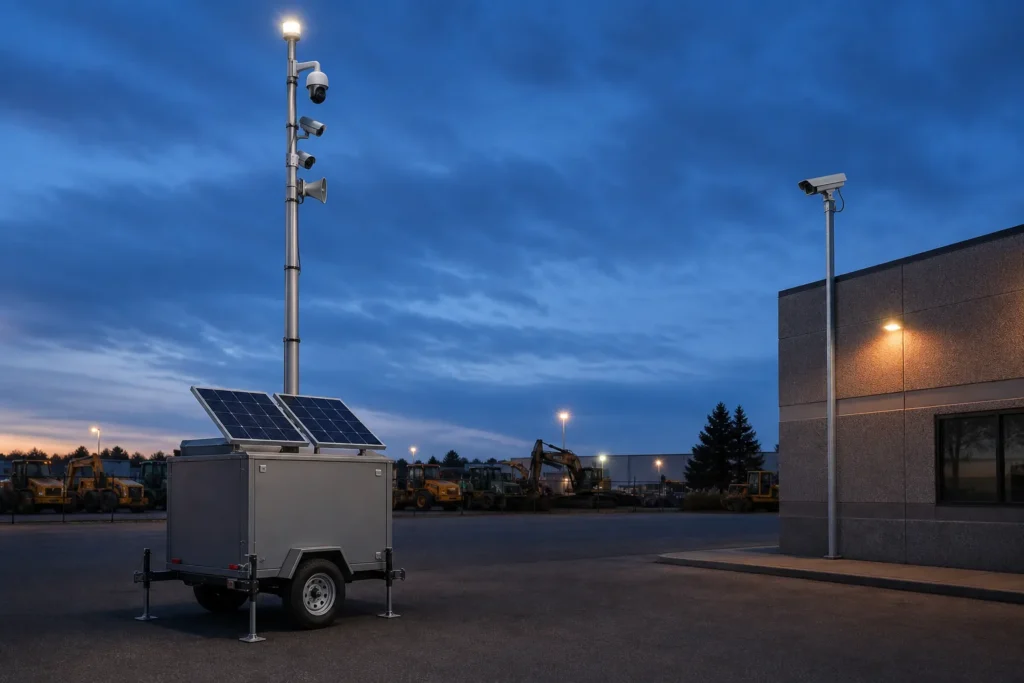
At a glance: A mobile surveillance trailer is usually the stronger fit for a temporary, changing, open, or power-limited commercial or construction site that needs active monitoring and visible response. Fixed security cameras usually win for permanent indoor areas and stable long-term views. A guard is still valuable where people need access control, directions, or immediate on-site judgment. The trailer sits between those options as a redeployable, monitored outer layer in a concentric security plan, while fixed cameras protect stable inner zones. Hawk deploys solar and compact rental trailers across Northern California, with standard units setting up in hours after scope, placement, access, and availability are confirmed. Talk to a Hawk Security Specialist to compare coverage for your site.
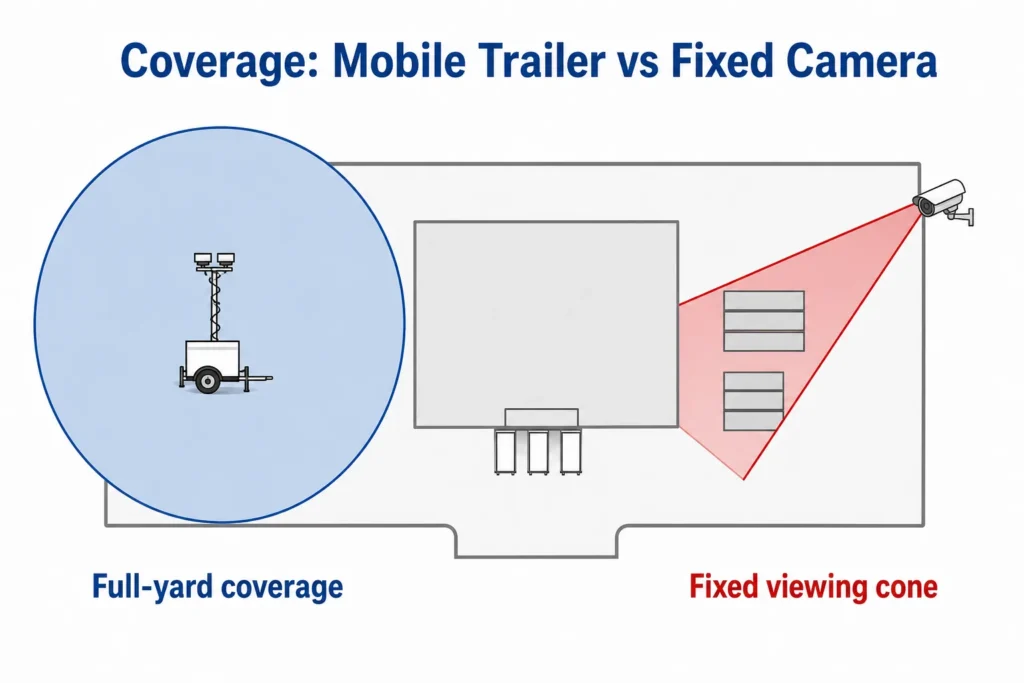
The real trade-off: fixed cameras vs a mobile trailer
In brief: Choose fixed cameras when your site and viewing angles will stay stable for years, and choose a mobile trailer when the footprint, power access, perimeter, or response needs can change; the right decision follows the operating life of the site, not a blanket claim that one technology always wins.
Start with five questions. How long will the layout last? Are power and data available? Are priority views indoors or along an open perimeter? Does the team need live response or recorded footage? What is the full cost after installation, monitoring, maintenance, and relocation?
Northern California operators have real exposure to mobile assets, but public data should not be misread as a jobsite loss forecast. The California Highway Patrol’s 2024 vehicle theft fact sheet reports that the San Francisco Bay Area accounted for 25.36 percent of statewide vehicle thefts, while the Central Valley accounted for 11.31 percent. The same report classifies 6.04 percent of stolen vehicles as commercial trucks and trailers, plus 6.40 percent as other vehicles, a group that includes construction and farm equipment. These figures describe regional vehicle theft, not the loss rate at any specific property.
For a short project with moving gates and no permanent power, a mobile surveillance trailer rental avoids designing fixed infrastructure for a temporary footprint. For a finished warehouse interior with stable aisles and existing network paths, fixed cameras are usually the cleaner long-term choice.
Why guards and fixed cameras leave gaps at your site
In brief: Guards, fixed cameras, and trailers each leave different gaps: guards concentrate skilled human attention at one post, fixed cameras concentrate coverage within installed angles, and trailers concentrate mobile technology in an elevated footprint, so a layered plan assigns each option to the job it performs best.
A guard can verify credentials, speak with drivers, manage visitors, notice context that software may miss, and provide immediate human judgment. Those strengths make guards a strong fit for customer-facing entrances, staffed gates, delivery coordination, and sites where policy requires a person. The trade-off is that one guard cannot remain at a gate and patrol every perimeter edge at the same time, while continuous staffing carries the highest recurring cost profile.
Fixed cameras keep watching their assigned views without breaks. They work especially well at permanent entrances, interior corridors, production lines, loading doors, and other stable zones. They do not automatically provide live intervention unless the system includes analytics, monitoring, audio, and a response workflow. The federal Office of Justice Programs summary of a CCTV systematic review found a significant but modest association with crime reduction, with larger effects for actively monitored systems and programs that combined cameras with other measures.
That evidence supports layered design, not an all-or-nothing choice. Hawk’s earlier comparison of trailer vs guards ROI can help teams examine the guard side of the decision without assuming that technology replaces every human role.
“A point guard is very effective at the position they are assigned to. The operational advantage of a mobile trailer is that elevated cameras and live monitoring can watch the wider site, then direct attention to the area that actually needs a response.”
Paul Wittner, Hawk Surveillance Systems
How a mobile surveillance trailer protects your site
In brief: A mobile surveillance trailer protects a changing outdoor site by combining elevated camera views, independent power, cellular connectivity, event detection, and operator-controlled lights or speakers in one movable platform, giving the site an active outer layer without waiting for permanent poles, trenching, or network construction.
The elevated mast improves views across gates, fence lines, parking areas, laydown yards, and equipment zones. Solar generation and battery storage support sites without commissioned power, while cellular connectivity carries video and alerts without a finished network. Placement still matters: buildings, containers, vegetation, terrain, and equipment can block views, so no parking spot guarantees full coverage.
Monitoring changes the system from a recorder into an active workflow. With 24/7 remote monitoring, an event can be reviewed against site rules, followed by a strobe or speaker warning, notification to the site contact, or dispatch according to the agreed protocol. The objective is verified, proportionate response, not noise from every motion event.
National providers such as WCCTV’s solar surveillance trailer program and LVT’s mobile security units also combine solar power, cellular connectivity, elevated cameras, and active deterrence. Hawk’s fit is Northern California rental deployment, placement, repositioning, and concierge-level monitoring coordination. Compare service area, response protocol, equipment, and field support, not just the trailer silhouette.
In a concentric plan, the trailer serves as the mobile active outer layer. Fixed cameras can remain on permanent inner zones, access systems can control doors and gates, lighting can improve visibility, and a guard can manage people where human interaction is essential. The layers complement one another
Which Hawk trailer fits
In brief: Choose Hawk’s Solar Surveillance Trailer for open or power-limited sites, the Compact Urban Surveillance Trailer for constrained paved locations, and fixed cameras for permanent indoor or long-term fixed views; trailer selection should follow footprint, available power, traffic flow, monitoring needs, and expected project duration.
The solar surveillance trailer fits remote construction, infrastructure corridors, logistics yards, and outdoor properties where a mast, battery storage, and independent power reduce reliance on unfinished site infrastructure. Its larger visual presence and off-grid design suit open areas where coverage may need to move as work progresses.
The compact urban surveillance trailer fits paved lots, tight urban projects, retail edges, and space-constrained commercial properties where traffic lanes, fire routes, pedestrian paths, and appearance affect placement. A site walk should confirm turning room, clearances, stable ground, and useful camera sight lines.
For a permanent interior, a completed building, or a fixed gate that will remain unchanged, a properly designed fixed-camera system can be simpler and more economical over a long operating life. Hawk trailers are rental assets for the mobile and temporary portions of the security plan. For regional availability, see Sacramento surveillance trailer rentals.
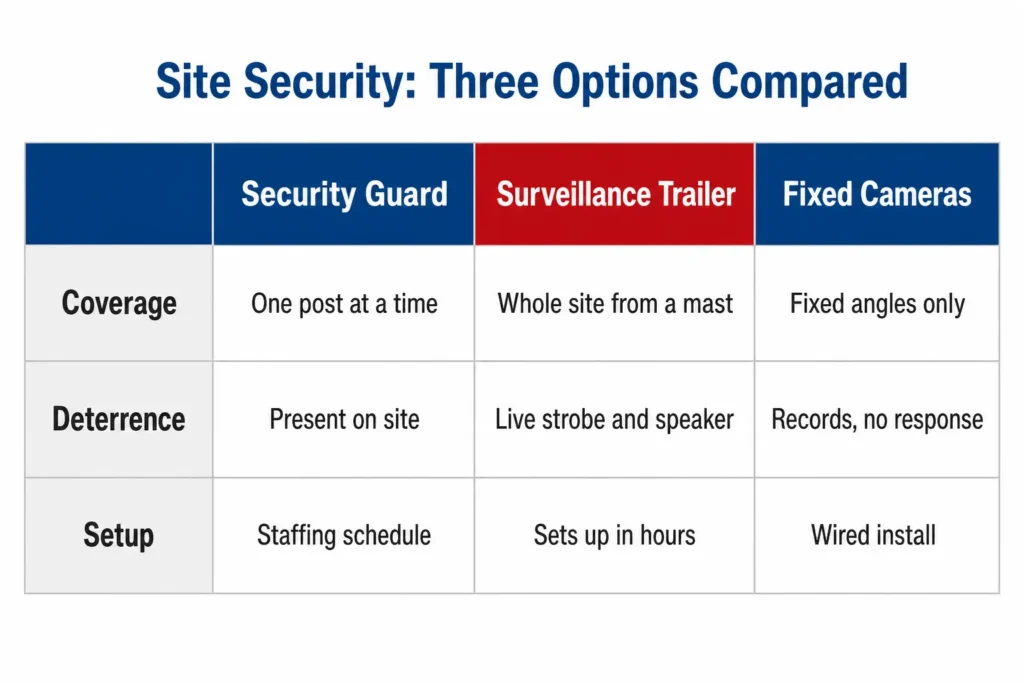
Trailer vs guard vs fixed cameras (cost and coverage)
In brief: A monitored trailer is the operational middle path for many open commercial sites: it costs less to sustain than a continuously staffed guard post, offers more active response than passive fixed cameras, and remains movable, while guards and fixed systems retain clear advantages in the specific roles shown below.
| Factor | Mobile surveillance trailer | Physical guard | Fixed security cameras |
|---|---|---|---|
| Coverage | Elevated outdoor views across a broad site, subject to placement and obstructions | Strong attention at one post or patrol route, but not everywhere at once | Reliable coverage inside installed viewing angles |
| Deterrence | Visible mast, strobe, speaker, and monitored intervention | Visible human presence with immediate judgment | Visible camera presence; live warning requires added monitoring or audio |
| Cost profile | Middle recurring profile for rental, technology, and monitoring | Highest recurring profile because continuous coverage requires staffing | Lowest upfront profile for a limited camera scope; power, cabling, monitoring, and response are separate |
| Deployment speed | Sets up in hours after scope, access, safety, and availability are confirmed | Depends on recruiting, scheduling, post orders, and supervision | Depends on design, mounting, power, cabling, network, and commissioning |
| After-hours | Continuous video with operator review and an agreed escalation plan | Active presence during staffed hours | Continuous recording; response requires monitoring or another integration |
| Best for | Temporary, open, off-grid, changing, or perimeter-focused sites | Customer-facing access control, visitor management, and on-site judgment | Permanent indoor areas, stable entrances, and long-term fixed views |
A trailer is the middle path: a visible, responsive presence closer to a guard, with a technology cost profile closer to cameras. It cannot admit drivers, repair a fence, or provide physical intervention. Fixed cameras remain least disruptive where power and network paths already exist.
Deployment and monitoring
In brief: Deployment starts with a site walk and response plan, then places the trailer where its elevated views can cover entrances, perimeter gaps, access routes, and outdoor asset areas without interfering with traffic or work; Hawk can set up in hours once scope, access, safety, and availability are confirmed.
The site walk should map outer boundaries, vehicle and pedestrian entrances, material storage, high-value equipment, delivery paths, work fronts, existing cameras, lighting, neighboring properties, and likely obstructions. Placement must preserve fire access, traffic flow, overhead clearance, safe stabilization, and a clean line of sight. Camera angles and detection zones are then tuned to the site’s operating hours and permitted activity.
Monitoring begins with rules. Hawk and the client define authorized people and vehicles, risk windows, notification contacts, when a strobe or speaker may be used, when to call a supervisor, and when an operator may request dispatch. This concierge-level approach gives the monitoring team enough site context to review an event before escalating it.
Deployment is also a lifecycle. As construction phases move, gates change, or inventory shifts, the trailer and camera views can be repositioned. At project close, Hawk removes the rental instead of leaving permanent infrastructure that no longer matches the site. Hawk’s published trailer vs guard cost guide confirms that a standard unit can set up in hours, but constrained access, complex integrations, multiple trailers, or special safety requirements can extend planning time.
Frequently asked questions
In brief: The answer depends on site duration, infrastructure, geometry, and who must respond: the questions below separate temporary from permanent coverage, active monitoring from passive recording, and single-site technology from layered security, so teams can choose a trailer, fixed cameras, or both for the right operational reason.
Is a mobile surveillance trailer better than fixed security cameras?
A mobile surveillance trailer is usually better for a temporary, changing, open-perimeter, or power-limited site that needs live deterrence, while fixed security cameras are usually better for permanent indoor or long-term views where cabling and mounting infrastructure already make operational sense. The deciding factors are site duration, power, camera geometry, monitoring, and whether the coverage must move with the work.
When are fixed security cameras the better choice?
Fixed security cameras are the better choice when the property is permanent, camera angles will remain useful, reliable power and data paths are available, and the goal is continuous coverage of stable entrances, interior corridors, production areas, or other defined zones for years. They also fit locations where a small number of fixed views can solve the problem without adding a mobile platform.
When is a mobile surveillance trailer the better choice?
A mobile surveillance trailer is the better choice when the site is temporary, off-grid, open around the perimeter, or changing by phase, especially when operators need elevated views, live event review, and strobe or speaker intervention without a permanent camera installation. Its value rises when camera positions must follow gates, storage zones, or work fronts during active construction as the layout changes.
Is a trailer cheaper than installing a fixed camera system?
A trailer is often less costly than building a permanent fixed system for a temporary or changing site because it avoids some pole, trenching, power, and cabling work, but a small fixed-camera installation may have the lower upfront cost when suitable infrastructure already exists. Compare the whole operating period, including installation, monitoring, maintenance, relocation, response, and removal, instead of comparing camera hardware alone
Can you use a trailer and fixed cameras together?
Yes, a trailer and fixed cameras can work together as concentric layers: fixed cameras can watch stable indoor areas and permanent gates, while the trailer covers the changing outdoor perimeter, temporary access routes, and risk areas that move with site operations over time. The monitoring protocol should define which system detects, verifies, records, warns, and escalates each type of event after hours.
How fast can a mobile surveillance trailer be deployed?
A standard mobile surveillance trailer can set up in hours after scope, access, placement, safety, connectivity, and availability are confirmed, because the cameras, power, communications, mast, and deterrence equipment arrive together on one platform instead of being assembled as a permanent site system. More complex sites may require additional planning for traffic, clearances, overlapping views, or integration with an existing security center.
Not sure which fits your site? Talk to a specialist
In brief: If your site is temporary, open, power-limited, or changing by phase, Hawk can map the perimeter, compare a trailer with your existing cameras and guard coverage, and recommend a rental and monitoring plan that fits the actual operating window without forcing permanent infrastructure into a short-term need.
Bring the site address, operating hours, project duration, current camera plan, access points, available power, after-hours contacts, and any known perimeter gaps. Hawk can then recommend whether the job calls for a solar trailer, a compact unit, fixed cameras, a guard, or a layered combination.
Get NorCal rental pricing for a mobile surveillance trailer rental, or Talk to a Security Specialist about site placement and monitoring.