

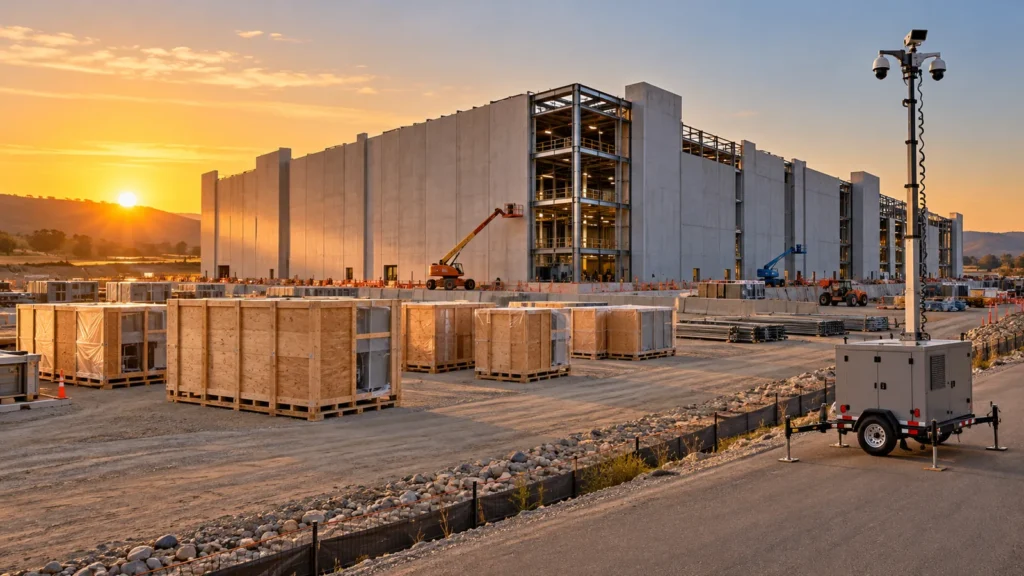
Why data center sites are different
Plan data center construction site security around electrical equipment, changing access and the interval before permanent protection is ready. A finished-looking shell does not tell you who controls its entrances or receives an alert. The general contractor and owner representative should check those responsibilities against the actual construction schedule.
The California Energy Commission’s data center overview describes dedicated power and cooling systems, including backup generation. For site planning, that means looking beyond tools and vehicles to delivered electrical assemblies, cable storage and the routes used to bring equipment inside. Ask each trade what is arriving, where it will wait and who takes custody.
The local context is substantial. In its October 6, 2026 council report, the City of Santa Clara reported “56 stand-alone data centers active or under construction and two approved but not yet built.” That combined category should not be read as a count of operating facilities.
On a long project, the original security drawing can become outdated while it still looks orderly on paper. Review it against current delivery routes, temporary openings and work areas shared by multiple trades. A crew’s need for access should have a defined approval process, including work outside normal hours.
Temporary security by construction phase
A data center construction site carries some of its highest-value equipment, switchgear, generators and copper, before the building’s permanent security system is commissioned, so temporary coverage has to protect each phase until handover. Use the following phase review to assign coverage and acceptance responsibilities. If you are writing the site’s plan from scratch, our construction site security plan template sets out the same responsibilities in document form.
| Phase | The risk | Temporary coverage | Hands off to |
|---|---|---|---|
| Site clearing and civil | Open boundaries, parked plant and changing haul-road access | Define controlled entry, check temporary fencing and place camera views on access and equipment parking | General contractor’s site lead, with a revised plan before shell work changes the boundary |
| Building shell | New doorways, loading openings and material stacks interrupting earlier views | Reassess entrances and storage; relocate temporary coverage before the old view becomes obstructed | Shell and interior leads, with current access arrangements documented |
| MEP and equipment delivery | Cable reels, electrical assemblies and generators waiting for placement or installation | Cover receiving and laydown areas; control delivery windows, storage access and inventory handoffs | Receiving lead and responsible trade; owner security representative for accepted areas |
| Commissioning | Testing crews, extended working hours and areas with different security readiness | Keep agreed temporary zones active; update authorized activity and test the alert contact chain | Owner security lead after documented, area-specific acceptance |
| Handover | Coverage removed while punch-list access or outdoor storage remains | Retain coverage for unresolved areas; verify the replacement arrangement before scheduling pickup | Owner’s designated security operator, with contractor responsibilities closed or expressly retained |
Source: Hawk Surveillance site practice. General guidance.
MEP means mechanical, electrical and plumbing. These phases can overlap; the table is a review framework, not a required construction sequence. A campus may have one building in commissioning while another still needs civil-work coverage. Mark each area’s status separately rather than giving the whole site one handover date.
Copper, cable and equipment deliveries
Protect deliveries with a controlled receiving process, secure laydown space and camera views that show movement into and out of storage. Assign a person to receive each shipment and reconcile it with the delivery record. Footage supports that record; it does not replace checking quantities, identifiers or custody.
A 2010 U.S. Department of Energy assessment documented copper-wire theft from spools at unsecured construction and storage sites. It illustrates an established exposure, not today’s theft rate for data centers. Our guide to copper wire theft on Bay Area sites covers related jobsite precautions.
Before an electrical shipment arrives, settle these practical details:
- Receiving: Confirm the delivery window, gate, receiving contact and approved destination with the responsible trade
- Storage: Choose an access-controlled laydown location that follows the supplier’s handling and storage instructions
- Documentation: Record quantities, equipment identifiers, visible condition, arrival time and the person accepting custody
- Camera view: Check that the receiving route and storage access remain visible after the shipment is stacked
- Exceptions: Define who approves a late arrival, relocated shipment or collection by another subcontractor
Record the movement into installation as carefully as arrival. If a reel or crate is missing, the team needs to distinguish an authorized transfer from an unexplained removal. Keep inventory details in the project record and share access only with people who need them.
Coordinating with the permanent security program
Make temporary-security removal an acceptance decision for named areas, not an automatic consequence of a construction milestone. Agree who confirms the replacement coverage, who receives its alerts and who approves pickup. Keep the temporary arrangement in place for unresolved areas until the responsible owner has approved a workable transition.
Build a short handover record with the owner representative, general contractor and permanent security lead. For each temporary view, identify the gate, yard or entrance it protects and the arrangement that will assume that responsibility. Include the following hold points:
- Confirm the replacement view or access procedure is ready for the intended area and operating hours
- Check who receives and handles alerts, with a test and a named backup
- List remaining gaps, punch-list work and outdoor materials that still require temporary coverage
- Have the owner representative and responsible security lead record acceptance and the approved removal date
Agree those sign-off roles at project setup; actual authority follows the project’s assigned responsibilities. During phased occupancy, draw a clear boundary between accepted space and active construction. Keep contractor entry and delivery instructions current on both sides. Commissioning activity alone should not be treated as confirmation that the security handover is finished.
Monitoring and response
Temporary cameras need an agreed process for reviewing activity and escalating concerns during the coverage window. Where our managed monitoring service is included, sites are monitored through our monitoring partner. Confirm the hours, authorized work, contact order and emergency routing before treating the camera deployment as a complete response arrangement.
Keep the escalation list short enough to use during an incident:
- The site address, agreed gate names and access instructions for responders
- The first available site contact, a backup and the owner representative
- The authority responsible for approving after-hours work and delivery exceptions
- The procedure for urgent assistance, routine notifications and equipment faults
- The person responsible for recording the event and preserving relevant footage
Test a routine alert with the assigned contacts and document the result. Confirm local emergency routing separately; urgent requests for emergency help should not wait for an internal callback chain. Do not ask workers to confront a suspected intruder. Update the monitoring contact when testing crews or late deliveries change the expected activity.
If the owner already staffs its own monitoring function, discuss the customer-operated approach described under live professional monitoring. Decide explicitly which party reviews each temporary feed.
How we help
We start with a site walk and current drawings to match temporary camera positions to your gates, storage and phase changes. Hawk Surveillance supports Northern California rentals, with monitoring arranged through our monitoring partner when included. The placement discussion should also identify power, connectivity, safe access and the planned handover.
For a surveillance trailer rental from our Northern California fleet, we deliver, position and activate a trailer within 24 to 48 hours in most cases. Units configured or built to a site’s requirements are scheduled at survey. Bring the delivery schedule when discussing construction jobsite security, including any external equipment areas relevant to utility and infrastructure security.
Frequently asked questions
Use these answers to check the construction plan with the people responsible for deliveries, site access and security acceptance. Each decision needs a location, an owner and a review point. Confirm arrangements against the current drawings rather than assuming a generic camera layout will suit every phase.
How do you secure a data center construction site?
Secure a data center construction site with controlled access, protected storage, appropriate camera coverage and a defined response procedure. Start with the assets and work areas in the current phase, then assign responsibility for receiving deliveries, closing gates and handling alerts. Review the plan when storage or access changes. Keep temporary coverage in place until the owner accepts the replacement arrangement for each area.
When does permanent security take over on a data center project?
Permanent security should take over when the responsible owner accepts the agreed coverage and operating responsibilities for the area concerned. Building enclosure, equipment energization and commissioning dates are not substitutes for that decision. Record the acceptance owner, tested alert contacts, unresolved gaps and temporary-unit removal date. On phased projects, keep separate handover records for completed space, active construction and any outdoor laydown areas still in use.
What gets stolen from data center construction sites?
For prevention planning, include copper cable, tools, portable equipment and stored electrical components in the inventory at risk. This is not a measured ranking of items stolen from data centers. Review what the actual project holds, including components awaiting installation and equipment parked outside. Record identifiers and custody, secure storage and investigate unexplained inventory differences. The asset list should change as deliveries arrive and materials move into installation.
Can camera trailers cover a large construction site?
Camera trailers can provide temporary views across selected areas of a large construction site, but coverage depends on placement and site conditions. Buildings, stacked equipment and changing work zones can obstruct views. Identify what each camera must show, check it in the intended lighting conditions and mark uncovered areas. A site survey determines whether additional positions or other controls are needed; acreage alone does not establish coverage.
How do you protect equipment deliveries on a jobsite?
Protect equipment deliveries by controlling arrival, receipt, storage and later movement into installation. Give the delivery team an approved window, gate and receiving contact. Check quantities and identifiers, record who accepts custody and place materials in the agreed secure location. Review the receiving and storage camera views after unloading. Handle late arrivals through an exception process so an unexpected truck is not admitted solely because it resembles a scheduled delivery.
Do data center sites need security before the building is enclosed?
Plan site security before building enclosure because equipment, materials and construction activity can already require protection outdoors. Begin with the current boundary, access routes, parked equipment and storage arrangements. Assign closing checks and decide how after-hours activity will be reviewed and escalated. As the shell develops, revisit camera views and new entrances. This is practical risk-planning guidance, not a claim that every project needs the same equipment or service.
Building a data center in Northern California?
Bring Hawk your site plan, construction phase, delivery schedule and expected security handover dates. We can review temporary coverage for gates, equipment storage and changing work areas, then discuss the monitoring arrangement and contact procedure. Start before the next major delivery so the plan reflects where equipment will actually land.
Call (530) 593-4295, email sales@hawksurveillancesystem.com, or contact Hawk.