

By Noah Williams
Last updated: October 2026
Equipment rental yard security starts with controlling equipment handoffs and checking the places machines wait between rentals. An equipment rental yard is most exposed where machines change hands or sit unattended, the return lane, the ready-to-rent line, the service bay and the after-hours drop, so coverage should follow that workflow rather than just the fence line.
Use that as a practical planning rule, then adjust priorities to your branch’s layout and incident history. Pair named responsibility for returns and keys with lighting, gates, registration records and camera views that remain useful when the yard is full. Decide who reviews alerts and reconciles overnight returns. Hawk helps Northern California rental branches plan surveillance trailer coverage, with professional monitoring through our monitoring partner when included.
Why rental yards are a target
Rental yards combine movable equipment with frequent customer pickups, returns and service movements. That creates several points where staff need to know who has a machine, where it belongs and whether its departure is authorized. Treat physical intrusion and rental fraud as separate problems that need connected procedures.
A compact machine waiting for its next rental, an attachment left beside a bay and a trailer staged for collection need different checks. High-value equipment can leave through an apparently ordinary handoff as well as through a damaged boundary. A camera at the fence cannot establish whether a rental release was approved.
Start with the branch’s own records: unexplained inventory differences, missing keys, overdue returns and incidents at particular entrances. Those observations are more useful for placement than assuming every yard has the same weak point. Keep this review distinct from a national theft ranking; no ranking is asserted here.
Coverage by workflow point
An equipment rental yard is most exposed where machines change hands or sit unattended, the return lane, the ready-to-rent line, the service bay and the after-hours drop, so coverage should follow that workflow rather than just the fence line. Treat this as qualitative site-planning guidance.
The table turns that planning rule into questions for a site walk. Adapt each row to your actual traffic, staffing and documented incidents. Equipment yard security cameras should show a useful action, not simply produce an impressive wide view.
| Workflow point | The risk | What to cover | Camera approach |
|---|---|---|---|
| Return lane | A machine or attachment changes hands without a completed check-in. | Unloading position, inspection space and the handoff to yard staff. | Use a stable handoff view plus an overview of the arrival route. |
| Ready-to-rent line | A staged machine moves without an authorized release. | Parking rows and the path from those rows toward the exit. | Test views with the normal fleet parked; add angles where machines block one another. |
| Service bay | Equipment, keys or attachments leave the repair workflow without a record. | Bay entrance and the transition back to the ready line. | Cover entry and exit activity without assuming a yard camera can see inside. |
| After-hours drop | An unattended return is unrecorded or exposes the main fleet. | Designated unloading area, access route and key-return point. | Check the full arrival sequence after dark and align alerts with expected returns. |
| Perimeter and gate | Unauthorized entry or equipment removal bypasses normal handoffs. | Gate approaches, fence gaps and routes connecting to parked machines. | Combine boundary views with a gate view; assess dedicated plate capture separately. |
Source: Hawk Surveillance site practice. General guidance.
Give every handoff an owner. At closing, compare physical returns with the rental system, identify machines still awaiting inspection and record exceptions for the next shift. A machine visible in the drop area should not become ready to rent simply because someone assumes another employee checked it in.
Registration and recovery programs
Equipment registration supports identification after a loss; it does not replace securing the yard. Keep machine identifiers accurate, know how to report missing equipment, and confirm the current terms of any membership benefit directly. Use US program information for US branches rather than carrying forward old offers or overseas statistics.
The National Equipment Register’s HELPtech registration guidance asks for machine details including make, model, year and product identification number, or PIN. NER recommends taking identifying information from the machine’s plate. Keep attachment identifiers and ownership records with the fleet record so staff can find them without searching through a busy service bay.
NER currently lists the American Rental Association as an industry affiliate. ARA’s 2025 membership benefits sheet describes Equipment Rental Guard as a suite for theft prevention, renter verification and asset protection. Check current enrollment and benefits with ARA or NER instead of assuming an older registration offer still applies.
If a machine is missing, preserve the relevant records and contact local law enforcement. NER’s theft-reporting page requires an accurate PIN and explains that a police report number is needed to classify the record as theft rather than missing. Its FAQ confirms that prior registration is not required to report a loss. Let law enforcement handle recovery.
Keys, telematics and immobilizers
Key control, tracking information and approved immobilization should support the same closing routine. Assign key custody, check which fleet systems are actually working, and follow each manufacturer’s security instructions. Avoid treating a tracking dot, removed key or camera view as proof that the machine cannot leave the yard.
A European industry guide from the European Rental Association includes secure storage, telematics, asset marking and anti-fraud practices. Those are useful planning ideas, not evidence of US theft totals or guaranteed results.
- Keep keys in controlled storage and record who receives and returns them. Reconcile missing keys before closing.
- If your telematics supports movement or location alerts, test the settings, contact routing and connectivity for the actual machine.
- Use only manufacturer-approved immobilization and shutdown procedures. Keep security steps compatible with safe operation and servicing.
- Document who can authorize pickup changes. Route unresolved identity or booking mismatches to the branch manager before release.
Lighting, gates and camera trailers together
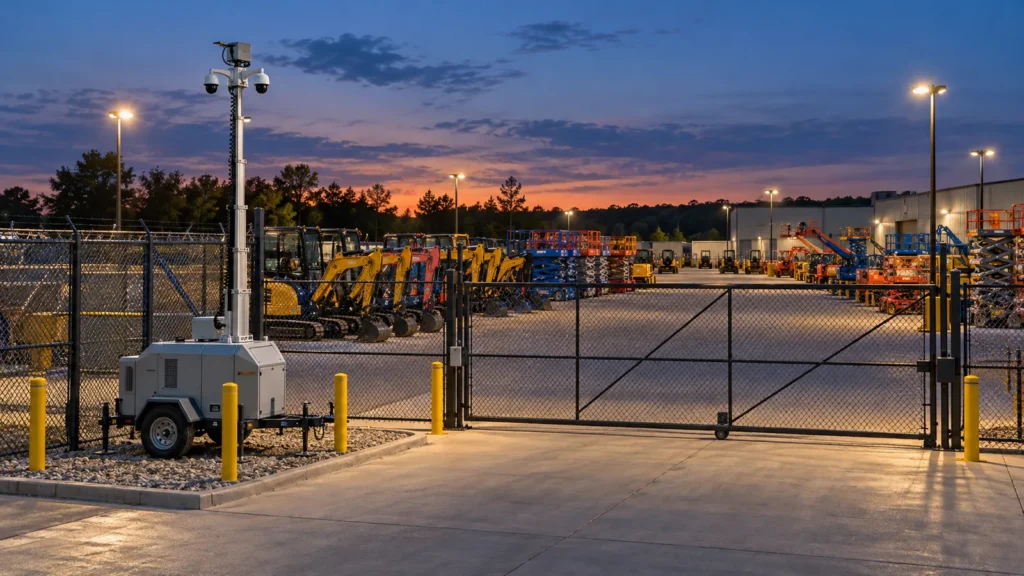
Lighting, gates and cameras should cover one connected route from entry through equipment handling to exit. Check the layout during ordinary operations and after dark, with parked machines in place. A surveillance trailer needs a safe position and useful sightlines, while alerts need a documented review and escalation process.
Walk a typical return through the yard. Can the driver reach the drop without passing the ready line? Does an open service door create another route? Look at the recorded image with headlights on and nearby lights running. Identify shadows, glare and obstructions before accepting a view.
Consider license plate recognition at the gate where vehicle identification is a defined need. Test actual approaches and nighttime conditions; do not assume an overview camera will provide reliable plate reads. Keep responsibility for access to recordings and retention decisions clear.
Coverage can be monitored through our monitoring partner. Agree on authorized late returns, the branch contact, a backup and what happens when connectivity is lost. Define the scope of 24/7 remote video monitoring rather than assuming every recorded event triggers an immediate response.
How we help
We help Northern California rental branches turn a site walk into a practical surveillance trailer placement plan. Bring the branch layout, operating hours, return process and known problem areas. We review the views and setup needs, then align professional monitoring through our monitoring partner with your designated contacts and authorized activity.
For a standard rental from our Northern California fleet, deployment is available within 24 to 48 hours in most cases. Units configured or built to a site’s requirements are scheduled at survey. Explore yard and logistics security, or use our construction equipment theft prevention guide for the contractor-side jobsite discussion.
Frequently asked questions
These answers summarize the decisions a branch manager needs to make about equipment rental yard security. Apply them to the actual return process, fleet and staffing arrangement. Confirm responsibilities with the yard lead, service manager and monitoring contact so the plan remains usable when a different shift closes the branch.
How do equipment rental companies prevent theft?
Equipment rental companies reduce theft risk by combining controlled access, documented handoffs, secure key storage and camera coverage of equipment movement. Match each machine to its rental record when it leaves and returns, then reconcile the yard before closing. Keep identifying information available for a loss report and review who handles after-hours alerts. Registration, tracking and surveillance serve different purposes; no single measure or combination guarantees that theft will not occur.
Where should cameras go in a rental yard?
Place cameras where equipment changes custody or waits unattended: the return lane, ready-to-rent line, service bay entrance, after-hours drop and gate. Give each view a defined job, such as showing a handoff or the route a machine takes toward the exit. Test with normal rows of parked equipment in place and repeat after dark. Use a separate plate-capture assessment if identifying gate traffic is a requirement.
What is the National Equipment Register?
The National Equipment Register provides equipment registration and theft-reporting resources that support identification and recovery work. Its HELPtech database holds equipment records that law enforcement and NER analysts can access. Rental branches should keep accurate machine identifiers and update records as their fleet changes. NER also accepts loss reports for equipment that was not previously registered. Registration helps connect an identified machine with its ownership record; it is not a guarantee of recovery.
How do you secure an after-hours equipment drop?
Secure an after-hours equipment drop by defining one return area with controlled access, lighting, camera coverage and a protected key-return process. Avoid giving returning customers access to the full ready-to-rent fleet. Record the expected machine and arrival window, tell the monitoring contact what is authorized, and assign someone to reconcile returns when staff reopen the branch. Keep the route clear for safe unloading and document exceptions before closing.
Do camera trailers work for equipment yards?
Camera trailers can suit equipment yards when their placement, power, connectivity and camera views match the work being done there. A mobile unit is useful to consider when rows move or a temporary overflow area needs coverage. Confirm what the cameras can actually see between parked machines and test the images at night. If professional monitoring is included, agree on alert review, authorized returns and escalation before relying on the service.
How do you stop rental fraud?
Reduce rental fraud risk with a consistent renter-verification and pickup-authorization process, backed by staff training and a clear escalation rule. Check that the person collecting equipment is authorized for the booking, resolve mismatches before release, and record approved changes. A familiar company name or hurried request should not bypass normal checks. Use industry training and alerts as supporting information, and apply your verification process consistently rather than treating an alert as proof of wrongdoing.
Dealing with dumping on your property?
Start with a marked yard sketch and the movements you need to see: returns, pickups, service transfers and overnight drops. We can discuss camera placement and Northern California rental availability, then identify the monitoring arrangements and setup checks needed for your branch’s daily workflow and closing routine.
Call (530) 593-4295, email sales@hawksurveillancesystem.com, or contact Hawk to discuss your yard.