
Reviewed by Noah Williams, Security Systems Specialist
By Hawk Surveillance Systems. California construction and logistics security Last updated: [05/13/2026]
Editorial note: This guide is educational and intended for licensed California cannabis cultivators and their advisors. It is not legal, regulatory, or compliance advice. Hawk Surveillance Systems provides surveillance system design and deployment, not regulatory interpretation. Cannabis regulations evolve frequently, CCR section numbers change, and cannabis remains illegal under federal law. Always confirm specific surveillance requirements, retention periods, premises coverage standards, and inspection obligations directly with the California Department of Cannabis Control, qualified counsel, your license consultant, and your local jurisdiction before relying on any guidance in this article.
TLDR: DCC Surveillance Compliance at a Glance
California licensed cannabis cultivators are required under California Department of Cannabis Control (DCC) regulations in California Code of Regulations Title 4, Division 19 to operate continuous video surveillance systems with defined coverage, recording quality, and retention standards. These requirements apply across indoor, mixed-light, and outdoor cultivation sites and are enforced during licensing, renewal, and inspection cycles.
In practice, compliance is not only about installing cameras. It is about maintaining continuous recording coverage, ensuring footage retention (generally 90 days under current DCC surveillance rules), and confirming that all required access points and cultivation areas are consistently monitored and retrievable for inspection.
Outdoor and mixed-light cultivation sites in regions such as Humboldt, Mendocino, Trinity, Lake, Yolo, and Monterey counties often face additional operational constraints due to remote locations and limited grid power. These conditions make mobile solar surveillance trailers a practical fit for maintaining coverage across large or off-grid premises.
Harvest season, typically late summer through fall depending on region and license type, generally represents the highest-risk operational window for surveillance reliability. This is also when DCC inspection readiness matters most due to increased activity across cultivation, drying, and storage zones.
This article explains the regulatory framework, the practical compliance reality, site-specific risk profiles, and how mobile surveillance trailers align with DCC expectations.
If you want a written DCC-aligned surveillance plan for your specific premises and license type, send the details and your counsel can review the configuration before deployment.
Why Cultivation Security Is a Compliance Issue, Not Just a Risk Issue
Cannabis cultivation security in California operates under a dual requirement: risk management and regulatory compliance. Most industries treat surveillance as a protective measure against theft or liability. In licensed cannabis cultivation, surveillance is also a licensing requirement governed by the California Department of Cannabis Control (DCC).
Under California Code of Regulations Title 4, Division 19, surveillance systems are part of the licensing framework itself, not optional infrastructure. This means that a failure in surveillance coverage, retention, or access can move beyond a security incident into a compliance issue that affects licensing status.
In practical terms, a theft event at a non-cannabis agricultural site results in financial loss. At a licensed cultivation site, a surveillance gap during the same event may also raise questions during inspection or renewal review. That is why compliance officers, operations leaders, and license consultants typically treat surveillance as part of the licensing system, not just physical security.
Hawk works with cultivators at this intersection of compliance and infrastructure, focusing on system design that aligns with regulatory structure rather than interpreting regulatory law. Counsel and license consultants remain the authoritative voices on regulatory interpretation.
The DCC Video Surveillance Requirements Every Cultivator Should Know
The Regulatory Foundation: Title 4, Division 19 of the CCR
The surveillance framework for licensed cannabis cultivation in California is governed by California Code of Regulations Title 4, Division 19, commonly referenced through the DCC regulatory structure. These rules define how surveillance systems must operate as part of licensed premises requirements.
The relevant surveillance provisions are generally located in CCR Title 4, Division 19 (specific section numbers may have changed since prior reorganization; verify current numbering on the official California Office of Administrative Law site and the DCC laws and regulations page).
These regulations establish the baseline expectations for continuous recording, coverage of licensed areas, and system accessibility for inspection.
For the broader California surveillance legal framework that underlies DCC requirements, see our are surveillance trailers legal in California guide.
Coverage Requirements: What Must Be Recorded
DCC surveillance regulations generally require that all licensed premises activities are captured on video. This typically includes cultivation areas, processing zones, storage locations, and all points of ingress and egress.
Coverage expectations are tied to the licensed premises diagram submitted during licensing. If an area is part of the licensed footprint, it is generally expected to be within surveillance coverage unless explicitly exempted under regulatory provisions.
💬 Hawk Insight: Coverage gaps are one of the most common issues identified during inspection reviews, especially when cultivation layouts change seasonally but surveillance layouts are not updated accordingly. The premises diagram on file at the DCC is the reference point. Physical site changes that drift from the diagram are where compliance gaps appear.
Resolution and Recording Standards
DCC regulations generally specify minimum standards for resolution and recording quality sufficient to identify individuals and monitor activity within covered areas. While exact technical thresholds should always be confirmed against the current CCR text, the intent is consistent: footage must be usable for identification and compliance review.
In practice, this means surveillance systems must maintain consistent image clarity across varying lighting conditions, particularly in outdoor and mixed-light cultivation environments where exposure conditions change throughout the day.
For current technical specifications, operators should confirm requirements directly through the California Code of Regulations and consult qualified technical vendors or compliance advisors.
The 90-Day Retention Rule
DCC surveillance requirements generally include a retention period of at least 90 days for recorded footage. This ensures that historical footage is available during inspections, investigations, or compliance reviews.
Retention must be stable, retrievable, and protected from corruption or unauthorized deletion. Systems that fail to maintain accessible archives can create compliance issues even if cameras are functioning at the time of inspection.
For reference, confirm current retention requirements through the official DCC regulatory publications.
Camera Placement at Ingress and Egress Points
All licensed premises must generally maintain surveillance coverage of entry and exit points. This includes gates, doors, and any controlled access areas defined in the premises diagram.
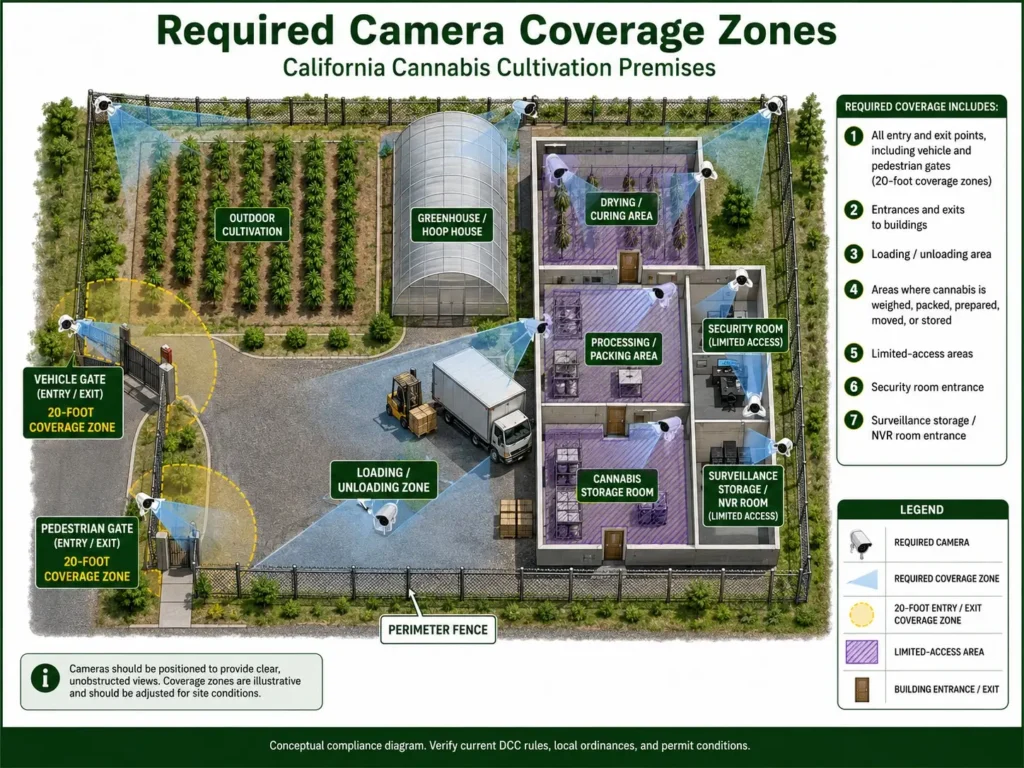
Ingress and egress coverage is particularly important in cultivation environments where activity levels increase significantly during harvest and transport phases.
License-Type Variations: Outdoor, Mixed-Light, Indoor
Surveillance expectations may vary depending on license type and tier classification under the DCC framework. Cultivation licenses currently include outdoor, mixed-light, indoor, and nursery categories with various size tiers. Operators should confirm their specific license type and applicable surveillance obligations directly with the DCC.
Outdoor cultivation sites typically require broader perimeter coverage due to spatial scale. Mixed-light operations often require layered coverage across greenhouse structures and surrounding outdoor areas. Indoor facilities focus more on controlled entry points and internal zones.
Operators should confirm their specific obligations with the DCC and their license consultant based on their license type and approved premises design.
The Practical Compliance Reality
What an Annual DCC Inspection Looks Like
A DCC inspection typically includes a review of the licensed premises, surveillance system functionality, and documentation alignment with the approved premises diagram. Inspectors may evaluate whether cameras are operational, whether footage is accessible, and whether retention archives are intact.
Surveillance is generally evaluated as part of a broader compliance review, which may also include track-and-trace verification, storage controls, and operational records.
The Most Common Reasons Cultivators Fail Surveillance Compliance
Surveillance-related compliance issues commonly include:
- Camera or recording system failure without documented redundancy
- Inaccessible or corrupted retention archives
- Coverage gaps due to layout changes not reflected in camera placement
- Insufficient recording quality for identification purposes
- Loss of footage during system upgrades or storage migration
These issues often emerge during routine inspections or renewal reviews rather than during active operations.
What Happens When a System Goes Down at the Wrong Time
If surveillance systems fail during an inspection window or DCC records request, it can create a compliance escalation. The outcome depends on context, documentation, and whether backup systems or redundancy measures are in place.
Operators with documented response plans, redundant recording systems, or temporary coverage solutions are generally better positioned than those without documented continuity measures.
💬 Hawk Insight: The inspection moment itself rarely surprises the operator, but documentation does. Being able to show “the system went down on this date, redundancy activated, and footage was retrieved from backup” is the difference between a routine note and a compliance finding.
The Cultivation Site Risk Profile
Outdoor Grow Risks
Outdoor cultivation sites often operate across large acreage with limited fixed infrastructure. In regions such as Humboldt and Mendocino counties (part of the Emerald Triangle, which also includes Trinity), sites may be remote with limited connectivity and long response times for service access.
According to industry security analyses such as those referenced by the National Insurance Crime Bureau, agricultural cultivation sites with high-value seasonal assets are generally exposed to elevated theft risk during peak operational windows.
Mixed-Light and Greenhouse Risks
Mixed-light cultivation environments combine structural coverage with open-air exposure. While greenhouses provide physical barriers, they also introduce defined entry points that must be consistently monitored.
Surveillance planning in these environments typically focuses on perimeter access, internal movement zones, and transitional points between indoor and outdoor cultivation areas.
The Harvest-to-Drying Window
The harvest-to-drying period generally represents one of the most operationally sensitive phases in cultivation. Activity increases across harvesting, transport, and processing zones, which can place additional demands on surveillance continuity.
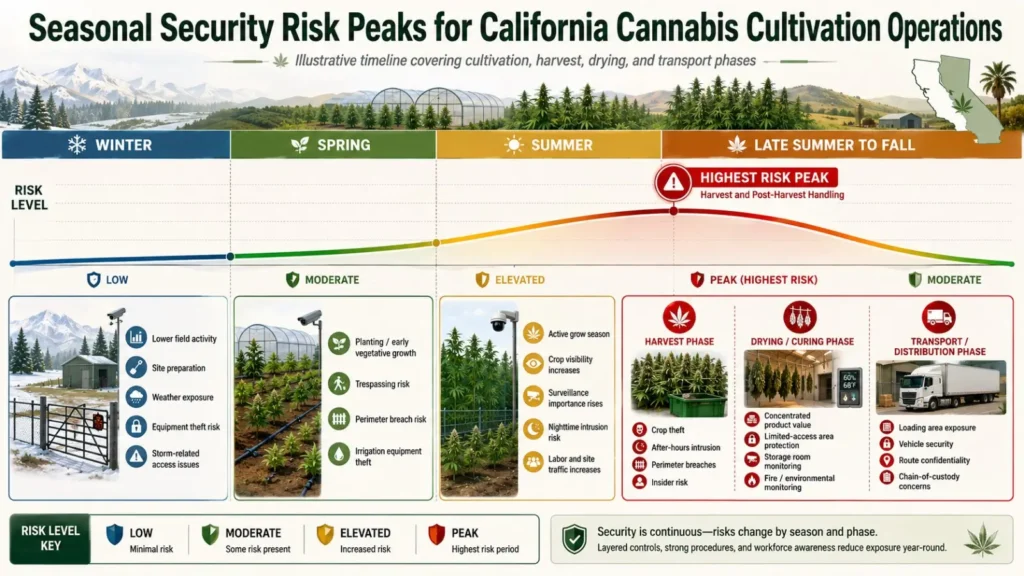
This window often determines whether surveillance systems are tested under peak operational load conditions.
Transport-Adjacent Risks
Surveillance requirements also extend to loading and transfer points where cultivation products move into transport channels. These areas are typically included in licensed premises definitions and must remain within surveillance coverage during active operations.
Why Mobile Surveillance Trailers Fit Cannabis Cultivation Specifically
Off-Grid Capability for Remote Sites
Many cultivation sites operate without stable grid power. Mobile solar surveillance trailers provide a self-contained power and recording solution that supports continuous operation without reliance on local infrastructure.
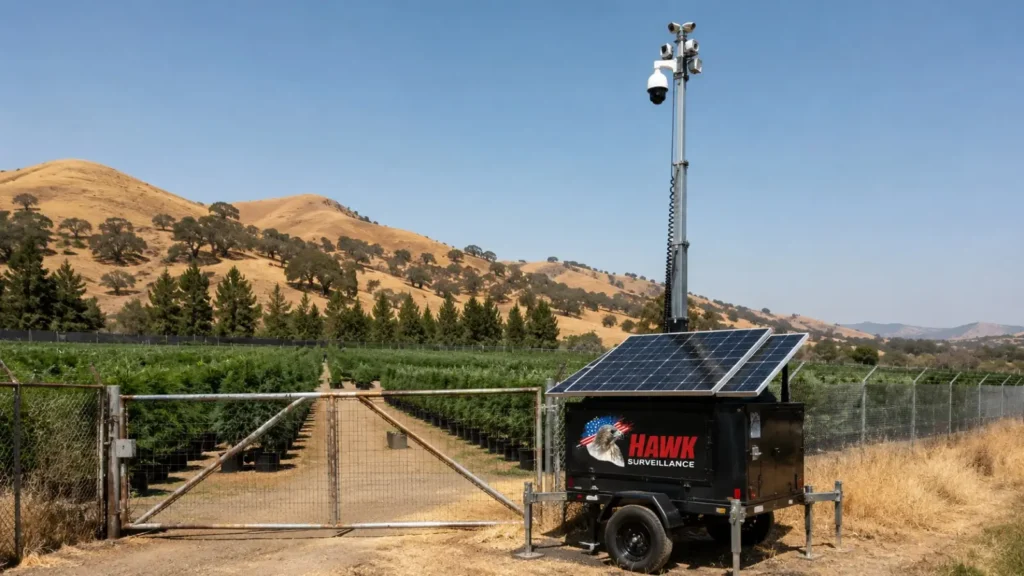
This is particularly relevant in remote cultivation regions where grid access is limited or cost-prohibitive. For more on solar trailer winter runtime in remote California regions, see our solar surveillance trailer California winter runtime guide.
Coverage of Large Outdoor Acreage
Outdoor cultivation sites can span large areas that exceed the practical reach of fixed-camera installations. Mobile trailers allow elevated camera systems to cover broader perimeters and multiple activity zones from a single deployment point.
For sizing logic, see our coverage math guide for jobsites, yards, and lots.
Repositioning Across Phases (Planting, Vegetative, Flower, Harvest)
Cultivation sites change activity zones across seasonal phases. Mobile trailers can be repositioned as operational needs shift, supporting surveillance alignment with active areas rather than static infrastructure limitations.
Documentation and Evidence Quality for DCC and Insurance
Modern surveillance trailers support digital recording, timestamping, and structured archival systems. This supports both regulatory inspections and insurance documentation requirements by maintaining accessible and structured footage records.
Configuring a Surveillance Trailer for DCC Compliance
Camera Specifications That Meet the Standard
Surveillance trailers used in cultivation environments typically integrate PTZ and fixed cameras configured for continuous coverage. Resolution and recording settings must align with current DCC expectations under CCR Title 4, Division 19 (verify current technical thresholds via cannabis.ca.gov).
Recording, Retention, and Access Controls
Retention systems are generally configured for at least 90 days of storage. Access controls define who can retrieve footage, modify settings, or export recordings for inspection purposes.
Premises Diagram Integration
Surveillance coverage must align with the approved DCC premises diagram. This ensures that recorded footage corresponds directly with licensed operational areas. Any layout change should trigger a review of camera placement against the diagram on file.
What Hawk Provides as Compliance Documentation
Hawk deployments typically include:
- Camera and system specifications
- Coverage mapping aligned to premises diagrams
- Retention configuration details
- Monitoring and maintenance structure
- Deployment summary for review by counsel or license consultants
💬 Hawk Insight: Most compliance issues are not caused by missing cameras, but by undocumented changes to layouts or systems over time. Documentation discipline is as important as hardware design. The cultivator who can show every system change, layout adjustment, and outage event with date stamps is the cultivator who passes inspection cleanly.
Send your premises and license details. Hawk will return a configuration, retention plan, and compliance summary your counsel and license consultant can review
Three California Cultivation Scenarios
The following are illustrative scenarios drawn from typical patterns we see across California cultivation deployments. Specific compliance outcomes for any individual operator depend on license type, premises diagram, current DCC regulations, and operational documentation.
Scenario 1: Emerald Triangle Outdoor Grow, Off-Grid
A remote outdoor cultivation site operates across approximately 10 acres without grid access in the Humboldt-Mendocino region. Two solar surveillance trailers are deployed to cover perimeter zones and approved access points per the DCC premises diagram. The system operates on continuous recording with 90-day retention.
Outcome: The configuration supports continuous coverage of licensed premises areas through the harvest season. Compliance interpretation remains the operator’s counsel decision.
Scenario 2: Central Coast Mixed-Light Operation, Multi-Phase
A mixed-light cultivation site includes greenhouse structures and adjacent outdoor cultivation zones. One surveillance trailer covers perimeter access while another is repositioned across operational phases as activity zones shift through the cultivation cycle.
Outcome: Surveillance coverage aligns with the premises diagram across seasonal transitions, with documented repositioning events recorded for compliance review.
Scenario 3: Central Valley Multi-Site Cultivator, Harvest Reinforcement
A multi-site operator uses fixed surveillance systems year-round and deploys mobile trailers during harvest season across three locations to reinforce coverage during peak activity.
Outcome: Temporary surveillance reinforcement supports continuous coverage during peak operational activity periods, with deployment dates and configurations documented for inspection readiness.
Send your site info and harvest timeline. Hawk will return a deployment plan including any harvest-season augmentation within two business days.
Inspection Readiness: A Pre-Audit Checklist
Walk through this list with your operations team before any DCC inspection or renewal review:
- Confirm all surveillance cameras are operational and recording continuously
- Verify at least 90 days of accessible footage across all channels
- Cross-check camera placement against the DCC-approved premises diagram
- Document system specifications including resolution and retention settings
- Record any maintenance or outage events within the retention window
- Confirm access permissions for all surveillance system users
- Conduct an internal walkthrough of inspection scenario procedures
- Review surveillance setup with qualified counsel or license consultant
- Document the readiness review, including date and participants
Your counsel and license consultant remain the authoritative voices on whether the system meets current DCC requirements.
Frequently Asked Questions
What are the DCC video surveillance requirements for California cannabis cultivators?
DCC video surveillance requirements generally mandate continuous recording of all licensed cannabis cultivation premises under California Code of Regulations Title 4, Division 19. This typically includes coverage of cultivation areas, storage, and access points. Requirements are enforced during licensing and inspection processes. Operators should confirm exact obligations directly with the California Department of Cannabis Control and consult qualified counsel for interpretation.
How long does California require cannabis surveillance footage to be retained?
California generally requires cannabis surveillance footage to be retained for at least 90 days under current DCC regulations. This retention must be secure, retrievable, and protected from deletion or corruption. Exact requirements are defined in CCR Title 4, Division 19 surveillance provisions, section numbers may have changed since prior reorganization, so verify current text before relying on any specific reference.
What camera resolution is required for cannabis cultivation surveillance?
DCC regulations generally require surveillance systems to maintain sufficient resolution to clearly identify individuals and monitor activities within licensed premises. Specific technical thresholds should be verified in the current California Code of Regulations. Operators should ensure systems perform consistently across varying lighting conditions and consult technical compliance specialists for implementation guidance.
Where do cameras need to be placed on a cannabis cultivation premises?
Cameras are generally required at all ingress and egress points, as well as across cultivation, storage, and processing areas within the licensed premises. Placement must align with the approved premises diagram submitted to the DCC. Exact requirements are defined in CCR Title 4, Division 19, and should be confirmed with the California Department of Cannabis Control.
Can mobile surveillance trailers be used for outdoor cannabis grow security?
Yes, mobile surveillance trailers can generally be used to support outdoor cannabis cultivation security when configured to meet DCC surveillance requirements. They are often used in remote or off-grid environments where fixed infrastructure is limited. Compliance depends on whether coverage, retention, and access standards align with current CCR requirements and approved premises diagrams.
Do mixed-light grows have different surveillance requirements than outdoor grows?
Mixed-light cultivation sites may have different surveillance configurations compared to outdoor grows due to structural differences such as greenhouse coverage and controlled access points. Both must comply with DCC surveillance requirements under CCR Title 4, Division 19. Operators should confirm specific obligations based on their license type with counsel and the DCC.
How do I prepare cannabis cultivation surveillance for a DCC inspection?
Preparation typically includes verifying camera functionality, confirming 90-day footage retention, aligning coverage with the approved premises diagram, documenting system specifications, and reviewing access controls. Many operators also conduct a pre-audit walkthrough and consult license professionals to ensure readiness for inspection.
What happens if my surveillance system fails an annual DCC inspection?
If surveillance systems fail during an inspection, outcomes depend on severity, documentation, and corrective action. This may result in requests for remediation or additional regulatory review. Operators should consult qualified counsel and the California Department of Cannabis Control for guidance on compliance resolution pathways.
Are surveillance trailers cost-effective for seasonal cannabis cultivation?
Surveillance trailers are generally considered cost-effective for seasonal cultivation because they can be deployed during high-risk periods such as harvest season and repositioned as operational needs shift. This generally reduces the need for permanent infrastructure across all phases of cultivation while maintaining compliance coverage when configured against the premises diagram.
Does Hawk Surveillance support DCC-compliant cannabis cultivation deployments?
Hawk Surveillance provides configuration, deployment planning, and documentation support aligned with DCC surveillance frameworks for licensed cannabis cultivators. Final compliance interpretation remains the responsibility of the operator’s counsel, license consultant, and the California Department of Cannabis Control. Hawk does not provide regulatory advice.
Key Takeaways
- DCC surveillance requirements are part of licensing compliance, not optional security infrastructure
- California Code of Regulations Title 4, Division 19 governs surveillance expectations for licensed cultivation
- Footage retention is generally 90 days minimum and must remain accessible and secure
- All ingress and egress points on a licensed premises must generally be covered
- Outdoor and mixed-light cultivation sites face additional operational constraints due to scale and location
- Harvest season generally represents the highest operational risk period for surveillance continuity
- Mobile surveillance trailers are commonly used in off-grid and large-acreage cultivation environments
- Inspection readiness depends heavily on documentation, not just hardware functionality
- Operators should always confirm regulatory interpretation with DCC, qualified counsel, and license consultants
Get a DCC-Aligned Surveillance Plan from Hawk Surveillance
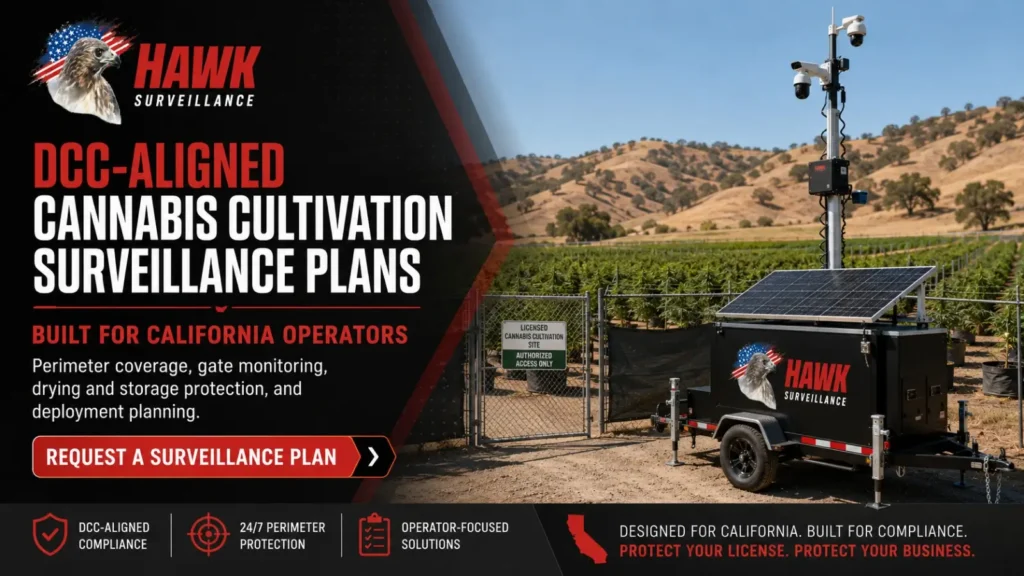
Send your premises information, license type, and current surveillance setup. Hawk will return a configuration recommendation, deployment cost estimate, retention plan, and compliance summary your counsel and license consultant can review.
We do not provide regulatory advice. We provide surveillance system design and deployment planning aligned with the DCC framework for licensed California cannabis cultivators.
This guide is educational and intended for licensed California cannabis cultivators and their advisors. It is not legal, regulatory, or compliance advice. Cannabis regulations evolve frequently, CCR section numbers change, and cannabis remains illegal under federal law. Always confirm specific surveillance requirements, retention periods, premises coverage standards, and inspection obligations directly with the California Department of Cannabis Control, qualified counsel, your license consultant, and your local jurisdiction before making decisions about your cultivation operation.