

Last updated: August 2026. By Noah Williams, Hawk Surveillance Systems.
TL;DR: A virtual guard, also called remote guarding, is a trained remote operator team that runs scheduled camera patrols, live talk-downs, access checks, and escalation to law enforcement dispatch through monitored cameras instead of standing a post on your property.
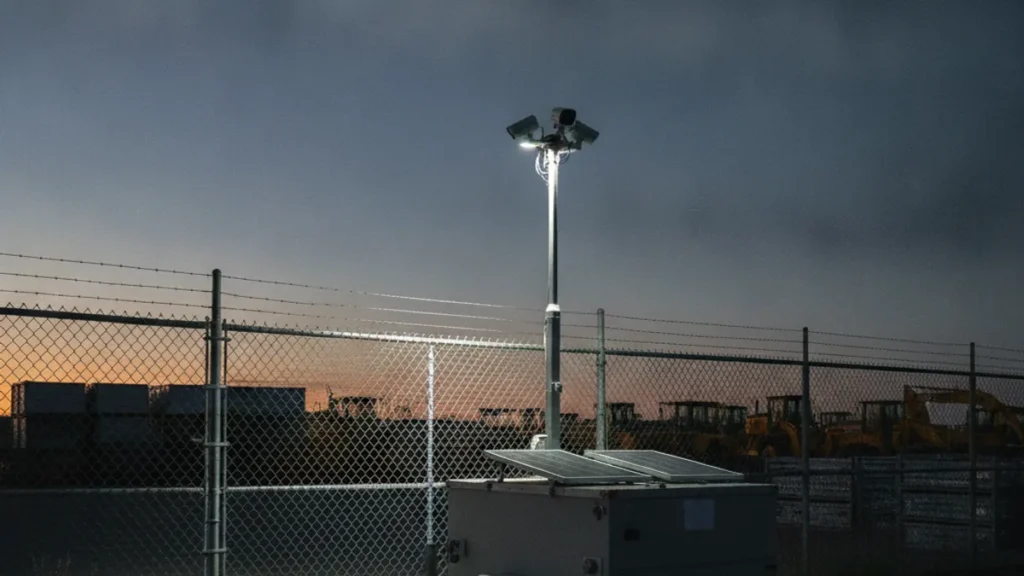
The honest answer to the replacement question: it fully replaces a physical guard on gated yards and after-hours construction sites, pairs with one on mixed-use sites, and does not replace one anywhere people have to be handled face to face or stopped by hand. Hawk delivers remote guarding on rented solar surveillance trailers across Northern California, set up in hours, with no installation project and no grid power needed. See how live professional monitoring works.
What a virtual guard actually does, shift by shift
In brief: A virtual guard works a shift the way a posted officer does, with the walking replaced by camera movement: scheduled patrol tours of the whole site, event-driven checks when something moves, a live voice warning when someone should not be there, a call to dispatch when that warning fails, and a written shift report in the morning.
- Scheduled patrol tours. At set intervals an operator drives the pan-tilt-zoom cameras through a tour of the site: gate, laydown area, fuel tanks, back fence line, the row where the newest equipment sits. It is the remote version of walking rounds, and it takes minutes instead of most of an hour, so it repeats far more often.
- Event-driven checks. Between tours, analytics classify motion as a person, a vehicle, or neither and push anything that qualifies to an operator. The machine watches, the human decides.
- Live talk-downs. On confirming someone who should not be there, the operator speaks over the on-site speaker, describes what that person is wearing and where they are standing, and says police are being called. Strobes fire at the same time. Most incidents end here.
- Access and gate verification. Where a site is equipped for it, operators verify arrivals against an expected list, read plates, and confirm a gate closed behind a departing truck.
- Escalation and the morning report. Verified incidents go to dispatch with a live description of the scene, and you get a written record with clips, which is what an insurer, a general contractor, or a claims adjuster will ask for.
That scope is standard across the category, not a Hawk invention. Pinnacle Security Guards, a licensed California patrol operator, describes its virtual guard service as real-time CCTV monitoring, remote access control, incident detection, live audio intervention, and response coordination with on-site personnel or local authorities. Underneath all of it runs the same verification chain: analytics flag the event, then a trained operator confirms on the live feed what is actually there before anyone acts. Our companion guide to live video monitoring services walks that chain through in detail.
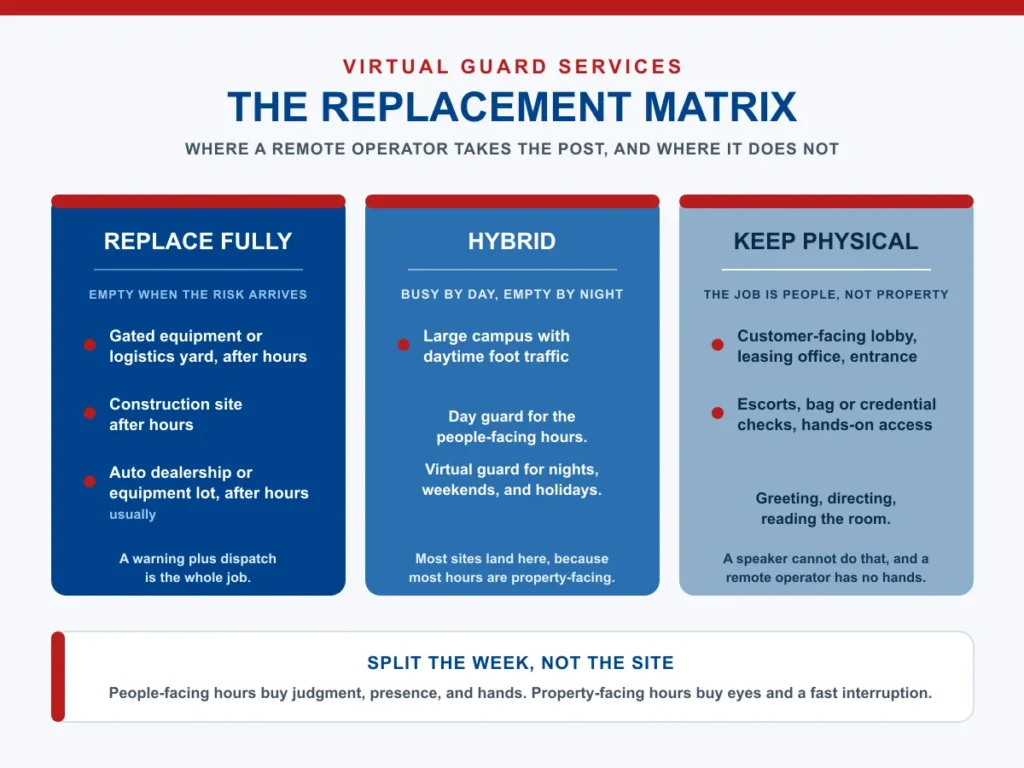
Can a virtual guard replace your physical guard? The honest matrix
In brief: A virtual guard fully replaces a physical guard on sites that are empty and closed when the risk arrives, pairs with one on sites busy by day and empty by night, and does not replace one where the job includes greeting people, checking credentials at a door, or putting hands on a gate, a person, or a vehicle.
| Site type | Verdict | Why |
|---|---|---|
| Gated equipment or logistics yard, closed after hours | Replace fully | Nobody belongs inside the fence, so every person on camera is an event and a warning plus dispatch is the whole job. |
| Construction site after hours | Replace fully | No public, no access decisions, exposure spread across acres. Cameras cover the whole footprint at once; one officer covers one corner. |
| Auto dealership or equipment lot after hours | Usually replace | High-value inventory outdoors with the lot closed. Talk-down on approach is the intervention that matters, and it needs no body on site. |
| Customer-facing lobby, leasing office, or visitor entrance | Keep physical | The job is people: greeting, directing, reading the room, being visibly present. A speaker cannot do that. |
| Site requiring escorts, bag or credential checks, or hands-on access control | Keep physical | Each of those tasks needs hands and a body in the room. A remote operator has neither. |
| Large campus with daytime foot traffic | Hybrid | Day guard for people-facing hours, virtual guard for nights, weekends, and holidays, where most of the hours and the risk sit. |
The pattern is simpler than the table looks. Split your week into people-facing hours and property-facing hours. People-facing hours buy judgment, presence, and hands, and a physical guard is the right tool for them. Property-facing hours buy eyes on an empty property and a fast, credible interruption, which a virtual guard delivers across the whole site at once rather than wherever one officer is standing. Most sites we survey are mostly property-facing hours, which is why the hybrid row applies more often than either extreme. Two rows here are our weekly work: construction jobsites after the crews leave, where rented jobsite security cameras cover the whole footprint at once, and logistics and warehouse yards overnight.
The cost math: a guard post vs a monitored trailer
In brief: The replacement decision is not a comparison of two prices, it is a comparison of two cost shapes: a guard post is priced in coverage hours you have to staff continuously, and a monitored trailer is priced as one flat monthly line item that does not move with the calendar.
Start with the arithmetic, because it does more work than any quoted rate. Covering a site around the clock is 168 hours a week. At 40 hours a position that is more than four full-time officers before relief, holidays, callouts, overtime, supervision, agency overhead, and margin. So the first question worth asking is not “what does a guard cost” but “how many of those 168 hours actually need a person.”
Published rates on the monitored side are rare, and where a provider does post one it is quoting its own packaging rather than a market average. None of it is a quote for your site.
Camera count, watched hours, escalation scope, site conditions, and contract length are what move a monitored quote. Our comparison of mobile surveillance trailers versus security guards works that math out in full. Hawk publishes no rate card because sites are not interchangeable. We quote site by site, usually the same day.
What a virtual guard cannot do
In brief: A virtual guard has no hands, and any vendor who blurs that line is selling something they cannot deliver. Here is what a remote operator will never do, stated before you buy rather than discovered during an incident.
- No physical intervention. An operator cannot block a gate, stand between a person and a machine, or physically stop anything.
- No detainment. Nobody is held, cuffed, or walked to an office. That is law enforcement, and only law enforcement.
- No escorts. Staff walking to a car at 11pm want a person beside them, not a camera above them.
- No hands-on gate or door operation. Operators can verify and, where the site is equipped for it, trigger a gate. They cannot chain one or fix one that jams.
- No medical or fire response beyond calling it in. An operator sees smoke or a person down and dials. They carry no extinguisher and perform no first aid.
So a determined intruder who hears the talk-down, looks up at the strobe, and keeps walking is handled by dispatch, not by hands, and response time from that point belongs to the responding agency. That single limit is why the matrix above has “keep physical” rows at all.
Licensing and recording rules in California (short)
In brief: Two things are worth knowing before you sign anything in California: security services are licensed activities under state law, so ask any vendor which license they hold, and audio is the part of a camera system that gets buyers into trouble, not video.
Licensing. Business and Professions Code section 7582.1 defines a private patrol operator as a person who, for any consideration, agrees to furnish or furnishes “a watchman, guard, patrolperson, or other person to protect persons or property,” licensed activity under the Private Security Services Act administered by the Bureau of Security and Investigative Services. Section 7590.2 separately defines an alarm company operator as a person who engages in business or accepts employment to install, maintain, alter, sell on premises, monitor, or service alarm systems, with monitoring expressly named. Which of those a given remote monitoring service falls under depends on what the service actually does, a question for the vendor and their counsel rather than for a blog post. Your job is to ask which California license they hold and what the number is.
Camera placement. Penal Code section 647(j)(1) makes it an offense to use a camera to view “the interior of a bedroom, bathroom, changing room, fitting room, dressing room, or tanning booth, or the interior of any other area in which the occupant has a reasonable expectation of privacy,” with intent to invade privacy. On a commercial site that means placement discipline: aim at your own yard, gates, and approaches, and watch any lens that reaches a neighboring residence.
Audio. Penal Code section 632 makes it an offense to use an electronic amplifying or recording device to eavesdrop upon or record a confidential communication without the consent of all parties. That all-party consent rule is why most site systems, ours included, run one-way warning audio out to the speaker rather than recording conversations. We cover placement, signage, and audio in are surveillance trailers legal in California. None of this is legal advice; your counsel should see any site plan.
What remote guarding looks like on a rented trailer
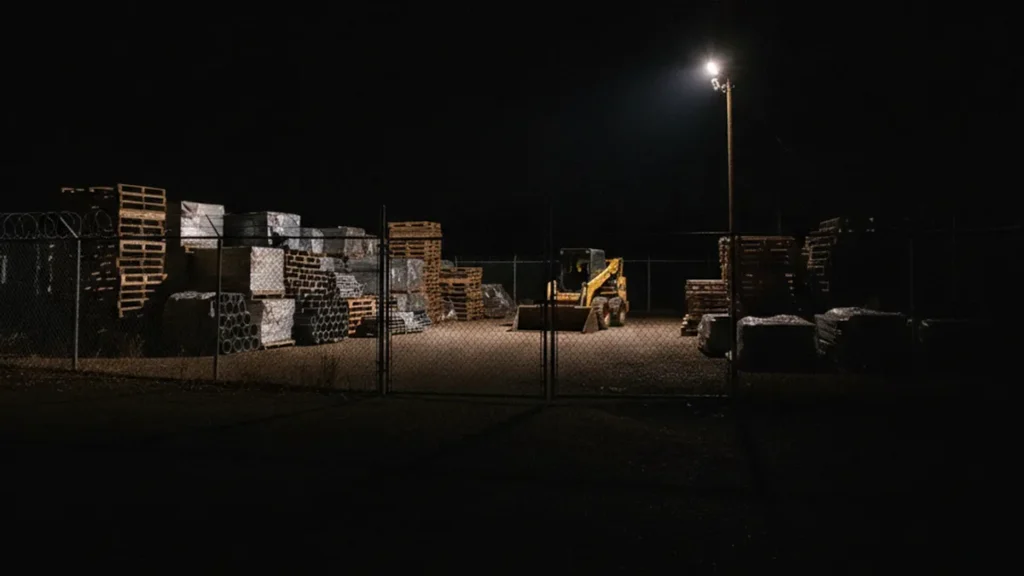
In brief: On a mobile deployment the whole service arrives as one delivered unit rather than a construction project, which is what makes a virtual guard practical on a site with a start date, an end date, and no power at the gate.
It starts with a site walk to find where the exposure sits: the gate, the laydown yard, the fuel and copper, the blind corner behind stacked materials. Hawk then places a rented surveillance trailer with a telescoping mast carrying pan-tilt-zoom and fixed cameras, running on solar and battery with LTE backhaul, so there is no grid connection and no trenching. Speaker and strobes go on the mast, and 24/7 remote monitoring and response runs the shift described above.
Configuration follows the site. The Mobile Command solar surveillance trailer suits open yards and jobsites where mast height and camera count matter; the compact urban trailer fits tight infill lots. Both set up in hours and both redeploy when the site changes, which an installed system cannot do. We run this across Northern California, including Sacramento and San Jose.
“I talk people out of this more often than you would think. If your front desk is the first thing a visitor sees, keep your guard, because that job is a person’s job and a camera will make it worse. What I will take off your plate is the eleven hours after everyone goes home, when you are paying an officer to sit in a truck and watch one gate out of four.” Paul Wittner, Hawk Surveillance Systems
Frequently asked questions
What is a virtual guard?
A virtual guard is a trained remote operator who runs security patrols, live voice warnings, and escalation to law enforcement dispatch through monitored cameras instead of standing a post on your property. The operator drives pan-tilt-zoom cameras through scheduled tours, checks events that analytics flag, speaks over an on-site speaker to anyone who should not be there, and calls dispatch if that warning is ignored. Remote guarding is the same service under a different name.
How much does a virtual guard cost compared to a security guard?
The two are priced in different shapes. A guard post is priced in coverage hours, and covering a site around the clock is 168 hours a week, more than four full-time positions before relief, overtime, supervision, and agency overhead. A virtual guard is priced as a flat monthly fee that does not move with the calendar. Camera count, watched hours, escalation scope, and site conditions move that fee. Hawk quotes site by site, usually the same day.
Can a virtual guard replace a security guard?
On some sites yes, on others no, and the split is predictable. It replaces a guard fully on gated yards and after-hours construction sites, and usually on closed dealership or equipment lots, where nobody is supposed to be present and a warning plus dispatch is the whole job. It does not replace a guard at a lobby, a leasing office, or any post involving escorts, credential checks, or hands-on access control. Mixed sites run a day guard and a virtual guard overnight.
How fast does a virtual guard respond to an intruder?
Analytics flag movement within seconds, then a human opens the feed and confirms whether it is a person, a vehicle, or a raccoon before acting, so the honest answer is seconds to minutes depending on what the camera shows. Verification is the step that matters, because it is what keeps you from paying for dispatches to shadows. Ask a provider how they verify and how many operators are on shift rather than for a guaranteed response time.
Do virtual guards actually talk to intruders?
Yes. Once an operator has visually confirmed a person on the property, they speak over the on-site speaker live, usually describing what that person is wearing and where they are standing, and telling them police are being called. Strobes fire at the same time. Most incidents end there, because being described out loud by a live human removes the sense of being unobserved. If the warning is ignored, the operator escalates to dispatch.
Is it legal to record video of my commercial property in California?
Recording video of your own commercial premises is generally lawful, and the care goes into placement and audio. Penal Code section 647(j)(1) covers viewing the interior of areas where an occupant has a reasonable expectation of privacy, such as bathrooms and changing rooms, so keep those out of frame and watch any lens that reaches a neighboring residence. Audio is the real trap: Penal Code section 632 requires all-party consent to record confidential communications. Ask your own counsel.
Does remote guarding work overnight?
Overnight is the core use case, not an edge case. Most commercial sites are empty from early evening to early morning, which is when almost all of the exposure sits and when a physical post costs the most per useful hour. Infrared and low-light cameras handle the dark, scheduled patrol tours run through the night, and coverage windows can be set to overnight only rather than around the clock if the site is staffed by day.
A virtual guard is a trained remote operator who runs security patrols, live voice warnings, and escalation to law enforcement dispatch through monitored cameras instead of standing a post on your property. The operator drives pan-tilt-zoom cameras through scheduled tours, checks events that analytics flag, speaks over an on-site speaker to anyone who should not be there, and calls dispatch if that warning is ignored. Remote guarding is the same service under a different name.
The two are priced in different shapes. A guard post is priced in coverage hours, and covering a site around the clock is 168 hours a week, more than four full-time positions before relief, overtime, supervision, and agency overhead. A virtual guard is priced as a flat monthly fee that does not move with the calendar. Camera count, watched hours, escalation scope, and site conditions move that fee. Hawk quotes site by site, usually the same day.
On some sites yes, on others no, and the split is predictable. It replaces a guard fully on gated yards and after-hours construction sites, and usually on closed dealership or equipment lots, where nobody is supposed to be present and a warning plus dispatch is the whole job. It does not replace a guard at a lobby, a leasing office, or any post involving escorts, credential checks, or hands-on access control. Mixed sites run a day guard and a virtual guard overnight.
Analytics flag movement within seconds, then a human opens the feed and confirms whether it is a person, a vehicle, or a raccoon before acting, so the honest answer is seconds to minutes depending on what the camera shows. Verification is the step that matters, because it is what keeps you from paying for dispatches to shadows. Ask a provider how they verify and how many operators are on shift rather than for a guaranteed response time.
Yes. Once an operator has visually confirmed a person on the property, they speak over the on-site speaker live, usually describing what that person is wearing and where they are standing, and telling them police are being called. Strobes fire at the same time. Most incidents end there, because being described out loud by a live human removes the sense of being unobserved. If the warning is ignored, the operator escalates to dispatch.
Recording video of your own commercial premises is generally lawful, and the care goes into placement and audio. Penal Code section 647(j)(1) covers viewing the interior of areas where an occupant has a reasonable expectation of privacy, such as bathrooms and changing rooms, so keep those out of frame and watch any lens that reaches a neighboring residence. Audio is the real trap: Penal Code section 632 requires all-party consent to record confidential communications. Ask your own counsel.
Overnight is the core use case, not an edge case. Most commercial sites are empty from early evening to early morning, which is when almost all of the exposure sits and when a physical post costs the most per useful hour. Infrared and low-light cameras handle the dark, scheduled patrol tours run through the night, and coverage windows can be set to overnight only rather than around the clock if the site is staffed by day.
Talk to a security specialist
If you are weighing a guard post against remote guarding on a specific site, the fastest way through it is a short conversation about that site. We will tell you plainly if the answer is to keep your guard, and which hours we can take off your budget if it is not.
Or read the detail on live professional monitored systems, which covers what operators do, what is included, and how monitoring fits alongside an existing security team.