

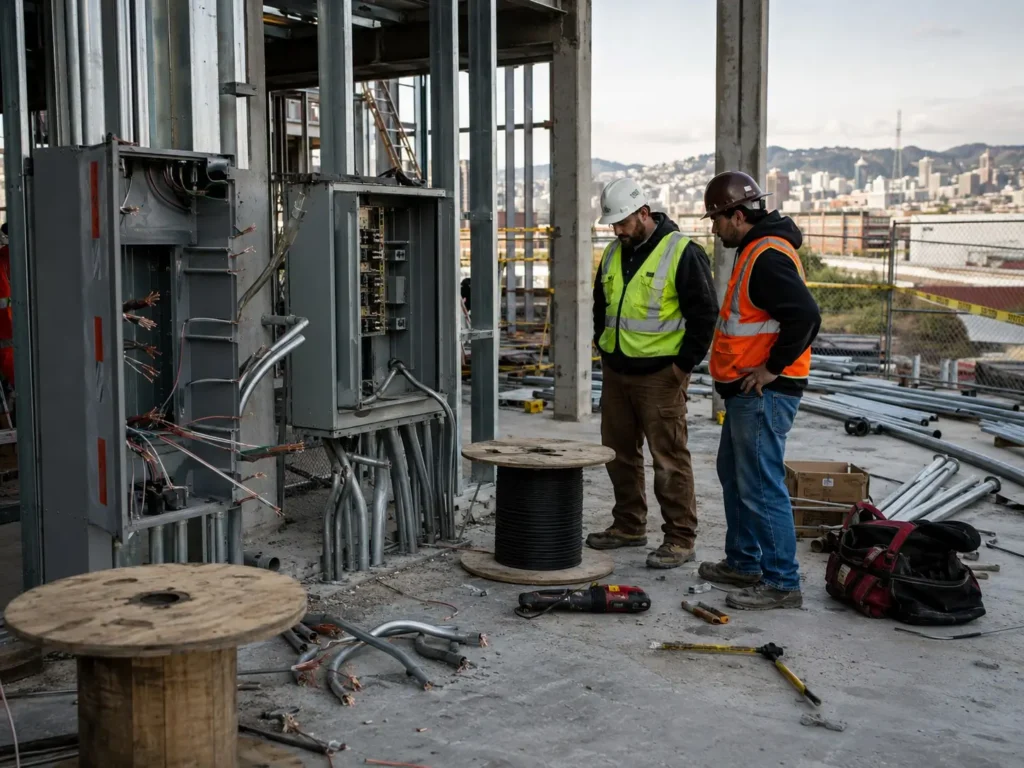
By Hawk Surveillance Systems, California construction site security Last updated: June 8, 2026
Editorial note: This article is educational and intended for general guidance. Cost figures, theft pattern observations, and deployment timelines reflect typical industry conditions and Hawk operational ranges as of early 2026. Actual outcomes vary by site, project, carrier, and circumstances. If you have just experienced a theft, secure the site for electrical safety first, then contact your insurance broker, the responsible electrical subcontractor, and law enforcement before relying on any guidance in this article.
TLDR: Bay Area Copper Theft in 2026
Copper theft on Bay Area construction sites is up materially in 2026, driven by sustained high copper prices and dense, overlapping jobsite activity. A single overnight incident on a multifamily project commonly results in $5,000 to $25,000 in direct copper loss, plus one to three weeks of schedule slippage once electricians re-pull wire and inspections reset.
Most incidents typically occur overnight on weekends, especially during electrical rough-in and finish phases when copper is exposed and staged. Layered prevention works. Basic site hardening combined with active surveillance and voice-down monitoring stops the majority of attempts before material leaves the site.
A mobile surveillance trailer can typically be deployed to an active Bay Area jobsite within 24 to 72 hours of a quote request, with immediate monitoring and audible deterrence.
If you are reading this Monday morning after a weekend loss, scroll to “What to Do Immediately After a Copper Theft” and then to the deployment timeline. The rest is context.
Why Copper Theft Is Surging Across the Bay Area
Copper Prices and the Resale Market
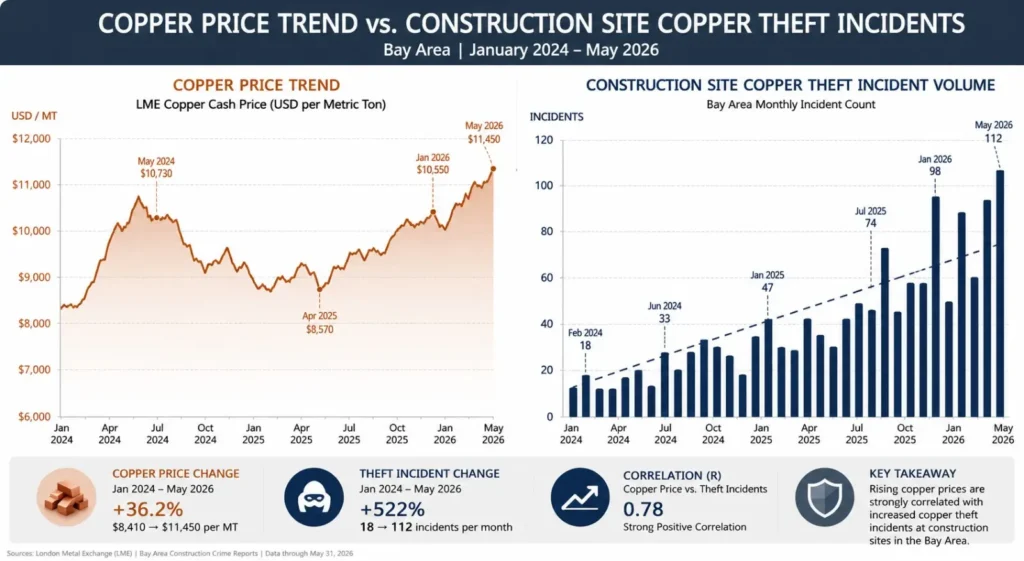
Copper has held above historical averages through 2025 and into 2026, increasing the incentive for theft. Per the London Metal Exchange copper futures, copper has traded around $4.10 to $4.40 per pound in early 2026 depending on contract month and date. That is significantly higher than mid-2010s averages that often ranged between $2.00 and $3.00 per pound.
At those levels, even modest quantities of clean scrap wire translate into quick resale value. A single multifamily site can have tens of thousands of dollars in copper staged across conduit runs, spools, and mechanical rooms. Scrap copper can be resold within hours through recycling channels, often before a loss is discovered the next business day.
The Bay Area Construction Density Problem
The Bay Area has one of the highest concentrations of active multifamily, infill, and infrastructure construction in California. According to U.S. Census construction spending data, California consistently leads the nation in total construction value, with tens of billions in annual activity at the state level.
In dense urban corridors, multiple jobsites often sit within blocks of each other. That concentration creates a patterning problem. Crews that identify one exposed site can identify several in a single night. The result is repeat exposure across similar project types and phases.
For a broader view of California-wide theft patterns, see our California construction site theft 2026 statistics report.
Limited Recycling Enforcement
California regulates scrap metal transactions under Business and Professions Code § 21605 et seq., which generally requires recordkeeping and seller identification. These laws are designed to reduce stolen metal resale.
In practice, enforcement and verification vary. Stolen copper often enters the resale stream quickly. That short turnaround compresses the response window for contractors and owners. By the time a site is inspected Monday morning, the material is typically unrecoverable. Because stolen copper typically moves through recycling and salvage channels, owners increasingly pair jobsite monitoring with dedicated scrap-metal and recycling yard security in Northern California.
💬 Hawk Insight: The financial math drives the timing. When copper holds above $4 per pound and resale can happen within hours, a Friday-night theft becomes Monday-morning unrecoverable. The window to disrupt is during the act, not after.
What a Single Copper Theft Actually Costs
The figures below are typical patterns we see across Bay Area sites. Actual costs on any specific project depend on scope, copper pricing at the time of loss, and policy structure.
The Direct Loss: Wire, Pipe, and Ground
The direct material loss is the first number everyone sees. A typical rough-in theft of 600 to 1,000 feet of copper Romex or THHN can represent $3,000 to $10,000 or more in replacement cost, depending on gauge and current pricing.
That figure includes wire, ground conductors, and any copper pipe or components removed during the incident. Replacement costs also fluctuate with copper pricing, which has remained elevated through 2026 per LME data.
The Indirect Loss: Schedule, Labor, and Insurance
The indirect cost is generally three to five times the material loss. Electricians must re-pull wire, re-stage materials, and often repeat inspections. That alone can add one to three weeks to a schedule.
Insurance deductibles for builders risk policies often fall between $5,000 and $25,000, depending on the policy structure (Insurance Information Institute). Claims require documentation, site visits, and time from project managers and foremen.
Nationally, construction theft results in hundreds of millions of dollars in losses annually, according to industry tracking by the National Insurance Crime Bureau. In the Bay Area, the schedule impact is often more costly than the copper itself.
For more context on how theft losses interact with insurance, see our breakdown of surveillance trailers and builders risk insurance.
Total Cost Snapshot
| Cost Component | Typical Range | Source / Note |
|---|---|---|
| Direct material loss (wire, ground, pipe) | $3,000 – $10,000 | 600-1,000 ft Romex/THHN at 2026 copper pricing |
| Indirect loss (re-pull labor, schedule, inspections) | $10,000 – $20,000+ | 1-3 weeks of slippage typical |
| Builders risk deductible | $5,000 – $25,000 | Insurance Information Institute |
| Total project impact per incident | $15,000 – $30,000+ | Bay Area multifamily rough-in average |
The Worst Case: Live Voltage and Liability
Copper theft is not only a property loss. It can create immediate safety hazards. Utilities have generally reported incidents where energized lines were cut during theft attempts, creating arc-flash and fire risks. PG&E newsroom and Caltrans news releases periodically cover infrastructure incidents tied to metal theft.
For a jobsite, that translates to potential liability exposure if energized systems are disturbed and not secured before workers return. Always verify electrical safety with a licensed electrician before crews re-enter affected areas.
Which Construction Phases Are Most Vulnerable
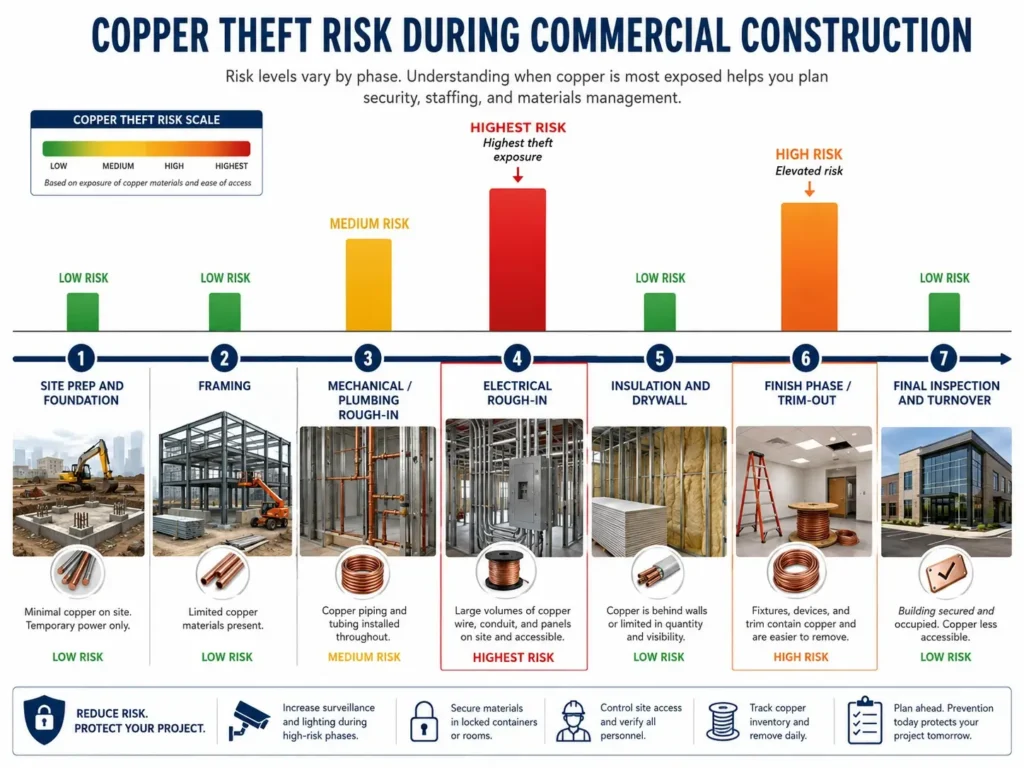
Phase | Exposure Level | Why It Matters |
Electrical Rough-In | High | Wire is exposed and staged across the site |
Switchgear Installation | High | Concentrated high-value copper in one location |
Finish Phase | Medium to High | Fixtures and appliances accumulate |
Demolition | Medium | Existing copper becomes accessible |
Electrical Rough-In
Electrical rough-in is consistently the highest-risk phase. Copper is pulled through studs, laid in conduit, and staged across open structures. Portions may remain unguarded for days, especially across large multifamily sites.
Service and Switchgear Installation
High-amperage feeders, ground rods, and bus bars represent concentrated value. These components are often staged in a single area, making them an attractive target during off-hours.
Finish Phase: Appliances and Fixtures
As projects near completion, copper-containing equipment accumulates. Water heaters, HVAC components, and plumbing fixtures may be stored temporarily before installation. That creates a second exposure window late in the schedule.
Demolition and Existing Conduit
Renovation and demolition sites expose existing copper systems. Weekend downtime combined with open access makes these sites a consistent target.
When Copper Theft Happens (Timing Patterns That Matter)
Time Window | Relative Risk | Notes |
10 PM to 4 AM | Highest | Low visibility, minimal site activity |
Friday to Sunday | Highest | Longer response delays |
Holidays | Elevated | Extended shutdown periods |
Overnight, Weekend, and Holiday Windows
Most construction theft generally occurs between 10 PM and 4 AM, with Friday and Saturday nights showing the highest volume per industry security reporting from NICB. Weekend timing increases the delay before discovery.
The First 30 Days of Electrical Work
Once visible copper appears on a site, the project is often identified quickly by offenders. The first 30 days of electrical rough-in consistently show the highest incident rates. Pattern recognition by offenders generally drives repeat targeting.
Long Weekends and End-of-Project Material Accumulation
Holiday weekends such as July 4 and Christmas show increased incident rates due to extended inactivity. End-of-project staging creates a second risk window as materials accumulate before installation.
💬 Hawk Insight: The “first 30 days of rough-in” pattern is the one most contractors miss. By the time you see signs of activity, you are already past the easy prevention window. Start surveillance before the wire goes in, not after the first hit.
Where Copper Theft Hits Hardest in the Bay Area
San Francisco and the Mission, SoMa, and Bayview Districts
Dense infill construction dominates. Limited setbacks and street-level exposure mean copper is often accessible from the perimeter. Tight sites reduce natural barriers. See our San Francisco surveillance trailer rentals.
Oakland and the East Bay Industrial Corridor
Larger industrial and conversion sites create broad lay-down areas. More material is staged at once, increasing total exposure per incident.
San Jose and South Bay Multifamily Development
High-volume multifamily development spreads across larger footprints. Longer perimeters increase monitoring challenges.
Hayward, Fremont, and the Inner East Bay
This corridor has shown consistent activity between 2024 and 2026. Mixed-use and industrial builds create overlapping risk patterns across nearby sites.
Concord and the I-680 Corridor
Less dense than the inner Bay, but recent activity shows increased targeting of business parks and medical construction projects.
Layered Prevention: What Actually Stops Copper Theft
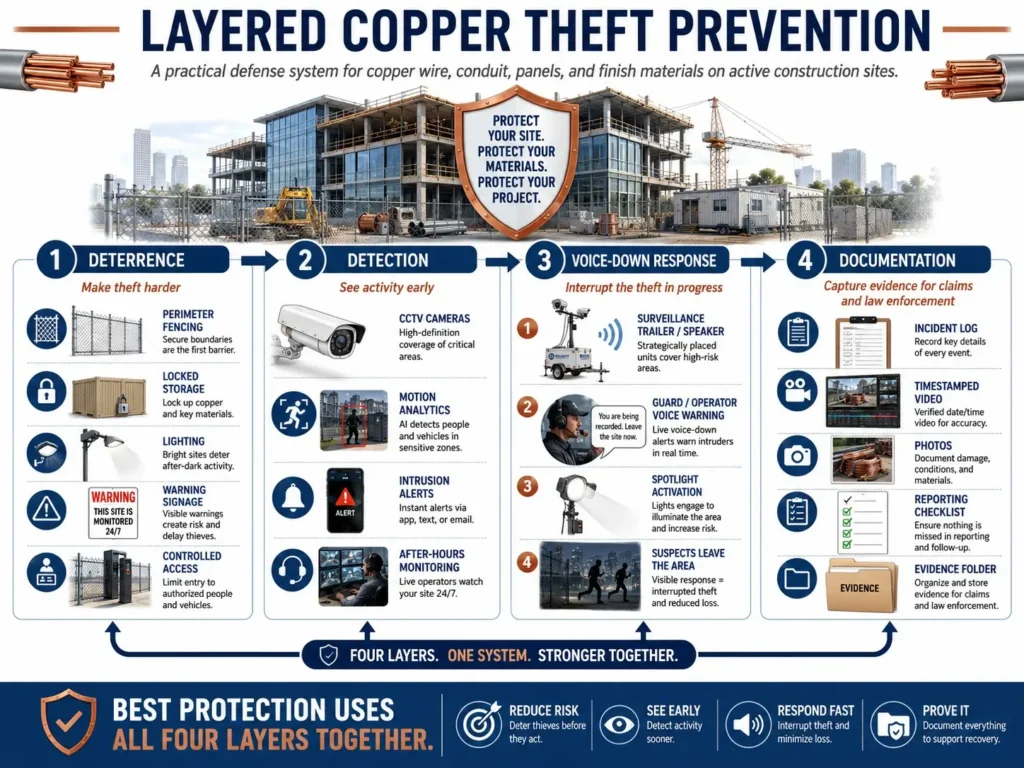
Layer | Function | Impact |
Site Hardening | Physical barriers | Reduces casual access |
Surveillance | Detection | Identifies activity in real time |
Response | Intervention | Stops incidents in progress |
Documentation | Evidence | Supports claims and reporting |
Layer 1: Site Hardening (Lighting, Fencing, Storage Cages)
Fencing, lighting, and locked storage reduce opportunistic access. These measures are low cost relative to losses but generally do not stop determined entry.
Layer 2: Active Surveillance (Cameras and Trailers)
Visible cameras and mobile surveillance trailers add deterrence and coverage. Continuous monitoring changes how a site is perceived. It shifts from passive to actively managed. For a side-by-side comparison of trailer-based monitoring versus on-site guards, see our surveillance trailers vs security guards cost and ROI breakdown.
Layer 3: Active Response (Voice-Down and Monitoring)
24/7 remote monitoring with voice-down capability resolves many incidents immediately. A live warning generally interrupts activity before copper is removed.
Layer 4: Documentation and Recovery
High-definition video, timestamps, and inventory records support insurance claims and reporting. Recovery rates for stolen copper are generally low, but documentation reduces friction in claims processing.
💬 Hawk Insight: Layered prevention is what works. Hardening reduces access. Monitoring detects activity. Voice-down stops it in real time. No single layer carries the load alone.
How a Mobile Surveillance Trailer Stops Copper Theft on a Bay Area Site
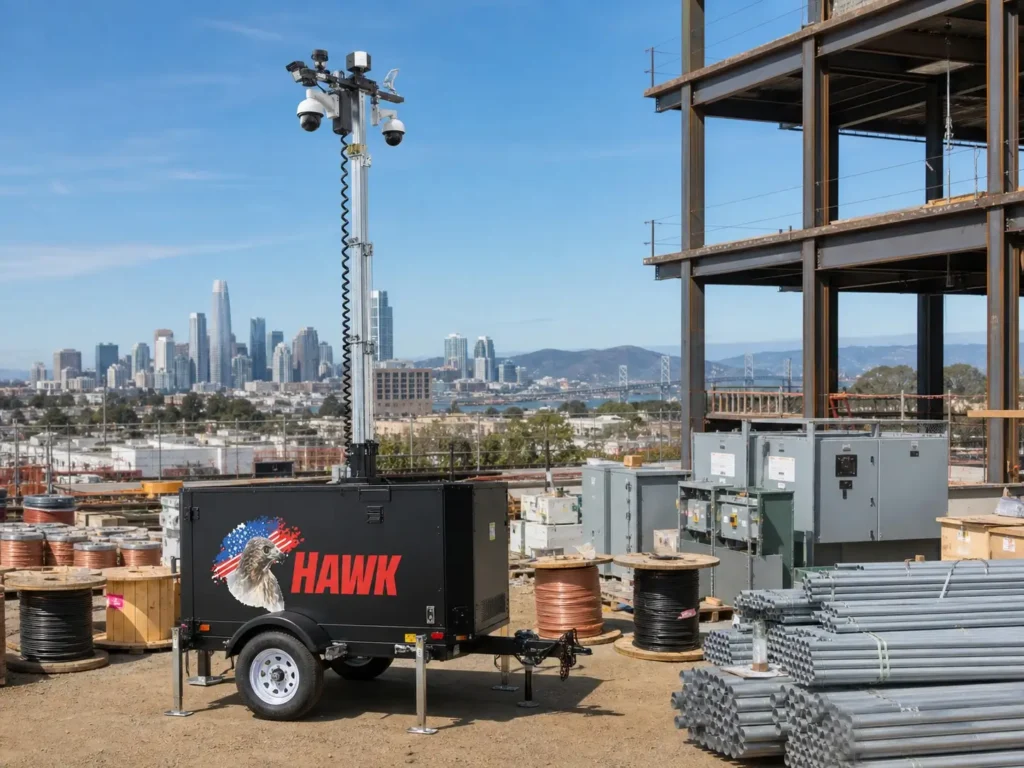
What the Right Configuration Looks Like
Effective setups generally include PTZ cameras, multiple fixed views, and elevated masts for line of sight. Industrial sites typically use heavy-duty industrial trailers, while dense infill projects benefit from compact urban surveillance trailers. For projects spanning multiple buildings or large laydown yards, see our coverage math guide on how many surveillance trailers you actually need.
Why Voice-Down Works on Copper Thieves Specifically
Most incidents are time-sensitive. A live warning introduces risk and delay. That disruption often causes immediate exit before any material is removed.
Documentation for Insurance and Police
Recorded video supports claims and reporting. It provides a clear timeline and visual record, which can improve claim processing efficiency.
Tell us your site location and current phase. Hawk can typically deploy within 24 to 72 hours across the Bay Area.
What to Do Immediately After a Copper Theft on Your Site
If you have just discovered a copper theft, work through the following sequence:
- Secure the site and confirm electrical safety ; verify with a licensed electrician before crews re-enter
- Document all affected areas with photos and notes
- File a police report and record the report number for insurance
- Notify your broker and open the insurance claim
- Inform the property owner and electrical subcontractor
- Inventory all missing materials by type and quantity
- Request a surveillance deployment quote immediately to prevent the next incident
- Preserve any existing video footage before it is overwritten
- Document total costs including labor and schedule delay
- Brief the field team on updated security measures
💬 Hawk Insight: Step 1 is non-negotiable. Energized lines and damaged conduit can put crews at serious risk before the theft is even noticed. Get a licensed electrician on site before anyone returns to work in affected areas.
Three Bay Area Scenarios Where a Trailer Shut Down Repeated Theft
The following are illustrative scenarios drawn from typical Bay Area patterns. Specific outcomes for any individual project depend on site conditions, configuration, and operational circumstances.
Scenario 1: Hayward Multifamily Project, 800 Feet of Romex Stolen
A weekend loss resulted in roughly $22,000 in combined material and schedule impact. A heavy-duty trailer was deployed on a standard rental turnaround, with monitoring active immediately. The remaining months of rough-in completed without further incidents.
Scenario 2: Oakland Industrial Build, Repeated Weekend Hits
Three incidents in one month totaled approximately $48,000. Two trailers were deployed with overlapping coverage. A voice-down event occurred in the first week, and no successful theft followed during the deployment period.
Scenario 3: San Jose Infill Site, Active Theft During Rough-In
Repeated attempts were observed across consecutive weekends. A compact trailer with thermal capability was deployed on a standard rental turnaround. A return attempt was interrupted by voice-down on the first weekend after deployment, and subsequent weekends remained clean.
Send your site details. We will return a configuration, cost, and deployment timeline within one business day.
Frequently Asked Questions
Why is copper wire theft surging on Bay Area construction sites in 2026?
Copper wire theft is surging on Bay Area construction sites in 2026 because copper prices have held above $4.00 per pound (LME data, early 2026), making even small wire pulls profitable to resell within hours. The Bay Area’s dense construction footprint compounds the problem: thieves who scout one exposed site can typically identify three to five within walking distance.
How much copper is typically stolen from a single construction site?
A typical Bay Area copper theft incident involves 600 to 1,000 feet of stolen wire, equal to $3,000 to $10,000 in direct material loss. Once labor, schedule slippage, and insurance deductibles are added, total project impact usually reaches $15,000 to $30,000 per incident.
What is copper worth on the scrap market right now?
As of early 2026, copper has traded around $4.10 to $4.40 per pound on the London Metal Exchange. Scrap pricing varies by yard, but clean copper wire commands strong resale value relative to mid-2010s averages of $2.00 to $3.00 per pound.
When does most copper theft happen on construction sites?
Most copper theft on Bay Area construction sites occurs between 10 PM and 4 AM, with Friday and Saturday nights showing the highest volume. Weekend timing is the worst case because incidents are typically not discovered until Monday morning, by which point stolen copper has already entered the resale stream (per National Insurance Crime Bureau reporting).
What construction phase is most vulnerable to copper theft?
Electrical rough-in is the highest-risk construction phase for copper theft because wire is exposed and staged across the site, often unguarded for days. Switchgear installation and the finish phase (when fixtures, water heaters, and HVAC components accumulate) carry a secondary risk window.
How can I prevent copper theft on my construction site?
The most effective way to prevent copper theft on a construction site is layered prevention: combine site hardening (fencing, lighting, locked storage), active surveillance (cameras or mobile trailers), and 24/7 monitored response with voice-down. A live audible warning interrupts most incidents before any material leaves the site.
Are surveillance trailers effective against copper theft?
Yes, mobile surveillance trailers are effective against copper theft when paired with active 24/7 monitoring and voice-down. Visible deterrence alone reduces opportunistic attempts, but the real disruption comes from a real-time audible warning that interrupts the theft in progress, before copper is cut, removed, or loaded.
Does insurance cover copper theft on construction sites?
Builders risk policies typically include theft coverage for materials on the jobsite, including copper, but deductibles ($5,000 to $25,000 is common per the Insurance Information Institute) and policy terms vary widely. Confirm coverage limits, deductible structure, and documentation requirements with your broker before relying on it.
What should I do immediately after a copper theft on my site?
After a copper theft on your construction site, the first action is always to confirm electrical safety with a licensed electrician before crews re-enter, since cut conductors can remain energized. Then document damage with photos, file a police report, notify your insurance broker and the property owner, inventory missing materials, preserve any existing video, and request a surveillance trailer deployment to prevent repeat hits within the same 30-day window.
How fast can Hawk deploy a trailer to an active Bay Area site?
Hawk Surveillance Systems can typically deploy a mobile surveillance trailer to an active Bay Area construction site within 24 to 72 hours of a quote request, with monitoring and audible voice-down active immediately. Exact timing depends on site conditions, configuration (heavy-duty industrial vs. compact urban), and current scheduling.
Key Takeaways
- Copper prices above $4.00 per pound generally increase theft incentive
- Bay Area density creates repeat exposure across nearby sites
- A single incident often costs $15,000 to $30,000 total
- Electrical rough-in is the highest-risk phase
- Most theft typically occurs overnight on weekends
- Layered prevention is the most effective approach
- Voice-down monitoring can stop many incidents immediately
- Surveillance trailers shift sites from passive to active protection
- Deployment can typically occur within 24 to 72 hours
Protect Your Active Site This Week
Copper theft is a timing problem. Once a site is identified, the next 30 days carry the highest risk of repeat attempts. The fastest way to reduce exposure is to move from passive security to active monitoring.
Tell us your site location, current phase, and the timeline of any recent incidents. Hawk will return a configuration recommendation, deployment cost, and a deployment timeline within one business day. Active Bay Area sites can typically be deployed within 24 to 72 hours.
This guide is educational and intended for general guidance. It is not legal, insurance, or electrical safety advice. Always confirm electrical safety with a licensed electrician before re-entering theft-affected areas, confirm insurance coverage and claim procedures with your broker, and consult law enforcement for reporting and investigation. Cost figures, theft pattern observations, and deployment timelines reflect typical industry conditions and Hawk operational ranges as of early 2026.