If you run a jobsite, yard, lot, or event in Northern California, the choice between a mobile security camera trailer and a security guard usually comes down to one number: the monthly cost. This guide explains guard-cost benchmarks, trailer quote requirements, and the duties each option can cover.
Security Camera Trailer vs. Security Guard: The Short Answer
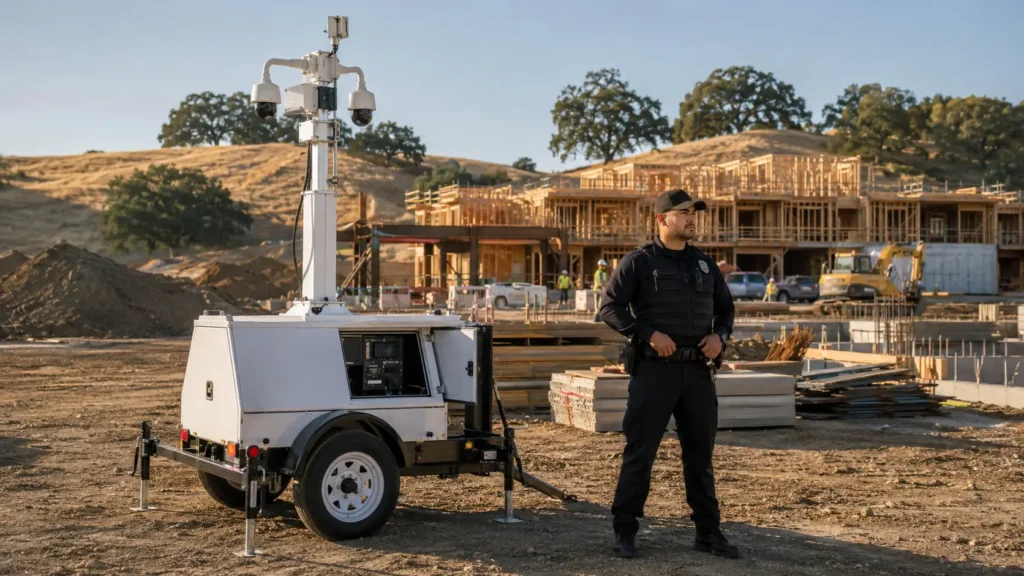
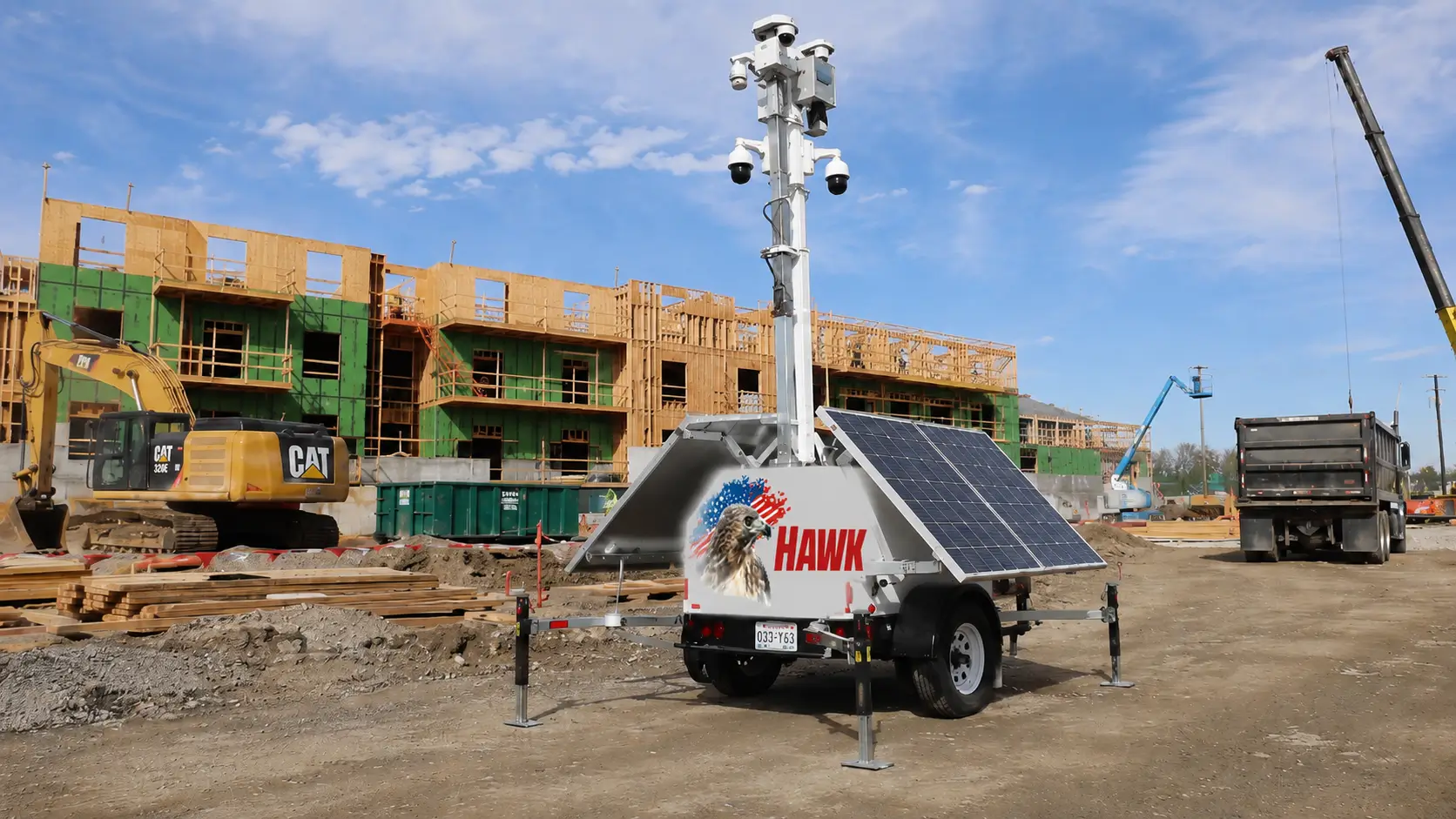
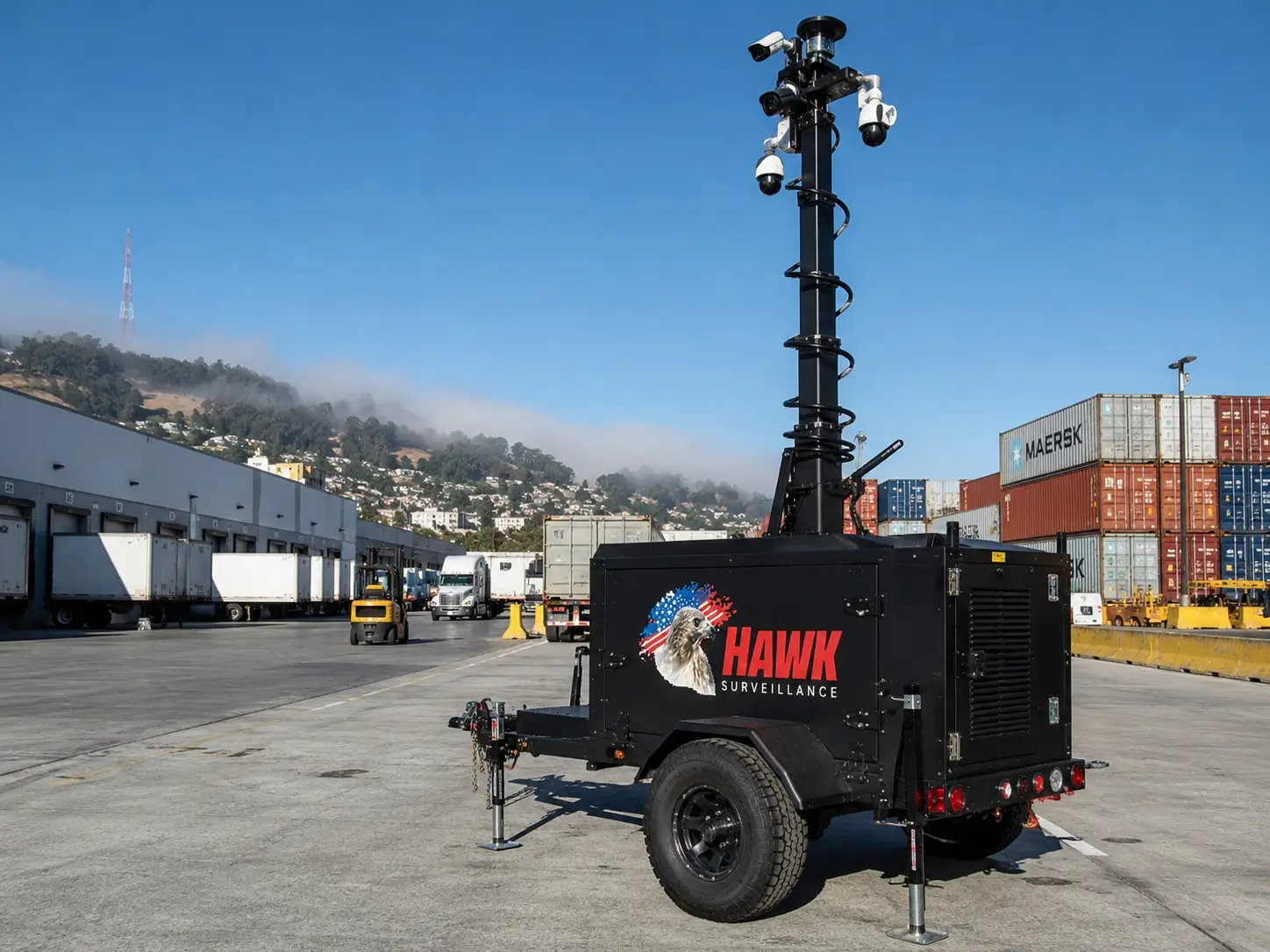
In Northern California, a monitored security camera trailer is quoted per site, while a single security guard on a 24/7 schedule costs roughly $20,000–$30,000 per month. For most jobsites, yards, and parking lots, a mobile surveillance trailer records activity within its configured camera views around the clock, without shift breaks.To compare costs, define the coverage and response duties first, then request complete quotes. The better business question is whether a trailer can give your site enough deterrence, monitoring, and response to replace or reduce guard coverage.A security camera trailer is a mobile, solar-powered surveillance unit that can be deployed to a jobsite, yard, parking lot, utility site, or remote property without permanent power or wired internet. It uses cameras, cellular connectivity, remote video monitoring, and active deterrence tools like voice-down audio to help stop incidents before they become losses.If you are a GC trying to stop copper theft, a logistics operator watching a large yard, or a property manager dealing with after-hours risk, the comparison comes down to coverage, response, evidence, and monthly spend.
How Much Does a Security Guard Cost in California in 2026?
In 2026, a realistic Northern California client bill rate for an unarmed security guard is about $28–$45 per hour. Armed guards often run $40–$65+ per hour, depending on location, risk level, post requirements, supervision, and vendor availability.That hourly rate is not the guard’s take-home wage. It is the bill rate you pay the security company. The vendor has to cover the guard’s wage, payroll taxes, workers’ compensation, liability insurance, supervision, training, scheduling, uniforms, recruiting, turnover, and margin.California labor costs are also not static. California’s 2026 minimum wage is $16.90 per hour for all employers, and some Bay Area cities are higher. For example, San Francisco’s minimum wage is higher than the state rate. That wage floor matters because security companies must price contracts high enough to recruit, retain, and supervise guards in expensive Northern California labor markets.Security guard work is also regulated.Licensed security guards in California must meet BSIS requirements, including age, background checks, and training. Those are important protections, but they also add administrative cost.The number that surprises most buyers is not the hourly rate. It is the 24/7 math.One guard post covered 24 hours a day requires about 720 billable hours per month:24 hours x 30 days = 720 hoursThat means even a modest unarmed guard rate becomes a large recurring expense. At $30 per hour, one 24/7 post costs $21,600 per month. At $40 per hour, that same post costs $28,800 per month.Those figures cover only one post. If your site needs a gate guard and a roaming patrol, or if you need coverage across a large yard with multiple blind spots, the labor cost multiplies fast.There are also hidden operational costs. Guard programs can face shift gaps, no-shows, overtime charges, fatigue, turnover, and inconsistent reporting. A guard can be helpful at a gate or customer-facing access point, but one person can only stand in one place at a time.Federal labor data also shows why guard coverage is labor intensive. Federal wage data for security guards describes a role built around patrol, access control, rule enforcement, emergency response, and observation. Those duties can be valuable, but they require people, scheduling, and supervision every hour you want the post covered.
What Determines a Security Camera Trailer Quote?
Request a rental quote based on your site, camera requirements, and monitoring needs. Ask the provider to specify whether the trailer, camera system, solar power, cellular connectivity, setup, and live monitoring are included. Monitoring costs depend on hours, risk level, camera count, alert volume, and response protocol.For most short-term and mid-term projects, renting is the cleanest option. A surveillance trailer rental turns site security into a predictable monthly operating expense instead of a large capital purchase.Buying a trailer outright can make sense for some owners, municipalities, utilities, and long-term multi-site operators. Purchase pricing is quoted per build, depending on mast height, solar capacity, battery system, cameras, analytics, communications, build quality, and accessories.Compare rental and ownership over your planned period of use, including relocation, maintenance, and removal. You can deploy a trailer when the risk starts, move it as the project changes, and remove it when the job closes. That flexibility matters on construction sites in Sacramento, laydown yards in the Central Valley, and parking lots across the Bay Area.Several factors drive security camera trailer cost:
Trailer type: Compact, urban, heavy-duty, and industrial trailers have different build requirements.
Camera package: Fixed cameras, PTZ cameras, thermal cameras, and wide-angle views affect coverage and cost.
Monitoring level: Compare professional monitoring charges with the staffing and response arrangements needed for self-monitoring. Professional monitoring gives you verified alerts, voice-down intervention, and dispatch escalation.
Rental duration: Request a quote for the full required term, including extension and early-return conditions.
Number of sites: Identify the equipment, deployment, and monitoring requirements at each location.
Guard coverage scales with staffed hours, while the trailer quote reflects equipment and service requirements. Once deployed, a trailer watches continuously.
Side-by-Side Cost & Coverage Comparison
Security camera trailer vs. security guard, typical Northern California site (2026)
Factor
Hawk Camera Trailer (monitored)
24/7 Security Guard
Typical monthly cost
By quote
$20,000–$30,000
Coverage
Configured recording schedule; confirm monitoring hours and outage arrangements
Shift-based; breaks, gaps, single post
Blind spots
Multiple cameras, 360° and PTZ options
One person can watch one area at a time
Evidence
Recorded HD video within configured camera views
Variable; depends on reports and memory
Active deterrence
Lights, voice-down audio, live monitoring
Physical presence (where the guard stands)
Operational start date
Confirm equipment, access, connectivity, and monitoring activation
Confirm available licensed staff and site induction
Key risks
Power/connectivity (solar + LTE/5G mitigate)
No-shows, turnover, fatigue, liability
Best for
Most jobsites, yards, lots, and remote sites
Access control and customer-facing posts
Use this guard benchmark when requesting a site-specific comparison:A single 24/7 unarmed guard post can cost about $22,000 per month. Ask for the complete alternative plan, covering the trailers, monitoring, and deployment your site needs, plus any guard duties you keep.
Want a real number for your site?
Get a free, no-pressure quote and we’ll recommend the right trailer and monitoring level for your location and risk, usually within one business day.
Request a Free QuoteNo obligation · Northern California coverage · Fast deployment
But Can a Camera Trailer Really Replace a Guard?
Yes, for many Northern California sites. But not for every security job.A guard is still the better choice when your site needs physical intervention, visitor management, badge checks, customer-facing presence, escort services, or complex on-the-spot judgment. A camera trailer cannot open a gate, search a bag, direct traffic, or physically remove a trespasser.That said, many sites do not need a person standing there all night. They need fast detection, visible deterrence, recorded evidence, and a response path when something happens.A monitored trailer combines camera coverage with remote review and an agreed response process.With 24/7 remote monitoring, a trailer can detect activity after hours, alert a trained operator, trigger a real-time voice-down warning, record the event, and escalate to law enforcement when needed. Instead of paying one guard to patrol one section of a site, you are using cameras and monitoring agents to watch key zones continuously.This matters on large, open, or changing sites. A construction project may have tools near one area, copper near another, fuel near another, and fence lines that move as phases change. A single guard can miss activity happening outside their line of sight. A trailer with multiple cameras can watch the perimeter, entry points, equipment zones, and staging areas at the same time.The best answer is often not “trailer or guard.” It is the right tool for the right risk.Many Northern California sites use a hybrid model. A guard handles daytime access control or public-facing duties. A monitored trailer handles after-hours perimeter coverage, evidence capture, and active deterrence. Hawk can help you decide whether live professional monitoring is enough on its own, or whether a hybrid plan makes more sense.
Which Is Right for Your Site? (Use-Case Guidance)
Construction jobsites
For most construction sites, a monitored trailer is the stronger first move for after-hours theft. Tools, copper, generators, materials, and equipment are usually most vulnerable at night, on weekends, and during quiet phases of the project.A trailer can provide visible deterrence and recorded evidence within its camera views. Compare the full deployment quote with the guard duties and hours your site requires. For larger jobs, multiple trailers can cover entrances, laydown areas, and high-value zones.If your project also needs daytime gate control, delivery coordination, or public-facing access management, use a guard during staffed hours and a trailer after hours. For more guidance, review Hawk’s construction jobsite security solutions.
Logistics yards and warehouses
Logistics yards have a different problem. They often cover a large area with trailers, cargo, fuel, fencing, and limited entry points. A single guard can patrol, but they cannot see every row and corner at once.A surveillance trailer is usually a better fit for perimeter visibility, after-hours alerts, and evidence. PTZ cameras can help monitor movement across the yard, while fixed cameras can stay locked on gates, fence lines, or high-value storage areas.For yards in Sacramento, the Central Valley, and Bay Area industrial corridors, if cameras can take over monitoring duties, a site may be able to reduce staffed guard hours. Compare the total cost of the revised plan. See Hawk’s logistics yard security page for more use-case detail.
Retail and parking lots
Retail centers, parking lots, and commercial properties need deterrence, documentation, and liability support. A visible trailer can help discourage loitering, break-ins, vandalism, dumping, and after-hours trespass.A guard may still make sense during open hours if the property needs customer interaction or on-site de-escalation. But for overnight coverage, a trailer watches continuously, records incidents, and supports response protocols.Hawk’s retail & parking lot security solutions are designed for commercial sites that need a visible security presence without turning every parking lot into a full-time labor post.
Remote and off-grid sites
For utilities, solar fields, agriculture, remote infrastructure, and unpowered lots, a guard can be hard to staff and expensive to retain. A trailer is often the only practical option.A solar surveillance trailer can operate without permanent power and use LTE/5G connectivity where wired internet is not available. That makes it useful for remote Northern California sites where risk is real but daily staffing is not practical.
Events and short-term spikes
Events, seasonal operations, temporary storage yards, and construction phase changes often need security for a defined window. Hiring and scheduling guards for a short period can be expensive and slow.Hawk’sdeployment process is built around practical site assessment, placement, setup, and monitoring alignment. For temporary coverage in areas likeSacramento, ask each provider to confirm the earliest operational start date.
See what a monitored trailer would cost for your site
See how a monitored Hawk surveillance trailer compares to a guard contract for your exact site. We’ll build a side-by-side cost breakdown and recommend the right setup.
Get My Free Cost ComparisonServing construction, logistics, retail, municipal & event sites across Northern California
Frequently Asked Questions
How much does a security camera trailer cost compared to a security guard?
In Northern California, a monitored security camera trailer is quoted per site. A single 24/7 security guard post costs roughly $20,000–$30,000 per month. The trailer quote depends on camera count, monitoring tier, deployment, and rental term, so compare complete quotes for the same coverage period.
What is the hourly cost of a security guard in California in 2026?
In 2026, unarmed security guards in Northern California commonly bill at about $28–$45 per hour, while armed guards often bill at $40–$65+ per hour. These are client bill rates, not just wages. They include labor, insurance, licensing, supervision, scheduling, overhead, and margin.
Can a surveillance trailer really replace a security guard?
For 24/7 deterrence, remote monitoring, recorded evidence, and dispatch escalation, yes. A monitored trailer can replace or reduce guard coverage on many jobsites, yards, parking lots, and remote properties. Guards are still better for physical intervention, visitor management, and staffed access points, so some sites use both.
How do I check whether switching would reduce total security spending?
The saving, if any, depends on your current guard bill and the complete replacement plan. One 24/7 unarmed guard post can cost about $22,000 per month or more. Request a quote covering the required trailers, monitoring, deployment, and any guard duties you still need.
Do security camera trailers work without permanent power or wired internet?
Yes. Hawk trailers are designed for sites without permanent power or wired internet. They use solar panels, battery backup, and LTE/5G connectivity to support remote and off-grid Northern California deployments. That makes them a strong fit for construction sites, utility work, yards, solar projects, and temporary properties.
Is a guard or a camera trailer better for a construction site?
For after-hours theft of tools, copper, materials, and equipment, a monitored camera trailer is usually the better first choice because it watches more of the site at once. A guard can still be useful for daytime access control, delivery coordination, and staffed entrances.
How fast can a surveillance trailer be deployed in Northern California?
Ask each provider to confirm the earliest operational start date. For a trailer, confirm equipment availability, access, placement, connectivity, and monitoring activation. For guards, confirm available licensed staff and site induction. For urgent coverage, start with Hawk’srequest a quote page and share your site location, timeline, and risk areas.
The Bottom Line for Northern California Sites
A security camera trailer is not simply a guard swapped for a camera. It is a different security model.
For most Northern California jobsites, logistics yards, parking lots, and remote properties, a monitored trailer delivers 24/7 visibility across the zones it covers. It records activity, watches multiple zones at once, and does not take breaks, call in sick, or leave a shift uncovered.
Guards still matter when you need physical access control, public interaction, or intervention. But for perimeter security and after-hours risk, a monitored trailer or a hybrid plan is worth pricing against your current guard plan.
See what a monitored trailer would cost for your site.
Tell us your location and timeline, and Hawk Surveillance will send a clear quote within one business day.