
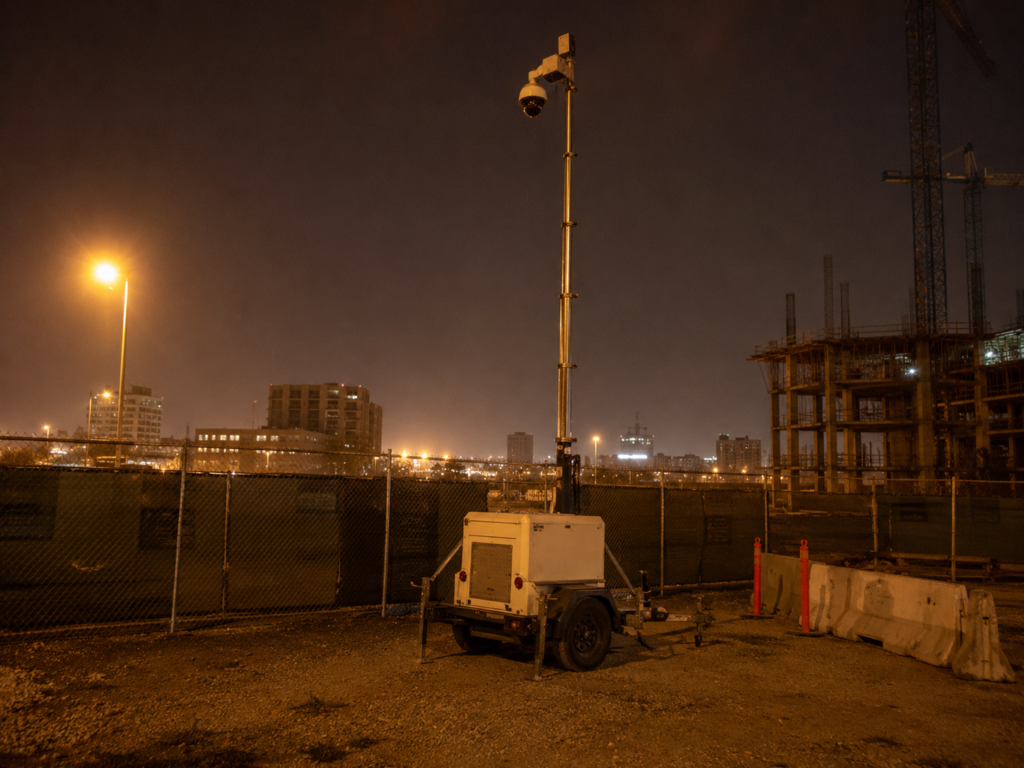
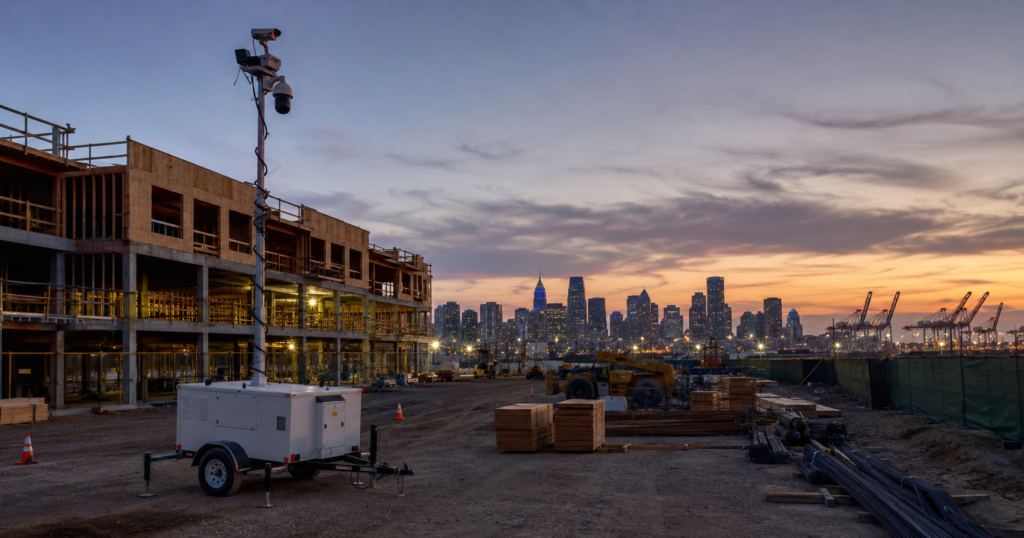
The practical comparison is not “guards versus cameras.” It is continuous wide-area detection versus intermittent human observation. National surveillance providers such as WCCTV, Pelco, SentraCam, and Joint Power Security may fit broad procurement lists, but Hawk’s wedge is NorCal-specific trailer placement for construction, logistics, utilities, and industrial sites where guards, cameras, and monitoring need to be coordinated around the actual jobsite.
What mobile surveillance actually does on an Oakland site
In brief: Mobile surveillance gives Oakland contractors wide-area visibility, deterrence, recorded evidence, and a response path without waiting for permanent poles, power, or internet.
A mobile surveillance trailer is a temporary, repositionable security platform that combines elevated cameras, power, connectivity, deterrence features, recording, and optional live monitoring. On a construction site, it is used to observe high-risk zones that move as the build moves: gates, laydown areas, tool storage, copper staging, equipment, temporary power, exposed perimeters, and finish-material storage.
A trailer’s elevated mast can see over fencing and across staging yards. Hawk’s homepage describes trailers that protect jobsites, parking lots, and high-risk facilities, with high-definition views of entrances, perimeter lines, parking areas, equipment yards, and other critical zones. Hawk also states that it typically delivers, positions, and activates a mobile surveillance trailer within 24 to 48 hours, depending on conditions and scheduling. (Hawk Surveillance Systems)
For Oakland sites without reliable grid power, a solar surveillance trailer keeps coverage active while the electrical plan is temporary. For sites that need operator response, 24/7 remote monitoring adds live review, voice-down warnings, alert routing, and escalation steps. For general contractors, Hawk’s construction jobsite security approach is built around the reality that risk changes between foundation, framing, rough-in, finishing, and turnover.
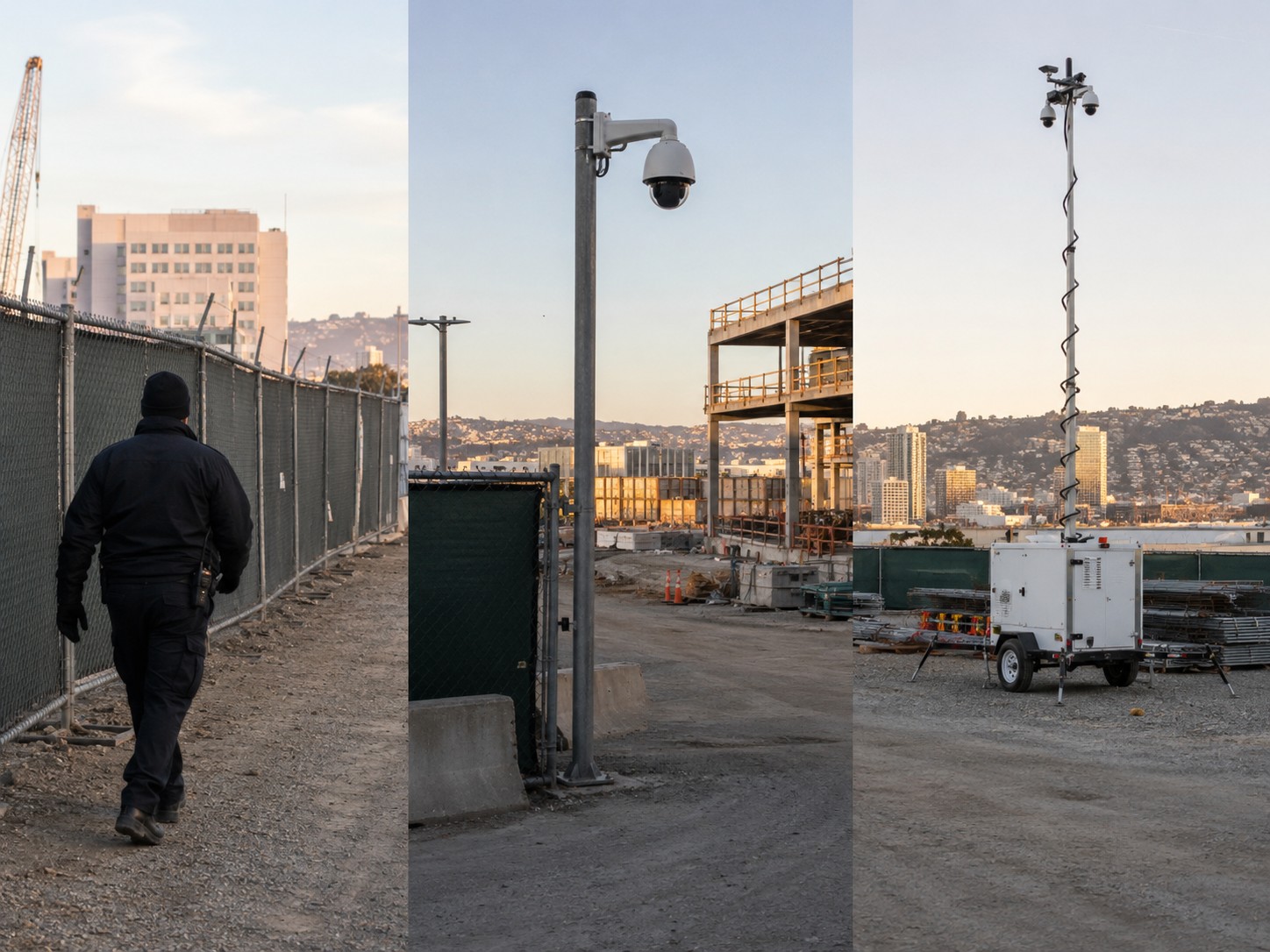
This is where trailers outperform fixed cameras. Fixed cameras are useful when power, internet, and final mounting points already exist. Oakland jobsites often do not have that early in the schedule. Mobile trailers can move when the laydown yard shifts, when a new access gate opens, when the finish-material area becomes the highest-value target, or when a phase turns a previously low-risk corner into the easiest entry point.
Oakland-specific risk patterns by neighborhood
In brief: Oakland security planning should be based on site geometry, access points, material staging, street exposure, and project phase. It should never be based on broad assumptions about a neighborhood.
Oakland’s risk picture is corridor-specific. West Oakland, East Oakland, the Coliseum area, Downtown, Jack London, Fruitvale, and port-adjacent industrial zones all have different traffic patterns, staging constraints, visibility, and approach routes. A good security plan respects those differences without overgeneralizing or disparaging any area.
West Oakland projects often have infill footprints, port-adjacent vehicle movement, transit proximity, and constrained access. The City of Oakland’s Major Projects Division says its transportation work includes strengthening connections between West Oakland, Chinatown, Downtown, Old Oakland, and Jack London while improving goods movement around the Port of Oakland. That matters because construction security has to consider deliveries, gate placement, street frontage, and vehicle movement together. (City of Oakland)
East Oakland and Coliseum-adjacent sites often require strong perimeter review, equipment security, after-hours entry-point control, and temporary lighting. Downtown and Jack London sites may benefit from higher public visibility, but that does not remove the risk. In dense areas, tools, fixtures, and finish-stage materials can be exposed to quick entry and exit routes.
Major phased development also creates moving security requirements. Oakland’s Brooklyn Basin page notes a marina expansion approval in May 2023 that included an increase of 600 residential units, bringing the project site total up to 3,700 units. That kind of phased activity shows why construction security cannot be designed once and ignored for the rest of the project. (City of Oakland)
Hawk supports this local need through Oakland surveillance trailer rental. Local deployment matters because Oakland sites may involve tight urban frontage, port-adjacent access, public visibility, street restrictions, and changing construction phases.
Oakland does not publish one universal jobsite-security ordinance that applies the same way to every project. Instead, security-related controls may appear through fencing, lighting, construction management plans, site conditions, permits, and project-specific requirements. Oakland’s fence permit guidance says commercial-zone fences higher than 8 feet but lower than 10 feet are subject to Small Project Design Review, while industrial-zone fences higher than 8 feet but lower than 12 feet are also subject to Small Project Design Review. (City of Oakland) The city also notes that the 2025 California Building Standards Code took effect January 1, 2026, which makes 2026 planning especially timing-sensitive for active and new projects. (City of Oakland)
Insurance and builders-risk, the security ROI most GCs miss
In brief: The insurance value is not a guaranteed discount. The value is better documentation, stronger underwriting support, cleaner incident evidence, and proof that the site is not being left uncontrolled after hours.
The measurable ROI of construction surveillance is often found in avoided loss, fewer disputes, better claim documentation, and stronger risk-control conversations. Builders-risk carriers may ask about fencing, lighting, theft prevention, site access, watch service, fire protection, and protective safeguards. They may also care whether a contractor can prove the security plan was active and maintained.
IRMI’s builders-risk protective-safeguards update identifies protective safeguards used by underwriters, including fencing, lighting, detection systems, video surveillance, and security services. (IRMI) IRMI’s separate protective-safeguard discussion gives example language where security service can mean watchmen making no less than hourly rounds of the entire jobsite during nonworking hours and maintaining logs. (IRMI)
That does not mean every Oakland site needs a guard walking hourly rounds all night. It means the project team should be able to show the broker and carrier what controls are in place. A hybrid plan can include a mobile trailer, remote monitoring event logs, recorded clips, lighting, fence checks, gate procedures, subcontractor access rules, and targeted guard logs where guards are used.
For a deeper insurance-focused planning discussion, see Hawk’s guide to builders-risk insurance.
Clean incident evidence also helps outside insurance. Video can help determine whether a loss was theft, misuse, internal movement, vendor access, vandalism, or a disputed claim. It can support police reports, subcontractor accountability, incident reviews, and project-owner communication.
Five Oakland construction security scenarios
In brief: The best system depends on site size, phase, power, street exposure, and material value. These five scenarios show when guards, fixed cameras, trailers, and monitoring fit together.
Scenario card 1: West Oakland infill site with tight frontage
A compact infill site may not need multiple guard posts, but it does need strong gate visibility, street-facing deterrence, tool-container coverage, and after-hours monitoring. A compact or standard mobile trailer positioned near the gate can watch the entry point and the highest-value staging zone. Add a guard only during high-traffic delivery windows or public-facing work.
Scenario card 2: Coliseum-area equipment and laydown yard
An equipment yard or heavy laydown site needs long sight lines, lighting, vehicle detection, and recorded evidence. Guards can check drivers and control access during work hours, but the after-hours exposure is better handled with trailer coverage, remote monitoring, and voice-down response. For rough ground or large footprints, a heavy-duty trailer may be the right platform.
Scenario card 3: Downtown tenant-improvement or finish-stage project
A downtown project may have more ambient street visibility, but the risk shifts when finished materials arrive. Appliances, fixtures, tools, copper, and lighting packages can become attractive targets. A mobile trailer near the access point, paired with camera coverage of the delivery and storage area, provides evidence and deterrence without requiring a full-time overnight guard post.
Scenario card 4: Multi-phase mixed-use development
Phased projects are where fixed systems fall behind. The risk zone changes from excavation to framing to rough-in to finishes. A trailer can move as site geometry changes, which means coverage follows the actual value on site. Monitoring rules should also change by phase, especially when copper, fixtures, or finished materials are being installed.
Scenario card 5: Stalled, paused, or delayed project
A paused site is not risk-free. It can attract dumping, vandalism, trespass, and material theft because normal trade activity is lower. A mobile surveillance trailer provides visible site control, lighting, recording, and remote escalation while the project is waiting for financing, inspections, materials, or schedule restart.
Deployment workflow, what your first 48 hours look like
In brief: A strong Oakland deployment starts with the jobsite map, not the hardware. Trailer position, camera angles, monitoring hours, and guard roles should follow the actual risk zones.
The first step is a site walk or remote intake. Hawk reviews gates, laydown areas, high-value materials, equipment, blind corners, lighting, neighbor constraints, street access, power availability, and cellular coverage. The goal is not just to place equipment. The goal is to decide what the trailer must see, what the operator should respond to, and whether a guard belongs at a specific post.
The next step is configuration. That includes trailer type, camera mix, mast height, power setup, connectivity, lighting, audio deterrence, and monitoring tier. Hawk’s site describes a deployment process that includes assessment, configuration, delivery, positioning, mast raising, camera tuning, connectivity checks, and alert testing. (Hawk Surveillance Systems) For the company workflow, review how we deploy.
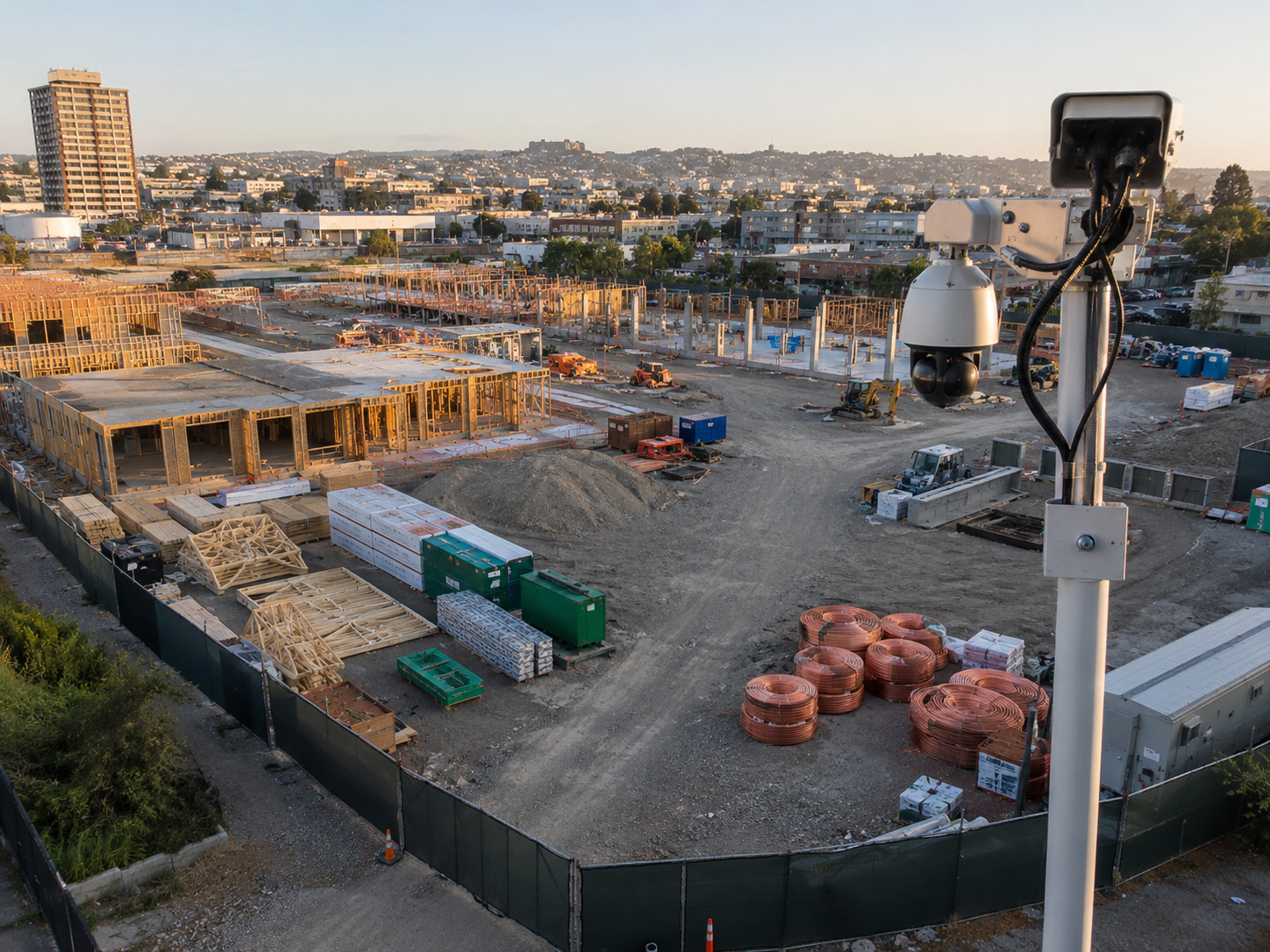
Then the monitoring plan is set. Some Oakland sites self-monitor because they already have a security operations center or an internal team. Higher-risk sites usually benefit from active video monitoring, especially when copper, tools, generators, fixtures, or finished materials are staged. The monitoring plan should define after-hours windows, escalation contacts, voice-down rules, police-call thresholds, superintendent notifications, and reporting expectations.
Finally, the plan should include repositioning. A trailer that was correct during foundation work may be wrong during framing. A trailer that watched the main gate may need to move when finish materials arrive. Repositioning is one of the major advantages over fixed cameras, and it is why Oakland construction managers should treat security as a phased operating plan rather than a one-time install.