

Last updated: June 2026
TL;DR, AT A GLANCE
San Jose construction sites face copper theft, equipment loss, and after-hours vandalism. For 2026, the practical answer is not guards alone, fixed cameras alone, or a one-size national package. South Bay projects need flexible coverage that moves as foundations, framing, MEP rough-in, and finish work shift across the site. A monitored surveillance trailer rental gives GCs an elevated, visible, after-hours layer without permanent installs, while targeted guards handle access control, escorts, gate checks, and response tasks. The best plans map risk areas first, close perimeter gaps second, and document incidents clearly for owners, insurers, and project teams.
Why San Jose construction sites are getting hit in 2026
San José’s own streetlight data showed wire-theft outages rising from an average of 24 affected lights per month in late 2023 to 167 affected lights per month in early 2024, with 712 outages reported to date in the City’s October 2024 update. (San José City)
San Jose is not a simple “high crime” story. It is the Bay Area’s largest city, a major housing-production market, a tech-corridor construction market, and a transit-adjacent development market. The same theft and vandalism pressures shape construction site security in Oakland and construction site security in San Francisco, the other large Bay Area build markets. The City’s housing-production reporting says San José is working toward 62,200 additional units by 2031, permitted 2,211 units in 2024, and had 3,586 units built since July 2022. That level of activity means more temporary fencing, more staged materials, more subcontractor turnover, and more sites that look different every month. (San José City)
The materials profile matters. Copper conductor, temporary power cable, grounding wire, tools, fixtures, appliances, batteries, generators, camera hardware, and stored MEP materials all have theft value. For South Bay sites, copper is especially visible because it appears in electrical rough-in, grounding systems, temporary power, streetlight infrastructure, utility tie-ins, and tech-equipment work. Hawk’s broader guide to Bay Area copper-wire theft covers that pattern in more detail.
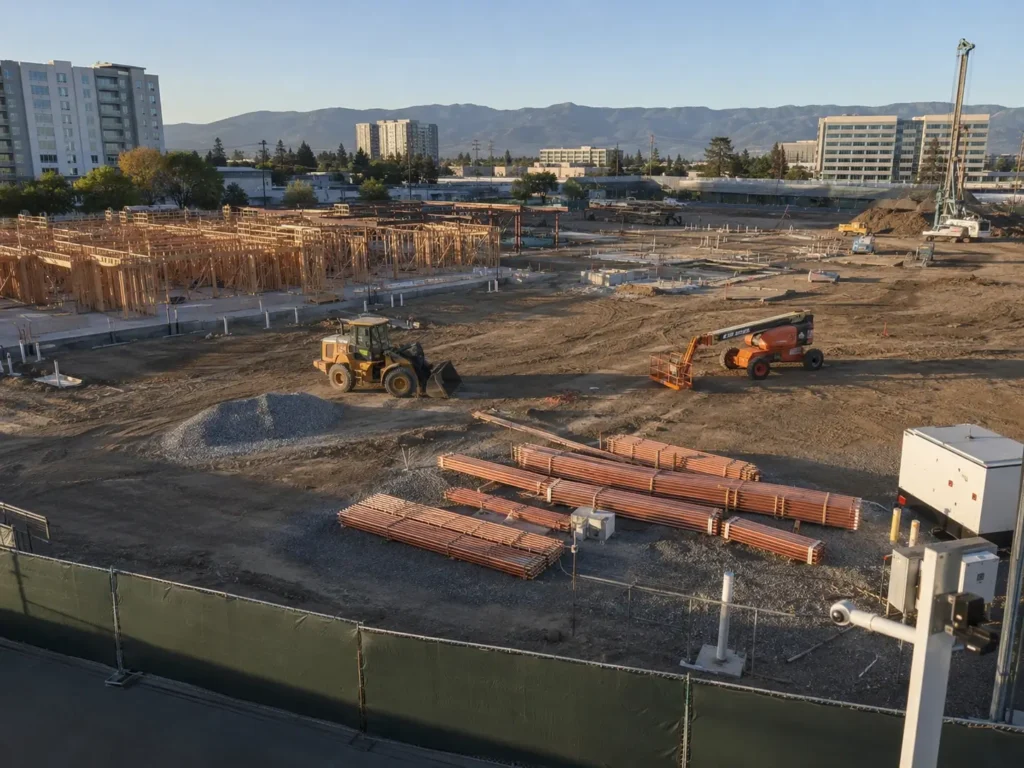
The risk is not limited to one project type. A North San Jose tech-campus build may have large fencing lines and multiple access gates. A Downtown or Diridon-adjacent project may have tighter street frontage, more pedestrian activity, and less laydown room. An East San Jose housing project may have residential neighbors, smaller staging zones, and different access points. The common issue is the same: after-hours risk areas shift as the site changes.
San Jose Police Department materials also show why jobsite teams should avoid simplistic year-over-year claims without context. SJPD notes that NIBRS crime reporting can capture more offense detail than older reporting, including property categories such as burglary, vandalism, theft from building, theft from motor vehicle, and trespass, and that changes in reported statistics can reflect reporting-method changes as well as field conditions. (San Jose Police Department)
For construction teams, the lesson is practical. Do not wait for a loss to reveal the weak point. Map gates, staging, dark edges, stored copper, trailer offices, tool containers, and blind corners before the site reaches the phase where those targets become valuable.
Why guards alone don’t cover a South Bay job site
One staffed 24/7 guard post equals 168 staff-hours per week before adding rover coverage, relief, supervision, or multiple posts.
A guard can deter, verify, report, escort, and respond. Those are valuable tasks. The problem is coverage geometry. One guard is one person in one place at one time. On a compact site, that may be enough for gate control. On a multi-acre South Bay project with long fence lines, material staging, tool containers, and multiple access points, a single guard can leave perimeter gaps between patrols.
Pricing also scales linearly. More hours require more guard hours. More gates require more posts. More patrol frequency requires more labor. For high-tempo sites, that can become expensive before the site has true visual coverage.
The practical San Jose model is not “trailers replace guards.” It is “use trailers for wide-area monitoring, then use targeted guards where human presence is actually needed.”
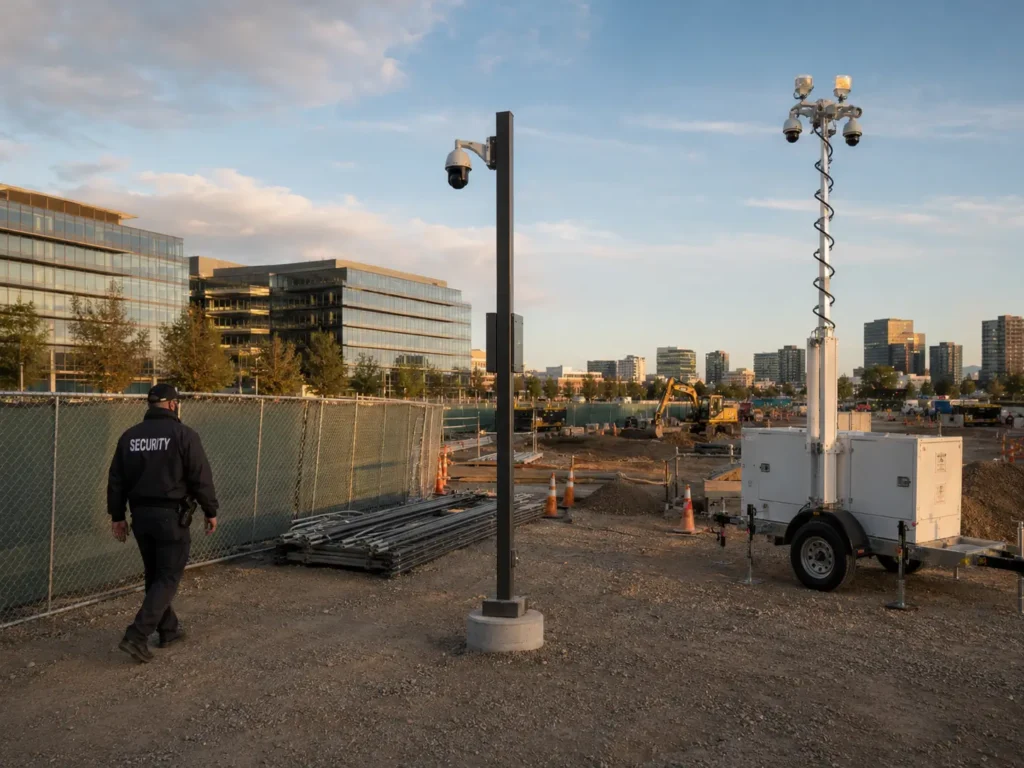
Compared with national surveillance providers such as WCCTV, Pelco, SentraCam, or Joint Power Security, Hawk’s differentiator is local deployment logic: trailer placement, phase repositioning, monitoring fit, and guard coordination for Northern California sites rather than a generic camera package.
The right question is not “guards or cameras?” The right question is “which risk areas need human control, and which need monitored visibility?” Once that is clear, the jobsite plan becomes easier to price, manage, and explain to the owner.
What mobile surveillance actually does on a San Jose site
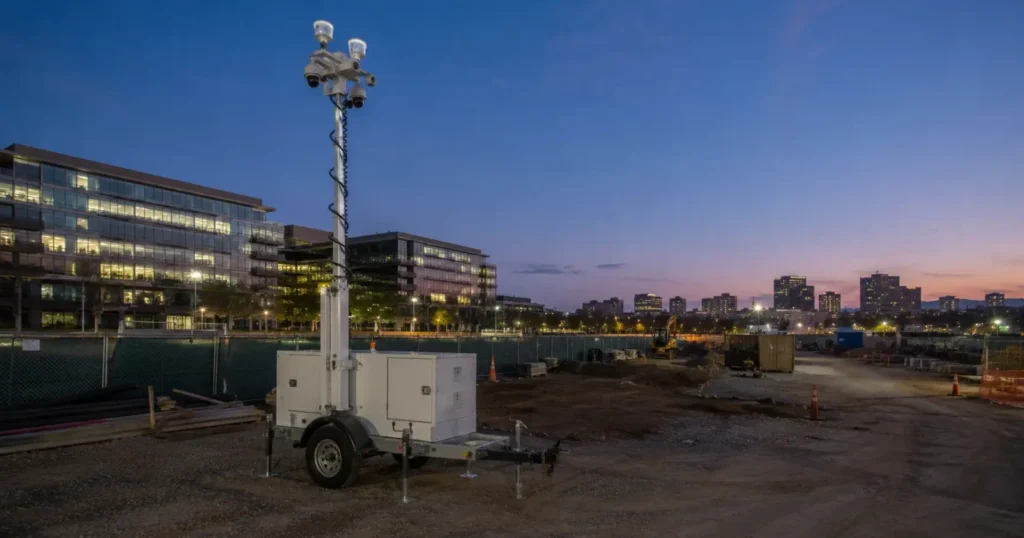
A mobile surveillance trailer is a temporary, elevated security platform that combines cameras, power, communications, and optional live monitoring for active jobsites.
Mobile surveillance is a deployable security layer for temporary or changing environments. On a construction site, it covers perimeters, gates, laydown yards, material staging zones, tool containers, access roads, and dark fence lines. Unlike fixed cameras, the trailer can move when the work moves.
On a San Jose jobsite, that usually means three things. First, the mast gives line-of-sight over temporary fencing, parked equipment, and stacked materials. Second, off-grid power allows deployment before permanent utilities are ready. Third, monitoring rules allow the site team to distinguish between expected activity, after-hours subcontractor access, unauthorized entry, and incident escalation.
Hawk frames construction jobsite security around placement, visibility, monitoring, and operational response. The equipment is only one part of the program. The real value comes from where the trailer sits, what it watches, how events are reviewed, who gets notified, and how the plan changes as the build progresses.
A typical San Jose mobile trailer program may include:
- An elevated, masted surveillance trailer positioned for line-of-sight over fencing, equipment, and staged materials
- Off-grid solar and battery power so the unit can deploy before permanent utilities are live
- Cellular connectivity for remote viewing and alert delivery
- Perimeter, gate, and laydown-yard camera angles aimed at the highest-risk zones
- After-hours active or scheduled monitoring with defined approved-work-hour rules
- Clear escalation paths and response contacts (superintendent, owner rep, guard company, or police reporting)
- Phase-based repositioning as foundation, rough-in, and finish work shift across the site
For active monitoring, Hawk’s 24/7 remote monitoring layer helps turn cameras into an operating program. Monitoring is most useful when the site team defines approved schedules, authorized vendors, gate rules, response contacts, and escalation thresholds before the first alert.
A solar surveillance trailer is especially useful during early phases, surface work, site utilities, foundation work, and large laydown setups because it can operate before permanent electrical and network infrastructure is in place.
California privacy law is another reason to design the program correctly. California Penal Code section 632 restricts recording confidential communications without consent, so jobsite surveillance plans should default to video-focused monitoring, posted notice, and careful audio policy review with counsel where needed. (California Legislative Information)
San Jose-specific risk patterns by area
North San José’s development policy historically contemplated 32,000 homes, more than 25 million square feet of office and industrial space, 3 million square feet of retail and commercial space, and 1,000 hotel rooms, which explains why large, phased sites remain a core security planning concern. (San José City)
For local coverage planning, Hawk supports San Jose projects through its San Jose surveillance trailer rental page and site-specific deployment planning. The city is too varied for one template. A downtown infill project, a North First Street tech-corridor build, and a residential podium project need different sightlines.
Scenario card 1: North San Jose tech corridor
Typical risk areas: long fence lines, multiple subcontractor gates, temporary power, copper grounding, site trailers, and large laydown zones.
Best-fit coverage: one or more elevated trailers positioned to see access routes, tool containers, and material staging, with monitoring rules tied to approved work hours. This is where phase repositioning matters most because rough-in, equipment delivery, and finish material storage do not happen in the same area.
Scenario card 2: Downtown and Diridon-adjacent projects
Typical risk areas: tight urban frontage, limited staging, pedestrian visibility, alleys, garage entries, and street-facing access.
Best-fit coverage: visible trailer placement where allowed, fixed camera angles focused on entry points, and clear after-hours escalation. Diridon planning remains active: partner agencies selected a preferred station alternative in May 2025, and the next environmental review phase is expected to take about three to four years. (Diridon Station Area)
Scenario card 3: East San Jose residential and infill sites
Typical risk areas: smaller lots, repeated vendor visits, fixture deliveries, tool theft exposure, and after-hours trespass.
Best-fit coverage: compact trailer placement, targeted camera views at gates and material storage, and coordination with the superintendent so monitoring teams know which trades are expected after normal hours.
Scenario card 4: Highway-adjacent staging and logistics edges
Typical risk areas: easy vehicle access, stored equipment, open yards, trailers, fuel, and material bundles.
Best-fit coverage: trailer visibility at the most likely vehicle approach, camera views of license-plate paths where legally appropriate, and response contacts who can verify whether a late-night pickup is authorized.
Scenario card 5: Finish-stage multi-family and commercial builds
Typical risk areas: appliances, copper trim-out, fixtures, tools, doors, hardware, and interior-access points.
Best-fit coverage: trailer coverage outside plus interior access control by the GC. The risk shifts from bulk materials to finished goods, so the plan should shift from broad perimeter visibility to access verification and evidence capture.
Insurance + builders-risk: the security ROI most South Bay GCs miss
Builders-risk coverage commonly applies to construction-phase property loss from perils such as fire, theft, vandalism, malicious mischief, collapse, flood, windstorm, and materials exposure, depending on the policy. (Dartmouth)
Most South Bay construction teams think about security after a theft, after a vandalism incident, or after the owner asks why the site was exposed. The better approach is to make security part of the project-risk file before the loss.
That does not mean promising a guaranteed insurance discount. Hawk should not make that promise, and neither should a GC. But a documented plan can help a broker or risk manager explain the site’s controls. For larger projects, the security file may include trailer locations, monitoring schedules, response protocols, gate maps, incident logs, camera coverage screenshots, lighting notes, and phase-repositioning records.
This matters because builders-risk conversations are evidence-driven. If a carrier asks how copper, fixtures, stored equipment, or work-in-progress is protected, “we have a guard sometimes” is weaker than a dated site plan showing coverage areas, monitoring hours, escalation procedures, and incident documentation. Hawk’s guide to builders-risk insurance explains the insurance-facing value of surveillance documentation in more detail.
A practical builders-risk security file should include:
- Trailer placement maps showing camera coverage and sightlines for each phase
- Monitoring schedules (active, scheduled, weekend, holiday, or shutdown coverage)
- Escalation procedures and a current response-contact list
- Gate and access rules, including authorized vendors and after-hours work
- Dated incident logs with timestamped camera clips and screenshots
- Lighting notes and identified perimeter or blind-spot gaps
- Phase-repositioning records documenting how coverage changed as the build progressed
The financial value is not only premium-related. A clear incident clip can reduce dispute time, support police reporting, help the superintendent identify perimeter gaps, and show the owner that the site team acted quickly. For GCs managing several South Bay projects at once, that documentation can become a repeatable risk-control process.
Not sure where your San Jose site is most exposed?
Hawk maps your risk areas, closes perimeter gaps, and times coverage to each construction phase, from foundation to finish.
Talk to a Security SpecialistDeployment workflow: what your first 48 hours look like
A prepared San Jose site can typically move from placement plan to commissioned trailer within 24 to 48 hours, while larger multi-trailer rollouts are usually phased over 3 to 7 days depending on access, site readiness, and coverage scope.
A good deployment starts with a site walk, not a product list. Hawk looks at the fence line, access points, staging zones, grade changes, lighting, power status, cellular signal, neighboring uses, gate schedules, and where the project will change next. That is how a trailer becomes a site-security tool instead of just equipment in the corner.
The workflow usually follows four steps.
Step 1: Site walk and placement plan
The first task is to identify risk areas. That includes copper storage, tool containers, temporary power, unfinished openings, parking areas, office trailers, and the access point most likely to be used after-hours. From there, Hawk defines the initial trailer position and camera priorities.
Step 2: Delivery and commissioning
A trailer is delivered, positioned, leveled, powered, connected, aimed, and tested. Solar and battery setup matters. Cellular connection matters. Camera angle matters. A few feet of placement can determine whether the system sees the gate, the fence gap, or the wrong side of a material stack.
Step 3: Monitoring tier selection
Not every site needs the same monitoring rules. Some projects need full after-hours active video monitoring. Others need scheduled monitoring during weekends, holidays, or shutdown periods. Some need alerts routed to the superintendent first, while others need a property manager, owner rep, guard company, or police-reporting process involved.
Step 4: Phase repositioning
A San Jose construction site changes quickly. Once the foundation phase ends, the highest risk zone may move. When MEP rough-in starts, copper exposure may increase. When finish materials arrive, interior access becomes more important. Hawk’s how we deploy process is built around flexible repositioning instead of permanent installs that become stale as the jobsite changes.
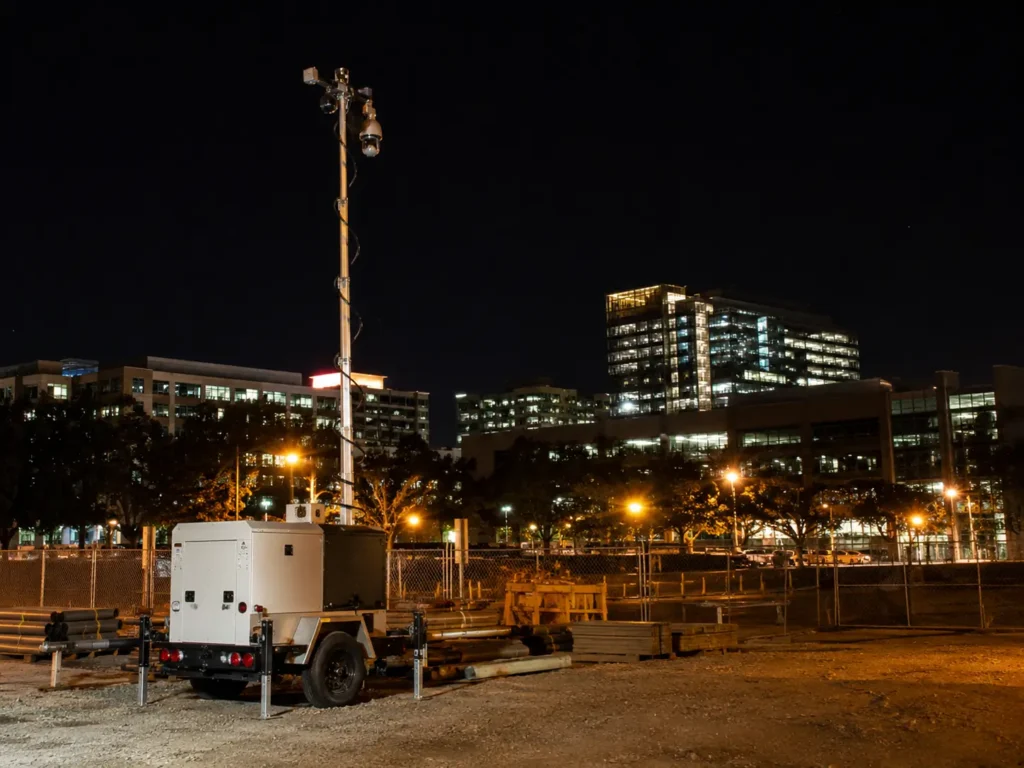
The handoff should be simple: site contact list, monitoring hours, response rules, camera coverage notes, and the next review date. That gives the superintendent a clean operating process and gives the owner a clear view of what is being protected.
Frequently asked questions
What is the biggest security threat at San Jose construction sites?
Material theft dominates, copper conductor first, then tools, fixtures, and high-value tech equipment. After-hours vandalism and occasional squatting on stalled sites add to the risk. High-density South Bay urban access patterns make San Jose jobsites among the most targeted in the Bay Area.
Do San Jose construction sites need guards or can cameras alone work?
Hybrid is standard. A single guard covers only a small fraction of perimeter at a time. Combining mobile surveillance trailers with selective guard presence and 24/7 monitoring gives wide-area coverage at lower total cost than scaling guards alone on multi-phase South Bay projects.
How much does construction site security in San Jose cost?
Cost depends on site size, perimeter complexity, monitoring tier, and contract length. A single monitored surveillance trailer is quoted per site, and multi-trailer programs on large tech-campus or housing sites scale from there. Equivalent 24/7 guard coverage can exceed $15,000 per month for a single staffed post. Exact figures depend on site specifics, so request a placement plan and quote.
What role do mobile surveillance trailers play on a San Jose job site?
They provide wide-area coverage of perimeters, gates, staging zones, and high-risk zones, with visible deterrence plus active monitoring. Trailers reposition as build phases shift on multi-stage Silicon Valley projects, where risk zones change between foundation, framing, and finishing.
How fast can a mobile surveillance trailer be deployed in San Jose?
Typical deployment is within 24 to 48 hours on a prepared site, including delivery, placement, commissioning, and monitoring-center connection. Site access, gated versus open, is the main variable. Multi-trailer rollouts on large tech-campus or housing sites phase over 3 to 7 days.
Can construction site surveillance reduce my builders-risk insurance premium?
Documented active security monitoring can favorably influence builders-risk terms with some insurers, particularly when active video evidence is part of the program. The effect varies by insurer and policy structure, so provide your security plan during underwriting conversations.
For South Bay GCs, developers, owners, and risk managers, construction site security in San Jose should be planned before the site reaches its most theft-sensitive phase. Hawk Surveillance Systems can help map risk areas, close perimeter gaps, deploy trailers rapidly, and coordinate monitoring rules around your project schedule. Request a quote or Talk to a Security Specialist for a site-specific San Jose placement plan.
Protect your San Jose site before the high-risk phase hits
Hawk Surveillance Systems maps risk areas, closes perimeter gaps, deploys monitored trailers in 24–48 hours, and coordinates guards around your schedule.
Request a QuoteTalk to a Security Specialist