
Last updated: June 2026
Reviewed by Noah Williams, Security Systems Specialist
Industrial Plant Perimeter Security in California: 2026 Best Practices for Refineries, Chemical Sites, and Heavy Industry
California industrial plants face copper theft, intrusion, and perimeter risk. In 2026, the practical perimeter challenge is not replacing every guard post or fixed camera. It is closing coverage gaps across fence lines, contractor staging areas, back lots, laydown yards, and remote utility corridors without slowing operations or forcing permanent installs. A surveillance trailer rental gives plant security teams a rapid, flexible layer for risk areas that move during turnarounds, expansions, and camera upgrades. The strongest approach is layered: fixed cameras for critical assets, guards for gate control and response, and mobile trailers for after-hours visibility where cabled infrastructure does not reach.
Why California industrial plants face unique 2026 perimeter risk
In brief: California industrial plant perimeter security is harder in 2026 because plants operate across large footprints with active contractor traffic, remote assets, and fence-line risk areas that shift by project phase. Mobile trailers help cover those changing zones without permanent installs.
California’s refinery and heavy-industry environment is concentrated, operationally complex, and highly regulated. CARB’s May 5, 2026 refinery update lists 8 oil refineries in California that produce transportation fuel, split across Southern California and Northern California districts. Around those refineries sit chemical processing, terminals, food processing, logistics, manufacturing, recycling, cold storage, and utility support operations that often share the same perimeter problem: wide property lines with only a few heavily controlled interior zones.
The active threat profile is practical rather than cinematic. Plant security managers are usually dealing with copper wire theft, scrap-metal theft, fuel access, after-hours fence-line intrusion, contractor control, and remote equipment yards. California DOJ’s June 5, 2025 bulletin tied copper wire theft and infrastructure vandalism to telecommunications outages, utility outages, business disruption, agricultural impacts, and public-safety concerns. For industrial plants, the direct risk is not only asset loss. The bigger issue is operational disruption near process areas, substations, tank farms, warehouse yards, rail spurs, and contractor gates.
That is why industrial plant security in California needs to be planned by zone. Coastal facilities may also coordinate with maritime security programs. Federal 33 CFR Part 105 requires regulated maritime facility owners or operators to operate in compliance with the security requirements for the MARSEC Level in effect. Inland plants have different constraints, often tied to remote acreage, local trespass patterns, utility corridors, and long back-lot perimeters.
CalEPA-adjacent continuity matters too. CalEPA explains that CalARP applies to certain stationary sources handling regulated substances above threshold quantities and requires prevention planning, emergency preparedness, and a Risk Management Plan. Security equipment does not replace those safety programs. It supports continuity by improving awareness near risk areas before a small access issue becomes a shutdown, response, or investigation problem.
Where fixed cameras and guards leave gaps at a heavy-industry site
In brief: Fixed cameras and guards are necessary, but each leaves coverage gaps at large industrial properties. Trailers fill the gap between permanent infrastructure and human patrol coverage.
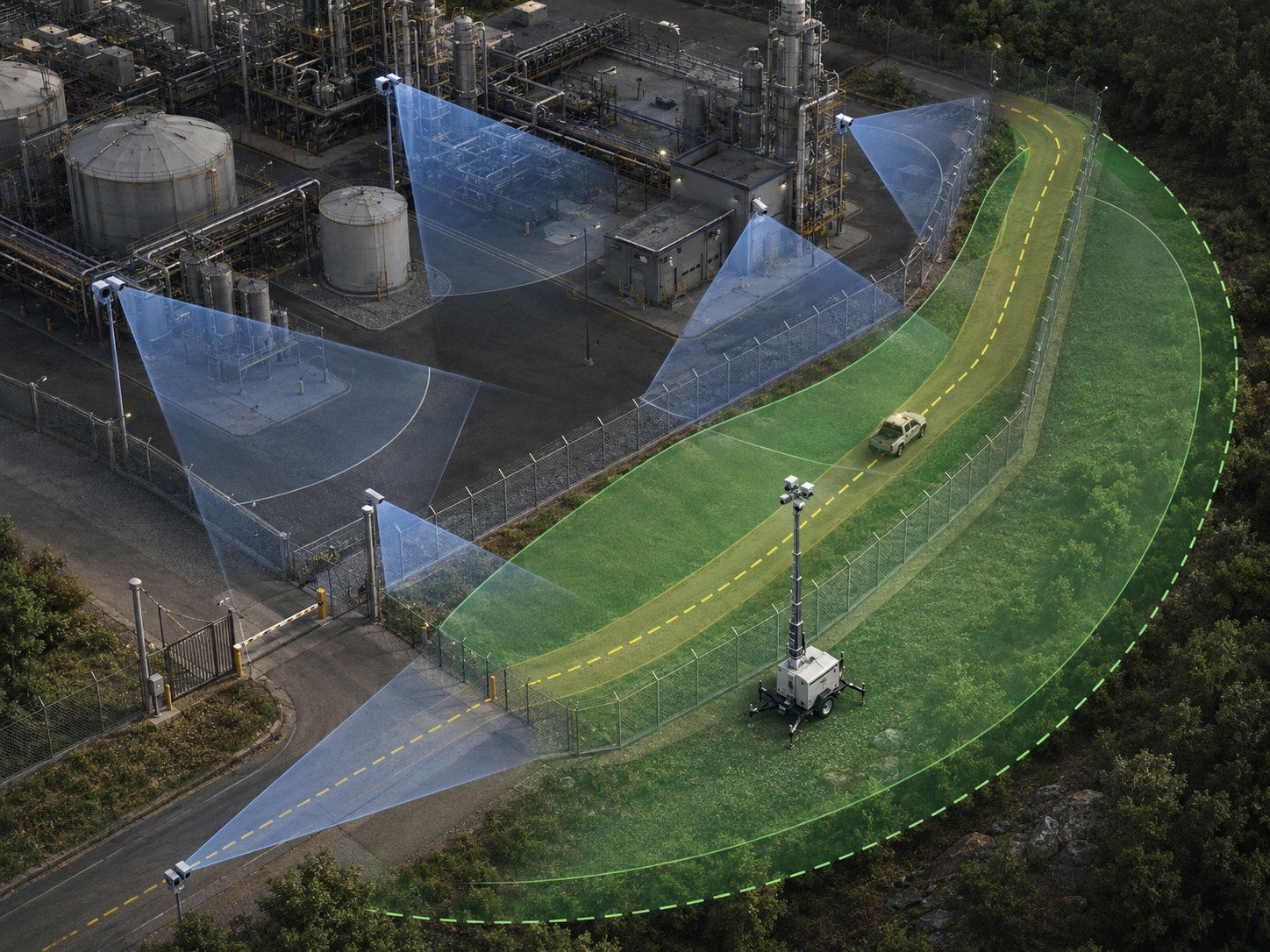
At a multi-acre plant, a single perimeter gap can create more exposure than a well-covered main gate reduces. Fixed cameras work well at known, permanent assets: gates, control-room entrances, tank-farm approaches, loading racks, weigh stations, and warehouse docks. Their weakness is reach. Cabled cameras need poles, power, trenching or network access, approvals, and installation windows.
Guards solve a different problem. They verify incidents, control access, escort contractors, handle gate procedures, and respond to alarms. Their weakness is physical coverage. A guard can patrol a fence line, but cannot continuously watch every back-lot road, unused gate, temporary laydown yard, and equipment corridor at the same time.
The value of mobile surveillance at an industrial plant is not that it replaces fixed cameras or guards. The value is that it covers perimeter gaps while the permanent system and guard force keep doing what they do best.
Security layer | Best fit | Common gap | How a mobile trailer complements it |
|---|---|---|---|
Fixed CCTV | Permanent gates, high-criticality assets, process approaches | Blind spots where power, cabling, or poles do not exist | Adds temporary or semi-permanent video coverage without trenching |
Guard patrols | Gate control, response, access verification, escort duties | Patrol-gap windows and limited line of sight | Gives guards a live video source to verify activity before dispatch |
Fencing and access control | Baseline perimeter control and controlled entry points | Does not show what is happening before or after a breach attempt | Adds visual detection and event context along fence-line risk areas |
Mobile surveillance trailers | Back lots, contractor yards, remote fence lines, expansion zones | Requires placement planning and communications checks | Extends video coverage to changing risk areas during high-tempo operations |
Compared with national surveillance providers such as WCCTV, Pelco, SentraCam, or Joint Power Security, Hawk’s wedge is California-specific deployment planning for trailers versus guards versus fixed cameras at high-tempo industrial sites. The goal is not a generic camera drop. It is a placement plan that fits the plant’s traffic flow, safety rules, contractor access, and after-hours response workflow.
What mobile surveillance trailers add at an industrial plant
In brief: A mobile surveillance trailer is a relocatable video platform that adds wide-area visibility at outer perimeters, temporary work zones, and remote risk areas where permanent cameras are slow, expensive, or impractical to install.
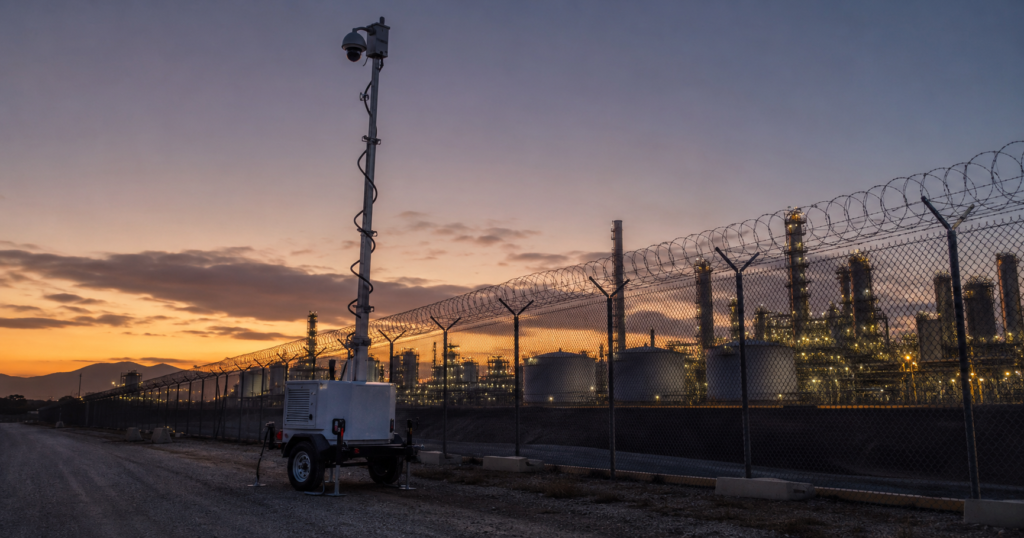
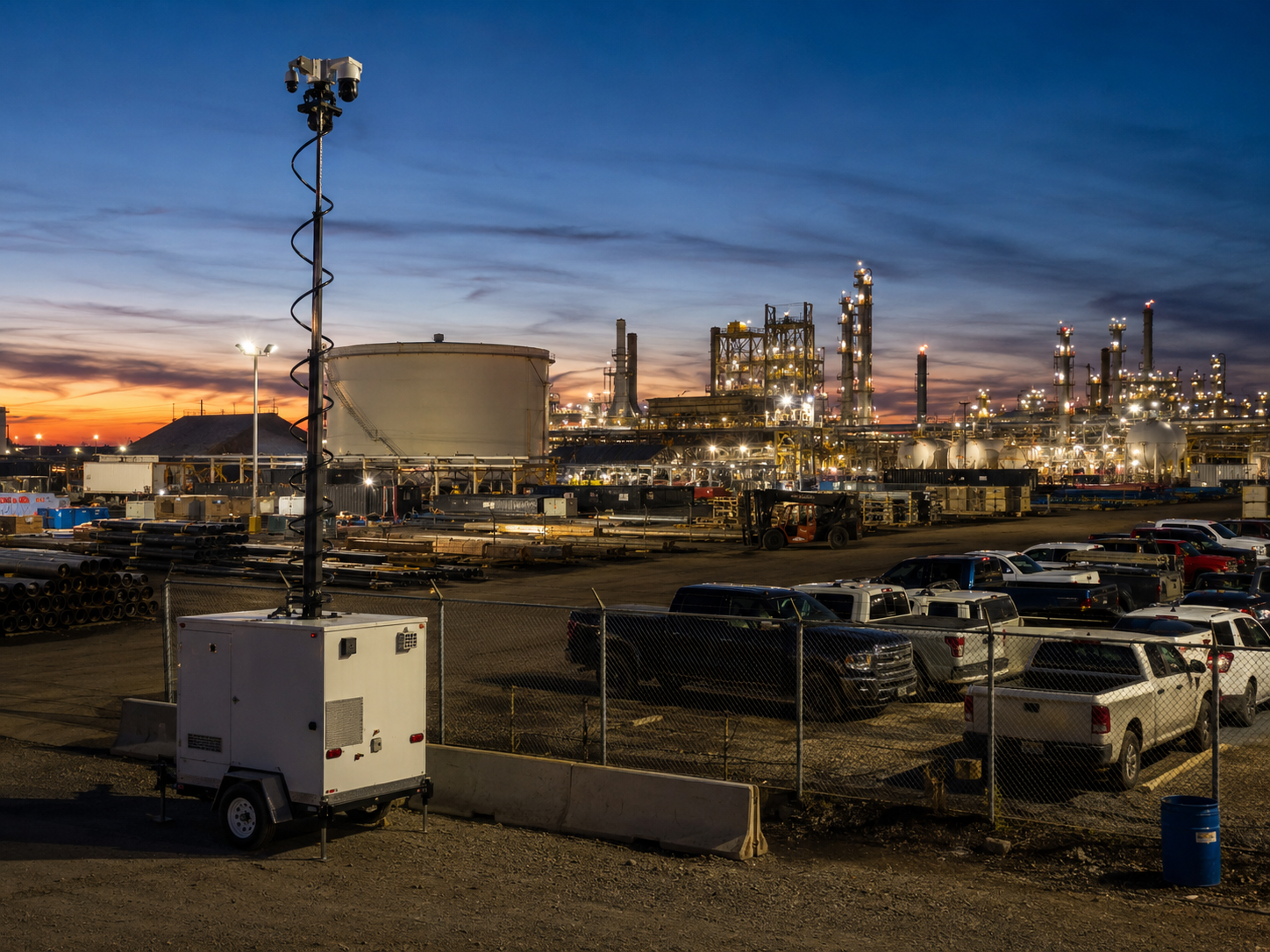
A mobile surveillance trailer is a self-contained field surveillance platform with an elevated mast, cameras, communications equipment, power system, and visible deterrence profile. At an industrial plant, it is used to monitor temporary or under-covered areas such as outer fence lines, back lots, contractor staging zones, expansion work fronts, equipment laydown areas, and remote access roads. It is not a replacement for the plant’s main CCTV system. It is a coverage extension.
A heavy-duty industrial surveillance trailer gives security teams a practical way to place video where the risk is current. During a turnaround, that might be a contractor gate and tool crib. During an expansion, it might be a temporary fence line near earthwork or steel staging. During a fixed-camera upgrade, it might be a blind spot caused by disabled cameras, open trenches, or offline network runs.
For after-hours operations, thermal imaging and elevated mast positioning can improve night perimeter awareness. Thermal cameras do not need the same lighting profile as standard optical cameras, which makes them useful for outer fence lines, remote yards, and low-light corridors. Plant teams still need to define what constitutes an actionable event, who receives alerts, and how guard response is routed.
Hawk can also pair trailer coverage with 24/7 remote monitoring where the plant wants event review outside normal staffing hours. In remote placements, an off-grid solar surveillance trailer can reduce dependence on plant power, which matters when the target area is a back lot, fence-line edge, or temporary construction zone.
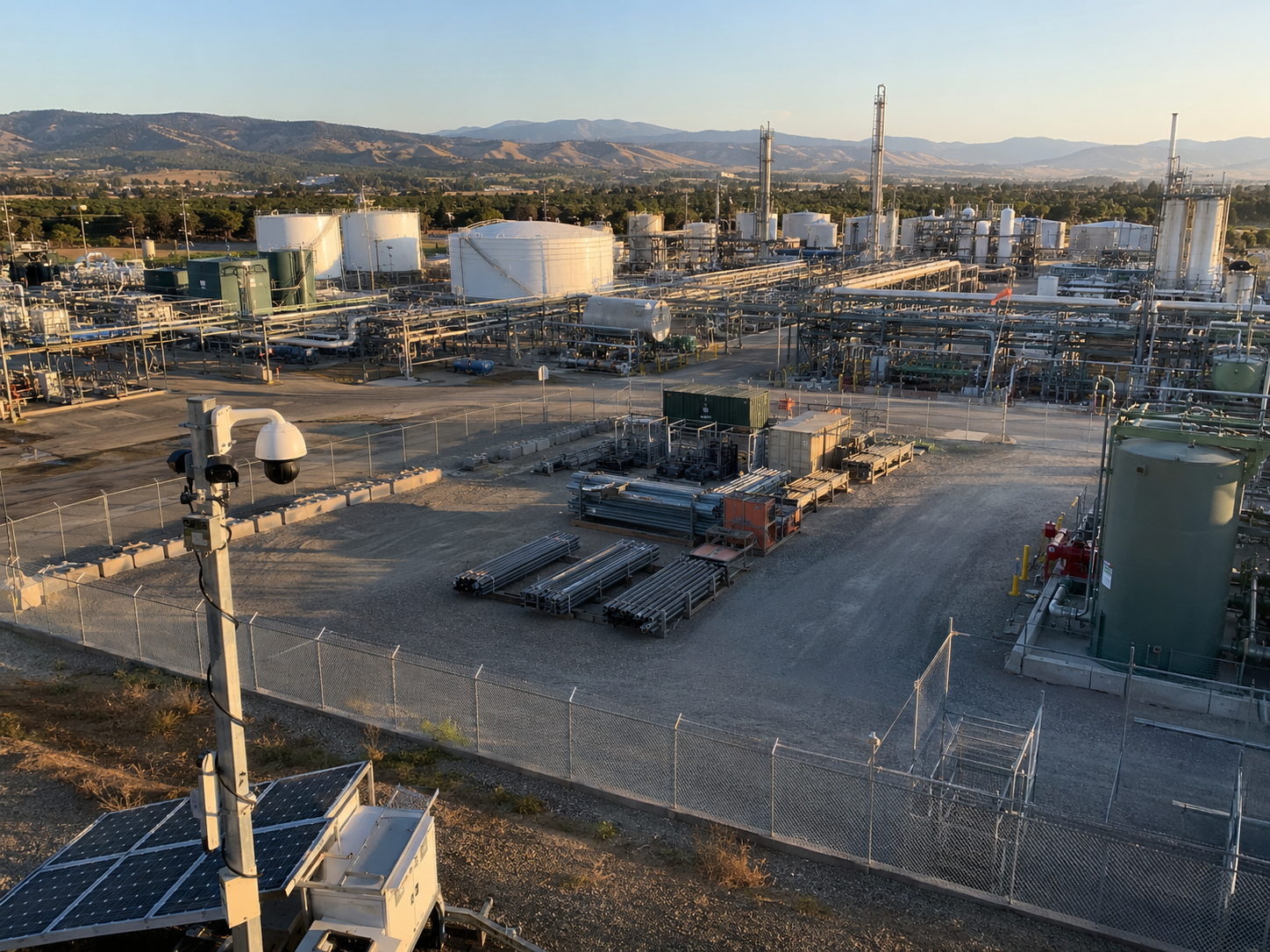
Modern integration planning should also account for standards. ONVIF describes itself as an open industry forum that promotes standardized interfaces for interoperability of IP-based physical security products and services. That matters because security teams do not want a separate video island unless the deployment is intentionally standalone.
Three deployment scenarios at industrial facilities
In brief: Mobile trailers fit best when the risk area is temporary, shifting, remote, or faster to cover with a trailer than with permanent construction.
Scenario A: Turnaround and maintenance contractor management
Turnarounds change a plant’s security profile quickly. Contractor volume increases, tool storage expands, temporary gates open, and staging areas move closer to process units, warehouses, or laydown yards. A mobile trailer can watch a contractor entrance, tool crib, scaffold yard, or temporary parking zone without adding a permanent pole or pulling new cable.
The security goal is not to slow the turnaround. It is to document access, monitor after-hours activity, and give guards a better view of what is happening in staging areas after crews leave. This is especially useful where multiple contractors share a single laydown area and responsibility for tools, generators, welding leads, or copper-containing materials becomes hard to separate. Plants that run on-site salvage or scrap staging can borrow the same playbook Hawk uses for dedicated recycling and scrap yard trailer coverage.
Scenario B: Outer-perimeter coverage during expansion construction
Expansion projects often push risk outward. Temporary fencing, soil work, steel delivery, modular equipment, and crane paths can create perimeter conditions that the permanent CCTV map was never built to cover. A trailer gives the project team a relocatable camera position that can move as construction phases change.
This is where trailers are more flexible than fixed cameras. A permanent camera may be justified once the new asset is complete, but the construction phase can last through several risk layouts. Mobile coverage lets security teams adjust to the current footprint instead of waiting for the final design.
Scenario C: Temporary coverage during fixed-camera upgrades
Plants upgrade cameras, networks, poles, and VMS platforms in phases. During that work, some views may be degraded, blocked, or offline. Temporary trailer coverage can keep visibility on the affected fence line, gate, or storage yard while the permanent system is being repaired or replaced.
This matters for auditability. If a camera outage is known and temporary, a trailer can provide a documented compensating measure. The plant can show that the gap was identified, covered, and removed once permanent coverage returned.
Integration with plant CCTV / SOC and existing security programs
In brief: Trailer video should fit the plant’s operating model, not create a disconnected screen that nobody owns. Integration planning should cover VMS compatibility, alert routing, guard response, and safety-team coordination.
For mature plants, the most important technical question is not whether a trailer has a camera. It is whether the trailer’s video and alert workflow can fit the plant’s existing SOC model. Some plants want trailer video streamed into the current VMS. Others prefer remote monitoring with escalation to plant security. Some want both.
RTSP and ONVIF compatibility are common starting points. ONVIF Profile S is designed for IP-based video systems where a device can send video data over an IP network to a client such as video management software. Compatibility still needs to be confirmed against the exact plant stack, including camera model, encoder settings, VMS version, firewall rules, credentials, time sync, and event workflow.
The operating workflow matters just as much as the stream. Before commissioning, define:
Which trailer views go to the SOC
Which events are monitored remotely
Which alarms trigger guard dispatch
Which incidents require plant supervisor notification
Which areas are view-only due to safety, union, privacy, or contractor agreements
Who owns evidence export and retention requests
Coordination with on-site guards is essential. A trailer can detect or verify activity, but guards handle physical response, gate control, escort procedures, and incident documentation. The cleanest programs give guards access to trailer views and define response routes before the first alert.
Deployment workflow for industrial-plant placements
In brief: A good trailer deployment starts with a site walk, safety coordination, and a placement plan. The trailer is the visible hardware, but the workflow is what makes it useful.
Typical industrial deployment follows site safety coordination and is confirmed in the site-specific quote. The reason timing varies is that plant access, safety orientation, hazardous-area review, escort requirements, network approval, and contractor onboarding often drive the schedule more than the physical placement.
A disciplined workflow starts with a site walk. Hawk and the plant team should identify camera objectives, trailer sight lines, likely intrusion paths, lighting conditions, wind exposure, traffic conflicts, access routes, and the nearest safe placement zones. The placement plan should be reviewed with security, operations, safety, and the project owner.
Hazardous-area placement deserves specific attention. OSHA’s hazardous classified location rule covers electric equipment and wiring in locations classified by the properties and likelihood of flammable vapors, liquids, gases, combustible dusts, or fibers. For refineries and chemical plants, trailer placements should normally remain in non-hazardous areas such as outer perimeters, staging yards, parking edges, and back lots unless the plant’s safety team has approved another approach.
Cal/OSHA’s PSM Unit states that it is responsible for inspecting refineries and chemical plants covered under Labor Code sections 7850-7873 that handle large quantities of toxic and flammable materials. That does not make a surveillance trailer a process-safety device. It does mean deployment should respect the plant’s permit-to-work, hot-work, escort, access, and electrical-area classification rules.
For multi-trailer placements, phased rollout is usually better than a single large drop. Start with the highest-value risk areas, confirm views and alerts, adjust placement, then expand to secondary fence lines or contractor zones. Hawk’s deployment & project services help plants build that sequence, and the how we deploy process gives security managers a practical way to turn a perimeter concern into a field-ready plan.
Frequently asked questions
In brief: The best mobile surveillance programs answer six questions before deployment: the main challenge, safe placement, integration, fixed-camera comparison, timeline, and guard coordination.