

What recycling and scrap-metal yards are actually losing
In brief: Northern California recycling and scrap-metal yards lose more than saleable metal when an after-hours incident disrupts operations: exposure includes copper and nonferrous inventory, damaged fencing, unauthorized dumping, trespass, fuel, batteries, catalytic components, tools, and movable equipment spread across a large open footprint.
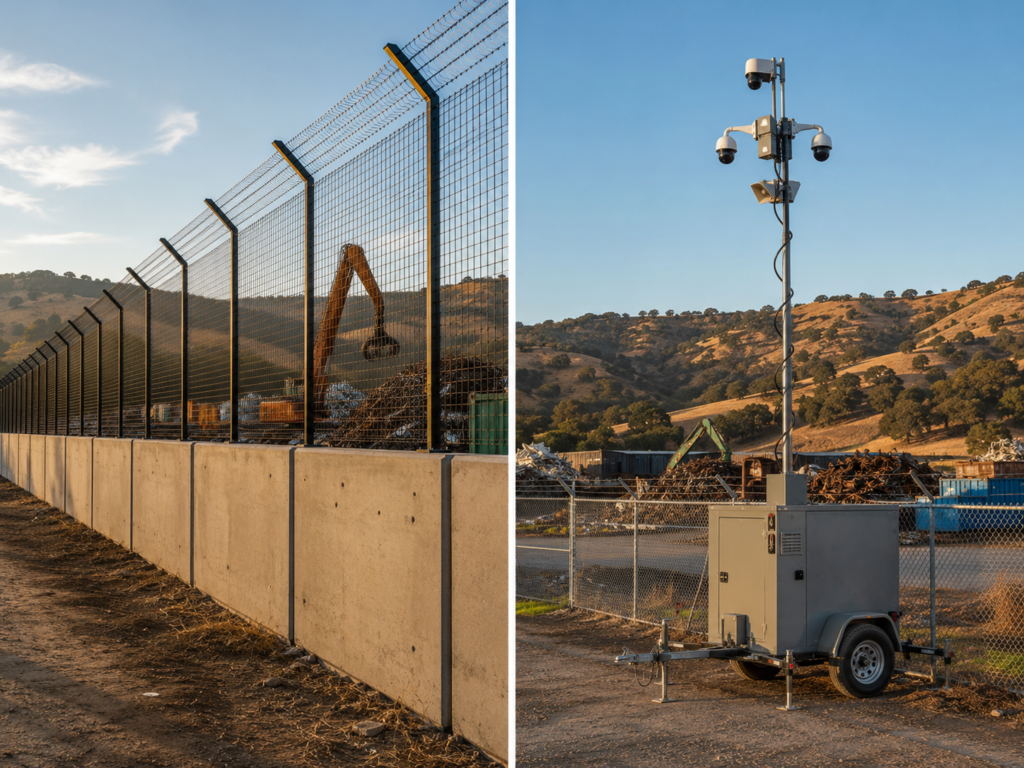
The operating problem is visibility. Stockpiles change height, loaders and roll-off containers move, and customer lanes shift. A cut-fence entry can therefore expose metal inventory, parked equipment, fuel tanks, batteries, and work areas during the same event. Unauthorized dumping creates a different cost through sorting, handling, and site cleanup, even when nothing is taken.
Richmond record: City commission minutes report that copper-wire theft increased from 22 reports between September 2022 and September 2023 to 222 reports in the following period, with 10 arrests reported at the meeting. These are citywide infrastructure reports, not a scrap-yard loss rate. Source: City of Richmond Community Police Review Commission minutes.
Current local impact: Richmond was managing more than 500 active streetlight outages attributed to copper theft, with about $2 million in municipal infrastructure damage over roughly 18 months, according to a May 2026 report that cites the city’s assistant deputy public works director. Source: Richmond Standard.
Sacramento repair program: The city’s adopted capital plan lists an estimated project cost of $3,703,677 for its streetlight and copper-wire repair program. That is a public-infrastructure repair budget, not an estimate of private-yard losses. Source: City of Sacramento 2025 to 2030 Capital Improvement Program.
Security also supports transaction discipline at the buying area. California Business and Professions Code section 21606 requires junk dealers and recyclers to record transaction details including seller identification, the delivery vehicle, material descriptions, and a signed ownership statement. Section 21608.5 generally delays access to payment for nonferrous material until the third business day, subject to listed exceptions, and also requires seller and material images. Review the exact requirements in section 21606 and section 21608.5. Video security can support an investigation, but it does not replace statutory records or staff procedures.
Why guards and fixed cameras leave gaps at a scrap or recycling yard
In brief: Guards and fixed cameras remain useful at scrap and recycling facilities, but they solve narrower problems: guards manage people and one post or patrol route at a time, while fixed cameras hold steady views that can miss changing stockpiles, temporary lanes, remote fence lines, and unpowered yard edges.
A guard genuinely wins where the job requires customer-facing access control, driver check-in, key handling, escorts, policy enforcement, or immediate physical presence. The trade-off is coverage and recurring staffing: a person can work a gate or patrol a route, but cannot continuously observe every fence line, metal pile, equipment row, and fuel point at once.
Fixed cameras genuinely win for permanent indoor spaces and stable long-term chokepoints such as scale-house doors, cashier windows, processing lines, gates, and fuel islands. They can also be actively monitored. Their limitation is that installed angles stay put while piles, containers, traffic lanes, and perimeter gaps change. Extending coverage can require poles, power, network cabling, approvals, and installation work.
The operational wedge is therefore not technology against people. It is assigning each control to the work it performs best: guards for interaction and response, fixed cameras for permanent views, and mobile coverage for open after-hours zones that move.
How a mobile surveillance trailer protects a scrap or recycling yard
In brief: A mobile surveillance trailer adds an elevated, active outer layer around a recycling yard by combining relocatable cameras, off-grid power, live event review, and audible or visual intervention, while the facility’s gates, fencing, lighting, transaction controls, fixed cameras, and response plan continue protecting the inner layers.
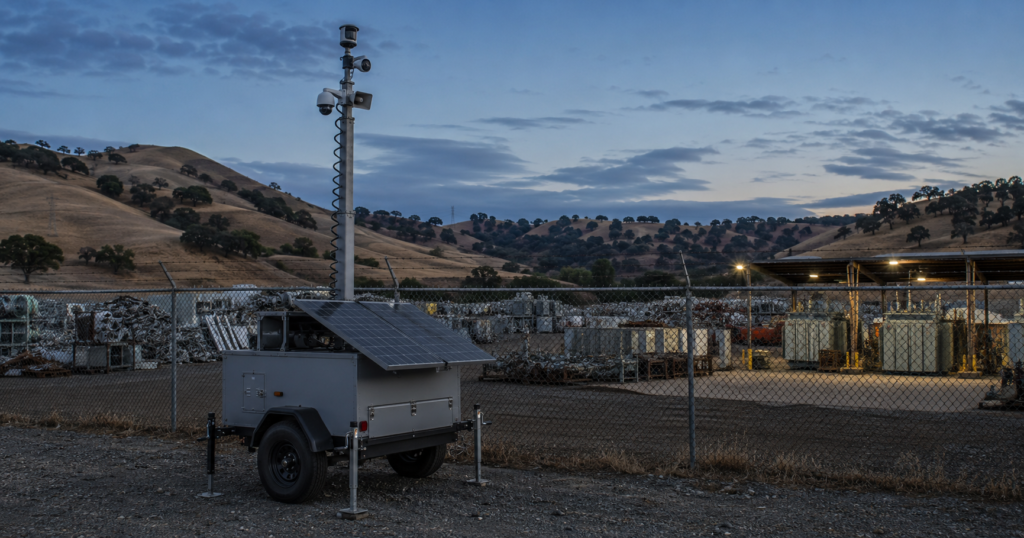
The mast lifts PTZ and fixed cameras above parked equipment and many ground-level obstructions. Solar generation, batteries, and cellular connectivity let the trailer cover a perimeter gap or back lot without permanent installs. Detection zones can focus on a closed gate, fence approach, copper storage area, fuel point, or equipment row. When an alert meets the yard’s rules, 24/7 remote monitoring can verify the event, activate a strobe or speaker, notify a site contact, and follow the agreed escalation plan.
This is Hawk’s concentric approach to mobile security. Fencing and access control form the physical boundary. Yard procedures and transaction controls protect the operating core. Fixed cameras hold stable interior views. The trailer becomes the flexible outer layer that moves when stockpiles, projects, or perimeter gaps move. For a related local threat review, see Hawk’s guide to copper wire theft across Bay Area worksites.
“A point guard can only see the gate or route in front of them. A mobile trailer gives the monitoring team an elevated view across the working yard, so we can watch the perimeter, verify activity, and direct response without pulling the guard away from access control.”
Paul Wittner, Hawk Surveillance Systems
WCCTV and LVT also publish solar-powered mobile units with cellular connectivity, deterrence tools, and remote video access, confirming that the category is established. See the official WCCTV solar trailer overview and LVT mobile security overview. Hawk’s distinction is local Northern California rental deployment, site-specific placement, solar and compact options, and concierge-level monitoring built around the yard’s own escalation workflow.
Which Hawk trailer fits
In brief: Hawk’s Heavy-Duty Industrial Surveillance Trailer fits rough, dusty yards with uneven ground, heavy vehicle traffic, vibration, and long perimeters, while the Solar Surveillance Trailer fits large open facilities or isolated fence lines where dependable grid power and network cabling are unavailable or impractical.
- Heavy-duty industrial surveillance trailer: start here for packed gravel, rough access, demanding yard conditions, large camera loads, and long after-hours operating windows.
- Solar surveillance trailer: use it for off-grid edges, remote stockpile zones, temporary overflow yards, or locations where trenching power and data would be impractical.
The model decision follows the site walk, not the industry label alone. Ground condition, sight lines, solar exposure, cellular service, trailer access, mast clearance, and the monitoring plan all matter. Yard operators can also use Hawk’s industrial plant security guidance to coordinate mobile coverage with fixed cameras, guards, and existing facility systems.
Trailer vs guard vs fixed cameras (cost and coverage)
In brief: For most open yards, a monitored trailer is the middle path between high recurring guard expense and the limited response of an unmonitored fixed-camera system, yet the right answer can still be a guard, fixed cameras, a trailer, or a hybrid based on access, permanence, response duties, and site geometry.
| Factor | Security guard | Surveillance trailer | Fixed cameras |
|---|---|---|---|
| Coverage | One post or patrol route at a time | Elevated, movable views across open yard zones | Installed angles, strong at stable chokepoints |
| Deterrence | Strong human presence and physical intervention | Visible mast, live strobe, speaker, and operator challenge | Visible cameras may deter; unmonitored systems mainly record |
| Cost profile | Highest recurring staffing profile | Mid-range rental and monitoring profile | Lowest upfront for a simple system; cabling, maintenance, and response are separate |
| Deployment speed | Depends on recruiting, scheduling, and post coverage | Sets up in hours after placement is approved | Depends on design, power, cabling, network, and installation |
| After-hours | Active during the staffed shift | Continuous cameras with remote review and planned escalation | Continuous recording; human response only when monitoring is added |
| Best for | Visitor control, gate procedures, escorts, and physical response | Large, changing, off-grid, or temporary outdoor risk areas | Permanent indoor views and stable exterior chokepoints |
No universal monthly price is responsible without a site scope. Guard costs vary by post hours and duties. Trailer costs vary by model, camera package, monitoring, connectivity, term, and unit count. Fixed-camera costs vary by camera count, poles, trenching, power, network work, storage, and whether active monitoring is included. Qualitatively, the trailer is the middle path: visible, monitored deterrence with a cost profile closer to camera service than continuous guard staffing.
Deployment and monitoring
In brief: A productive deployment begins with a yard walk that maps entrances, scale-house traffic, fence damage history, metal stockpiles, equipment parking, fuel storage, dark approaches, and line-of-sight obstructions, then places the trailer where one elevated view can cover the highest-priority after-hours zones without disrupting operations.
- Walk the site: confirm access, ground stability, traffic flow, mast clearance, solar exposure, cellular service, and safe maintenance access.
- Prioritize zones: rank gates, perimeter gaps, copper and nonferrous storage, equipment rows, fuel points, and isolated approaches.
- Place and aim: position the trailer outside loader paths, fire lanes, and customer circulation, then set PTZ tours and fixed views.
- Build the playbook: define authorized vehicles and people, monitored hours, speaker language, contact order, and dispatch criteria.
- Test and adjust: Hawk sets up in hours, tests connectivity and alerts, then revisits camera views when piles or yard operations change.
With 24/7 concierge-level monitoring, an analytic alert is reviewed by an operator before intervention. The approved sequence can move from observation to speaker or strobe, site-contact notification, guard response, or law-enforcement dispatch when the event and contract call for it. Operators near the Central Valley can review Hawk’s Sacramento surveillance trailer rental coverage as a supporting regional service page.
Frequently asked questions
In brief: Recycling operators usually need direct answers about price, coverage, deterrence, deployment, and whether a trailer can replace guards or permanent cameras, so the answers below state the decision first and then identify the site conditions that can change it during an actual yard assessment.
How do recycling and scrap-metal yards stop after-hours copper and metal theft, cut fences and break-ins, trespassing, and equipment/fuel theft in NorCal?
Recycling and scrap-metal yards reduce after-hours copper and metal theft, cut-fence break-ins, trespassing, dumping, and equipment or fuel theft by pairing an elevated mobile surveillance trailer with 24/7 remote monitoring, while keeping fencing, gates, lighting, inventory controls, and a written escalation plan as inner layers. The trailer covers changing outer risk areas, and the inner controls slow access, protect transactions, and guide response.
Is a surveillance trailer cheaper than hiring security guards for a scrap or recycling yard?
A monitored surveillance trailer usually has a lower recurring cost profile than staffing continuous guard shifts because one elevated unit can observe several yard zones, but pricing still depends on camera configuration, monitoring coverage, connectivity, deployment length, and the number of units required. A guard may still be worth the higher staffing profile when the job requires visitor service, access decisions, escorts, or immediate physical response.
Can one mobile trailer cover a scrap or recycling yard?
One mobile trailer can cover a small or open recycling yard when the mast has clear sight lines to the gate, fence, stockpiles, and equipment areas, but tall scrap piles, buildings, containers, terrain, or separated entrances can require repositioning or a second unit. Hawk confirms coverage during a site walk and adjusts placement as the material layout changes throughout the year.
Do surveillance trailers actually deter copper and metal theft?
Surveillance trailers can deter opportunistic metal theft at a specific site or time because the mast, cameras, strobe, and speaker make monitoring visible and let an operator address verified activity, but no security tool can guarantee that an incident will not occur. Results depend on placement, detection settings, monitoring discipline, response procedures, lighting, fencing, and how quickly the yard closes newly identified gaps.
How fast can Hawk deploy a trailer in NorCal?
Hawk can place and set up a standard rental trailer in hours once availability, yard access, safe placement, cellular connectivity, and the monitoring plan are confirmed for the yard, although remote locations, multi-unit deployments, or special site rules can extend the schedule. The field sequence includes delivery, stabilizing the chassis, raising the mast, aiming cameras, checking communications, and testing alerts before handoff.
Trailer or fixed cameras for a scrap or recycling yard: which is better?
A trailer is better for changing, off-grid, or temporary yard coverage, while fixed cameras are better for permanent indoor views and stable long-term chokepoints; many facilities use both, with the trailer covering outer perimeter gaps and fixed cameras watching scales, doors, and processing areas. Hawk’s industrial perimeter comparison of trailers, guards, and fixed cameras explains how the layers complement one another.
Get scrap-yard security pricing
In brief: Hawk scopes recycling and scrap-yard security around the yard’s actual layout, operating hours, power, access flow, loss history, and response plan, then recommends a rental configuration that assigns trailers, guards, fixed cameras, and physical controls to the jobs each performs best.
Start with the address, approximate yard size, operating hours, known perimeter gaps, available power, and the assets that need after-hours coverage. Hawk will review placement, trailer model, monitoring hours, escalation contacts, deployment timing, and any role for existing guards or cameras. Explore the mobile surveillance trailer rental program, then talk to a Security Specialist and get NorCal rental pricing.