
Last updated: June 2026 · Reviewed by Noah Williams
Crop theft during the late-season pre-harvest window is the dominant security threat at California outdoor cannabis grows in 2026. For licensed open-field cultivation, the security problem is not only the gate, the processing area, or the camera retention policy. It is the distance between those fixed compliance points and the actual risk areas across the field, access roads, staging zones, and perimeter gaps. A surveillance trailer rental gives outdoor operators a rapid, flexible layer of elevated visibility, active monitoring, and evidence capture without permanent installs. Used correctly, trailers do not replace DCC-required cameras. They extend the security posture where fixed cameras and patrol routes often run out.
Why outdoor cannabis grows in California face higher 2026 risk
In brief: Outdoor cannabis security is harder because the crop is exposed, the acreage is wider, and risk concentrates after-hours when staffing is light. The practical gap is not whether the site has cameras; it is whether those cameras see the field approaches that matter.
Outdoor cannabis cultivation is open-field production. DCC defines outdoor licenses as cultivation outside without artificial lighting on mature plants, while indoor and mixed-light licenses are tied to permanent structures or greenhouse-style production with specified lighting thresholds. That distinction matters for security because open-field sites have wider boundaries, longer approach routes, more weather exposure, and fewer natural choke points than indoor facilities. (cannabis.ca.gov)
A controlled indoor room can force movement through doors, corridors, sally ports, and badge-controlled zones. An outdoor grow near Humboldt, Mendocino, Trinity, Lake, Yolo, or San Benito may have dirt roads, orchard edges, fencing runs, drainage paths, utility corridors, and neighboring parcels. A fixed camera at the licensed entrance can document who used the gate, but it may not show a person crossing a back fence line after-hours.
The 2026 risk profile is operational, not theoretical. Outdoor operators still need to meet DCC expectations, keep footage retrievable, support insurance documentation, and avoid interruptions during the most sensitive seasonal period. At the same time, they must protect crop rows, irrigation assets, fuel, tools, and harvest staging areas without overbuilding permanent infrastructure that may only be needed for a defined window.
This is where the trailer-vs-guards-vs-fixed-cameras decision becomes practical. Guards can patrol and respond, but coverage depends on staffing, route discipline, and line of sight. Fixed cameras support compliance and long-term documentation, but trenching, poles, power, and network work can be slow. Mobile surveillance trailers sit between those two options: visible, movable, elevated, and built for changing risk areas.
Compared with national surveillance providers such as WCCTV, Pelco, SentraCam, and Joint Power Security, Hawk’s wedge is Northern California field deployment, trailers-vs-guards-vs-fixed-cameras planning, and rapid repositioning for high-tempo sites instead of a one-size equipment program. (WCCTV)
What DCC outdoor cultivation security requires vs. what most ops actually need
In brief: DCC compliance starts with required surveillance coverage, recording quality, and retention. Real-world outdoor grow security extends beyond compliance into approach routes, perimeter gaps, harvest staging, and after-hours response.
DCC video-surveillance rules are commonly referenced in legacy cannabis security conversations as §5044, but the current DCC rule is Title 4 CCR §15044. The rule requires a digital video surveillance system on the licensed premises, fixed camera placement that clearly records activity within 20 feet of points of entry and exit, 24-hour continuous recording at a minimum of 15 FPS, and 90 calendar days of retained recordings. (Legal Information Institute)
That is the compliance baseline. It is not a full outdoor field-security plan.
A licensed premises can have compliant gate cameras and still have blind approaches across a field edge. It can retain 90 days of footage and still miss the event if the camera was aimed only at the entry gate. It can maintain indoor and outdoor vantage points at entrances and exits while still lacking useful nighttime visibility across the crop perimeter.
DCC compliance cannabis surveillance should be treated as the foundation. For outdoor cultivation, the next layer is operational coverage:
- Boundary lines where a person or vehicle could enter without using the main gate
- Roads, easements, and farm tracks that create approach paths
- Harvest staging areas where plants, bins, vehicles, and staff concentrate
- Fuel, generator, irrigation, and equipment zones that support the grow
- After-hours periods when the site is less staffed and visibility drops
Compliance cameras answer, “Did we cover the required points?” Operational surveillance answers, “Can we see and respond where loss is most likely to happen?”
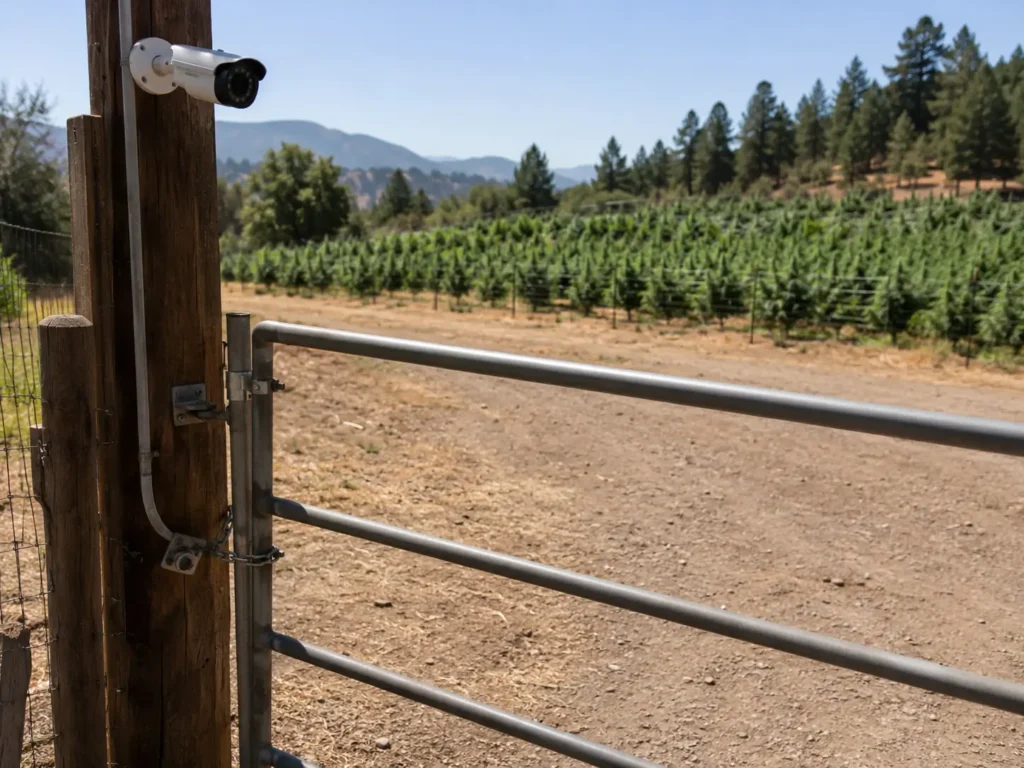
The operator’s goal should be simple: keep the DCC system clean, documented, and retrievable while adding mobile coverage where the field creates perimeter gaps. A trailer should never be positioned as a shortcut around required fixed cameras. It should be scoped as an extension of the site-security program.
What mobile surveillance trailers add at an open-field outdoor grow
In brief: Mobile trailers add elevated field visibility, off-grid power, monitoring options, and repositioning without permanent installs. They are most useful where fixed cameras cannot cover shifting outdoor risk areas quickly.
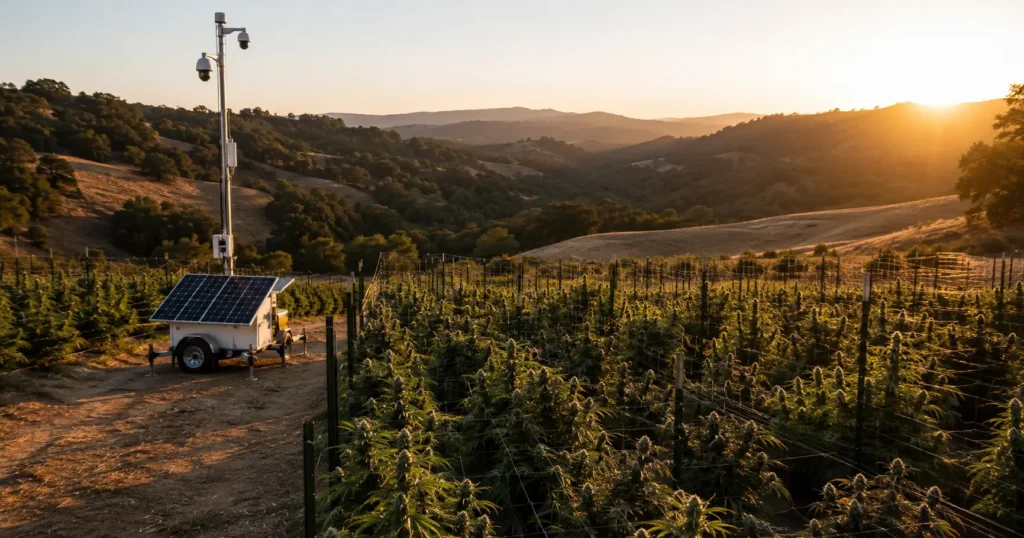
A single elevated trailer position can turn a field edge, access road, or harvest staging zone into a monitored coverage area without trenching, poles, or permanent power work. Hawk’s off-grid solar surveillance trailer combines solar generation, battery storage, camera hardware, LTE/5G connectivity options, local recording, and monitoring integration for sites where permanent infrastructure is limited. (Hawk Surveillance Systems)
For outdoor cannabis operations, the value is not just camera height. It is deployment flexibility. A trailer can be placed near the main approach during planting, moved toward perimeter risk areas during late season, then repositioned again around drying, transport, or post-harvest storage activity. That matters for high-tempo sites where the security problem changes as the crop cycle changes.
A typical mobile trailer program adds:
- Elevated PTZ and fixed-camera coverage over field rows, approaches, and gates
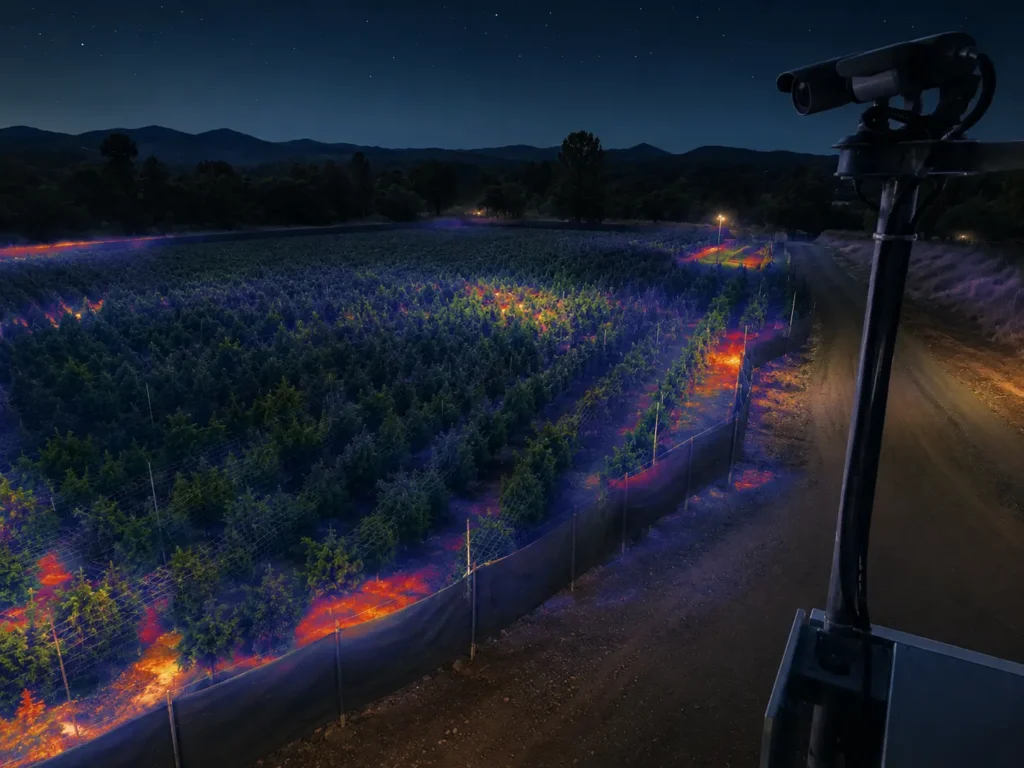
- IR, low-light, or thermal-capable options for after-hours visibility
- Solar and battery runtime for remote or limited-power parcels
- Cellular connectivity where fixed network service is not practical
- Voice-down, lighting, siren, and escalation options when configured
- Recorded incident documentation for internal review, DCC reporting, and claims support
24/7 remote monitoring changes the trailer from a passive recorder into an active response layer. Hawk’s monitoring page describes operator review, voice-down, structured escalation, incident logging, and standard 24/7 monitoring options. For cannabis grows, that means the field can be watched during the exact hours when staffing is lowest. (Hawk Surveillance Systems)
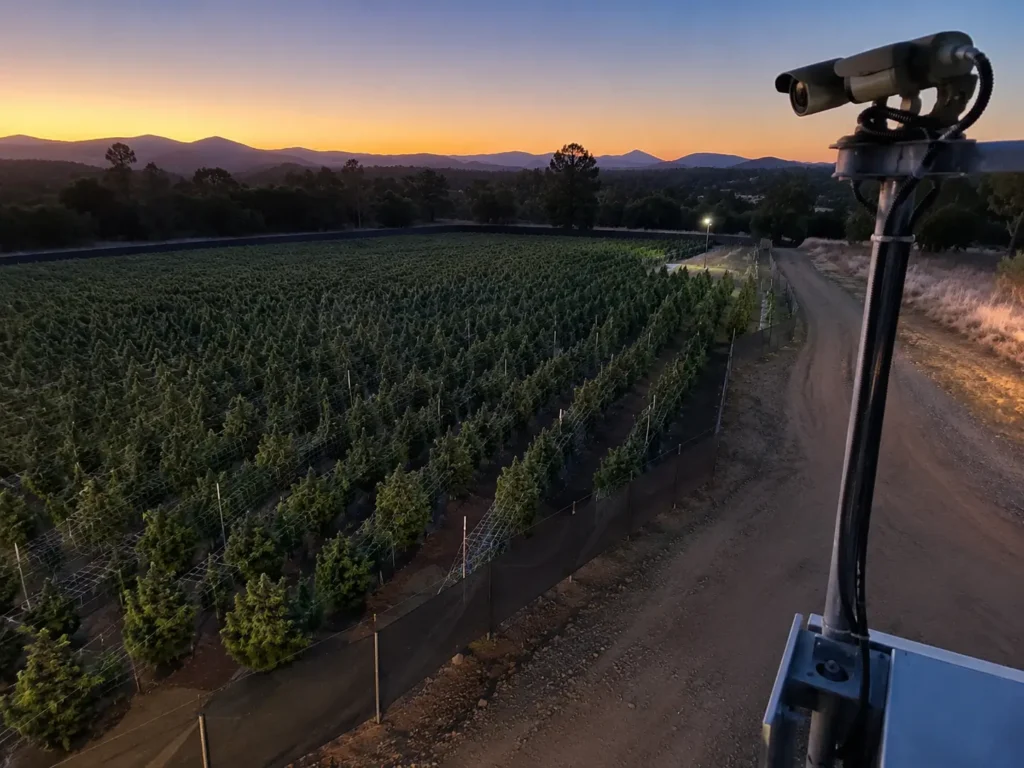
The deployment should be mapped around field geometry. One trailer may be enough for a gate-and-field-edge problem. Larger open-field operations may need multiple trailers, each assigned to a distinct zone: primary approach, rear fence line, harvest staging, or equipment support area.
The pre-harvest window: when surveillance matters most
In brief: The 30 to 60 days before harvest should be treated as a defined security phase, not a vague seasonal concern. Trailer placement, monitoring hours, and response lists should be tightened before the crop is most exposed.
For planning purposes, outdoor cannabis operators should treat the final 30 to 60 days before harvest as the highest-priority surveillance window. That is when mature plants are visible, field activity increases, and the site often carries more operational value in the open than it did earlier in the season.
The pre-harvest plan should be written before that window begins. Waiting until suspicious activity appears usually means the operator is reacting while crews are already busy with irrigation, staffing, testing, harvest scheduling, and transport planning.
A practical pre-harvest security plan should include:
- Updated map of risk areas, including fence lines, gates, roads, and blind approaches
- Trailer placement plan for wide-area field and perimeter coverage
- Monitoring hours matched to after-hours exposure
- Escalation list for managers, security contacts, and law enforcement coordination
- Procedure for saving video clips and incident notes
- Repositioning plan if activity shifts from one side of the site to another
Neighbor coordination also matters in rural cultivation areas. A neighboring property owner may see vehicle movement on a shared road before a camera does. A local law enforcement contact may need clear directions, gate codes, and parcel access instructions if an incident is verified. The goal is not to create alarm. The goal is to make response faster and more precise.
The trailer layer works best when combined with ordinary site discipline: locked gates, maintained fencing, limited-access rules, employee access control, camera signage, lighting where appropriate, and clean documentation. Mobile surveillance is not a replacement for basic physical security. It is the visibility and response layer that helps close field-scale gaps.
Integration with DCC-compliant CCTV programs
In brief: Trailer footage should complement the DCC system, not replace it. Keep required fixed-camera coverage intact, then use mobile video for wider perimeter visibility, incident review, and claim support.
DCC-compliant CCTV is about meeting specific regulatory coverage, recording, access, and retention requirements. Mobile trailers are about extending field visibility where compliance cameras do not reach. Those roles should stay separate in the site-security plan.
Start with the required system. Title 4 CCR §15044 requires fixed cameras in locations that capture activity within 20 feet of all points of entry and exit, plus areas where cannabis or cannabis products are weighed, packed, stored, loaded, unloaded, prepared, or moved within the licensed premises. It also requires clear date and time display, failure notification, and storage protected from tampering or theft. (Legal Information Institute)
Then add the trailer layer as a complementary camera group. In a mature operation, that may mean trailer feeds are available to the same security manager, SOC, or monitoring workflow that reviews fixed cameras. In smaller operations, it may mean Hawk or a monitoring partner handles trailer alerts while the licensee maintains the DCC video system separately.
Documentation is the connective tissue. If an incident occurs, the operator should be able to show:
- Required DCC camera coverage remained active
- Trailer footage captured the field, approach, or perimeter event
- Monitoring logs show when the alert was detected and reviewed
- Response actions were taken according to the escalation plan
- Relevant clips were preserved for insurer, law enforcement, or DCC review
The California Department of Insurance explains that commercial insurance can protect against losses such as property damage, business interruption, theft, liability, and worker injury, which is why documented video and incident records can matter when a theft claim is reviewed. (California Department of Insurance)
For privacy and compliance, be cautious with audio. California Penal Code §632 prohibits recording confidential communications without all-party consent, so most commercial security deployments should disable audio unless counsel has reviewed the use case and disclosure plan. Hawk’s California audio surveillance laws guide gives a practical starting point for that review. (Legislative Information)
Deployment workflow for remote NorCal cannabis grows
In brief: A good deployment starts with the site walk, not the trailer. Placement, sun exposure, cellular signal, field operations, and response routes determine whether the system works when the pre-harvest window opens.
Typical deployment is 24 to 48 hours on a prepared site, with larger multi-trailer programs phased over several days depending on road access, placement complexity, connectivity, and seasonal timing. Hawk’s public site states that for a standard rental from its Northern California fleet the team delivers, positions, and activates a mobile surveillance trailer within 24 to 48 hours in most cases, including delivery, mast raising, camera tuning, connectivity checks, and alert testing. (Hawk Surveillance Systems)
The workflow should look like this:
- Site walk and risk map
Identify the main gate, secondary access points, fence lines, road approaches, harvest staging, equipment areas, water and power infrastructure, and places where crews need unobstructed movement. - Placement plan
Choose trailer positions that respect cultivation work, vehicle flow, row access, irrigation lines, and sun exposure. A trailer should see risk areas without creating a safety or production obstruction. - Power and connectivity review
For remote Triangle and North Coast sites, confirm solar exposure, battery needs, cellular coverage, and whether any hybrid backup is required during low-sun periods. - Camera tuning and monitoring setup
Set analytic zones, field-of-view priorities, after-hours rules, escalation contacts, and reporting expectations. The camera should not treat every animal, worker, or wind event as a security incident. - Pre-harvest scaling
Add or reposition trailers before the final crop-value window, not during it. Seasonal planning reduces last-minute site disruption and gives the monitoring team time to tune alerts.
Hawk’s how we deploy page and deployment & project services offering are built for this kind of field program: site review, placement, setup, monitoring handoff, and pickup or repositioning as the project changes.
For remote outdoor cannabis grows, the best deployment is quiet and practical. The trailer arrives, the mast goes up, cameras are aimed, monitoring rules are tested, and the cultivation team gets back to work. Security should support the operation, not slow it down.
Frequently asked questions
In brief: Outdoor cannabis grow security in California is about layering DCC compliance, field visibility, monitoring, and documentation. The trailer is the flexible extension layer for the perimeter and open-field areas.
What is the biggest security threat to outdoor cannabis grows in California?
Crop theft during the late-season pre-harvest window is the dominant security threat at California outdoor cannabis grows in 2026. Open-field cultivation, high per-acre crop value, and remote Triangle locations make outdoor sites uniquely vulnerable during the 30 to 60 day window before harvest.
What does the DCC require for outdoor cultivation security?
DCC §5044, now codified for DCC licensees as Title 4 CCR §15044, requires 24-hour video surveillance covering required areas and all points of entry and exit at licensed cannabis premises, with footage retained for 90 calendar days. Specific minimum-coverage rules apply to entrances, exits, storage, loading, and limited-access areas. Outdoor open-field perimeter is typically left to operator discretion beyond required points. (Legal Information Institute)
Can mobile surveillance trailers meet DCC §5044 requirements?
Mobile trailers complement, not replace, DCC point-of-entry coverage. Trailers extend wide-area perimeter coverage beyond what required-entry cameras provide. For DCC compliance, ensure your fixed cameras cover all required entry and exit points; use mobile trailers to extend coverage across the open field and approach routes.
How do off-grid solar trailers work for remote Triangle cultivation sites?
Off-grid solar trailers carry their own solar panels and battery storage, requiring no grid connection. They use elevated camera masts with thermal and low-light cameras and connect via cellular to monitoring centers. This makes them ideal for remote Triangle sites where grid power and connectivity are limited.
How fast can a mobile surveillance trailer be deployed at an outdoor grow?
Typical deployment is 24 to 48 hours on a prepared site. Solar-trailer placement for seasonal sun-angle optimization can add planning time. Multi-trailer rollouts across large open-field operations phase over 3 to 7 days. Site access, including gated easements and unpaved roads, is the main variable.
Can mobile surveillance video support insurance claims for crop theft?
Yes, documented active video evidence can support cannabis insurance claims, particularly for outdoor crop-theft incidents. Active video monitoring with timestamped detection records and recorded incident response can support both insurance claims and DCC reporting after an incident.
For outdoor cannabis grow security in California, the right question is not whether to choose guards, fixed cameras, or trailers. It is where each layer belongs. Keep DCC-required CCTV stable and documented. Use guards where human judgment and patrol presence are needed. Add mobile surveillance trailers where open-field cultivation creates perimeter gaps, shifting risk areas, and after-hours visibility problems. To scope a seasonal field program,