

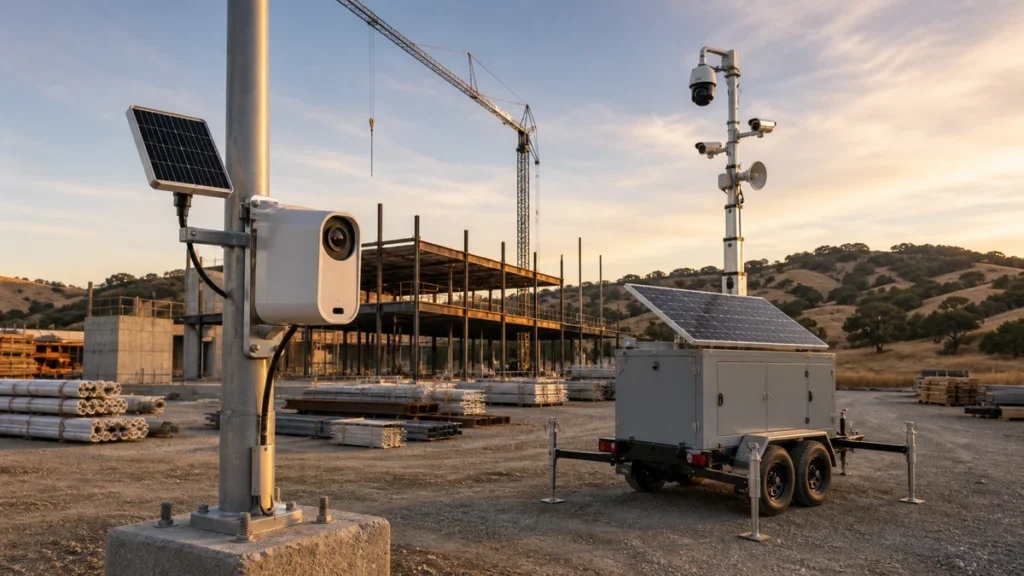
TL;DR: A construction time lapse camera documents a build through interval photos, progress films, stakeholder updates, and marketing content. A mobile surveillance trailer protects the site through continuous recording, live monitoring, and active deterrence. One camera contract rarely performs both jobs equally well. Choose time-lapse alone when documentation is the goal and theft exposure is low. Choose a trailer when materials, equipment, or after-hours access create a real security need. Many larger commercial builds use both, funded from separate documentation and security budgets. Hawk rents monitored trailers across Northern California, uses solar power and LTE where infrastructure is unavailable, and sets up in hours. Talk to a Security Specialist about the security side of the plan.
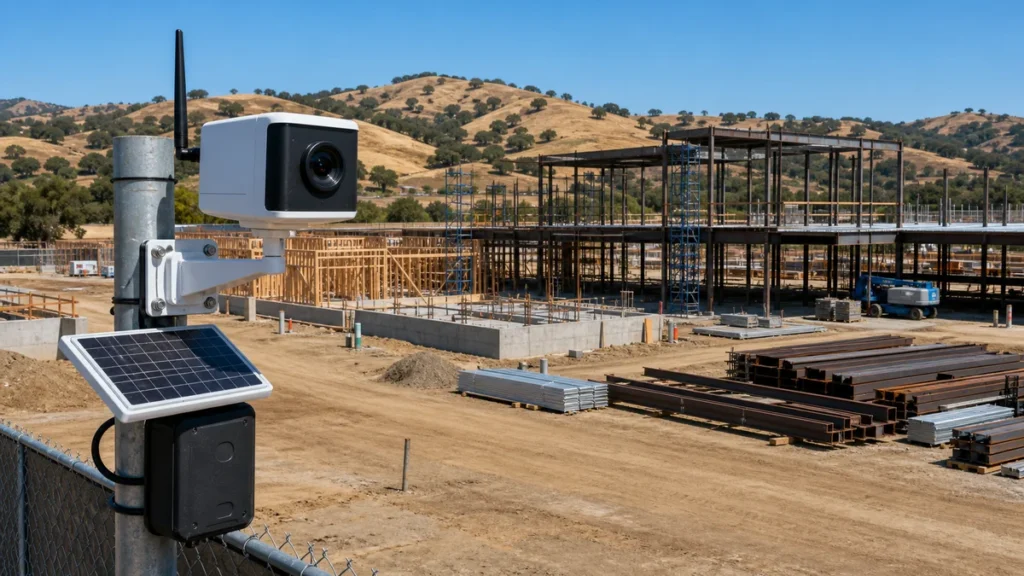
The confusion this post clears up
In brief:
A time-lapse camera and a surveillance trailer can both appear to be connected cameras pointed at a jobsite, but the important buying question is not what the hardware looks like. It is whether the contracted service is designed to document progress, detect and respond to security events, or perform both under separate specifications.
The documentation gap appears when a project manager buys interval photography and assumes it is an active security program. A camera taking one frame every 10 minutes can create an excellent construction film, yet it leaves most movement between frames unrecorded. Without live review, a speaker, a strobe, and an escalation plan, the setup is primarily a record of progress.
The opposite mistake is paying for continuous security recording and monitoring when the owner only wanted clean milestone photos and a finished marketing film. Security video may show what happened, but it does not automatically provide stable composition, image curation, branded editing, or a polished closeout deliverable. Define the job first, then buy the service that accepts responsibility for it.
Time lapse camera vs surveillance trailer: side by side
In brief:
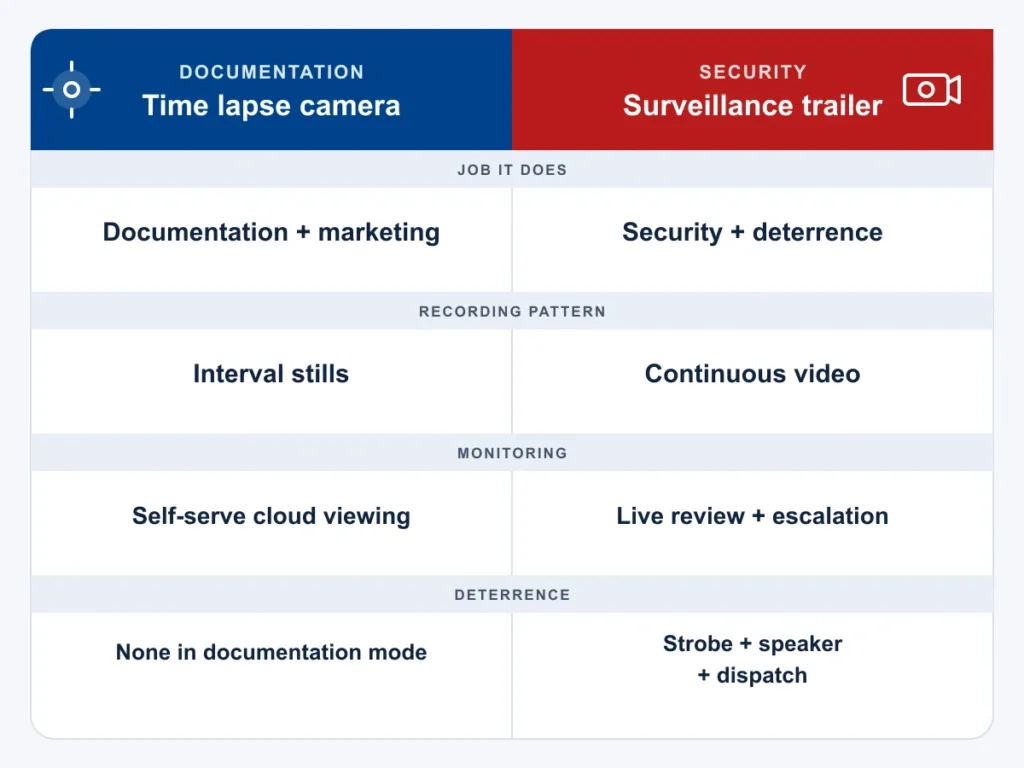
A construction time lapse camera is normally specified around a consistent view and a useful progress archive, while a surveillance trailer is specified around risk zones, continuous coverage, active response, and movement as the site changes. The table separates the two service models before optional hybrid features are added.
| Time lapse camera | Surveillance trailer |
|---|---|
| Purpose: Documentation and marketing, including progress records, stakeholder updates, and a final film. | Purpose: Security and deterrence, including detection, response, evidence, and escalation. |
| Recording pattern: Interval stills, commonly set around every 5 to 20 minutes based on project speed and duration. | Recording pattern: Continuous video recording with coverage available around the clock. |
| Monitoring: Self-serve cloud viewing for project teams, owners, and approved stakeholders. | Monitoring: Live human or event-based review with a defined escalation procedure. |
| Deterrence: None by design in a documentation-only configuration. | Deterrence: Visible mast, strobe, speaker, and dispatch coordination when included in the plan. |
| Power: Small solar panel, battery pack, or available site power. | Power: Trailer-scale solar array and battery bank, with auxiliary power where needed. |
| Typical cost model: Hardware purchase or a monthly service subscription. | Typical cost model: Monthly rental, with monitoring included in the quoted scope. |
| Rental availability: More often sold as hardware, a lease, or a managed subscription. | Rental availability: Rental is a standard project-based model. |
Hybrid products are real. TrueLook publishes continuous recording, motion detection, alerts, and optional professional monitoring alongside its time-lapse tools. EarthCam also separates time-lapse, live streaming, and security capabilities across its product line. The practical rule is to verify the recording, monitoring, deterrence, editing, and closeout deliverables in the proposal instead of relying on the word “camera.”
When a time lapse camera alone is the right call
In brief:
Buy time-lapse and skip the trailer when the business need is a reliable progress record, stakeholder visibility, dispute or sequencing reference, and polished marketing content on a low-theft site or a secured campus that already has an effective security program. Adding monitored security in that situation can be unnecessary duplication.
This is the category where dedicated providers deserve a fair look. OxBlue offers fixed-position construction cameras for progress capture, remote viewing, and time-lapse production. TrueLook says time-lapse functionality comes standard with every camera. EarthCam offers automated progress movies and professionally edited highlight films. WCCTV manages the work from placement and installation through long-term capture and final editing.
During active work, WCCTV says most construction projects use intervals of 5 to 15 minutes. The right interval still depends on project length, the speed of the work, desired film length, and storage. A high, stable, unobstructed viewpoint matters more than chasing the smallest interval. If documentation is your only need, a dedicated time-lapse provider is the better buy. Hawk does not sell time-lapse services.
When a surveillance trailer is the right call
In brief:
Choose a surveillance trailer when the site has defined after-hours exposure involving copper, tools, fuel, equipment, open access points, remote areas, or weekend gaps, and the operating requirement is to detect activity, review it live, deter it, and escalate under an agreed procedure rather than simply collect progress imagery.
In practice, monitored security starts with camera views and alert zones aimed at the areas that matter. A trained operator reviews qualified activity, uses an approved strobe or speaker warning when appropriate, contacts the designated site representative, and coordinates dispatch according to the written escalation plan. Hawk describes that workflow on its 24/7 remote monitoring and response page.
For an off-grid or changing construction perimeter, the solar surveillance trailer combines trailer-scale solar, battery storage, LTE-ready connectivity, a mast, and multiple camera types. The compact urban unit fits tighter infill locations. Both support the broader construction jobsite security use case. For the separate infrastructure decision, read the mobile trailer vs fixed cameras comparison.
When you need both (and how to budget it)
In brief:
Many larger commercial builds need both systems because owners want a defensible visual record and a useful final film while the field team also has materials, equipment, perimeter changes, and after-hours conditions to manage. Fund documentation from the project or marketing budget and security from the risk or site-operations budget.
The surveillance trailer protects defined risk zones. The construction time lapse camera holds a stable view, builds the progress archive, and produces the stakeholder and marketing asset. Give each vendor its own acceptance criteria: security coverage, response procedures, and incident reporting on one side; image cadence, uptime, archive access, editing, and final-film specifications on the other.
Some products cross the boundary. EarthCam offers a mobile trailer that also creates time-lapse movies, and TrueLook combines time-lapse with security recording and optional monitoring. Those platforms can be a sound single-vendor choice if the written scope covers both outcomes. A progress-still export is not automatically a professionally edited construction film, and a motion alert is not automatically live intervention. Judge the contracted workflow, not the enclosure.
What each costs in 2026
In brief:
Time-lapse pricing can combine camera hardware, installation, connectivity, cloud access, service, and editing, while a surveillance trailer is usually quoted as a monthly rental covering the selected hardware, deployment, connectivity, and monitoring scope. Compare complete project costs because a hardware price and a managed monthly service are not equivalent.
Provider-published figures illustrate the model without pretending there is one national average. TrueLook currently lists per-camera subscription tiers, while stating that camera prices, installation, monitoring, and other extras can be separate. CamDo lists its DataLens camera, which is a hardware figure rather than the total cost of a mounted, powered, connected, and edited project. Cascade Camera Works uses another model: a set installation fee followed by a weekly running fee.
Trailer pricing changes with unit type, camera package, monitoring hours, alert volume, rental duration, delivery distance, access, and required repositioning. The full decision framework belongs in our jobsite camera rental guide, scheduled to publish before this article. Hawk rents trailers rather than selling them and provides a site-specific quote, usually the same day. A buyer comparing proposals should confirm what is included instead of comparing a bare camera price with a monitored rental.
Frequently asked questions
In brief:
These answers address the most common buyer questions about whether time-lapse can provide security, whether a trailer can create progress content, how intervals and infrastructure work, what published prices mean, and when a commercial project should maintain two separately defined camera services.
Can a time lapse camera be used for security?
No, not as a time-lapse-only setup. Interval stills leave gaps between frames, and a documentation plan normally has no live operator, speaker, strobe, or response procedure. Motion alerts can improve awareness, but an alert sent to a busy project manager is not the same as active protection. Some platforms add continuous recording, professional monitoring, and deterrence. If those features are contracted, evaluate the system as a combined platform rather than assuming the time-lapse function provides security by itself.
Do surveillance trailers do time lapse?
Some do. Platforms from EarthCam and TrueLook can pair trailer-mounted cameras with scheduled progress images or automated time-lapse tools. That can be useful for routine updates, but it is not automatically a substitute for a dedicated documentation service. Confirm whether the proposal includes a stable long-term composition, image curation, archive access, branding, editing, music rights, and a finished film. If those deliverables matter, list them separately from security recording and monitoring.
What is the difference between a construction camera and a security camera?
A construction camera is usually optimized to document progress through scheduled still images, cloud viewing, comparison tools, and time-lapse films. A security camera is optimized for continuous video, event detection, review, evidence, and response. The labels can overlap because vendors offer hybrid platforms. The reliable way to compare them is to read the scope: recording pattern, monitoring hours, deterrence tools, escalation procedure, archive, editing, and final deliverables.
How much does a construction time lapse camera cost?
Cost depends first on the model. A buyer may purchase hardware, lease a camera, or pay for a managed subscription that includes connectivity, cloud tools, support, and editing. TrueLook publishes per-camera subscription tiers, with hardware and add-ons potentially separate. CamDo publishes a DataLens hardware price. Neither figure is a universal installed-project price. Mounting, power, cellular service, duration, maintenance, extra viewpoints, and final-film editing can materially change the total.
What photo interval should a construction time lapse camera use?
A 5 to 15 minute interval is common during active construction, according to WCCTV, while CamDo recommends 20 minutes as a starting point for general progress and 10 minutes for faster activity. Treat those as planning ranges, not fixed rules. Project duration, working hours, motion speed, storage, final video length, and critical milestones all affect the right cadence. Review sample output before launch and allow the interval to change when the work phase changes.
Do time lapse cameras need power and internet on a jobsite?
They need power, but not necessarily grid power or jobsite internet. Modern commercial systems can combine a small solar array, battery storage, and 4G LTE connectivity. WCCTV says its systems can use solar, battery, or hybrid power and cellular data, while EarthCam describes its Work Zone Cam Pro as a 4G wireless system. Confirm solar exposure, battery sizing, cellular signal, upload schedule, onboard backup, and responsibility for service before choosing the mounting location.
Should a commercial build have both a time lapse camera and a surveillance trailer?
Use both when the project has a genuine documentation requirement and a separate after-hours security exposure. The time-lapse camera should own the stable progress record, stakeholder views, archive, and final film. The surveillance trailer should own coverage of risk zones, live review, deterrence, and escalation. A low-theft site with existing security may need only time-lapse. A sensitive site with no marketing or documentation requirement may need only the trailer. Match each system to a written outcome and budget line.
Get Northern California trailer rental pricing
In brief:
If your project needs active security rather than documentation alone, Hawk can scope a monitored rental around the site layout, risk zones, operating hours, access, power, and response procedure. Solar and LTE configurations avoid grid power and trenching, set up in hours, and can move as the build changes across Northern California.
Review Hawk’s surveillance trailer rental service, including local deployment for Sacramento projects and San Jose jobsites. For a site-specific configuration and price, Talk to a Security Specialist.