
By Noah Williams | Last updated: August 10, 2026 | About 9 minutes
TL;DR:
- A solar powered security camera for commercial use fits one of three classes: consumer cameras from Reolink, eufy, or Ring for sheds and low-risk spots, fixed commercial solar units for one permanent coverage point, or solar surveillance trailers for elevated, monitored, redeployable coverage.
- Active commercial sites usually fit the trailer class because they demand protected mounting, wider sightlines, planned retention, live response, and winter energy reserve.
- Solar power, batteries, and LTE remove the need for grid power, trenching, and site Wi-Fi.
- Hawk rents monitored solar trailers across Northern California, with delivery and setup in hours.
- Pricing is a site-specific quote, usually same day. Talk to a Security Specialist.
Why solar matters for commercial security in 2026
In brief:
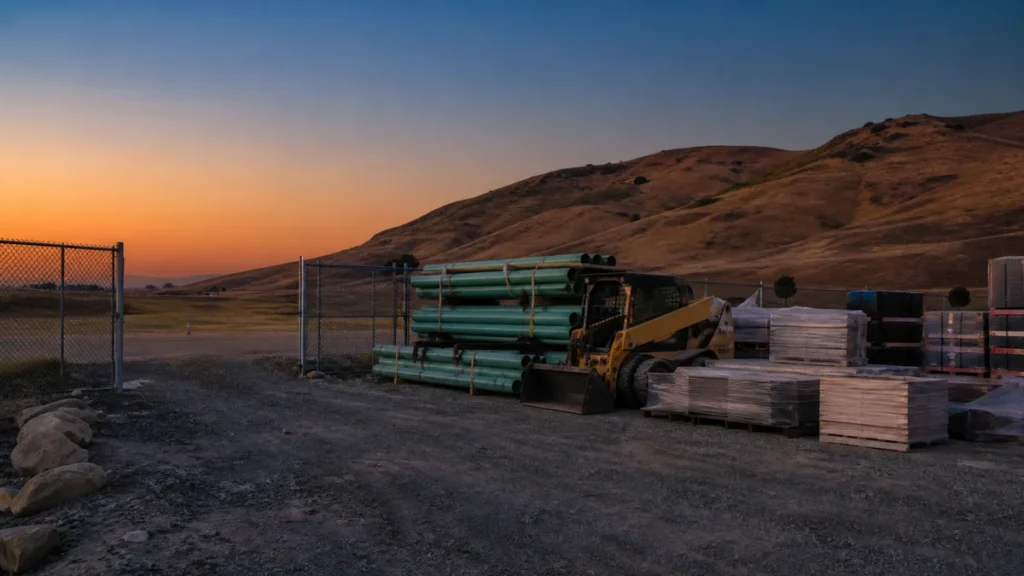
Solar matters because the useful camera position is often at a gate, yard edge, vacant parcel, or changing work zone where power and network service do not exist, so a self-contained system can cover the exposure without waiting for permanent infrastructure.
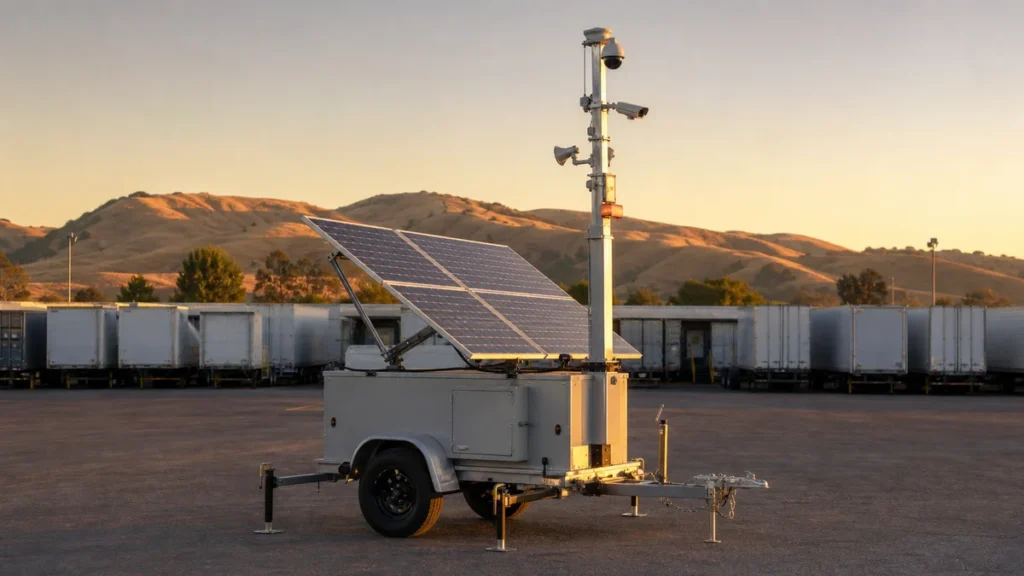
That makes solar the outer layer in a concentric security plan. It extends visibility beyond the powered building to construction phases, laydown yards, remote infrastructure, lots in transition, and isolated equipment areas. A fixed solar unit holds one stable point. A trailer turns that same layer into an elevated, monitored system that can move.
Valley Alarm describes its commercial units as self-contained solar, battery, camera, and LTE systems that need no Wi-Fi, hardwired power, conduit, trenching, or electrician. WCCTV also notes that solar removes generator refueling visits and related maintenance. Its published electricity example uses an old national rate assumption, so it should not be used to budget a Northern California site.
The three classes of solar security camera (and who each is for)
In brief:
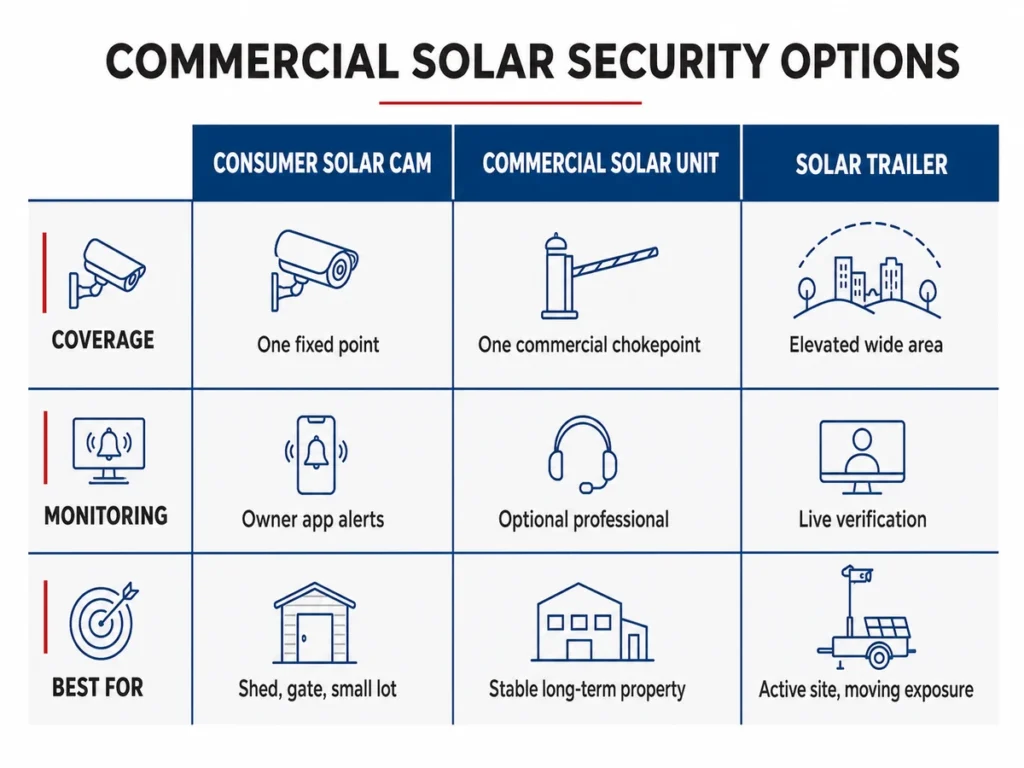
The right class depends on whether the buyer needs a small point camera, a professionally installed permanent unit, or a mobile security layer for an active site, and the cleanest comparison is based on power reserve, height, response, deployment, and how long the coverage point will stay put.
A commercial solar security camera is not one product category. It is a ladder. Consumer brands win the simple use case, fixed units win the stable chokepoint, and the solar trailer class wins when coverage must be elevated and redeployed.
| Decision factor | Consumer solar cam | Commercial fixed solar unit | Solar surveillance trailer |
|---|---|---|---|
| Typical cost class | Consumer purchase | Commercial equipment purchase or long-term lease | Monthly rental with a site-specific configuration |
| Power system | Small panel and internal battery | Sized panel and battery for one fixed load | Large panel array and battery bank for multiple loads and planned autonomy |
| Mounting height | Fence or wall height, often reachable | Professional pole height | Elevated telescoping mast |
| Monitoring | Owner app alerts | Optional professional monitoring | 24/7 live verification and escalation |
| Deterrence | Visible camera and passive recording | Signage and visible presence | Strobe, speaker, and live voice-down |
| Deployment | DIY screw mount in an afternoon | Professional installation | Delivered and set up in hours |
| Site fit | Shed, gate, home, or low-risk small lot | One fixed chokepoint on a stable property | Full active site with changing exposure |
| Rent or buy norm | Buy | Usually buy or lease | Usually rent for project-length needs |
Where a $150 consumer solar camera actually fails on a commercial site
In brief:
Consumer solar cameras are good products for the small, low-risk jobs they were designed to handle, but an active commercial site exposes gaps in camera height, tamper access, evidence workflow, response coverage, winter energy reserve, and connectivity that a residential installation may never encounter.
The price in this heading is not hypothetical. Reolink currently lists solar models around that price, and eufy and Ring compete in the same consumer use case. For a shed, gate, home, or small property where the owner can respond to alerts, that can be the sensible answer.
- Height and geometry: A fence or wall mount is easy to reach, cover, or redirect. It also cannot reproduce the wide sightline and PTZ reach of a telescoping mast across a yard.
- Tamper exposure: A reachable camera and its small panel can be removed with ordinary tools. Commercial placement protects the equipment while improving the view.
- Storage and evidence: Consumer workflows often prioritize event clips and app review, although capabilities vary by model. A business must specify retention, continuous recording where needed, timestamps, permissions, and a repeatable export process.
- Monitoring: An after-hours phone alert is not the same as live verification. It still leaves someone to open the app, interpret the scene, speak or call, and document the response.
- Winter uptime: Short days, fog, shade, frequent triggers, and night lighting can push a small energy budget below its charging budget. Commercial design starts with the load and the worst-season solar window.
- Connectivity: Many consumer cameras assume site Wi-Fi, although Reolink and eufy also sell cellular models. Check the exact SKU before choosing a solar security camera for business use on a vacant property or yard.
How commercial solar + LTE surveillance actually works (panel and battery sizing reality)
In brief:
A commercial system turns sunlight into stored operating time: the panel array charges a battery bank, the bank powers cameras and communications after dark, and an LTE modem sends video to operators without touching the property network, while optional strobes and speakers add to the electrical load.
A commercial solar powered security camera must be sized as an energy system, not chosen by panel wattage alone. Start with the total daily draw of cameras, modem, recorder, heater, lighting, strobe, and speaker. Then model the lowest-production season, panel angle and shade, conversion losses, and the required battery autonomy. NREL’s PVWatts uses location and long-term weather data for solar production estimates, which is more defensible than a universal Northern California multiplier.
Current vendor listings show how different the hardware can be. CCTV Security Pros lists a focused commercial LTE unit with a 60W panel and 320Wh battery. Alpha Alarm says its larger Solar-Shield configuration provides up to four days of battery backup. Those are vendor specifications, not interchangeable uptime guarantees.
Monitored vs unmonitored: the difference between recording a theft and stopping one
In brief:
An unmonitored camera creates evidence and alerts for later review, while a monitored system adds a live decision loop in which an operator verifies the event, uses a speaker or strobe when appropriate, escalates under the site protocol, and records what happened while the event is active.
That operational distinction matters more than another feature on a camera spec sheet. Hawk’s 24/7 remote monitoring is a concierge-level service for Hawk-rented trailers, with site-specific rules for voice-down, strobe use, dispatch, and client notification.
LVT reports on its own deployments a 70% reduction in parking lot incidents, a 62% decrease in violent crime, and a 69% drop in theft. The published page does not provide a sample size, comparison period, or study design, so those figures should be treated as vendor-reported customer outcomes, not an independent benchmark for every site.
When a solar trailer beats fixed solar units
In brief:
A fixed unit wins when one known chokepoint will remain important for years, while a solar surveillance trailer wins when the useful view must be higher, the coverage area changes with operations, the need has a defined end date, or live deterrence and redeployment are part of the response plan.
For a stable gate, alley, or remote equipment pad, buying a fixed unit can be the better decision. Valley Alarm says its pole systems can be operational within 24 to 48 hours after a site walk, and it positions them for permanent coverage gaps without conduit.
The trailer earns its footprint when the mast must see over stacked materials, vehicles, or changing fences, or when the exposure moves from grading to framing to finish work. Hawk can reposition the unit as the site changes. For construction-specific selection, see the construction industry guide, with a dedicated jobsite camera rental guide to follow.
A property with one stable chokepoint and a multi-year horizon may be better served by a fixed purchase. For broader tradeoffs, compare Hawk’s compact trailer and the mobile versus fixed camera guide.
Rent or buy solar security for a commercial site?
In brief:
Buy a consumer camera for a small point, consider buying or leasing a fixed commercial unit for a permanent off-grid chokepoint, and compare trailer rental with ownership by counting maintenance, monitoring, data, transport, redeployment, storage, and technology replacement, not hardware price alone.
Published listings illustrate the class difference without defining a universal market price. CCTV Security Pros lists its fixed LTE system, with a coupon discount displayed. Backstreet lists its current Guard-Box Solar package.
For ownership, 2M Technology lists standard trailer hardware, with cameras, VMS licensing, and LTE costs dependent on configuration. Ownership also creates upkeep, transport, and storage duties between projects.
Rental listings are package-specific. DuckView publishes a monthly base rate before optional monitoring, which it lists separately. SunRoad lists Standard and Pro packages. Those figures describe different vendors and inclusions, not one market range. Hawk rents only, bundles the agreed services, and provides a site-specific quote, usually same day.
Frequently asked questions
In brief:
Commercial buyers usually need clear answers about night operation, winter charging, battery autonomy, connectivity, suitability, rental availability, and pricing, and each answer depends on the system class and site design rather than on the word solar alone or one attractive product feature.
Do solar powered security cameras work at night?
Yes. The camera runs from energy stored in its battery after the sun goes down, and IR or low-light hardware handles the image. Night operation is therefore a battery-load question, not a sunlight-at-night question. On a commercial site, confirm that the power budget includes cameras, LTE, recording, lighting, strobes, and speakers. Night is also when live verification and a defined response protocol can matter most.
Do solar security cameras work in winter?
Yes, if the system is designed for its site and worst-season load. Short days, valley fog, shade, and repeated night events reduce the charging margin. A commercial designer should model local solar production, panel placement, total daily draw, and required battery autonomy. A small consumer panel may still suit a low-activity gate, but it provides less reserve for a busy site. There is no honest universal winter multiplier.
How long do solar security camera batteries last?
There are two different answers. Autonomy means how long a charged system runs without useful solar input. Alpha Alarm advertises up to four days for Solar-Shield, while other configurations vary with load, weather, and operating mode. Battery service life means how many years the battery remains fit for duty. There is no honest class-wide service-life figure. Ask for the battery chemistry, usable capacity, replacement plan, warranty, and tested load assumptions.
Do solar powered security cameras need Wi-Fi?
No, not necessarily. Commercial units commonly pair solar power with LTE cellular data, so they do not need the property’s Wi-Fi or wired network. Many consumer cameras do assume Wi-Fi, although cellular consumer models also exist. Check the exact model, carrier compatibility, data plan, signal strength, and local recording behavior before buying for a yard or vacant property. A site survey should test cellular coverage at the intended mast or pole position.
Are solar security cameras good enough for business use?
Yes, but the class must match the job. A consumer solar security camera for business use can be sensible at a low-risk shed, gate, or small property. An active yard or commercial project usually needs protected mounting, greater height, documented retention and export, LTE, planned winter reserve, and a real response path. Those requirements point toward a commercial fixed unit for one stable point or a monitored trailer for wider, changing coverage.
Can you rent solar powered security cameras?
Yes. Solar surveillance trailers are a common commercial rental format because the provider can deliver the complete power, camera, LTE, and monitoring package without a permanent installation. Hawk rents trailers across Northern California and sets up in hours. The rental can include maintenance, data, monitoring, response rules, and redeployment as agreed. Consumer cameras are normally purchased, while fixed commercial solar units are more often purchased or placed under a longer service agreement.
What do commercial solar security cameras cost?
Pricing is site-specific because coverage, power reserve, cameras, monitoring, data, delivery, and term change the configuration. Current fixed-unit listings include a discounted CCTV Security Pros unit and Backstreet’s Guard-Box Solar package. DuckView lists a trailer base rental rate before options. These are vendor listings, not a universal range. Hawk provides a site-specific quote, usually same day.
Get Northern California solar surveillance pricing
In brief:
For a monitored solar surveillance trailer in Sacramento, San Jose, the Bay Area, or elsewhere in Northern California, Hawk can review the site, choose the coverage class, and set up in hours with a site-specific quote that is usually available the same day.
Talk to a Security Specialist, review coverage in Sacramento or San Jose, or contact Hawk for pricing.