
By Noah Williams | Last updated: August 17, 2026 | About 9 minutes
The remote property problem: no power, no internet, huge perimeters
In brief: A farm camera plan must solve power, backhaul, distance, and long empty periods before it solves image quality. Start by mapping where electricity and usable internet actually end, then treat each gate, pump, fuel point, and equipment cluster as a separate coverage problem.
Farm surveillance is different from putting cameras around a house. Grid power may stop at the shop. Wi-Fi may stop at the farmhouse. The gate, pump, orchard edge, and equipment yard may sit far apart, while seasonal work leaves parts of the property empty at night for months.
That changes the buying question. You are not choosing one camera for an entire ranch. You are choosing a power source, connection method, recording plan, and response path for each priority area. Diesel tanks, copper wire in pump panels, mobile equipment, and harvested crop need clear coverage, but they do not always need the same hardware.
Begin with a site sketch. Mark every normal access road, the last reliable power point, the last reliable network point, and the clusters where replacement cost or operational downtime would hurt most. This turns a huge perimeter into a manageable set of camera jobs.
Your camera options for a farm or ranch
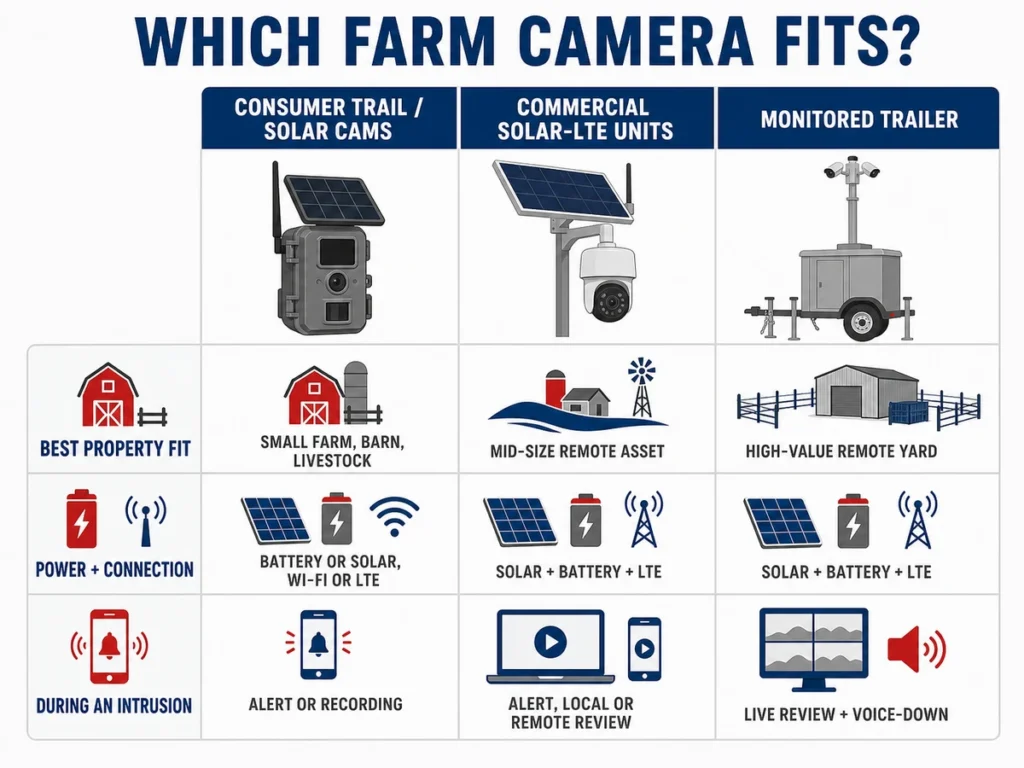
| Camera option | Best property fit | Power | Connectivity | Monitoring | Typical commitment |
|---|---|---|---|---|---|
| Trail or consumer solar cameras | Small hobby farm or homestead where a barn, a pasture, livestock, or one remote gate is the whole concern. A trail camera is the right tool when a handful of views cover the job and nobody needs to watch them live. | Replaceable battery, rechargeable battery, or small solar panel | Local storage, farm Wi-Fi, or a single-camera LTE plan | Usually owner alerts and review, not live professional intervention | Own the camera; add a data plan when LTE is used |
| Commercial solar LTE fixed units | Mid-size grower with a remote gate, pump, tank, or asset point that stays in one place | Larger solar panel and battery sized to the camera load | LTE, ideally with a tested failover path and local recording | Self-monitored alerts or a contracted monitoring service, depending on the system | Usually purchased or contracted as a fixed deployment |
| Fixed CCTV on buildings | Barns, offices, shops, packing areas, and other buildings with reliable power and network access | Grid power, often with battery backup | Wired network, local recorder, and site internet when remote access is needed | Recording and alerts, with optional third-party monitoring | Owned permanent installation |
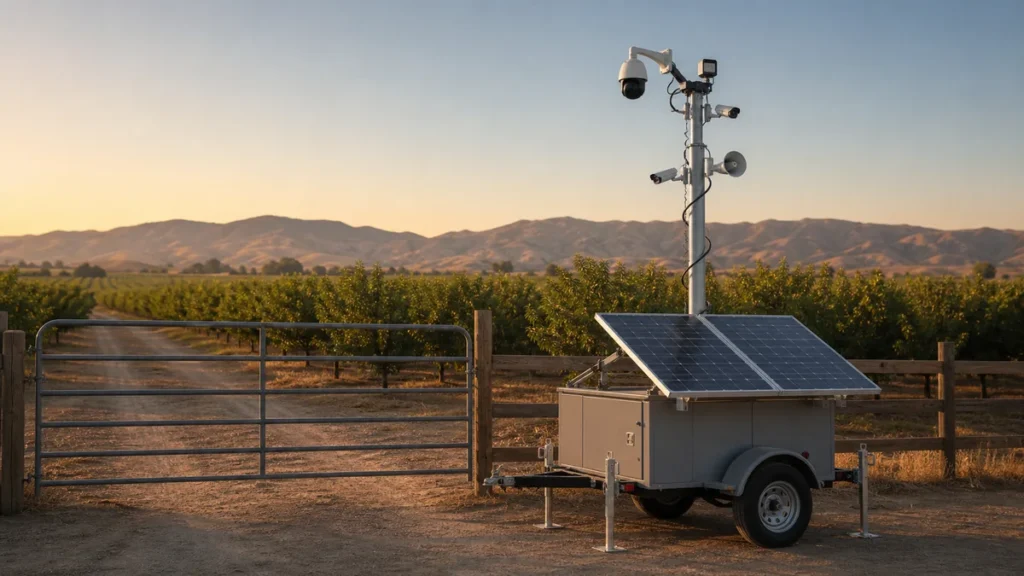
| Monitored solar surveillance trailer | High-value remote equipment yard, fuel cluster, pump infrastructure, or changing harvest operation. It is a poor fit for a small hobby farm with one barn camera. | Commercial solar array, battery bank, and a planned backup path | LTE confirmed at the exact placement, with local recording and failover when available | Live review, voice-down, strobe or lighting, escalation, and dispatch under the response plan | Rental from Hawk for the required site and season |
Off-grid architecture: solar power + LTE, and what rural coverage really means
In brief: An off-grid camera is a small power and communications system, not just a lens with a solar panel. The panel must refill a battery that runs cameras, recording, analytics, and an LTE modem through darkness and low-sun periods, while the modem must work at the exact field location. The basic chain is solar panel to charge controller to battery, then battery to cameras, recorder, modem, and deterrence devices. Daytime generation supports the load and recharges storage. At night, or when fog and clouds reduce generation, the battery carries the system. The right autonomy is site-specific because camera count, streaming, analytics, lights, temperature, shade, panel angle, and dust all change the load. The U.S. Department of Energy notes that season, clouds, dust, haze, rain, and shadows affect solar production, and that longer-duration storage can cover periods when production is low. That supports a practical buying rule: ask for a load calculation and low-sun operating plan, not a generic promise of a fixed number of backup days. Connectivity needs the same discipline. The FCC National Broadband Map shows provider-reported outdoor and in-vehicle availability, and the FCC provides a challenge process when field experience differs. Rural Central Valley coverage varies field to field. Confirm LTE at the gate, pump, or yard during the site walk with the intended modem and antenna. Failover matters only when a second usable network is actually present. For owned internet-connected cameras, follow basic cyber hygiene too. CISA recommends changing default passwords, applying security updates, using multifactor authentication where possible, and reviewing exposed devices routinely.Monitored or unmonitored? The honest answer for ag
In brief: Unmonitored cameras are appropriate when the job is checking livestock, confirming a gate event, or preserving evidence at a lower-value site. Monitoring becomes worth considering when someone must verify activity and intervene while fuel, equipment, crop, or infrastructure is still on the property. An unmonitored camera can send an alert or save a recording. That may be enough when the owner lives nearby, the site has low asset concentration, or the camera is mainly for animal health and operations. The weak point is human attention. An alert at 2 a.m. still needs someone to wake up, load the video, decide what it shows, and call the right person. A monitored system adds a response layer. An operator can review the event, use a speaker for voice-down, activate a strobe or light, document the incident, and escalate under an agreed plan. Hawk’s remote monitoring and live professional monitoring options apply to trailers Hawk rents, not to customer-owned camera systems. Rural response travel can be long, so the plan should not assume an immediate arrival. The operational benefit is intervention in the moment, plus better information for the owner or dispatcher. No universal monitored-effectiveness percentage is used here because results depend on placement, operator procedures, connectivity, site rules, and the event itself.Where cameras go on a working property
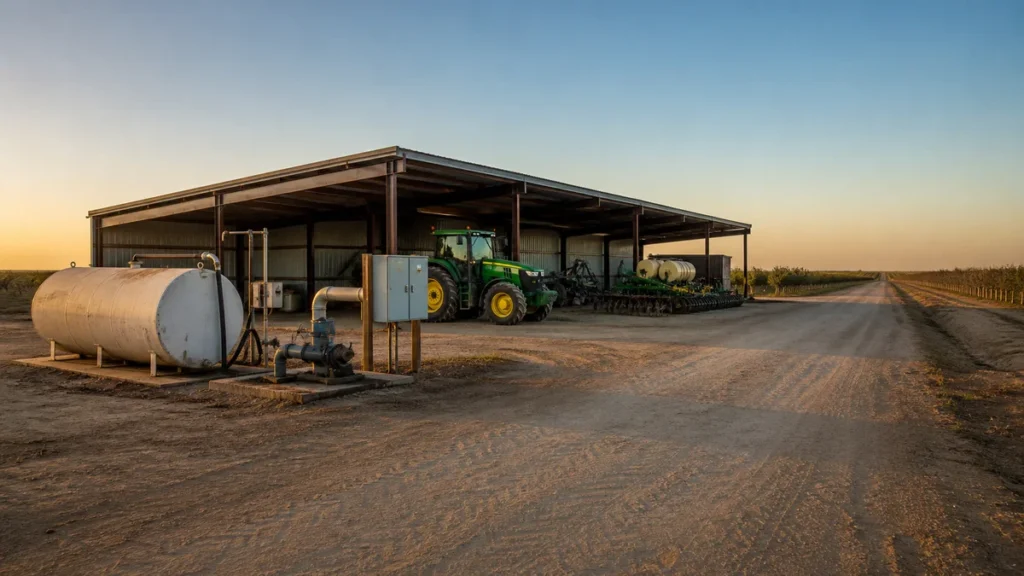
In brief: Place cameras in concentric layers: first observe how vehicles and people enter, then protect the concentrated assets inside. Gates and access roads form the outer layer. Fuel, equipment, and water infrastructure form the inner layer. Buildings come later because walls, locks, power, and fixed cameras already help them.- Gates and access roads first. Capture the approach, direction of travel, and a usable identification view. An overview camera and a tighter vehicle view often do different jobs.
- Fuel tanks second. Cover the fill point, pump, vehicle stopping area, and route back to the road without letting the tank block the view.
- Equipment yards third. Aim across the lanes between machines, not into one large mass of overlapping equipment. Keep the highest-value cluster inside the clearest night view.
- Water infrastructure fourth. Cover well pumps, electrical panels, and the vehicle approach. Keep glare from panel doors and work lights out of the identification angle.
- Barns and shops last. Use fixed cameras when power and a recorder are already available, then use mobile coverage outside where the building system cannot see.
Renting for harvest season: coverage when the value peaks
Frequently asked questions
In brief: The common questions all come back to fit: match the camera to the property’s power, connectivity, asset value, and response plan. Solar and LTE solve infrastructure gaps, but battery sizing, field-tested signal, useful placement, and a clear decision about who responds determine whether the system works.
What is the best security camera for a farm?
The best camera depends on the property and the job, not a product name. A small farm with a barn, Wi-Fi, and a few views can use consumer solar, trail, or fixed cameras. A remote grower may need commercial solar LTE units at pumps and gates. A high-value equipment or fuel yard may justify a monitored rental trailer that can support live intervention and move with operations.
What farm security cameras work without Wi-Fi or power?
Solar cameras with battery storage and 4G LTE can work where neither grid power nor Wi-Fi reaches. The solar panel replenishes the battery, while LTE carries alerts or video and local storage preserves footage if the connection drops. The system still needs site-specific sizing and a signal test at the exact location. A coverage map or a good phone signal at the farmhouse does not prove the gate will work.
Do solar security cameras work through Central Valley tule fog in winter?
Yes, but dense winter fog reduces the sunlight available to recharge the battery, sometimes across several low-sun days. The real questions are battery capacity, panel size and angle, camera load, and the backup plan. A properly planned system runs from stored energy when solar harvest falls. For monitored rentals, the provider should watch unit health and act before a low-battery condition turns into lost coverage.
Is monitored security worth it for a ranch?
Can I rent a surveillance trailer just for harvest season?
Can I use security cameras to watch livestock?
Where should I put security cameras on a farm?
Start at gates and access roads, then cover fuel tanks, equipment yards, water infrastructure, and finally barns or shops. Use the outer cameras to see approaches and the inner cameras to protect concentrated assets. Avoid glare, moving vegetation, and views blocked by machinery. Keep an overview angle for context and a tighter angle for identification. Put a mobile trailer at the highest-value cluster and move it when operations move.