

What a license plate recognition camera actually is (and how it works)
In brief: An LPR camera is a camera plus software that turns a passing vehicle into a line of text in a log, in three steps: capture the plate image at a chokepoint, read the characters with optical character recognition, then timestamp the result, store it, and compare it against the site owner’s own list.
Terminology first: LPR, ALPR (automated license plate recognition), and ANPR (automatic number plate recognition) all describe the same technology. ANPR is the term used outside North America.
- Capture. A camera with infrared illumination is aimed low and tight at a controlled point, usually a gate or a single entry lane. It exposes for the plate rather than the scene.
- Read. Software locates the plate and converts the characters to a text string with a confidence score attached. That score separates a usable log from a noisy one, and most buyers never ask about it.
- Log and alert. The string is timestamped and stored with the image. If it matches a list the site owner has supplied, it raises an alert.
The industry is also moving past the plate string. Flock Safety describes a Vehicle Fingerprint capability capturing attributes such as make, body type, color, and decals alongside the plate, so a vehicle can still be described when the plate is unreadable.
What LPR adds on a commercial site
In brief: Plate-level capability does four jobs that general camera coverage does poorly: it builds a searchable vehicle log, flags vehicles you have seen before, turns footage into evidence a police report can act on, and feeds the same monitoring escalation as any other alarm.
A searchable vehicle log at the gate
Every vehicle in and out, with a plate string, a timestamp, and an image. On a logistics yard that answers “which truck was on site at 2am on the 14th” in seconds instead of scrubbing hours of video.
Repeat-vehicle alerts on your own lists
The lists are yours, not a public database. A vehicle that circled the site twice last week, a banned contractor’s truck, a plate from a previous break-in: any of those can go on a watch list, so the next appearance raises an alert instead of sitting unnoticed in a log.
Incident evidence that includes a plate
A clip of someone loading copper into a truck is useful. The same clip with a legible plate is actionable. Hawk records, logs, and hands footage and plate data over on request. Investigating is law enforcement’s job, not ours.
Escalation through the same monitoring path
A plate hit is not a separate system with its own app. It raises an alert in the same monitoring center watching the trailer’s other cameras, an operator verifies visually, then it escalates like anything else: voice-down, strobes, and dispatch.
Fixed LPR networks vs trailer-mounted LPR vs standard PTZ cameras
In brief: These three answer different questions, and the split is about permanence: a fixed LPR network is built for chokepoints that will exist for years, a trailer-mounted unit for a chokepoint that lasts a project, and standard PTZ cameras to watch scenes rather than read plates.
| Fixed LPR network | Trailer-mounted LPR | Standard PTZ cameras | |
|---|---|---|---|
| What it reads | Plates at permanent chokepoints, across many sites | Plates at the chokepoint you park it at, plus full-site cameras on the same mast | Scenes, vehicles, and activity, not reliable plate capture |
| Deployment | Permanent install: mounting, power, permitting | Towed in, sets up in hours, solar and LTE, no trenching | Depends on the mount and the existing infrastructure |
| Cost model | Multi-year subscription, typically per camera | Monthly rental, no capital purchase | Hardware plus installation, then storage |
| Best for | Citywide or multi-site permanent programs, HOAs | Project sites, yards, and lots needing coverage for months, not years | General surveillance where plate-level logging is not required |
To be fair to the fixed-infrastructure vendors: if you run a permanent multi-site program, Flock Safety and Motorola Solutions build for exactly that, and a redeployable trailer is the wrong tool. The trailer wins a narrower question: when the chokepoint moves and the project ends in eight months, renting beats installing.
The honest accuracy section: when LPR misreads
In brief: LPR misreads, and it misreads in predictable ways, which is good news because every failure mode is addressable at deployment rather than in software: the angle the plate is presented at, the speed it passes, the light, the weather, and the plate itself.
Start with the caveat about numbers. Vendor marketing quotes accuracy in the high nineties. Those figures come from the vendors themselves under favorable conditions, and we found no independent published real-world benchmark worth citing, so this article quotes none. Treat a datasheet percentage as a ceiling measured in good conditions, not a promise for your gate at 3am in February.
What the research does support is that geometry dominates. A 2026 study, “Mapping License Plate Recoverability Under Extreme Viewing Angles for Opportunistic Urban Sensing” by Adamenko, Ben Aharon, Aperstein and Apartsin, concluded that viewing geometry rather than the restoration model determines what can be recovered from a degraded plate image. Plainly: no software fixes a badly aimed camera.
The failure modes worth planning around:
- Night and headlight glare. Infrared helps a great deal. It does not cure high beams pointed straight at the lens.
- Speed at the capture point. A plate crossing the frame quickly gives the sensor less to work with. Gates and barrier arms work well because vehicles slow at them.
- Angle and mounting height. A camera too high or off the lane axis sees a compressed, skewed plate.
- Weather and dust. Rain, fog, and jobsite dust cost reads. A dirty lens costs more.
- Plate condition. Dirty, bent, obstructed, or paper temporary plates are the most common real-world misses.
- Lookalike characters. 0 and O, 8 and B, 1 and I. This is why the confidence score matters and why a log is a strong lead, not proof.
“People shop LPR like they shop a camera spec. On a real yard, where you put the camera and how vehicles approach it decides your read rate. I would rather have an average sensor aimed correctly at a gate than a great one pointed down a wide lane.” Paul Wittner, Hawk Surveillance Systems
Is LPR legal for a private business in California?
In brief: Yes, a private business may operate an LPR system in California, and it takes on statutory duties when it does: Civil Code Section 1798.90.51 requires an ALPR operator to maintain reasonable security procedures and to implement and publicly post a usage and privacy policy, and a 2026 appellate decision made skipping that policy actionable on its own.
The statute is specific about what the policy must cover: the authorized purposes for collecting ALPR information, who may use the system and their training, how it is monitored for security and legal compliance, the rules on sale, sharing, or transfer, the custodian responsible for implementation, the measures used to keep the information accurate, and how long it is retained plus when it is destroyed. It must be in writing and prominently displayed on any website the operator maintains. The Electronic Frontier Foundation’s explainer confirms the law reaches private entities, not only agencies.
Enforcement got sharper in 2026. In Bartholomew v. Parking Concepts, Inc. (California Court of Appeal, First District, No. A171546), the court held that collecting ALPR information without implementing and publicly posting the required policy is itself a harm to the individuals whose plates were captured, enough to support a private action, with no breach or misuse required. The California Supreme Court declined review on May 13, 2026. Civil Code Section 1798.90.54 sets the exposure: actual damages but not less than liquidated damages of $2,500, plus punitive damages for willful violations, attorney’s fees, and costs.
On retention, be careful with the numbers you will see quoted. The California State Auditor reported in 2019 that SB 34 does not specify retention periods for ALPR data, and the short windows commonly cited, such as the 60-day cap on the California Highway Patrol and the 30-day to two-year windows in municipal police policies, are law enforcement rules, not obligations on a private business. The statute requires a private operator to state its own retention and destruction process, then follow it.
The boundary is simple. A business records, logs, and retains under a published policy. Law enforcement investigates and acts. Hawk hands over footage and plate data on request and claims nothing beyond that: no hotlist checks against DMV or police databases, no identification of drivers, no enforcement role. This is general information, not legal advice, so confirm your obligations with counsel.
Renting an LPR-equipped trailer: what it looks like
In brief: On a rental, plate-level capability is a configuration choice on a unit you already have rather than a separate installation project, so the decision comes down to one question: whether your site has a chokepoint worth reading and a reason to keep the log.
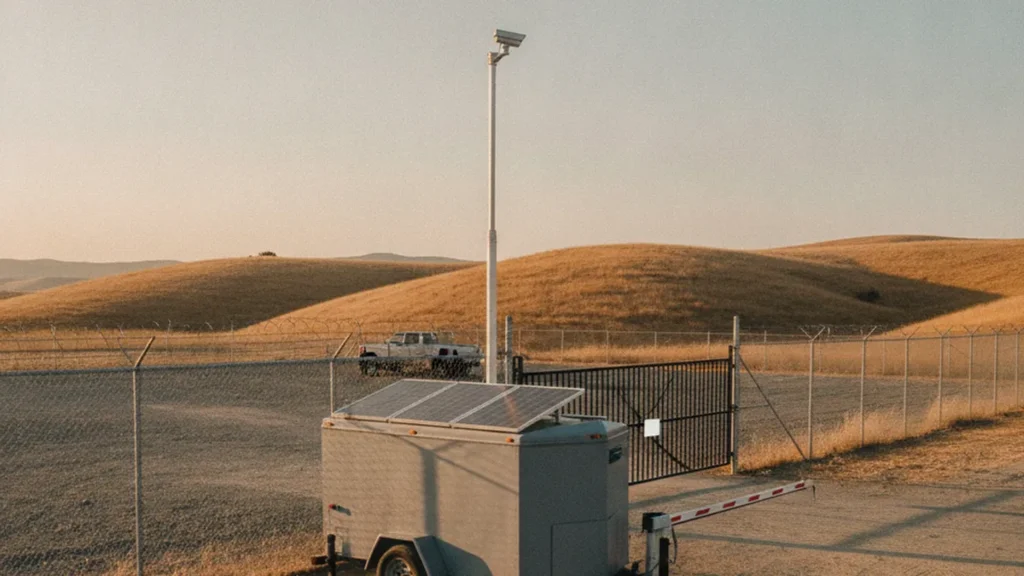
It starts with a site walk to find that chokepoint: one controlled point where vehicles pass slowly at a predictable distance and angle. Everything else on the mast keeps its normal job, so the Mobile Command primary solar unit, which lists license plate recognition among its optional analytics, covers the perimeter with PTZ and fixed cameras while one camera reads plates at the gate. For heavier sites, the heavy-duty industrial trailer carries the same idea on a tougher platform.
The unit tows in and sets up in hours on solar and LTE. No trenching, no grid power, no permanent structure. Alert lists are yours: banned vehicles, plates from prior incidents, expected deliveries. Alerts run the live monitoring escalation path. Terms are monthly. We quote site by site, usually the same day.
One honest constraint: LPR is stationary. It needs a deliberately aimed camera at a fixed capture point, so a trailer does not read plates while towed. We deploy across Northern California, including Sacramento and San Jose, on logistics yards and warehouses, construction sites, and dealership lots.
Frequently asked questions
What is a license plate recognition (LPR) camera?
An LPR camera is a camera plus software that automatically reads license plates. It captures the plate image at a chokepoint, converts the characters to text with optical character recognition, then timestamps that plate string, logs it, and checks it against the alert list the site owner has set up. ALPR and ANPR are the same technology under different names, and ANPR is the term used outside North America.
How accurate are license plate recognition cameras?
Accurate enough to be useful and conditional enough that you should not trust a marketing percentage. Real reads depend on the angle the plate is presented at, vehicle speed at the capture point, light and glare, weather, and whether the plate is clean. Research on recovering plates from degraded images finds that viewing geometry, not the software, sets the limit. Placement decides accuracy more than the spec sheet.
Is it legal for a private business to use LPR cameras in California?
Yes, with conditions. California Civil Code Section 1798.90.51 requires an ALPR operator to maintain reasonable security procedures and to implement and publicly post a usage and privacy policy covering purposes, authorized users, training, monitoring, sharing rules, the responsible custodian, accuracy measures, and retention and destruction. The Electronic Frontier Foundation confirms the law applies to private entities. This is general information, not legal advice, so confirm your obligations with counsel.
Do LPR cameras work at night?
Yes, with the right hardware and placement. LPR cameras use infrared illumination and short exposures to capture the reflective plate rather than the scene, which is why a good night capture looks like a bright plate on a black background. Headlight glare, high approach speed, and a steep angle all degrade night reads. A camera aimed at a slow chokepoint reads far better at night than one covering a wide lane.
Can you rent a license plate recognition camera?
Yes. On a mobile surveillance trailer, LPR is an add-on to the camera package rather than a separate installation, so you can rent plate-level capability by the month instead of committing to a permanent network. Hawk lists license plate recognition among the optional analytics on its Mobile Command primary solar unit. The trailer tows in, sets up in hours on solar and LTE, and leaves when the project ends.
Does LPR work while the trailer is moving or being towed?
No. LPR needs a stationary camera deliberately aimed at a controlled capture point, at a known distance, angle, and height, where vehicles pass slowly and predictably: a gate, a barrier arm, or a single entry lane. While a trailer is towed none of that holds, so plate reading is not part of the service in transit. The log starts once the unit is positioned, leveled, and aimed.
How do LPR alerts reach the monitoring team?
A plate read is matched against the alert lists you supply: vehicles banned from the site, plates captured during a previous incident, or expected deliveries. A match raises an alert in the same monitoring center that watches the trailer’s other cameras, an operator opens the live view and verifies what is there, then it follows the normal path: voice-down, strobes, and escalation to dispatch if needed.
Get Northern California LPR trailer pricing
If you are weighing whether plate-level logging is worth adding, the fastest way to decide is a look at your chokepoint. Tell us where vehicles enter, how fast they move, and how long the project runs, and we will tell you whether LPR earns a place on the unit.
Still choosing a deployment model? Read our comparison of mobile trailers and fixed security cameras.