
By Noah Williams | Last updated: August 18, 2026 | About 9 minutes
TL;DR: Thermal security cameras image heat instead of visible light, so they can detect people and vehicles in total darkness, wildfire smoke, and light fog when optical detail is limited. They detect presence but do not identify a face, plate, or clothing color. That is why serious sites pair thermal detection with an optical camera on the same mast, then use monitoring to confirm and escalate. At California properties in Fire Hazard Severity Zones, a suitable temperature-monitoring sensor can also alert people to abnormal hot spots. Hawk offers this as a rentable thermal and optical trailer capability, with solar power, LTE connectivity, monitoring, and Northern California deployment that sets up in hours. Talk to a Security Specialist for a site-specific quote, usually the same day.
How thermal security cameras work: heat, not light
In brief:
Thermal security cameras detect differences in infrared energy emitted by objects, then translate those differences into an image, so they need no visible light and can keep detecting in total darkness, smoke, and light fog even when a conventional optical view has lost useful contrast.
A thermal sensor is not looking for a particular color. It measures the relative heat radiating from organic and inorganic objects in its field of view. A running vehicle, a person, stored material, soil, and a wall can each present different heat signatures. The camera converts those differences into shapes that an operator or analytic rule can evaluate.
Teledyne FLIR’s security guidance documents operation in total darkness, glaring light, smoke, and light fog. Axis Communications likewise explains that thermal cameras rely on radiated heat rather than visible detail, can detect through smoke and light fog, and do not create images that identify an individual.
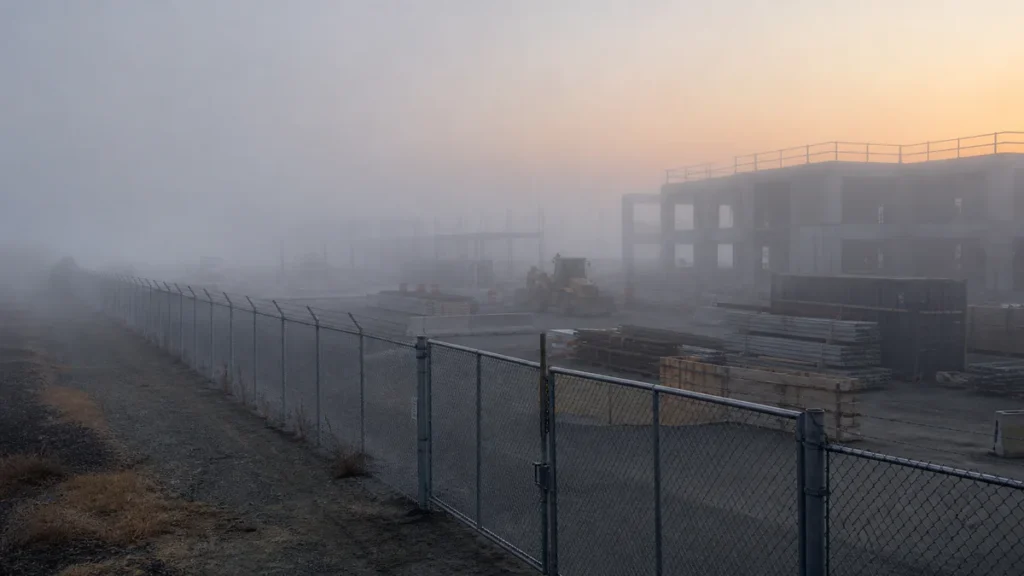
This matters in Northern California because visibility is not consistent. The National Weather Service identifies tule fog as a winter Central Valley phenomenon, while wildfire smoke can reduce visual contrast during the dry season. Thermal keeps working from heat contrast rather than reflected scene light, although dense fog, heavy rain, and low temperature contrast can shorten useful detection performance.
Kill the movie myths early: thermal cannot see through walls, and normal glass blocks or reflects the infrared energy used by most thermal cameras. It also cannot read a license plate, capture clothing color, or provide a useful facial image. FLIR’s manufacturer explanation of thermal limits confirms the wall, glass, and weather constraints.
Thermal vs optical vs IR-illuminated cameras
In brief:
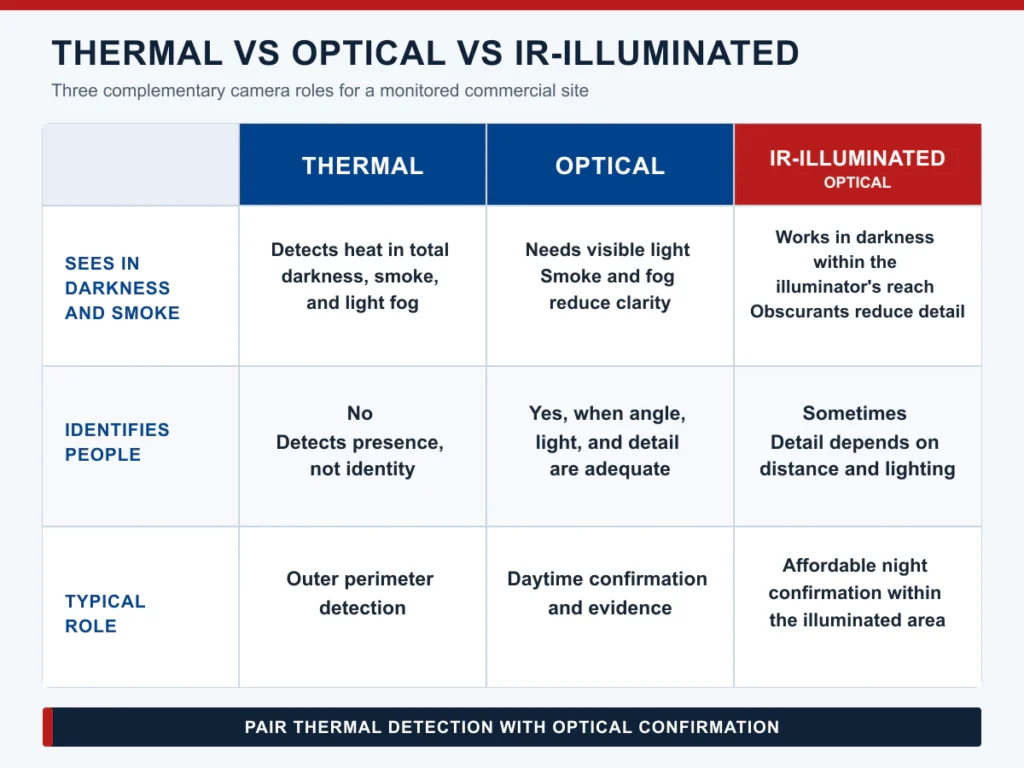
Thermal, daytime optical, and IR-illuminated optical cameras solve different problems: thermal is strongest at detecting heat over a dark or obscured perimeter, daytime optical captures the clearest identity and color evidence, and IR illumination provides an economical nighttime image inside the distance its light can reach.
| Decision point | Thermal | Optical, daytime | IR-illuminated optical |
|---|---|---|---|
| How it sees | Measures emitted heat differences | Records reflected visible light | Records near-infrared light reflected from an illuminator |
| Darkness performance | Works with zero visible light | Needs useful ambient or added white light | Works inside the illuminator’s coverage |
| Smoke and fog performance | Can detect through smoke and light fog, with reduced performance in dense moisture | Contrast and detail fall as visibility drops | Reflected illumination can lose detail in obscurants |
| Detection range | Lens and target specific; can extend well beyond typical IR illuminator reach | Lens, lighting, and required detail determine the useful distance | Limited by illuminator reach, angle, and required image detail |
| Identification and evidence | Detection only; no face, plate, or clothing color | Best for faces, plates, color, and incident evidence when the scene supports it | Grayscale evidence; identification depends on distance, angle, and illumination |
| Relative cost | Premium specialty capability | Standard daytime baseline | Affordable night default |
| Best role on a site | Outer perimeter detection | Daytime confirmation and evidence | Night confirmation within the illuminated area |
Axis describes the relationship plainly in its IR surveillance guidance: IR light can give a day-and-night optical camera an image in darkness, while thermal complements the system and visual cameras are generally still needed for identification. The useful distance for either technology depends on the camera, lens, target size, placement, weather, and the level of detail the operator needs.
Verdict: This is not a versus decision on a serious commercial site. Thermal detects but does not identify. The paired mast is the answer: thermal watches the outer approach, an optical camera confirms what happened and records evidence, and monitoring turns that information into a response.
Thermal on the construction perimeter
In brief:
On a construction perimeter, thermal works best as the outer detection ring, watching long fence lines, open approaches, and laydown yards where movement may begin beyond the useful reach of ordinary IR illumination, while optical cameras, active deterrence, and a human response process handle confirmation and action.
A large build often has uneven lighting, temporary gates, moving material stacks, and no useful mounting point at the boundary. A trailer mast gives the thermal camera a clear angle across those changing areas. Heat-based analytics can classify people and vehicles without depending on headlight glare, shadows, or clothing color. FLIR and Axis both state that thermal analytics can help reduce irrelevant alarms, but tuning still matters. Animals, hot equipment, weather, and poor exclusion zones can still create events that require review.
The operational sequence should be simple:
- Detect: Thermal analytics flag a person or vehicle crossing a defined outer zone.
- Confirm: An operator checks the paired optical camera and nearby views to understand the activity.
- Deter: If the event meets the site’s rules, the operator can activate the strobe or use the speaker for an approved live challenge.
- Escalate: The operator contacts the site lead, security, or emergency services according to the written response plan.
This is the concentric model in practice. Thermal extends the trailer’s outer detection ring. Optical video, the strobe, the speaker, and remote monitoring form the inner confirmation and deterrence layers. Hawk’s construction jobsite security service and guide to mobile trailers versus fixed cameras explain how that movable layer fits a changing build.
Thermal cameras in California wildfire zones
In brief:
At California sites in a Fire Hazard Severity Zone, a temperature-monitoring thermal camera can serve a second role by alerting people to abnormal heat around equipment or stored material before smoke or flame is visible, but only when the sensor, thresholds, sight lines, and response plan are designed for that purpose.
Start with the official map, not a sales label. CAL FIRE’s Fire Hazard Severity Zone page classifies State Responsibility Area land as moderate, high, or very high hazard. CAL FIRE also stresses that the map describes hazard, not the risk to a particular property after mitigation. A site team should use its actual address and local requirements when planning.
For a properly configured temperature-monitoring system, an alert can focus attention on an overheating electrical component, equipment hot spot, or smoldering material before a visible camera records smoke or flame. This is not a capability of every thermal security camera. The camera must support temperature or threshold monitoring, and the installer must account for surfaces, reflections, distance, weather, and normal operating heat. FLIR’s early fire detection guidance describes continuous monitoring for abnormal heat before smoke or flames are visible.
The wildfire use is not hypothetical. In September 2021, Teledyne FLIR documented a Triton PT-Series and an Elara DX-Series camera monitoring the Caldor Fire through dense smoke, while two Elara DX-Series cameras tracked the Dixie Fire in Northern California. Those were purpose-planned wildfire deployments, not proof that any security camera automatically becomes a fire system.
For regional planning, Hawk’s live guides cover Sacramento trailer rentals, Fresno trailer rentals, and the separate role of a wildfire surveillance trailer in California.
A thermal camera does not replace a required fire watch, fire code obligations, instructions from fire authorities, or evacuation orders. It is an early-detection and security layer that alerts humans faster. Site teams must keep required fire-safety procedures in force and follow CAL FIRE, the local fire authority, and emergency alerts.
Renting thermal: the trailer-mounted option
In brief:
Renting puts the thermal and optical pair on a mobile solar and LTE trailer without asking the project to buy specialty hardware, build poles, trench power or network cable, or maintain the system, so the same monitored outer layer can move as the fence line and high-value areas change.
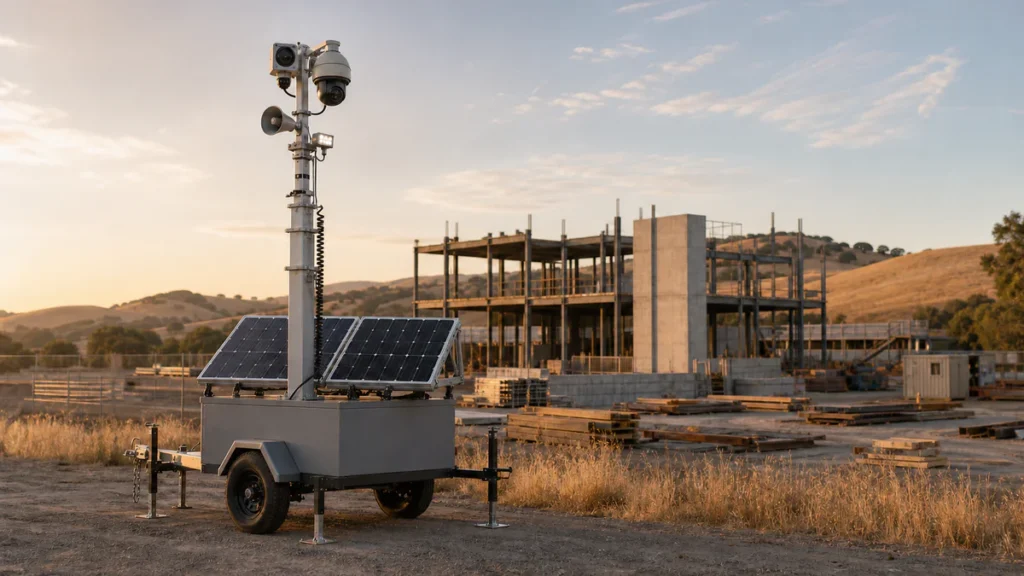
A Hawk thermal configuration is a rentable capability, not a hardware purchase pitch. The trailer brings solar generation, battery storage, cellular connectivity, an elevated mast, recording, speaker, and strobe as one field system. Standard placements set up in hours after delivery, subject to access, availability, and any special site requirements. The unit can then be repositioned as grading, framing, material storage, and final access routes change.
Choose thermal when the site has a large dark perimeter, long approaches, recurring tule fog, smoke exposure, glare, or a defined heat-alert objective that a suitable camera can support. Standard IR optical is often enough for a smaller, well-bounded site where the important activity stays inside the illuminator’s reach and identification is the main need.
Hawk’s solar surveillance trailer supports PTZ, IR, and specialty thermal configurations. The heavy-duty industrial trailer supports larger camera payloads for long perimeters and rough sites. Both are scoped through Hawk’s Northern California surveillance trailer rental service.
Expect a premium over a standard optical configuration because the sensor, lens, analytics, power load, monitoring workflow, and possible temperature-monitoring functions all affect the system. Public hardware prices do not translate cleanly into a monitored trailer rental. Hawk provides a site-specific quote, usually the same day, and does not sell trailers.
Frequently asked questions
In brief:
Most buyer questions come down to what thermal can detect, what it cannot identify, how weather changes performance, whether it can support early heat alerts, and when its higher configuration cost is justified, so the answers below keep those decisions separate from marketing claims and site-specific engineering.
Can thermal security cameras see through smoke and fog?
Yes, for detection under suitable conditions. Thermal cameras read infrared energy instead of reflected visible light, so smoke and light fog can block an optical view while a warm target still creates contrast. Performance is not unlimited. Dense fog, heavy rain, long distances, and a small temperature difference between the target and background can reduce useful range, so placement and field testing matter.
Do thermal cameras work during the day?
Yes. Thermal cameras work day and night because they respond to heat contrast rather than the amount of visible light. They are not blinded by headlight glare, deep shadow, or a setting sun in the same way as an optical camera. Daytime heat from pavement, roofs, machinery, and reflected surfaces can complicate a scene, so analytics and alarm zones still need site-specific tuning.
What is the difference between thermal and night vision cameras?
A thermal camera forms an image from emitted heat and needs no illumination. An IR night vision camera is an optical camera that shines near-infrared light into the scene and records the reflected light, usually as grayscale video. IR is the affordable night default inside the illuminator’s reach. Thermal is stronger for outer detection in darkness, smoke, light fog, and glare.
Can thermal cameras identify faces or license plates?
No. A thermal security camera can reveal that a person or vehicle is present, but it does not capture facial detail, a readable plate, or clothing color for an incident report. Identification belongs to a correctly placed optical camera with enough resolution, light, angle, and target size. That is why a commercial trailer should pair thermal detection with optical confirmation and evidence recording.
Can thermal cameras detect wildfires early?
A suitable temperature-monitoring thermal camera can alert people to an abnormal hot spot before smoke or flame becomes visible. FLIR has also documented purpose-planned thermal cameras monitoring the Caldor and Dixie fires through smoke. This capability requires the right sensor, thresholds, placement, and human response plan. It does not replace a required fire watch, fire code duties, official warnings, or evacuation instructions.
Can you rent a thermal security camera trailer?
Yes. Hawk offers thermal as an optional capability on a rented Northern California surveillance trailer. A typical configuration pairs thermal and optical cameras on an elevated mast with solar power, battery storage, LTE connectivity, recording, strobe, speaker, and monitoring. Availability and camera selection depend on the site and project schedule. Hawk provides a site-specific quote and sets up standard deployments in hours after delivery.
How much do thermal security cameras cost?
There is no useful single price because consumer thermal devices, fixed commercial cameras, multispectral units, lenses, analytics, and temperature-monitoring models solve different problems. On a rented trailer, thermal normally carries a premium over a standard optical configuration. The practical comparison is a site-specific total that includes the camera pair, power, LTE, installation, monitoring, service, and redeployment. Hawk usually provides that quote the same day.
Get Northern California thermal trailer pricing
In brief:
Hawk can scope a thermal and optical trailer around your site address, perimeter length, fog or smoke exposure, priority assets, monitoring hours, cellular service, and heat-alert objectives, then provide a site-specific rental quote, usually the same day, with standard deployments setting up in hours after delivery.
Talk to a Security Specialist or contact Hawk Surveillance Systems to discuss a monitored thermal trailer for a Northern California site.