

By Noah Williams
Last updated: October 2026
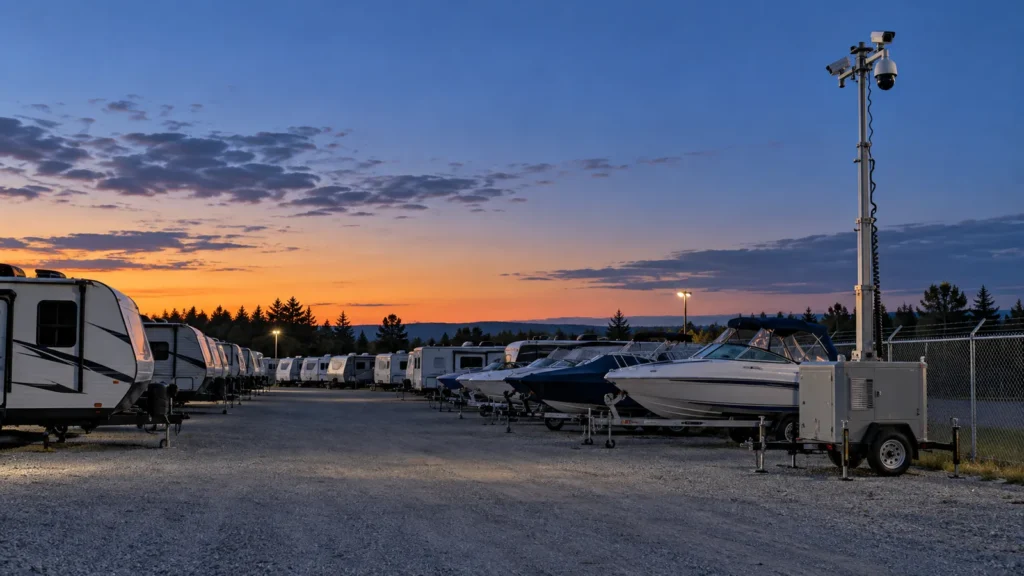
RV storage security starts with controlling entry and seeing the spaces between parked vehicles. Review exposed equipment, vehicle doors, trailer attachment points and the routes someone could use to leave the property. On an outdoor RV and boat storage lot, the tall vehicles themselves block camera sight lines, so coverage has to come from elevated cameras placed at the ends of rows and at the gate rather than from a single pole in the middle. Combine those views with maintained fencing, usable lighting, individual gate credentials and a clear response procedure. Test the plan when the lot is occupied and after dark; an empty-yard camera demonstration will not show every obstruction. At Hawk Surveillance, we help Northern California facility owners plan mobile camera coverage and professional monitoring through our monitoring partner.
What thieves target at RV and boat storage lots
Plan for theft from vehicles as well as theft of whole vehicles or trailers. Review catalytic converters, exposed batteries, solar panels, propane cylinders and outboard motors, along with doors, hitches and tongue locks. These are inspection priorities, not a ranked list of the most frequently stolen items.
Break the inspection into places a person would approach: beneath a motorhome, beside a battery box, behind a boat or at a trailer tongue. A camera that records the driveway may miss activity at each of those locations. Keep vehicle-door and compartment access in the coverage review, too.
The risk is not limited to an open gate. A Mountain View Police report involving RV catalytic converter theft describes entry to a fenced lot. That is a reason to inspect the perimeter, not evidence of a statewide theft rate.
Ask staff to record the space number, affected asset, discovery time and last known normal condition after an incident. Use those records to decide which rows need closer views. Treat owner reports as leads to check against footage, rather than assuming every missing item disappeared on the property.
Why tall vehicles create blind spots
Tall RVs, covered boats and tightly parked trailers interrupt the view between a camera and the activity you need to see. Elevated views can improve visibility along drive aisles, but height alone cannot reveal everything between vehicles. Start with row ends, then test the gaps behind the largest units.
Stand at each proposed camera location and look toward the far end of the row. Repeat the check with someone walking the aisle and stepping beside a parked vehicle. If that person disappears, identify the missing view instead of assuming additional zoom will fix it.
Mast height matters, but so do viewing direction and the distance to the target. A high overview can help track movement while a separate, more focused view captures the gate interaction. Neither should be treated as proof that every compartment or undercarriage is visible.
Recheck after seasonal arrivals or changes to assigned spaces. A tall motorhome parked where a low boat trailer stood can change the view without anything moving at the camera.
A coverage plan for an outdoor storage lot
On an outdoor RV and boat storage lot, the tall vehicles themselves block camera sight lines, so coverage has to come from elevated cameras placed at the ends of rows and at the gate rather than from a single pole in the middle.
| Zone | The risk | What to cover | Camera approach |
|---|---|---|---|
| Entry gate and keypad | Tailgating, shared credentials and disputed vehicle movements | Approach lane, gate opening and vehicles entering or leaving | Pair an overview with a gate-focused view; evaluate a dedicated plate view where suitable |
| Row ends and drive aisles | Approaches to vehicles hidden by neighboring units | Aisle travel and access into gaps between parked RVs and boats | Use elevated row-end views; check overlap and remaining obstructions with the lot occupied |
| Perimeter fence line | Climbing, damaged fencing or access from an adjoining parcel | Fence approaches, corners and routes toward vehicle rows | Aim along vulnerable boundaries; test shadows and parked-vehicle obstruction |
| Wash or dump station | Equipment tampering and disputed activity in a shared area | Approach, service equipment and departure route | Use a focused view of the shared area without relying only on distant aisle coverage |
| Office and after-hours drop area | Unauthorized approach, door tampering or unclear handoffs | Office entrance, drop location and connecting path | Combine an entrance view with approach coverage; check nighttime detail |
Source: Hawk Surveillance site practice. General guidance.
Use this table as a site-walk worksheet. Mark each zone on a lot plan, identify what an operator needs to recognize there, and record the view that serves it. The same row-and-boundary approach informs yard and logistics security, but the layout must fit your stored vehicles.
Give every uncovered area an explicit decision: change placement, add a view, change the parking arrangement or document the remaining limitation. Do not count a moving camera as continuous coverage of every direction it can turn toward.
Gate access and customer traffic
Gate access should connect an authorized credential with a reviewable entry or exit event. Use individual credentials where your system supports them, define after-hours permissions and compare exceptions with footage. A successful code entry shows that a credential was used; it does not prove who drove through behind it.
Write down how staff handle guests, service technicians, expired accounts and late returns. Avoid leaving an informal shared code active after a temporary need ends. Check gate operation through normal vendor procedures, and never alter safety sensors to make the barrier close faster.
Match camera and access-system clocks, including time zones, before trying to reconstruct an incident. Test whether staff can find a known vehicle movement in both systems. Manual comparison may be sufficient; do not assume the two systems integrate automatically.
Consider license plate recognition at the gate when a suitable approach view is available. Test actual tow vehicles, trailers and nighttime headlights. A readable plate record can support an investigation, but it does not establish driver identity or explain activity elsewhere in the lot.
Lighting, fencing and camera trailers together
Lighting, fencing, access control and cameras serve different purposes in an outdoor storage security plan. Maintain the physical boundary, light the areas you need to inspect and place cameras where they can show useful activity. Then define who reviews alerts and what happens when a suspicious event is confirmed.
Walk the perimeter in daylight and test camera views after dark. Look for fence damage, vegetation blocking views, failed fixtures and glare that obscures the gate image. Correct a poor angle or lighting problem before treating a brighter picture as a better picture.
Place a camera trailer outside turning paths and customer parking spaces. Confirm safe access for setup, the required operating clearance, power arrangements and connectivity during the site review. Do not place it where the next arriving RV can block its critical view.
When the site is monitored through our monitoring partner, agree on coverage hours, authorized after-hours activity, notification contacts and escalation steps. Review 24/7 remote video monitoring as an option, and confirm the actual service scope in the proposal. Recording alone does not define a response.
How we help
We start with your lot layout, access hours and the areas you cannot see clearly today. A site walk and review of your plans inform trailer placement and camera views. We arrange professional monitoring through our monitoring partner when included, with the alert procedure aligned to your designated contacts.
For a standard rental from our Northern California fleet, we deliver, position and activate a trailer within 24 to 48 hours in most cases. Units configured or built to a site’s requirements are scheduled at survey. Ask about mobile surveillance trailer rental in Northern California, and use our self-storage facility security guide for related facility planning.
Frequently asked questions
How do you secure an RV storage lot?
Secure an RV storage lot by combining controlled access, maintained fencing, useful lighting and camera views of gates, rows and perimeter approaches. Start with an occupied-lot walk-through, then check the same views after dark. Assign responsibility for gate credentials, footage review and incident escalation. Revisit the layout when parking patterns change, and document any remaining blind spots instead of assuming the cameras cover them.
What gets stolen most from stored RVs and boats?
There is no verified universal ranking of what gets stolen most from stored RVs and boats. For planning, review exposed equipment such as catalytic converters, batteries, solar panels, propane cylinders and outboard motors, plus vehicle break-ins and whole-trailer removal. Inspect hitches and tongue locks as security points. Use your facility incident records and relevant local reports to decide where closer coverage is needed.
Where should cameras go on an outdoor storage lot?
Place cameras to cover the gate, row ends, drive aisles and vulnerable perimeter approaches, then test the actual views. Add focused coverage for shared service areas, the office and after-hours drop locations where needed. Tall vehicles can conceal activity even beneath elevated cameras. Check the occupied lot in daylight and darkness, and distinguish an overview of movement from a view that provides useful detail.
Do RV storage lots need security guards?
The need for security guards depends on the facility assessment and the tasks that require an on-site person. A camera system cannot physically inspect a damaged gate or manage an in-person dispute. Define access assistance, patrol, incident response and escalation responsibilities before choosing the staffing plan. Cameras and professional monitoring may support that plan, but do not assume they replace every on-site duty.
Can a camera trailer cover a whole storage lot?
A camera trailer may cover selected areas of a storage lot, but whole-lot coverage requires a site-specific assessment. Vehicle heights, row spacing, fences, lighting and the detail needed at each location all affect the result. A wide overview does not mean every space between vehicles is visible. Test the proposed position with the lot occupied and add or reposition views where critical areas remain hidden.
How do you control after-hours gate access at a storage facility?
Control after-hours access with individual credentials, defined access windows and a documented process for exceptions. Remove access when it is no longer authorized, and give staff a way to report a gate that remains open or fails to operate normally. Compare gate logs with footage using synchronized clocks. Review tailgating events and confirm who receives alerts when authorized customers are still on the property.
Securing a storage lot?
Bring a lot plan, your access schedule and a short list of problem areas to the conversation. We can discuss Northern California rental coverage and monitoring options for your gate, vehicle rows and perimeter. The aim is a placement and response plan tied to how your facility operates.
Call (530) 593-4295, email sales@hawksurveillancesystem.com or contact Hawk to discuss your RV and boat storage surveillance needs.