
Editorial note: This checklist is intended to help California buyers compare surveillance trailer vendors with consistent, written, comparable answers. Example specifications, pricing ranges, and SLA descriptions in this article are illustrative of what a credible vendor response looks like. Actual specifications, pricing, contract terms, and service commitments vary by vendor. Always request written quotes and confirm specifics directly with each vendor under consideration.
Quick Answer
Before renting a surveillance trailer in California, ask 12 written-response questions covering camera specifications (DORI ranges, PTZ count), mast height and coverage area, power configuration, 24/7 monitoring, voice-down capability, evidence workflow, deployment SLA, on-site setup, failure response, itemized pricing, contract terms, and certificate of insurance and references, plus two California-specific bonus questions on compliance brief and industry experience.TLDR: The 12 Questions in One Glance
- What cameras are on the trailer, and what are their specifications?
- How tall is the mast and what is the active coverage area?
- Is the trailer solar, generator, or hybrid powered?
- Is 24/7 live monitoring included, an add-on, or not available?
- Does the vendor provide voice-down capability and active response?
- What is the documentation and evidence workflow after an incident?
- What is the deployment SLA from quote to active monitoring?
- Who handles site survey, placement, and on-site setup?
- What happens if the trailer goes offline or fails?
- Is the pricing transparent and all-inclusive?
- What are the contract terms, cancellation policy, and repositioning fees?
- Can the vendor provide a certificate of insurance, references, and credentials?
- Bonus: Does the vendor provide a California compliance brief?
- Bonus: Does the vendor have experience in your specific industry?
Why This Checklist Exists
You have already decided that a surveillance trailer is the right solution. You likely have one or two quotes on your desk and are trying to decide which direction to go. At first glance, most vendors look fine. The trailer photos look similar, the pricing is in the same range, and the sales conversation sounds reasonable. The differences show up in the gaps, the questions that did not get asked during the first call. This checklist is the set of questions most buyers only learn after a deployment that did not go as planned. It helps you avoid surprises in monitoring, service response, and contract terms. If you are still weighing whether a trailer makes sense at all relative to other security options, that is a different decision. This guide assumes you have already made that decision and now need to choose the right vendor.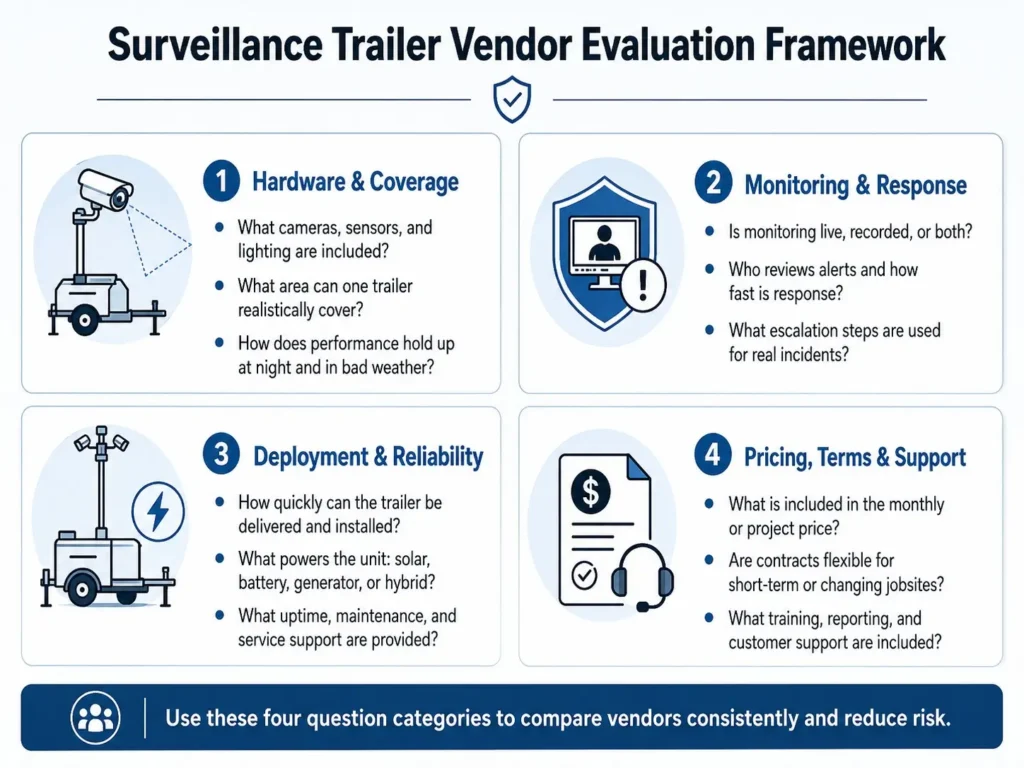
Equipment and Configuration (Questions 1-3)
The trailer is the most visible part of the deployment, but often the least differentiated. Many vendors use similar hardware. The real differences show up in specifications, mast height, and power setup. Ask for specifics, not general descriptions.
Question 1: What Cameras Are on the Trailer, and What Are Their Specifications?
Ask the vendor: What cameras are on the trailer, including PTZ count, fixed camera count, megapixel rating, optical zoom, low-light capability, and thermal options?
What a good answer sounds like (illustrative): “Two PTZ cameras with high optical zoom, multiple fixed cameras at 4MP or higher, IR illumination to a defined range, optional thermal. Detection, recognition, and identification ranges provided in writing per IEC EN 62676-4 (DORI) standards.”
What a red flag sounds like: “It has cameras that can see really far,” or no written specifications.
Why this matters: Camera specs determine real coverage. Without written specs, you are buying a black box.
For more on how DORI ranges work in practice, see our coverage math guide for jobsites, yards, and lots.
Question 2: How Tall Is the Mast and What Is the Active Coverage Area?
Ask the vendor: What is the mast height, typical deployment height, and recommended coverage area in acres?
What a good answer sounds like (illustrative): “A telescoping mast in the 18 to 25-foot range, with one trailer typically covering up to about five acres of open ground depending on obstructions and required identification range.”
What a red flag sounds like: “It covers large areas,” without acreage guidance.
Why this matters: Mast height drives line of sight. Poor height means blind spots, especially over stacked materials or vehicles.
Question 3: Is the Trailer Solar, Generator, or Hybrid Powered?
Ask the vendor: What is the power configuration, runtime, and backup plan?
What a good answer sounds like (illustrative): “Solar with battery storage designed for extended unattended runtime, with capacity for multiple cloudy days and optional generator backup for sites with low solar exposure.”
What a red flag sounds like: “It runs on solar,” with no runtime details.
Why this matters: If power fails, surveillance fails.
Monitoring and Response (Questions 4-6)
Equipment is the baseline. Monitoring is what actually stops incidents. This is where vendors differ the most and where quotes often lack clarity.
Question 4: Is 24/7 Live Monitoring Included, an Add-On, or Not Available?
Ask the vendor: Is monitoring included in the quote? If not, what does it cost and who provides it?
What a good answer sounds like (illustrative): “Live monitoring offered as a defined monthly add-on with documented tier options, staffed by trained operators, with a self-monitoring option also available for buyers who prefer to manage in-house.”
What a red flag sounds like: “Monitoring is included,” without tier, pricing, or operator details.
Why this matters: Quotes without clear monitoring details are not comparable.
Hawk offers both 24/7 remote monitoring and self-monitored surveillance trailers depending on operational preference.
Question 5: Does the Vendor Provide Voice-Down Capability and Active Response?
Ask the vendor: Does the system include live audio warnings and what is the typical response time from detection to voice-down?
What a good answer sounds like (illustrative): “Voice-down included with rapid response from detection event, with logged events and time-stamped audit trail.”
What a red flag sounds like: No mention of voice-down or only passive recording.
Why this matters: Voice-down can stop incidents before loss occurs. Passive recording only documents losses after the fact.
Question 6: What Is the Documentation and Evidence Workflow After an Incident?
Ask the vendor: How quickly can I get footage, how is it delivered, and what is the chain of custody?
What a good answer sounds like (illustrative): “Clips delivered through a secure portal within a defined window after request, with documented retention period and chain of custody supporting insurance claims and law enforcement reporting.”
What a red flag sounds like: “We can probably get it,” with no defined process.
Why this matters: Missing or slow footage means insurance claims can fail and law enforcement reports lack supporting evidence.
💬 Hawk Insight: Monitoring and evidence workflow are the two areas where the marketing slide deck and the operational reality diverge most often. Ask for a sample incident report or footage delivery example before signing. Vendors who cannot provide one are signaling something.
Deployment and Service (Questions 7-9)
Speed and service matter most when you need the system active fast. Ask for clear service commitments, ideally in writing as part of the contract.
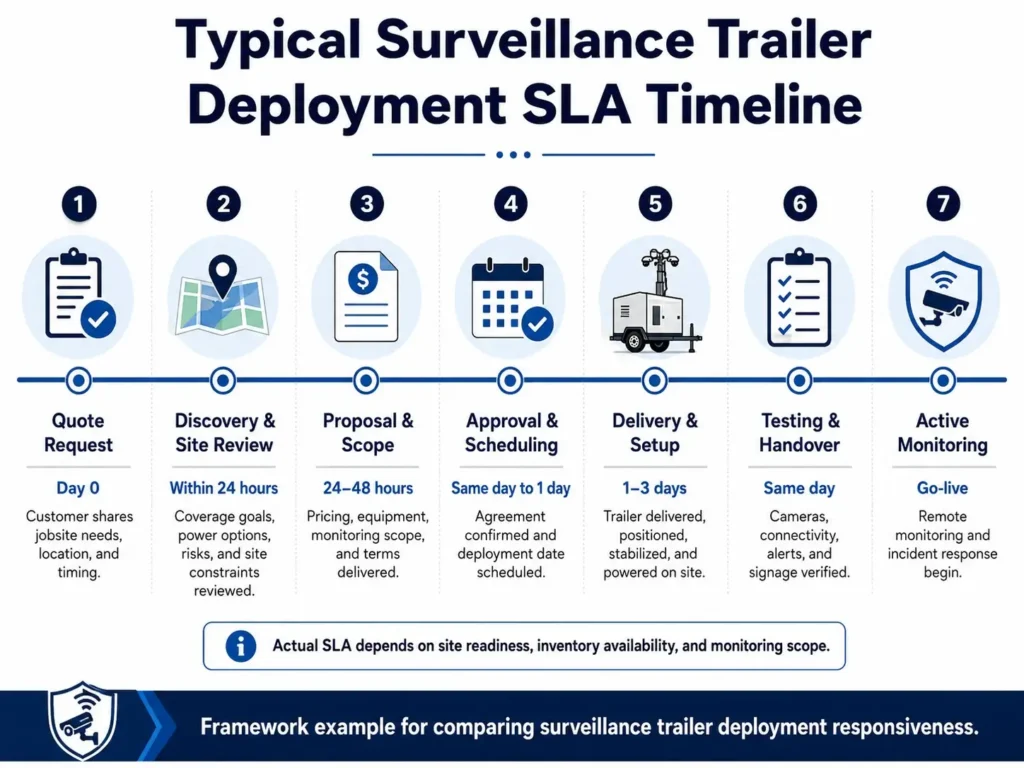
Question 7: What Is the Deployment SLA from Quote to Active Monitoring?
Ask the vendor: What is the timeline from contract approval to active surveillance, and is it in writing?
What a good answer sounds like (illustrative): “Deployment within a documented window after contract approval, with the SLA included in the agreement. Faster timelines available for urgent deployments at additional cost.”
What a red flag sounds like: “We will schedule you,” with no committed timeline.
Why this matters: Delays leave your site exposed. SLAs in writing create accountability.
Hawk’s deployment process is documented in our deployment and project services overview.
Question 8: Who Handles Site Survey, Placement, and On-Site Setup?
Ask the vendor: Who configures the system on site, in-house team, subcontractor, or you-the-buyer?
What a good answer sounds like (illustrative): “In-house deployment team handles site survey, optimal placement, mast deployment, and camera tuning. The buyer is not expected to configure the equipment.”
What a red flag sounds like: “Tell us where to drop it,” shifting placement responsibility to the buyer.
Why this matters: Placement determines effectiveness. A trailer in the wrong spot covers the wrong angles.
Question 9: What Happens If the Trailer Goes Offline or Fails?
Ask the vendor: What is the response time when a trailer reports a fault, and what is the replacement policy?
What a good answer sounds like (illustrative): “Faults trigger immediate alerts and service tickets. On-site response within a documented window, with replacement equipment dispatched if the issue cannot be resolved remotely. Standard service response included in the rental rate, no surprise charges.”
What a red flag sounds like: “We will send someone eventually,” or service response priced as a separate line item without a documented SLA.
Why this matters: Downtime eliminates protection. The middle of an active deployment is not when you want to negotiate emergency service rates.
Contract and Credentials (Questions 10-12)
This is where total cost and risk become clear. Review contracts carefully. What looks like a lower base rate often has add-on fees that close the gap.
Question 10: Is the Pricing Transparent and All-Inclusive?
Ask the vendor: Provide a fully itemized quote covering rental, monitoring, deployment, repositioning, fuel or solar maintenance, end-of-term retrieval, and any other recurring fees.
What a good answer sounds like (illustrative): “Itemized line items for monthly rental, monitoring tier, deployment fee, repositioning fee per move, retrieval fee, and any storage charges. Nothing labeled ‘standard fees’ or ‘industry charges’ without specifics.”
What a red flag sounds like: “Plus standard fees,” or hidden line items revealed only at invoice.
Why this matters: Hidden costs distort comparisons. Itemization makes vendors comparable on equal footing.
For typical pricing context, see our surveillance trailer rental cost in Northern California breakdown.
Question 11: What Are the Contract Terms, Cancellation Policy, and Repositioning Fees?
Ask the vendor: What are the minimum term, cancellation requirements, and repositioning costs if the project layout changes?
What a good answer sounds like (illustrative): “Defined minimum term aligned to typical project length, with documented notice requirements for cancellation and a stated repositioning cost per move. Flexibility for project extensions or early completion.”
What a red flag sounds like: Long minimum contracts with stiff cancellation penalties or unclear repositioning charges.
Why this matters: Your project needs can change mid-deployment. Contract flexibility matters more than the lowest base rate.
Question 12: Can the Vendor Provide a Certificate of Insurance, References, and Credentials?
Ask the vendor: Provide COI showing general liability, auto, and workers compensation; three references in similar verticals; and applicable licensing or compliance documentation.
What a good answer sounds like (illustrative): “COI delivered within a documented window after request, with references from similar industries and licensing or compliance documentation available. No hesitation on any of these.”
What a red flag sounds like: Hesitation, refusal, or “we can probably get that to you eventually.”
Why this matters: Vendor verification protects you from carrying their risk. Your insurance and your owners or clients will ask for these documents.
Hawk maintains documented certifications and compliance and data security and privacy standards available with every quote.
Two Bonus Questions for California Buyers
Bonus 1: Does the Vendor Provide a California Compliance Brief?
California has stricter privacy and signage rules than most states, particularly around audio recording under Penal Code § 632 and CCPA / CPRA data privacy. A vendor who provides a written compliance brief, covering signage, audio configuration, and applicable legal frameworks, significantly accelerates internal legal review on the buyer side.
For more on the California legal landscape, see our are surveillance trailers legal in California guide.
Bonus 2: Does the Vendor Have Experience in My Specific Industry?
Different industries require different setups. A construction site, a logistics yard, a public works project, and a parking lot have different priority zones, different exposure patterns, and different documentation needs. A vendor with relevant industry experience generally configures faster and avoids common setup errors.
💬 Hawk Insight: These two bonus questions often decide the final vendor choice when the first 12 answers are roughly comparable. A California compliance brief and industry-specific experience are the two areas where vendors most often differentiate in practice.
The Vendor Evaluation Scorecard (How to Use This Checklist)
Turn these questions into a scorecard. Send the same list to every vendor and request written responses. Compare answers side by side.
Vendors who provide detailed, written responses with specifics generally pass. Those who stay vague or offer verbal-only assurances generally fail the comparison test.
The vendor with the clearest answers and cleanest contract is generally the right choice, not always the lowest base price, since base price often inverts when add-ons are factored in.
💬 Hawk Insight: The discipline of writing the questions down and requiring written responses is what changes vendor behavior. Verbal sales conversations skip uncomfortable questions. Written RFPs do not.
Send your project details. Hawk returns a quote with itemized pricing, equipment specs, deployment SLA, COI, references, and a California compliance brief in two business days.
Three Buyer Scenarios
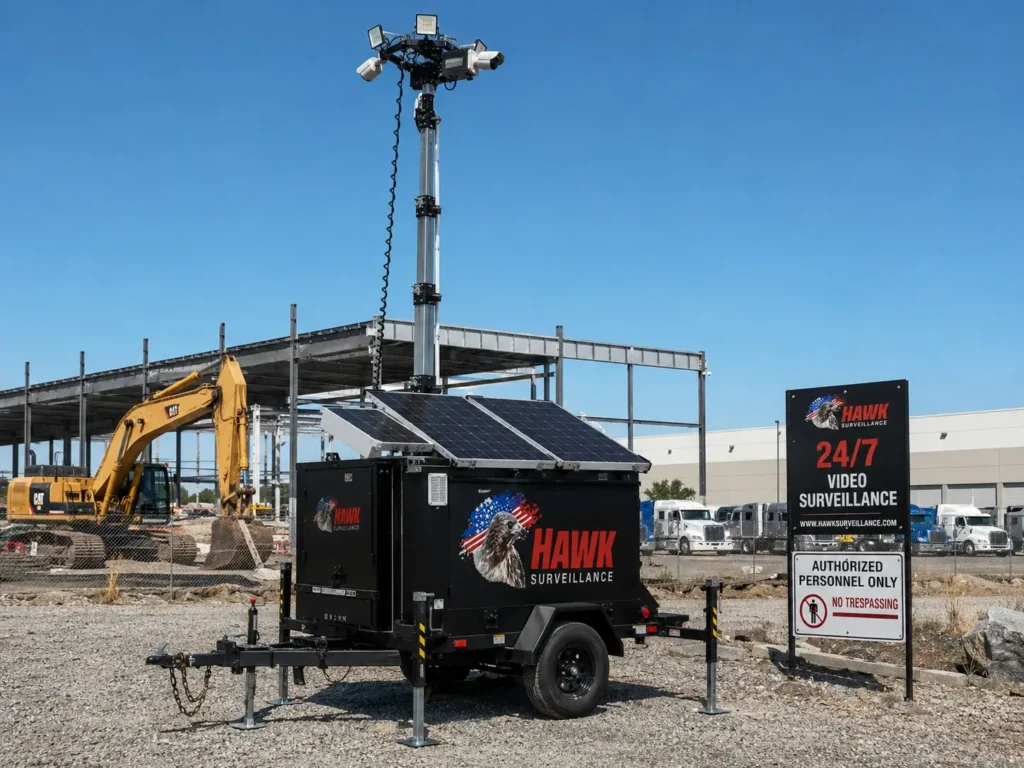
The following are illustrative scenarios drawn from typical patterns we see in California vendor selection. Specific buyer outcomes depend on the actual vendors compared and the project’s priorities.
Scenario 1: A General Contractor Comparing Two Bay Area Vendors
The lower-priced quote excluded monitoring and required a long minimum term. The higher-priced quote was all-inclusive with a flexible term. The checklist exposed that the “lower” quote was actually higher once monitoring was added and term flexibility was priced in. The GC chose the higher base price for the lower total project cost.
Scenario 2: A 3PL Sourcing for a 6-Yard Multi-Site Deployment
Only one vendor demonstrated centralized monitoring across multiple sites and a documented multi-yard fleet sizing approach. The checklist exposed that the others were single-site rental shops scaled up, not true multi-yard providers. The 3PL chose the vendor with the multi-yard model.
Scenario 3: A Property Manager Renting for a Seasonal Retail Peak
Flexibility in contract terms mattered more than the lowest monthly price. The checklist highlighted the vendor with a shorter minimum term and clear early-completion clause, even though their base monthly rate was slightly higher. Total seasonal cost was lower because the manager wasn’t locked into a longer contract.
Send your site details. Get a quote that answers all 12 questions in writing.
Frequently Asked Questions
How do I choose a surveillance trailer rental company in California?
Choose a vendor that provides detailed answers in writing across equipment, monitoring, deployment, and contract terms. Compare responses side by side. The vendor who offers clarity, documented SLAs, transparent pricing, and a California compliance brief is generally the safer choice.
What is a fair price for a surveillance trailer rental in California?
A fair price depends on configuration, monitoring tier, deployment timeline, and contract length. Most deployments range widely based on these features. Always compare fully loaded pricing across vendors, not base rates, to ensure accuracy.
How fast should a surveillance trailer vendor be able to deploy?
Most established vendors deploy within 24 to 72 hours after contract approval. Faster deployment may be available for urgent needs at additional cost. Confirm the SLA in writing as part of the contract.
What should be included in a surveillance trailer rental contract?
Contracts should include itemized pricing, deployment SLA, monitoring tier and pricing, service response terms, cancellation policy, and repositioning costs. Anything not in writing is a future negotiation, not a current commitment.
Should a surveillance trailer vendor provide a certificate of insurance?
Yes. A COI showing general liability, auto, and workers compensation coverage should be provided promptly upon request. Hesitation here is a significant red flag.
Is 24/7 monitoring included or a separate fee?
Monitoring is often a separate fee priced as a tiered add-on. Always confirm in writing whether monitoring is included, what tier, and what the pricing is so quotes are comparable on equal footing.
What happens if the surveillance trailer fails or goes offline?
A strong vendor provides immediate fault alerts, documented service response time, and replacement equipment if remote resolution fails. Service response should be included in the rental rate, not priced as a surprise add-on.
Can I get references from past clients in California?
Yes, reputable vendors should provide references relevant to your industry. Three references in similar verticals is a reasonable request.
What if I need to cancel my surveillance trailer rental early?
Most vendors require a notice period for cancellation. Flexible terms are preferable for changing project needs. Confirm cancellation policy and any associated fees in writing before signing.
What is a California compliance brief and why does it matter?
A California compliance brief is a written summary of how a specific deployment addresses applicable California legal frameworks, privacy expectations, audio recording under Penal Code § 632, signage standards, and CCPA / CPRA data considerations. It accelerates internal legal review by giving counsel a structured starting point rather than building the analysis from scratch.
Key Takeaways
- Equipment matters, but monitoring and service generally matter more
- Always compare full loaded pricing, not base rates
- Written answers create accountability. Verbal commitments do not
- Deployment speed directly affects exposure during the gap
- Contracts define both flexibility and total cost
- Credentials (COI, references, licensing) verify vendor reliability
- Use a written scorecard to compare vendors on equal footing
- The two California-specific bonus questions often decide the final shortlist
- The lowest base price often inverts once add-ons and contract terms are factored in
Get a Quote That Answers All 12 Questions in Writing
Hawk’s standard quote includes itemized pricing, equipment specifications, deployment SLA, monitoring tier options, certificate of insurance, references, and a California compliance brief.
Run the checklist on every vendor you are considering. Choose the one with the clearest answers and the cleanest contract.
Itemized pricing, equipment specs, SLA, COI, references, and California compliance brief, all in writing within two business days.
This guide is educational and intended to help California buyers structure vendor evaluations. Example specifications, pricing ranges, and SLA descriptions are illustrative. Actual specifications, pricing, contract terms, and service commitments vary by vendor. Always request written quotes from each vendor under consideration and confirm specifics directly. This article is not a substitute for direct vendor due diligence, contract review by counsel, or insurance verification.