
By Hawk Surveillance Systems. California construction and logistics security · Last updated June 7, 2026
Editorial note: Cargo theft data, hotspot mapping, fleet sizing rules, and ownership framing in this guide reflect typical industry conditions and Hawk operational ranges as of early 2026. Actual outcomes for any specific multi-yard operation depend on yard layout, cargo profile, dwell times, regional risk, insurance posture, and operational priorities. Always confirm cargo insurance coverage with your broker, security strategy with qualified consultants, and applicable legal requirements with counsel before relying on any guidance in this article.
TLDR: Northern California Logistics Yard Security in 2026
Cargo theft in Northern California is rising into 2026, with the Port of Oakland and the I-205/Central Valley corridor (Stockton, Tracy, Lathrop, Fresno) as the highest-risk zones. Operators with three or more yards typically need a fleet-based surveillance plan, not single-site systems, and buying outright usually beats long-term rental over a multi-year horizon.
Cargo theft in California has continued to rise in both incident volume and average loss value through 2024 into 2026, according to industry tracking byCargoNet. California consistently ranks among the top states for cargo theft, driven by the density of freight moving through the Port of Oakland and the Central Valley distribution corridor.
For Northern California operators, two regions dominate the risk profile: port-adjacent drayage yards in Oakland and inland hubs across Stockton, Tracy, Lathrop, and beyond. The four primary theft patterns shaping 2026 security planning are straight theft, strategic theft, fictitious pickup, and pilferage.
Multi-yard operators face a different challenge than single-site buyers. The right solution is rarely one system per yard purchased in isolation. It is a fleet strategy with standardized equipment, centralized monitoring, and predictable coverage across sites.
For operators running three or more yards, buying outright often delivers a lower total cost than long-term rental while aligning with budget cycles, depending on deployment scope and term length.
Below: the trend data, the tactics, the NorCal hotspots, a multi-yard sizing framework, and three NorCal scenarios so you can build the budget.
On this page
- Why NorCal Logistics Operators Are Tightening Security in 2026
- The Cargo Theft Tactics That Actually Hit NorCal Yards
- Northern California Cargo Theft Hotspots
- Yard-Type Risk Profiles
- The Multi-Yard Sizing Framework
- Why Mobile Surveillance Trailers Fit the Logistics Profile
- The Ownership Model for Multi-Yard Operators
- Three NorCal Logistics Scenarios
- Frequently Asked Questions
- Key Takeaways
Why NorCal Logistics Operators Are Tightening Security in 2026
The 2026 Cargo Theft Trend Line
Industry tracking by CargoNet generally reports that cargo theft incidents in the United States increased year over year through 2025, with California accounting for a disproportionate share of those incidents. Recent CargoNet quarterly reporting has noted that average loss values per incident often run in the six-figure range depending on cargo type, with higher figures for electronics, pharmaceuticals, and food-grade shipments.
California has consistently ranked among the top states nationally for cargo theft volume across multiple reporting periods, reflecting the scale of freight movement rather than a single spike. For operators budgeting in 2026, the relevant takeaway is consistency. Theft risk is not episodic. It is a standing operational cost driver.
Why California Specifically
California’s freight profile creates a concentration of exposure points. The state combines a major international port, high-density distribution networks, and continuous movement across intermodal systems.
TheNational Insurance Crime Bureau generally highlights that theft patterns often follow freight density and infrastructure access. California checks both boxes. The presence of major highways such as I-5, I-580, I-205, and I-880 creates predictable movement corridors. That predictability can be monitored, but it also creates repeatable exposure if yards lack coverage.
State-level property crime context is available through the FBI Uniform Crime Reporting program and California Open Justice for operators benchmarking regional risk against statewide trends.
For broader context on California construction-side theft patterns, see our California construction site theft 2026 statistics report; many of the same regional dynamics apply across both verticals.
The Port of Oakland and Its Inland Network
The Port of Oakland is one of the busiest container ports on the West Coast, handling well over two million twenty-foot equivalent units annually per Port of Oakland reporting. Containers do not stay at the port. They move inland through a network of drayage yards, transload facilities, and distribution centers.
Each transition point introduces risk. A container may move from a marine terminal to a chassis yard, then to a temporary lay-down yard, and finally to a distribution center in the Central Valley. At each stage, dwell time varies. Higher dwell time generally correlates with higher exposure.
For operators running multiple yards across this network, security planning must follow the cargo, not just the facility.
The Cargo Theft Tactics That Actually Hit NorCal Yards
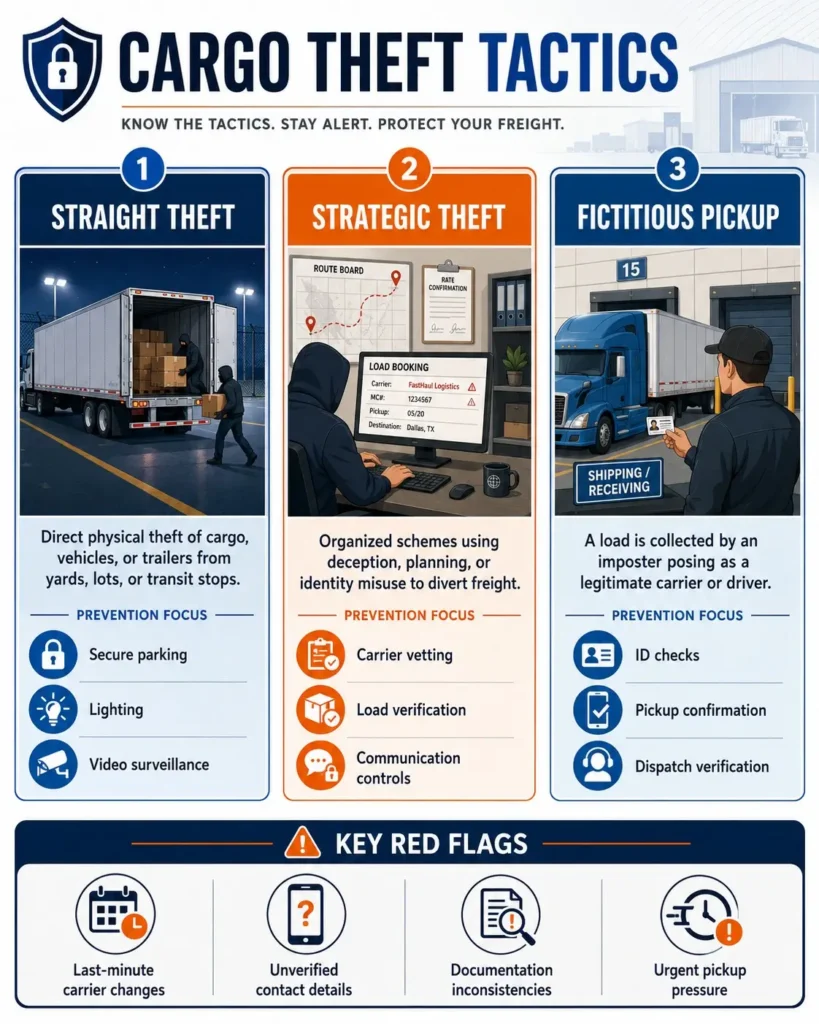
Straight Theft (Stolen Containers, Trailers, and Tractors)
Straight theft involves the direct removal of a tractor, trailer, or container from a yard, staging area, or roadside location. CargoNet data generally shows this remains one of the most common incident types in terms of volume.
In a NorCal context, this often occurs in open yards with limited perimeter control or limited after-hours visibility. The operational implication is straightforward. If a yard cannot maintain continuous visual coverage of its assets, it cannot reliably document or deter removal.
Strategic Theft (Targeted High-Value Loads)
Strategic theft focuses on specific cargo types with high resale value. Electronics, pharmaceuticals, alcohol, and premium food products consistently appear in CargoNet reports as high-target categories.
These incidents are planned. They rely on information about load contents, schedules, or routing. The operational takeaway is that not all cargo requires the same level of attention. High-value loads typically need defined high-security zones within the yard, not uniform coverage across all areas.
Fictitious Pickup and Identity Theft
Fictitious pickup is one of the fastest-growing cargo theft tactics, according to recent CargoNet reporting. In this scenario, an individual or group presents as a legitimate carrier using stolen or spoofed credentials.
They arrive with documentation that appears valid and remove the load without force. Double brokering, where a load is re-brokered fraudulently through multiple intermediaries, can contribute to this exposure.
The operational implication is verification. Yard processes should confirm carrier identity at pickup, and surveillance systems should document the transaction in a way that supports later claims and investigations.
Pilferage and Insider Theft
Pilferage involves smaller-scale removal of goods from within the yard. This may involve employees, contractors, or third-party visitors.
While individual losses are smaller, frequency can be higher. Over a year, cumulative losses can rival a single large incident. Continuous monitoring and recorded access points are critical for detection and accountability.
💬 Hawk Insight: Operators frequently underestimate pilferage because each incident looks small. Add the year up and it often matches a single straight-theft loss, without ever triggering the urgency that drives a security investment. Continuous monitoring is what surfaces the pattern before the totals get there.
Where It Happens: Northern California Cargo Theft Hotspots
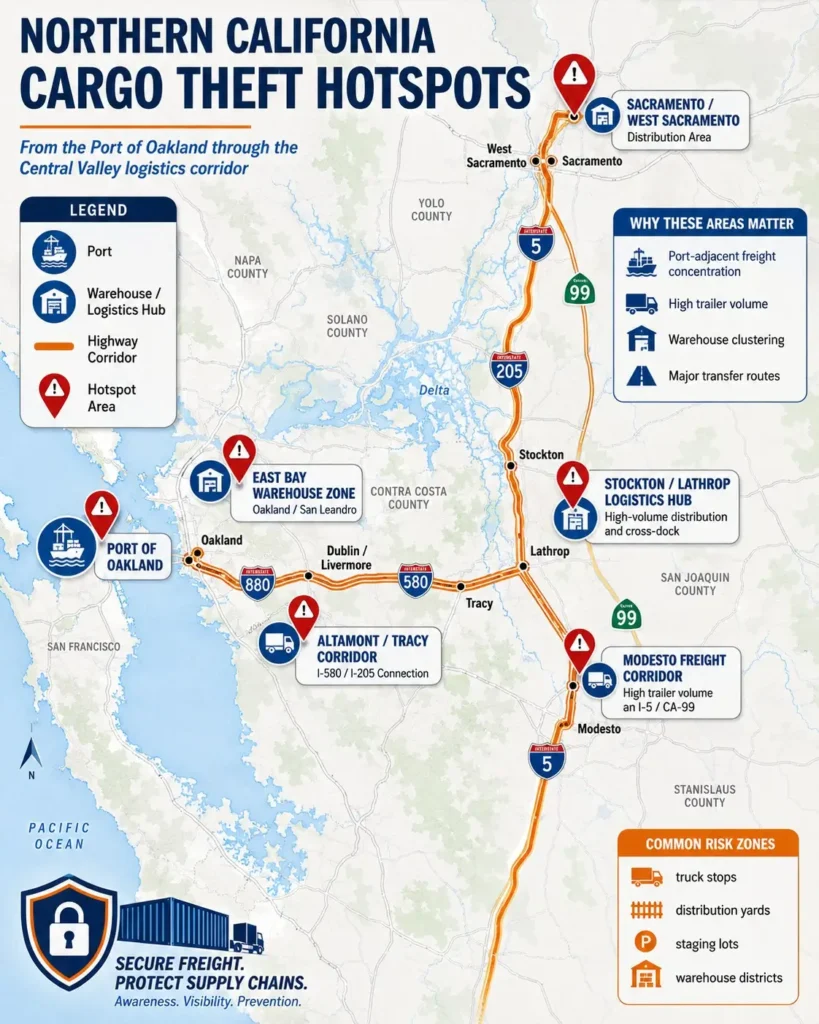
Port of Oakland and Adjacent Drayage Yards
The Oakland area supports dense drayage activity. Containers often dwell in staging yards before final delivery. Longer dwell times generally increase exposure, especially in yards without continuous monitoring.
Operational note: prioritize coverage for pre-pull and chassis staging zones.
Stockton, Tracy, and the I-205 Corridor
CargoNet reporting frequently highlights inland transload hubs as active theft regions. The I-205 corridor connects major distribution nodes and sees high trailer turnover. See our Stockton surveillance trailer rentals for site-specific configurations in this corridor.
Operational note: focus on ingress and egress points where trailers transition between carriers.
Lathrop, Manteca, and Modesto Distribution Cluster
Recent warehouse development has expanded this region rapidly. New facilities often come online before security infrastructure fully matures.
Operational note: plan security alongside expansion, not after incidents.
Fresno and the Central Valley Agricultural Logistics Belt
Refrigerated logistics and agricultural shipments dominate this region. Reefer trailers and temperature-sensitive goods carry higher value per load.
Operational note: include thermal-capable monitoring for night visibility and asset protection.
Sacramento Valley and the I-80 Corridor
This region supports food distribution, government logistics, and regional fulfillment. Theft patterns tend to align with mixed cargo environments. See our Sacramento surveillance trailer rentals for regional deployment options.
Operational note: combine perimeter coverage with focused monitoring of high-value staging areas.
💬 Hawk Insight: Inland transload hubs often show higher exposure than port-adjacent yards because dwell times are longer and security investment has lagged recent warehouse expansion. Bay Area operators expanding inland frequently underestimate this until a first loss.
Yard-Type Risk Profiles
Drayage and Container Yards
These yards face primary risk from straight theft of containers and chassis. Open layouts and limited fixed infrastructure make consistent coverage challenging. Mobile surveillance with elevated masts typically provides the most practical coverage approach.
E-Commerce Fulfillment and Cross-Dock Facilities
High volume and mixed cargo increase pilferage risk. Peak seasons introduce additional pressure, increasing exposure to strategic theft. Continuous monitoring and access-point coverage are typically the priority.
Refrigerated and Temperature-Controlled Yards
High-value loads and specialized equipment increase both theft risk and insurance scrutiny. Reefer trailers themselves are high-value assets. Thermal-capable surveillance generally supports both security and asset protection.
Bulk Commodity and Agricultural Logistics
These yards often operate in remote areas with limited power. Individual load values may be lower, but throughput is high. Solar-powered surveillance is typically the practical fit for off-grid placements.
The Multi-Yard Sizing Framework
Per-Yard Coverage Math
A common starting point is one surveillance trailer per five acres of open yard space. Adjustments depend on line-of-sight, stacking height, and high-value zones. Tight urban drayage yards often run denser than the rule (closer to 1 per 3 acres) due to limited visibility lines.
Yard Size | Base Trailer Count |
5 acres | 1 |
10 acres | 2 |
20 acres | 4 |
High-value zones may require additional units regardless of acreage.
For a more detailed walkthrough of the sizing logic, see our coverage math guide for jobsites, yards, and lots.
Multi-Yard Fleet Strategy
Operators with three or more yards generally benefit from standardizing equipment across sites. Fleet sizing typically exceeds the sum of individual yard requirements by 20% to 80%, depending on operational uptime requirements and maintenance cycles.
Yard Count | Typical Fleet Range |
3 yards | 4 to 5 trailers |
6 yards | 8 to 10 trailers |
10 yards | 14 to 18 trailers |
Centralized Monitoring vs Site-Level Monitoring
Centralized monitoring allows one team to oversee multiple yards simultaneously. This generally reduces cost per site and ensures consistent response protocols. Hawk operates 24/7 remote monitoring sized to multi-site deployments.
Send your yard list and acreage. Hawk will return a per-yard configuration and a fleet sizing recommendation within two business days.
Why Mobile Surveillance Trailers Fit the Logistics Profile
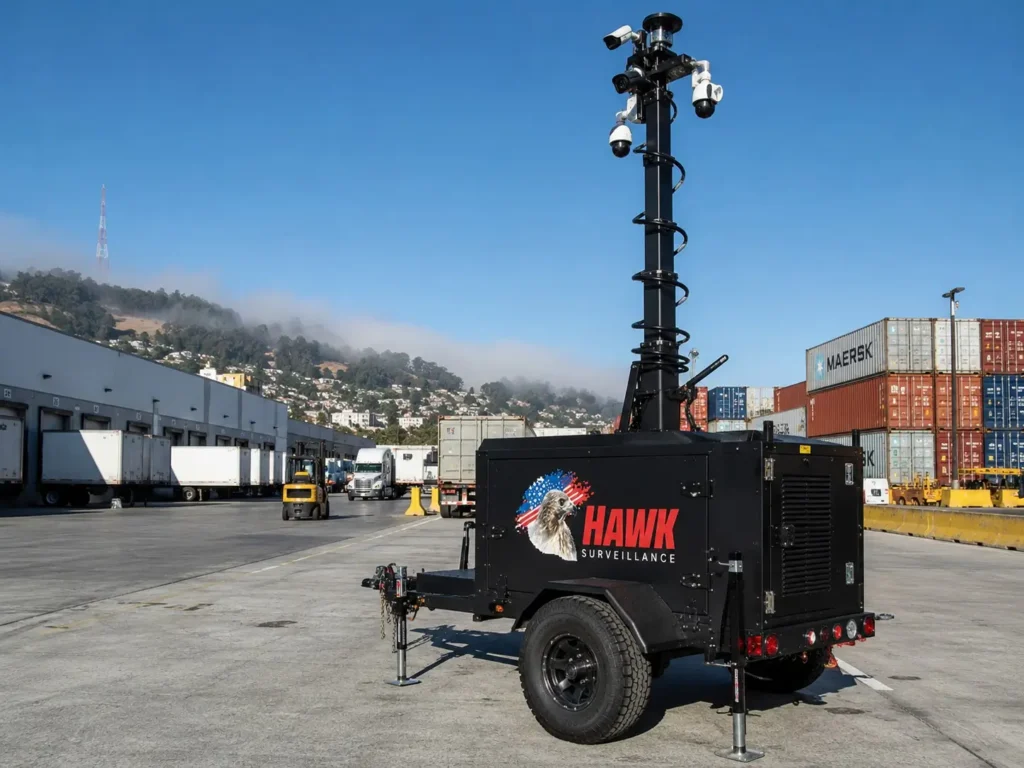
Coverage of Large Acreage with Few Fixed Assets
Logistics yards often lack vertical infrastructure. Mobile trailers provide elevated coverage without permanent installation. Heavy-duty industrial trailers are typically the right fit for sustained logistics yard deployments.
Repositioning as Yards and Volumes Change
Yard layouts shift with volume and lease changes. Mobile units can be repositioned without construction or permanent disruption.
Off-Grid Capability for Remote and Power-Limited Yards
Solar-powered surveillance trailers support yards without reliable power infrastructure, particularly relevant for Central Valley agricultural logistics and bulk commodity yards.
The Ownership Model for Multi-Yard Operators
When Buying Beats Renting
For multi-yard operators, buying outright often lowers total cost of ownership over a multi-year horizon compared to long-term rental, depending on deployment scope, term length, and operational requirements. See our surveillance trailer products overview for structure details.
What a Multi-Yard Purchase Looks Like
Standardized configurations, centralized support, and a fixed, owned asset generally define the model. You own the equipment outright from day one, which can align with longer-term operational planning.
Capital Treatment and Operational Considerations
Owned trailers are typically capitalized as long-term assets. Confirm accounting treatment with your finance team; capital vs. operational classification varies by structure and jurisdiction.
💬 Hawk Insight: A multi-yard fleet purchased outright often comes in below the cost of continuous guard coverage across the same yards, particularly for operators running three or more sites. The exact comparison depends on guard cost in your region, hours required, and yard size. Run both numbers before defaulting to one approach.
Three NorCal Logistics Scenarios
The following are illustrative scenarios drawn from typical NorCal patterns. Specific outcomes for any individual operation depend on yard layout, cargo profile, current security posture, and operational priorities.
Scenario 1: Drayage Operator with 4 Bay Area Yards
12 acres total across four tight urban drayage yards. Current setup includes one part-time guard. Proposed solution: four trailers with centralized monitoring across all yards. The denser-than-standard ratio (one trailer per yard) reflects Bay Area drayage yard density and limited visibility lines. This approach generally provides full visual coverage at a lower run rate than expanding guard staffing across multiple shifts.
Scenario 2: Central Valley 3PL with 6 DCs Across Stockton, Lathrop, and Tracy
50 acres total with reported losses in the prior 12 months running into the six figures. Proposed: ten trailers purchased outright with overlapping coverage and centralized monitoring. This approach provides full network coverage with equipment ownership at term completion, supporting longer-term operational planning.
Scenario 3: Refrigerated Logistics Operator with 3 Yards from Fresno to Sacramento
18 acres total with high-value temperature-controlled cargo. Proposed: five trailers with thermal capability for night visibility and reefer asset protection. This configuration supports operational documentation that the operator’s broker can use during builders risk and cargo insurance discussions, though specific coverage outcomes remain a broker conversation. For more on insurance-side framing, see our surveillance trailers and builders risk insurance breakdown.
Send your yard count, locations, and current security posture. Hawk will return a multi-yard plan with rental and ownership options.
Frequently Asked Questions
Is cargo theft increasing at the Port of Oakland?
Yes. Based on CargoNet reporting through 2025, California cargo theft has trended upward year over year, and operators connected to the Port of Oakland are part of that broader rise. Port-specific public figures are limited, but statewide data, combined with rising freight volume through Oakland and longer drayage dwell times; points to elevated risk through 2026. Operators should plan accordingly. (See current data: CargoNet.)
What is the average value of a cargo theft incident in California?
Recent CargoNet quarterly reporting has shown average cargo theft incident values in the six-figure range, with electronics and pharmaceuticals typically at the higher end. Specific quarterly averages vary, so review current CargoNet data for the most recent figures.
What are the most common cargo theft tactics in 2026?
The most common cargo theft tactics are straight theft, strategic theft, fictitious pickup, and pilferage. CargoNet generally identifies fictitious pickup as one of the fastest-growing categories.
Where are the Northern California cargo theft hotspots?
Key hotspots include Oakland, Stockton, Tracy, Lathrop, Fresno, and the Sacramento Valley. These areas align with major freight corridors and distribution clusters.
How do I secure a logistics yard against cargo theft?
Securing a logistics yard generally requires layered controls including surveillance, access verification, identity confirmation at pickup, and continuous monitoring. Continuous visibility is critical to both deterrence and documentation.
How many surveillance trailers do I need for a multi-yard logistics operation?
Most operations start with one trailer per five acres and adjust based on layout, stacking height, and high-value zones. Multi-yard fleets typically include additional units for redundancy and maintenance rotation.
Are surveillance trailers effective for container and chassis yards?
Yes. Surveillance trailers are generally effective for container and chassis yards due to their elevated coverage and flexibility. They address visibility gaps common in open layouts where fixed infrastructure is limited.
What is fictitious pickup and how can yards prevent it?
Fictitious pickup involves unauthorized carriers posing as legitimate operators using stolen or spoofed credentials. Prevention generally focuses on identity verification at pickup points, documented carrier credentials, and surveillance recording of the transaction.
Does insurance cover yard cargo theft losses?
Cargo insurance and yard-side coverage may apply to losses depending on policy structure, where the cargo was at the time of loss, and documentation. Coverage varies significantly by policy and carrier, so operators should review specific policies with their broker.
Does Hawk Surveillance support multi-yard fleet deployments?
Yes. Hawk supports multi-yard deployments with standardized equipment, centralized monitoring, and ownership options tailored to logistics operators running multiple sites.
Key Takeaways
- Cargo theft in California continues to rise in volume and value
- NorCal hotspots include Oakland, Stockton, Tracy, Lathrop, Fresno, and the Sacramento Valley
- Four primary tactics shape 2026 risk profiles: straight, strategic, fictitious pickup, and pilferage
- Yard type determines exposure and security needs
- Multi-yard operators generally require fleet-based solutions, not single-site purchases
- Centralized monitoring typically reduces cost per site
- Outright ownership can align with longer-term operations for three-plus yard operators
- One trailer per five acres is a common starting point that adjusts for yard density and high-value zones
- Standardization across sites improves scalability and response consistency
Get a Multi-Yard Quote from Hawk Surveillance
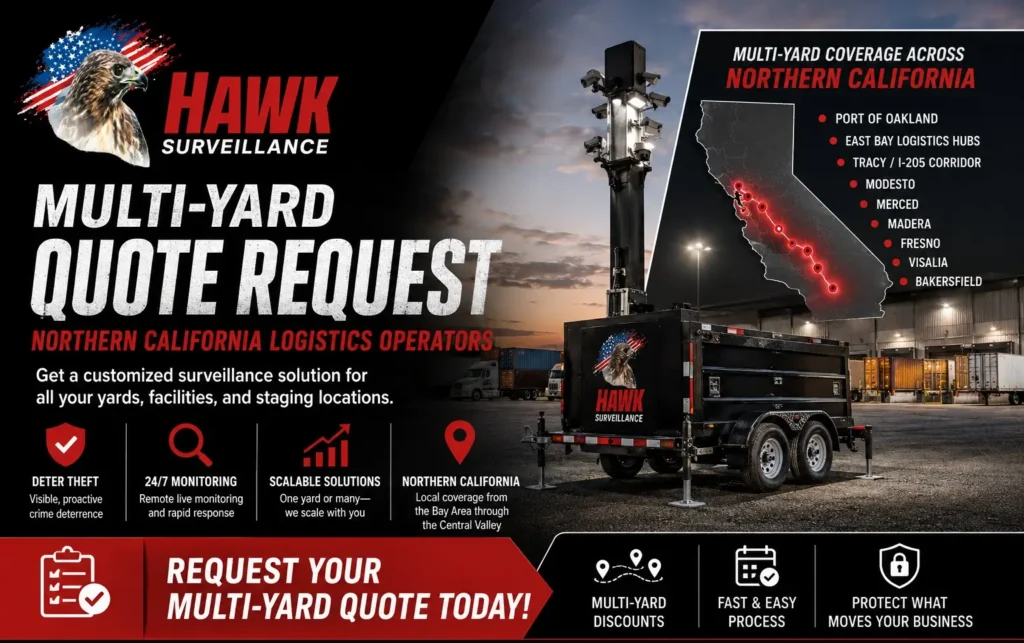
Send us your yard list, acreage, and current security posture. Hawk will return a multi-yard configuration plan, a per-site cost projection, and an ownership option scaled to your operation. Most operators see a configuration plan within two business days.
About the author
Noah Williams leads content at Hawk Surveillance Systems, focused on mobile surveillance trailer deployments for construction, logistics, and industrial yard operators across Northern California. He works directly with multi-site operators in the Bay Area, Central Valley, and Sacramento corridors on yard sizing, fleet rollouts, and fleet ownership programs.
This guide is educational and intended for general guidance. It is not insurance, legal, or operational advice for any specific yard or operator. Cargo theft data, hotspot mapping, fleet sizing rules, and ownership framing reflect typical industry conditions as of early 2026 and may change. Always confirm cargo insurance coverage with your broker, verify deployment specifics with a qualified security provider, and review applicable legal requirements with counsel before relying on any guidance in this article.