
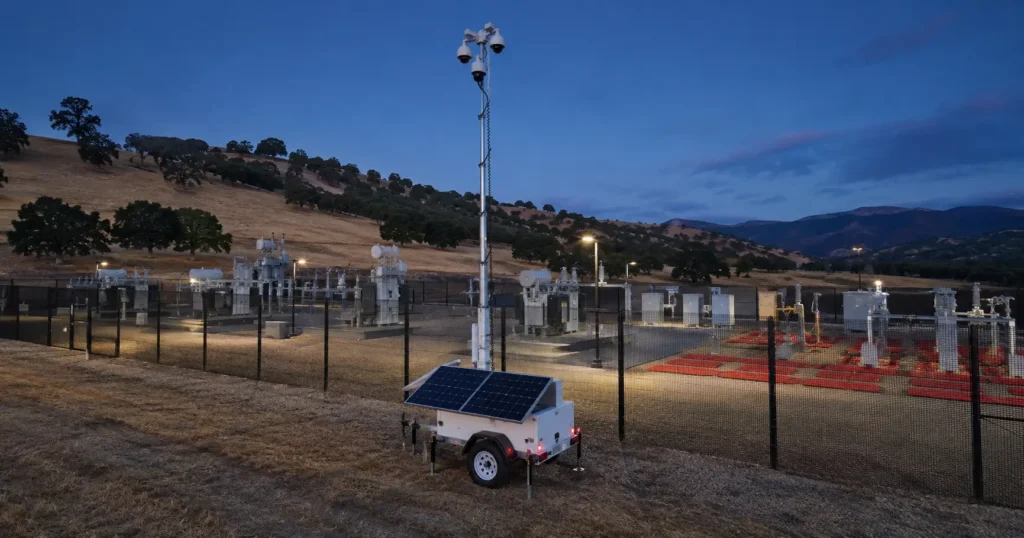
Quick answer: Concord jobsites lose equipment, tools, copper wire, and fuel to theft that guards and fixed cameras often miss. A solar mobile surveillance trailer provides continuous, elevated, monitored coverage of the whole site, deters intruders before losses happen, and moves with the project from phase to phase. Hawk Surveillance deploys trailers across Concord and the East Bay, matched to the size and risk profile of each project. This guide covers what Concord jobsites actually lose, where guards and fixed cameras leave gaps, how a mobile surveillance trailer closes them, which Hawk trailer fits your project, and what the cost comparison looks like.
Construction projects in Concord face ongoing exposure from copper wire theft, tool theft, equipment theft, after-hours trespassing, and vandalism. The most practical approach for many active jobsites is a layered security strategy that combines mobile surveillance, professional monitoring, controlled site access, and clear operational procedures instead of relying on a single security measure. Hawk Surveillance Systems provides solar and compact mobile surveillance trailers that set up in hours and become the active outer layer of protection around changing jobsites. Unlike permanent cameras that remain fixed or guards who can only observe one location at a time, mobile trailers provide elevated visibility, remote monitoring, and active deterrence while moving with the project as construction progresses across Concord and Northern California.
What Concord jobsites are actually losing
In brief: Construction sites in Concord are exposed to multiple forms of property loss, not just copper theft. Contractors are commonly concerned with protecting valuable materials, portable equipment, heavy machinery, fuel supplies, and unfinished structures during evenings, weekends, and project shutdowns.
Construction site security refers to the coordinated protection of people, equipment, materials, and unfinished infrastructure throughout every phase of a building project. Unlike permanent commercial properties, active jobsites change constantly. Access points move, fencing changes, equipment relocates, and electrical service may not yet be available.
That changing environment creates security challenges that fixed infrastructure often struggles to keep up with.
Some of the most common exposures on Concord construction projects include:
- Copper wire and electrical material theft
- Portable tool theft
- Small equipment theft
- Heavy equipment tampering or theft
- Fuel theft from machinery and storage tanks
- After-hours trespassing
- Graffiti and vandalism
- Damage to partially completed structures
Copper remains one of the highest-value materials commonly stored on construction projects. Electrical contractors may stage large quantities of wire before installation, making unfinished buildings attractive targets whenever perimeter security is weak.
Industry groups such as the National Insurance Crime Bureau and the National Equipment Register have long identified metal and copper theft as a persistent, high-cost problem on construction sites, which is why staged wire is treated as a priority asset to protect.
Portable tools also represent significant operational losses. Even relatively inexpensive equipment can delay subcontractors when replacements are unavailable, affecting schedules far beyond the cost of the tools themselves.
Heavy machinery presents a different challenge. While excavators, loaders, lifts, and generators are more difficult to remove from a site, they remain vulnerable to unauthorized operation, parts theft, fuel theft, and intentional damage.
Fuel storage creates another risk area. Diesel tanks supporting earthmoving equipment or backup generators may become attractive targets if they remain unmonitored overnight.
Vandalism and trespassing often create indirect costs that exceed repair expenses. Broken fencing, damaged materials, unauthorized entry, and cleanup requirements can interrupt inspections, delay subcontractors, and increase insurance documentation requirements.
Rather than focusing on a single threat, experienced contractors typically plan for multiple risks occurring simultaneously.
That is why many Northern California builders implement layered protection instead of relying on one security product or one overnight patrol.
For larger commercial projects, Hawk’s construction jobsite security solutions are designed specifically for evolving worksites where equipment, staging areas, and perimeter conditions change throughout construction.
Why guards and fixed cameras leave gaps at a Concord jobsite
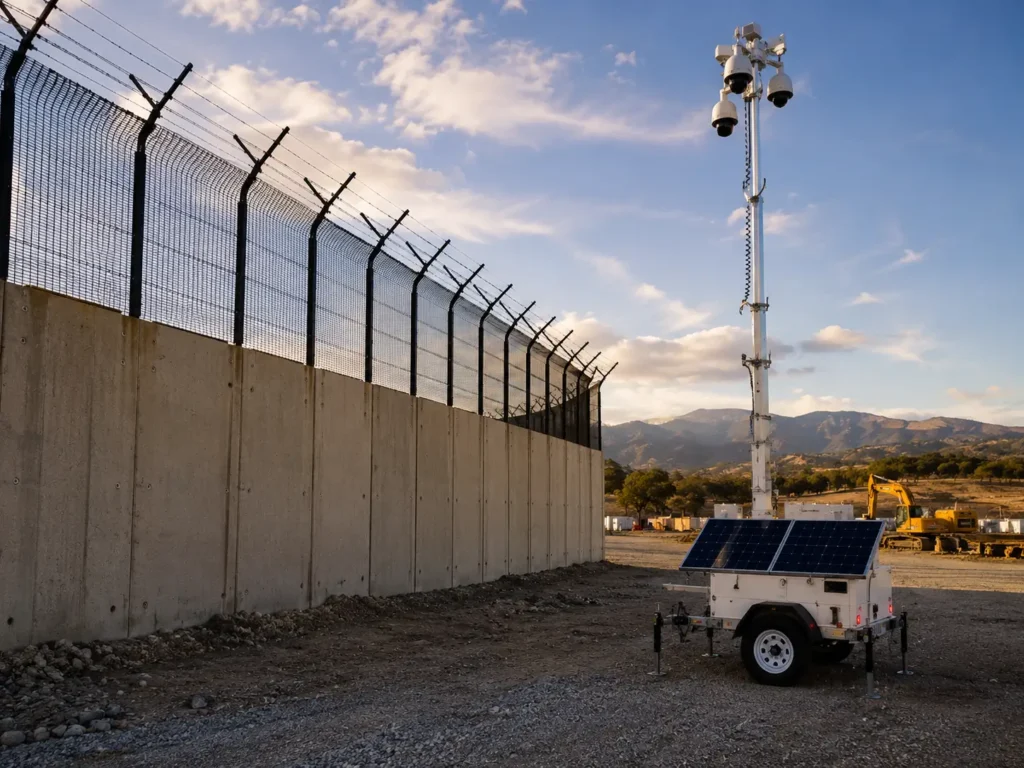
In brief: Neither security guards nor traditional fixed cameras solve every construction security challenge. Guards provide human judgment and access control, while fixed cameras work well on permanent facilities. Active Concord jobsites often benefit from a mobile solution that fills the operational gaps between those two approaches.
Many contractors automatically think of hiring overnight security guards when security concerns increase.
Guards absolutely have an important role.
They are particularly valuable when a project requires:
- Visitor management
- Gate access control
- Contractor credential verification
- Customer interaction
- Emergency coordination
- Immediate on-site decision making
However, guards also have practical limitations.
A single guard can only observe one location at any given time. Large construction projects frequently include multiple entrances, equipment yards, laydown areas, material storage zones, and unfinished buildings spread across several acres.
Covering every area continuously often requires multiple personnel.
Staffing also represents the highest ongoing operating cost for many security programs.
Traditional fixed surveillance cameras solve different problems.
Permanent camera systems perform extremely well when protecting completed facilities that already have reliable electrical service, structured networking, and stable building layouts.
They are excellent for:
- Warehouses
- Manufacturing plants
- Office buildings
- Distribution centers
- Permanent commercial properties
Construction sites rarely stay that consistent.
Power availability changes.
Perimeters shift.
Material storage moves.
Temporary offices relocate.
New phases begin every few weeks.
Installing permanent cameras across a constantly changing project often means relocating wiring, poles, or network equipment as work progresses.
Many fixed systems also function primarily as evidence collection tools. They record activity for later review but may offer limited real-time deterrence unless combined with active monitoring.
Mobile surveillance trailers address a different operational need.
Instead of becoming part of the site’s permanent infrastructure, they remain flexible assets that move alongside construction progress.
This approach aligns with Hawk Surveillance Systems’ concentric layers of security philosophy. The trailer serves as the active outer layer, monitoring entrances, perimeter gaps, equipment yards, and temporary storage areas while complementing existing fencing, lighting, access controls, and personnel.
As projects evolve from excavation through structural work and final finishes, the surveillance platform can be repositioned without requiring permanent installation.
This flexibility also differentiates Hawk from larger national surveillance providers such as WCCTV, LVT, Pelco, and similar vendors by emphasizing Northern California deployment experience, localized support, and surveillance trailers designed around changing regional construction environments rather than one-size-fits-all national programs.
“The strongest construction security plan doesn’t replace guards or permanent cameras. It combines each where they perform best, using mobile surveillance to protect the changing perimeter that static systems often cannot cover.”
How a mobile surveillance trailer protects a Concord jobsite
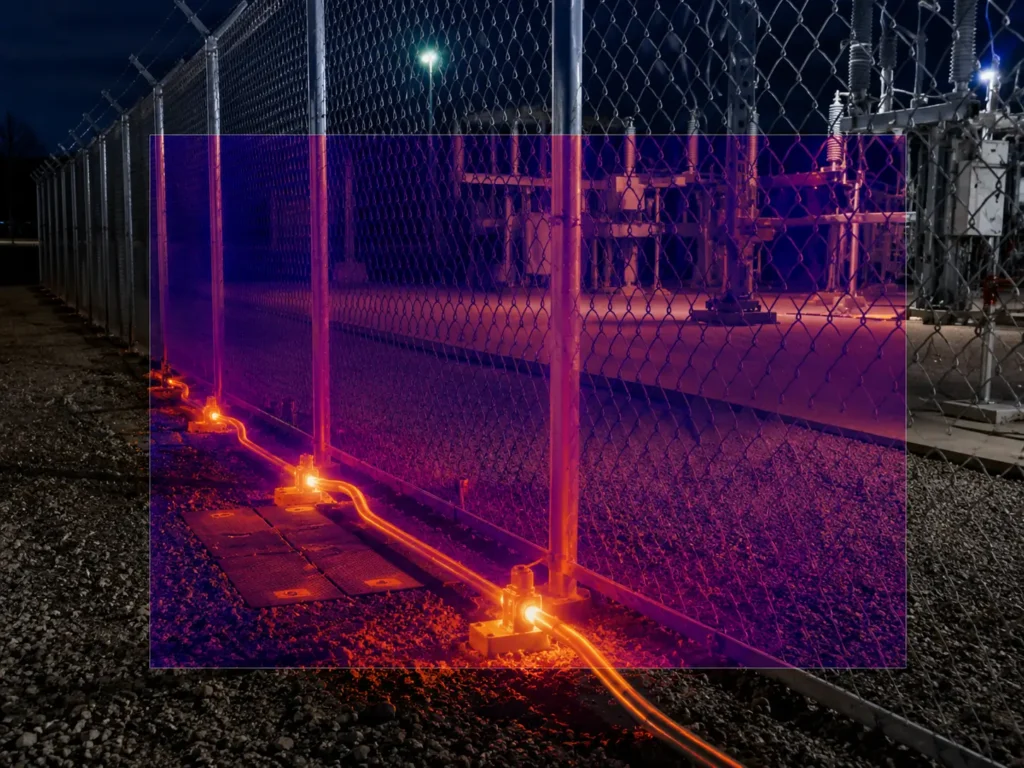
In brief: A mobile surveillance trailer gives contractors elevated visibility, active deterrence, and professional monitoring without permanent infrastructure. Because the trailer moves with the project, it remains effective as entrances, storage areas, and work zones change throughout construction.
A mobile surveillance trailer is a self-contained security platform designed for temporary and changing environments. Unlike permanent camera installations, it does not depend on fixed utility power, underground cabling, or building-mounted equipment. Instead, it provides elevated cameras, intelligent detection, and professional monitoring from a portable platform that can be repositioned as the project evolves.
That flexibility is particularly valuable on Concord construction projects where new phases frequently change the site’s layout.
A typical Hawk surveillance trailer includes:
- Elevated PTZ cameras for wide-area visibility
- Fixed overview cameras covering multiple approaches
- Infrared cameras for overnight monitoring
- Solar charging with battery backup on applicable models
- Real-time remote monitoring
- Two-way speaker capability
- High-visibility warning strobes
- Detection analytics that alert monitoring personnel
Rather than recording footage for later review, the system continuously watches active risk areas.
When monitoring specialists detect unauthorized activity, they can evaluate the situation in real time before escalating the response. Depending on site protocols, operators may issue live audio warnings through onboard speakers, activate warning strobes, notify designated site contacts, or request law enforcement dispatch when appropriate.
This active response helps discourage unauthorized activity before losses occur.
Another advantage is flexibility.
Construction projects rarely remain static.
Material staging areas move.
Temporary fencing changes.
Access roads shift.
Equipment yards expand.
Completed sections become occupied while other areas remain under construction.
Instead of abandoning camera coverage as conditions change, contractors can simply relocate the surveillance trailer to protect the highest-risk area.
This mobility supports Hawk’s concentric approach to mobile security. Permanent fencing, gates, lighting, and site policies remain important layers of protection, while the surveillance trailer provides an adaptable outer layer that follows the changing perimeter.
Unlike traditional fixed camera systems, there is no need for permanent trenching, poles, or network infrastructure.
For many Northern California contractors, that means security can begin long before permanent utilities are available.
The system is particularly effective for:
- Commercial developments
- Multifamily construction
- Industrial projects
- Municipal infrastructure work
- Utility upgrades
- School construction
- Transportation improvements
- Long-duration phased developments
Because Hawk specializes in mobile surveillance trailer rental, contractors can scale security based on the current phase of construction instead of investing in permanent infrastructure before the building is complete.
Which Hawk trailer fits your Concord project?
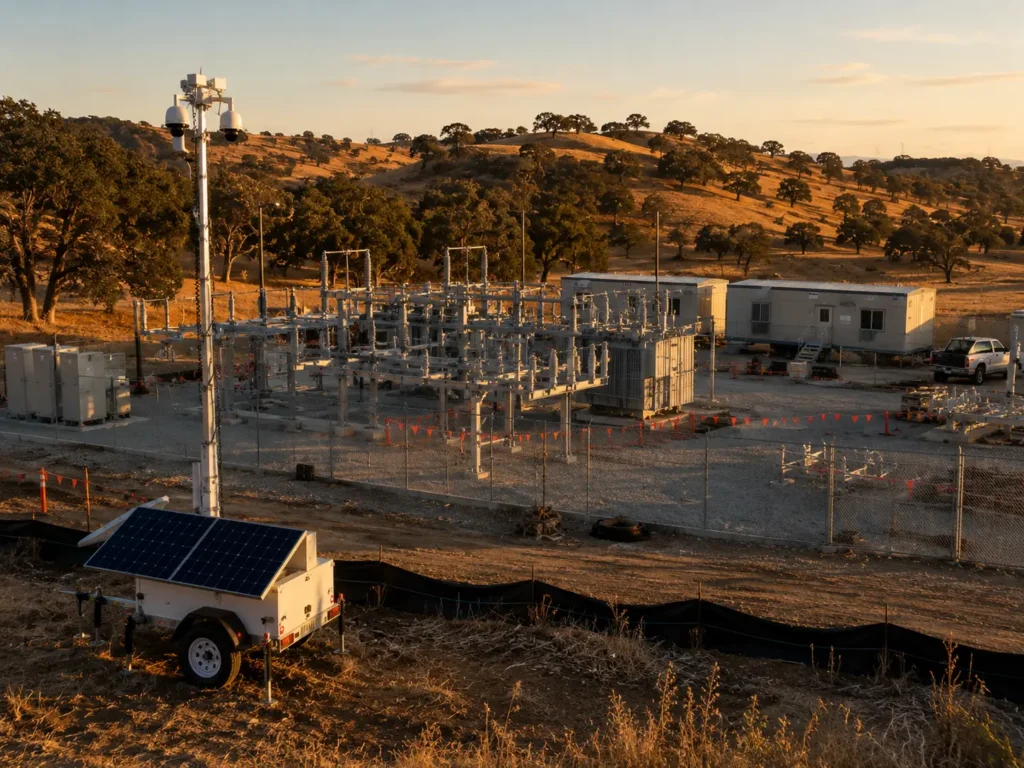
In brief: The right surveillance trailer depends primarily on project size, available space, and access to utility power. Large open projects generally benefit from solar-powered trailers, while tighter urban construction sites often benefit from compact platforms.
No two construction projects have identical security requirements.
Some sites span multiple acres with limited utility access.
Others occupy dense commercial corridors where equipment must fit into restricted staging areas.
Hawk offers two primary trailer platforms designed to address those different environments.
Solar Surveillance Trailer
The solar surveillance trailer is designed for larger projects where long operating periods and flexible placement are priorities.
Because the unit operates independently of permanent electrical infrastructure, it works well during early construction phases when utility connections may not yet exist.
Common applications include:
- Commercial developments
- Infrastructure projects
- Industrial construction
- Utility projects
- Large residential developments
- Long-duration construction sites
Key advantages include:
- Solar-powered operation
- Elevated camera coverage
- Flexible positioning
- No permanent installation
- Easy relocation throughout construction
- Continuous monitoring across changing work zones
As project priorities shift, the trailer can move to new entrances, laydown yards, or equipment storage locations with minimal disruption.
Compact Urban Surveillance Trailer
The compact urban surveillance trailer is designed for locations where available space is more limited.
Many Concord projects occur in active commercial corridors, redevelopment districts, or infill locations where equipment footprints matter.
The compact platform provides many of the same surveillance capabilities while fitting into tighter staging areas.
It is commonly used for:
- Urban redevelopment
- Retail construction
- Mixed-use developments
- Municipal projects
- Downtown construction
- Constrained commercial lots
Its smaller footprint makes transportation and placement easier while maintaining elevated camera coverage and professional monitoring.
Choosing between the two platforms typically comes down to three questions:
- How large is the site?
- How frequently will security coverage need to move?
- How much staging space is available?
Hawk’s security specialists evaluate those factors during an initial site review before recommending the most appropriate solution.
Whether the project requires a solar-powered platform or a compact trailer, both systems integrate with 24/7 remote monitoring to provide continuous oversight beyond standard working hours.
Trailer vs. guard vs. fixed cameras: Cost and coverage
In brief: For many Concord construction sites, a mobile surveillance trailer delivers broader after-hours coverage than a single guard while avoiding the permanent installation requirements of fixed cameras. Each option has strengths, and many projects combine more than one solution for the best overall protection.
Headline comparison: A mobile surveillance trailer often provides guard-level visibility with a cost profile that is closer to camera systems than full-time on-site staffing. Exact pricing varies by project scope and should be quoted individually.
Feature | Mobile Surveillance Trailer | Security Guard | Fixed Camera System |
Coverage Area | Elevated, wide-area visibility across multiple work zones | One person’s line of sight | Fixed locations only |
Deterrence | Live monitoring, speakers, strobes, visible presence | Strong human presence | Primarily passive unless actively monitored |
Deployment | Sets up in hours | Immediate once staffed | Requires installation and infrastructure |
Infrastructure Needed | None beyond placement area | None | Permanent power, networking, mounting |
Flexibility | Easily relocates as construction changes | Patrol routes can change | Cameras remain fixed |
After-hours Monitoring | Continuous remote monitoring | Limited to scheduled shifts | Depends on monitoring service |
Cost Profile | Project-specific; typically priced between full-time guard staffing and a permanent camera install | Highest ongoing cost, driven by hourly staffing for every shift covered | Lower operating cost after installation, though upfront installation and infrastructure costs vary by site |
Best Fit | Active construction sites with changing layouts | Access control, visitor management, occupied facilities | Permanent completed properties |
This comparison is not about replacing one security method with another.
Instead, it is about matching the solution to the operational challenge.
For example:
Security guards are the better choice when:
- Visitors must be checked in
- Contractors require credential verification
- Customer interaction is expected
- Immediate human decision-making is essential
Fixed cameras are the better choice when:
- The facility is complete
- Utilities are permanent
- Camera locations will remain unchanged
- Long-term infrastructure investment makes sense
Mobile surveillance trailers are often the strongest option when:
- Construction layouts change regularly
- Utilities are incomplete
- Equipment and materials move around the site
- Temporary protection is needed
- Contractors want elevated visibility without permanent installation
Rather than competing directly with national providers such as WCCTV or LVT, Hawk focuses on Northern California projects that benefit from local deployment, flexible equipment selection, concierge-level monitoring, and trailers designed for rapidly changing construction environments.
Deployment and monitoring
In brief: Effective construction site security begins with thoughtful placement and continues with professional monitoring. A surveillance trailer delivers the greatest value when it is positioned to cover the site’s highest-risk areas and supported by trained operators who can respond to events as they occur.
Headline fact: A mobile surveillance trailer can be positioned and operational in hours, allowing contractors to secure new phases of a project without waiting for permanent infrastructure.
Technology alone does not create an effective security program.
Successful construction security combines equipment, planning, monitoring, and operational procedures that adapt as the project changes.
Every Hawk deployment begins with a site assessment to identify:
- Primary vehicle entrances
- Pedestrian access points
- Material laydown areas
- Equipment parking locations
- Temporary offices
- Utility staging areas
- Blind spots along the perimeter
- Locations where fencing changes throughout construction
Rather than placing cameras in the middle of the site, Hawk typically positions surveillance trailers where they provide the widest possible field of view over entrances and high-value assets.
As construction progresses, those priorities naturally change.
During excavation, expensive earthmoving equipment may require the greatest protection.
During structural work, material storage and steel deliveries often become higher priorities.
Later in the project, electrical materials, HVAC equipment, and finish products frequently represent the highest-value assets.
Because the trailer is portable, coverage can evolve alongside the project instead of remaining fixed in one location.
That flexibility reduces the need for repeated infrastructure work while helping contractors maintain visibility over changing risk areas.
Professional monitoring makes the difference
A camera that simply records video is useful for reviewing incidents after they occur.
A professionally monitored surveillance system aims to intervene while an incident is still developing.
When intelligent detection identifies activity after hours, monitoring specialists review the event in real time.
Depending on the circumstances and the site’s response plan, they may:
- Determine whether authorized personnel are present
- Issue a live voice warning through onboard speakers
- Activate visible warning strobes
- Contact designated project managers
- Coordinate with local law enforcement when appropriate
- Document the incident for later reporting
This layered response helps reduce unnecessary dispatches while ensuring legitimate incidents receive attention quickly.
The combination of elevated cameras, real-time monitoring, and active deterrence provides capabilities that many standalone recording systems cannot offer on their own.
For contractors managing multiple projects across Northern California, this approach also creates consistency. Security procedures remain similar from one site to another, even when layouts and project sizes differ.
Whether the project is a commercial development in Concord or a regional infrastructure upgrade elsewhere in Northern California, the same layered methodology can be adapted to fit changing conditions.
Get Concord construction site security pricing
In brief: Every construction project has different security requirements. Hawk recommends equipment based on the site’s size, layout, timeline, and operational needs instead of offering a one-size-fits-all solution.
Construction projects rarely stay the same from groundbreaking through final inspection.
Security should be able to adapt just as easily.
Hawk Surveillance Systems provides mobile surveillance trailers that help contractors protect equipment, materials, and active work areas without investing in permanent security infrastructure before the project is complete.
Whether your project requires a solar surveillance trailer for a large, off-grid development or a compact urban surveillance trailer for a constrained commercial site, Hawk can recommend the right platform based on your construction schedule and site conditions.
Unlike traditional fixed systems, mobile trailers can be repositioned throughout the life of the project while continuing to provide elevated camera coverage, live professional monitoring, and active deterrence.
This flexible approach works particularly well for phased developments where work areas, access points, and material storage locations change over time.
If you’re planning a commercial, industrial, municipal, or infrastructure project in Concord, speaking with a security specialist before construction begins can help identify potential coverage gaps and determine the most effective trailer placement strategy.
To learn more about Concord surveillance trailer rental, explore Hawk’s mobile surveillance trailer rental solutions or contact the team to discuss your project requirements and receive customized Concord rental pricing.
By combining portable surveillance technology with 24/7 professional monitoring and a layered security strategy, contractors can better protect people, equipment, and materials while maintaining operational flexibility throughout every phase of construction.
Frequently asked questions
How do construction jobsites stop copper wire, tools, and heavy-equipment theft plus after-hours vandalism and trespassing in Concord?
The most effective approach combines a mobile surveillance trailer, 24/7 professional remote monitoring, and layered site security that adapts as construction progresses. Mobile surveillance trailers provide elevated camera coverage, active deterrence through speakers and warning strobes, and real-time monitoring that can identify suspicious activity before losses occur. When combined with fencing, controlled access points, lighting, and good jobsite management practices, they help reduce security gaps across changing construction environments.
Is a surveillance trailer cheaper than hiring security guards for a Concord jobsite?
Security guards generally represent the highest ongoing operating cost because they require continuous staffing for every shift. Mobile surveillance trailers typically provide broader after-hours coverage with lower long-term staffing requirements, although exact pricing depends on project duration, monitoring requirements, site size, and equipment selection. Hawk provides customized pricing after evaluating the project’s security needs rather than offering fixed packages.
Can one mobile trailer cover a Concord jobsite?
One surveillance trailer can often provide effective visibility across a significant portion of a construction project thanks to elevated camera placement and wide-area coverage. The exact coverage depends on site size, terrain, fencing, building placement, and visual obstructions. Larger commercial developments may benefit from multiple trailers positioned to protect entrances, equipment yards, and high-value storage areas.
Do surveillance trailers actually deter copper wire theft?
Yes. Visible surveillance equipment, active monitoring, warning strobes, and live voice communication can discourage unauthorized activity before materials are removed from the site. While no security solution eliminates every risk, combining visible surveillance with professional monitoring creates multiple opportunities to interrupt suspicious activity before it develops into a significant loss.
How fast can Hawk deploy a trailer in Concord?
Hawk surveillance trailers are designed to set up in hours, allowing contractors to begin protecting active jobsites without waiting for permanent electrical infrastructure or lengthy construction of fixed security systems. Following an initial site assessment, equipment placement is selected to maximize visibility over entrances, perimeter gaps, and material storage areas while allowing future relocation as construction progresses.
Trailer or fixed cameras for a Concord jobsite: Which is better?
Neither solution is universally better because they solve different operational challenges. Fixed cameras are an excellent long-term choice for completed facilities with permanent power and stable layouts. Mobile surveillance trailers are generally better suited for active construction sites where work zones, entrances, and equipment locations change frequently. Many contractors ultimately combine both approaches as projects move from active construction into permanent occupancy.