
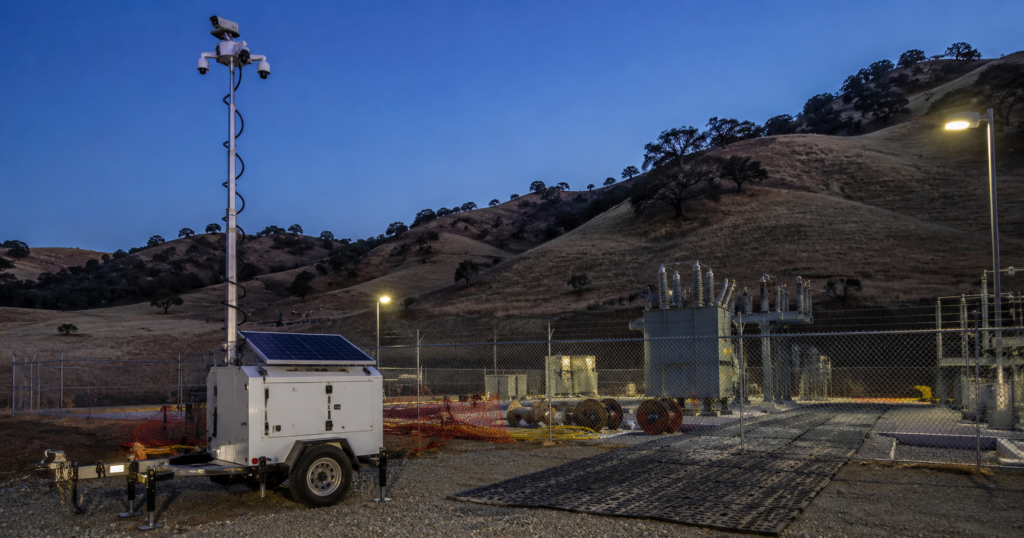
Quick answer: Stockton jobsites lose equipment, tools, copper wire, and fuel to theft that guards and fixed cameras often miss. A solar mobile surveillance trailer provides continuous, elevated, monitored coverage of the whole site, deters intruders before losses happen, and moves with the project from phase to phase. Hawk Surveillance deploys trailers across Stockton and the Central Valley, matched to the size and risk profile of each project. This guide covers what Stockton jobsites actually lose, where guards and fixed cameras leave gaps, how a mobile surveillance trailer closes them, which Hawk trailer fits your project, and what the cost comparison looks like.
Construction jobsites in Stockton face ongoing exposure from copper wire theft, tool theft, equipment theft, after-hours trespassing, and vandalism. The most effective approach is not relying on a single security measure, but combining multiple layers of protection. A mobile surveillance trailer serves as the active outer layer by providing elevated camera coverage, live remote monitoring, real-time audio and visual deterrence, and flexible placement as the project evolves. Unlike permanent camera systems, trailers do not require fixed infrastructure and can be relocated as construction phases change. Hawk Surveillance deploys both solar and compact surveillance trailers throughout Stockton and Northern California, typically setting up in hours so contractors can protect changing jobsites without permanent installations. Contact Hawk to discuss the right deployment strategy for your project.
What Stockton jobsites are actually losing
In brief: Stockton construction sites are most commonly exposed to copper wire theft, portable tools, fuel, heavy equipment, vandalism, and unauthorized after-hours access. The financial impact often extends beyond replacing stolen property because project delays, subcontractor downtime, and insurance claims frequently become the larger cost.
Construction site security is the practice of protecting active projects, workers, equipment, and materials from theft, vandalism, trespassing, and operational disruption. Unlike permanent commercial properties, construction sites change every week as buildings rise, equipment moves, and temporary utilities are installed. That constant change creates security gaps if protection does not adapt alongside the project.
For Stockton contractors, the greatest risks generally fall into several categories:
Copper wire and electrical materials
Copper remains one of the highest-value materials targeted by organized thieves because it can be resold quickly. The National Insurance Crime Bureau notes that copper theft continues to increase as demand and pricing remain elevated across transportation, energy, and construction markets. (National Insurance Crime Bureau)
Electrical contractors are particularly vulnerable during phases involving:
Temporary power installations
Electrical rough-in
Service entrances
Utility connections
Spools of copper wire awaiting installation
Even a relatively small theft can delay inspections or force crews to repeat completed work before a project moves forward.
Portable tools and equipment
Contractors frequently store valuable portable assets overnight, including:
Rotary lasers
Power tools
Concrete saws
Generators
Compressors
Welding equipment
These items are valuable, easy to transport, and often difficult to recover after theft.
Heavy equipment and fuel
While large machinery is more difficult to remove, attachments, batteries, fuel tanks, and smaller machines remain attractive targets during overnight hours.
Equipment theft often creates indirect costs that exceed replacement value because scheduled work cannot continue until replacements arrive.
Trespassing and vandalism
Not every security incident involves theft.
After-hours trespassing can result in:
Property damage
Graffiti
Damaged materials
Safety hazards
Insurance complications
The longer a site remains inactive overnight or during weekends, the greater the need for active monitoring rather than passive recording alone.
Project delays
For many general contractors, schedule disruption becomes the largest financial consequence.
A missing electrical panel, damaged conduit, or stolen generator can affect multiple subcontractors simultaneously, creating cascading delays across the construction schedule.
Recent construction security reporting found confirmed U.S. jobsite break-ins increased significantly during 2025, with weekends and late-night hours representing the highest-risk periods. Materials, tools, generators, and equipment remained among the most common targets. (National Roofing Contractors Association)
Why guards and fixed cameras leave gaps at a Stockton jobsite
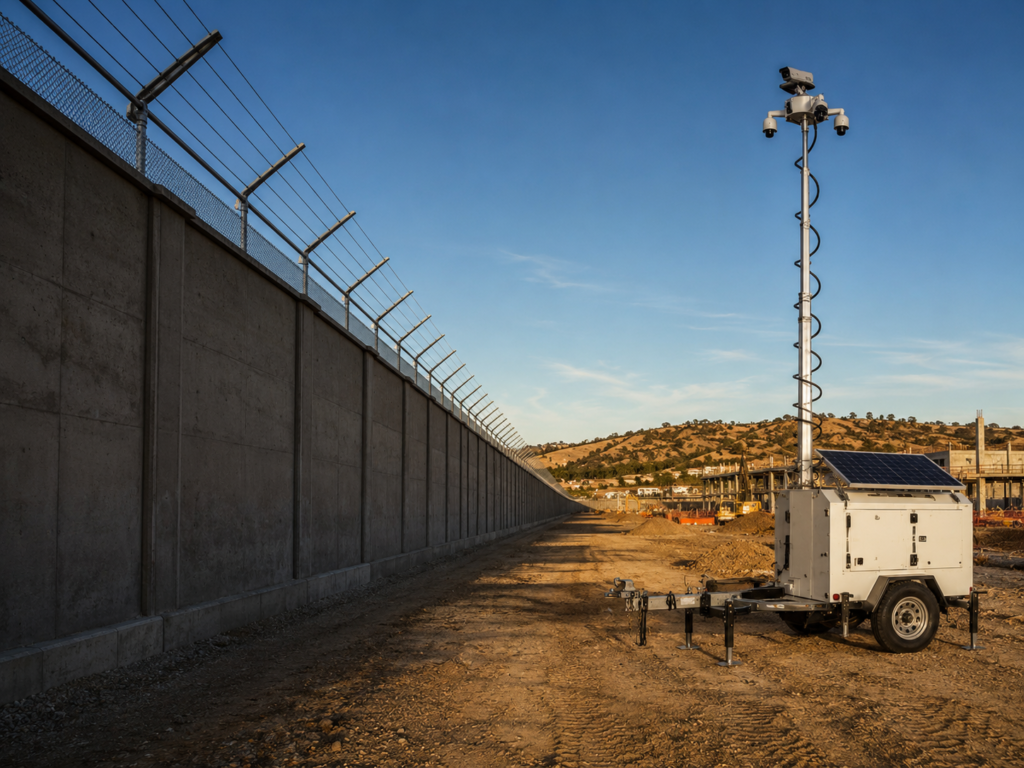
In brief: Security guards and fixed cameras both provide value, but neither solves every challenge on a changing construction site. Mobile surveillance trailers bridge the gap by combining broad site visibility, active deterrence, and flexible deployment without permanent infrastructure.
Construction managers generally evaluate three primary approaches:
Security guards
Fixed surveillance cameras
Mobile surveillance trailers
Each has advantages depending on project size, duration, and operational requirements.
Physical security guards
Security guards remain valuable when a site requires:
Visitor management
Access control
Contractor check-in
Public interaction
Immediate on-site response
However, one guard can only observe one area at a time. Large Stockton construction sites often include multiple entrances, laydown yards, equipment staging areas, and partially completed structures spread across several acres.
For overnight monitoring, maintaining continuous guard coverage may also become the highest recurring operating expense.
Fixed camera systems
Permanent camera installations work well for:
Finished commercial facilities
Warehouses
Manufacturing plants
Long-term industrial sites
Their limitations appear during active construction.
Fixed systems generally require:
Permanent power
Network infrastructure
Pole or building installation
Cabling
As projects evolve, cameras may no longer cover the highest-risk areas without additional installation work.
Most systems also record events rather than actively discouraging unauthorized activity while it is happening.
Mobile surveillance trailers
A mobile surveillance trailer addresses many of these operational gaps.
Instead of relying on permanent infrastructure, the trailer provides:
Elevated camera visibility
Solar-powered operation
Off-grid capability
Live video verification
Two-way speaker communication
High-visibility strobe deterrence
Flexible relocation throughout construction phases
Rather than replacing every other security measure, the trailer becomes the active outer layer within a broader security strategy.
This layered approach aligns with Hawk Surveillance’s concentric security philosophy, where multiple overlapping protections reduce blind spots instead of relying on a single point solution.
Compared with national providers such as WCCTV, Pelco, SentraCam, or Joint Power Security, Hawk focuses specifically on Northern California deployments, flexible trailer configurations, and concierge-level monitoring designed around changing construction projects rather than permanent facilities.
How a mobile surveillance trailer protects a Stockton jobsite
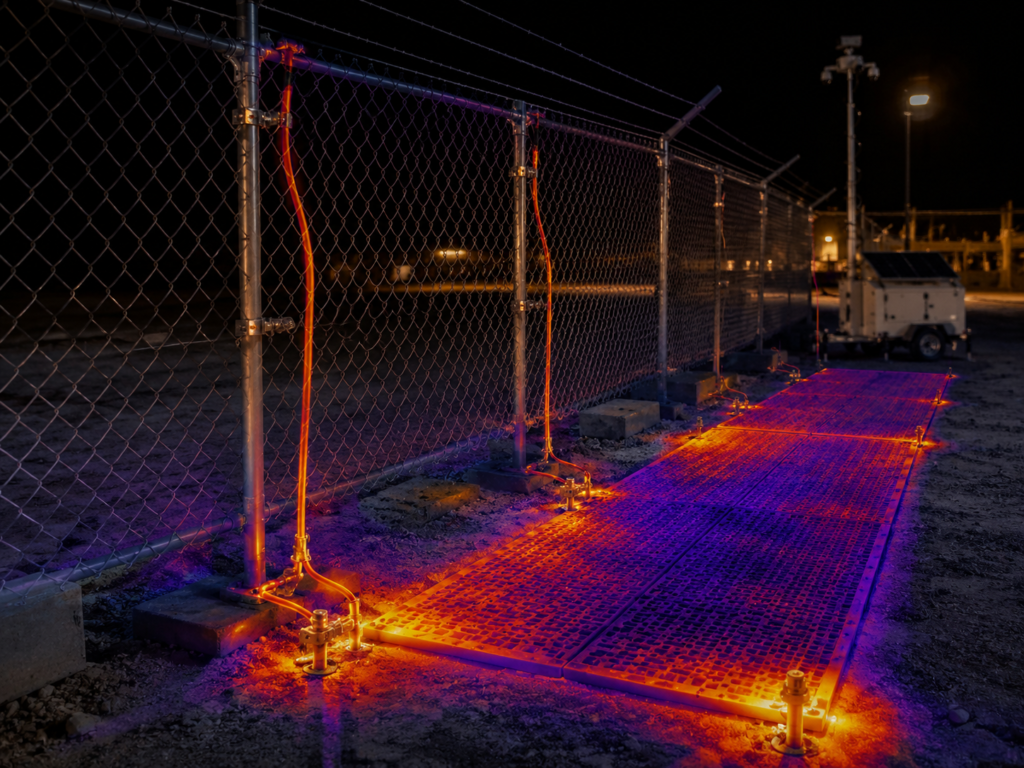
In brief: Mobile surveillance trailers combine elevated visibility, live monitoring, real-time deterrence, and flexible deployment into a single system that moves as the construction project changes.
A mobile surveillance trailer is a portable security platform that combines high-mounted cameras, remote monitoring technology, solar power, and active deterrence into one relocatable unit. Unlike permanently installed systems, it can be repositioned throughout the project lifecycle as site conditions evolve.
For Stockton contractors managing phased developments, this flexibility becomes one of the system’s greatest advantages.
Key capabilities include:
Elevated camera coverage
Camera masts provide a wider field of view than many fixed building-mounted cameras, helping reduce blind spots around:
Site entrances
Material storage
Equipment yards
Utility staging
Temporary fencing
Perimeter gaps
Solar and off-grid operation
Many construction sites do not have permanent electrical service available during early phases.
Solar-powered surveillance trailers continue operating without relying on finished utility infrastructure, making them well suited for remote and developing projects.
Live remote monitoring
Instead of simply recording footage for later review, professionally monitored systems can verify activity as it occurs.
When appropriate, monitoring personnel may escalate through:
Live video review
Audio communication
Strobe activation
Dispatch coordination
This provides a faster response than discovering incidents the following morning.
Moves with the project
Construction sites rarely remain static.
As foundations become structures, laydown yards shift, and access roads change, surveillance coverage can move alongside the project instead of requiring permanent reinstallation.
For contractors seeking a flexible solution designed specifically for active projects, Hawk’s mobile surveillance trailer rental service integrates portable hardware with 24/7 remote monitoring while supporting evolving construction layouts across Northern California.
Which Hawk trailer fits a Stockton construction project?
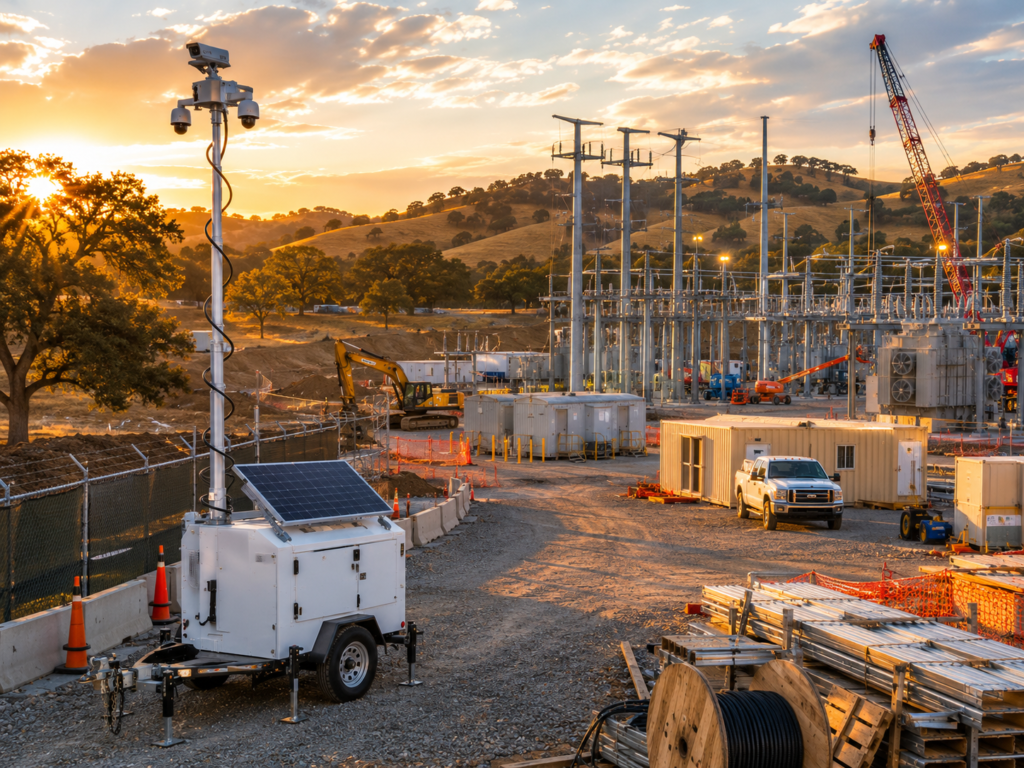
In brief: Large projects with limited utility access typically benefit from a solar surveillance trailer, while tighter urban jobsites often benefit from a compact surveillance trailer that fits restricted spaces without sacrificing active monitoring.
No two construction projects have the same layout, schedule, or security requirements. Hawk offers two primary trailer platforms so contractors can match surveillance coverage to the realities of the site instead of forcing every project into the same solution.
Solar surveillance trailer
Large commercial developments, subdivision projects, utility work, and infrastructure construction often lack reliable power during early phases.
A solar surveillance trailer is designed for these environments by providing:
Solar-powered operation
Elevated multi-camera coverage
Off-grid deployment
Live remote monitoring
Active speaker and strobe deterrence
Easy relocation as the project progresses
Because the system operates independently of permanent utilities, contractors can secure active work zones long before permanent electrical service is installed.
The platform is particularly effective for:
Highway projects
Industrial construction
Utility infrastructure
Large commercial developments
Distribution centers
Multi-acre residential developments
Compact urban surveillance trailer
Urban infill construction presents different challenges.
Downtown Stockton developments, smaller commercial lots, municipal improvements, and constrained staging areas often have limited room for large equipment.
The compact urban surveillance trailer is designed for these environments while still providing:
Elevated camera positioning
Live monitoring
Active deterrence
Flexible placement
Fast relocation throughout changing construction phases
Its smaller footprint allows contractors to maintain security without consuming valuable workspace.
Choosing the right trailer depends on factors such as project size, available space, power availability, construction timeline, and the locations of the highest-risk assets.
Trailer vs. guard vs. fixed cameras: Cost and coverage
In brief: Mobile surveillance trailers offer a balanced middle ground by combining broad site visibility, active deterrence, and flexible deployment at a lower ongoing operating cost than full-time guard coverage while providing more active protection than traditional fixed camera systems.
For most Stockton construction sites, a mobile surveillance trailer provides guard-level deterrence with broader visibility and greater flexibility than permanent cameras.
Feature | Mobile Surveillance Trailer | Security Guard | Fixed Cameras |
|---|---|---|---|
Site Coverage | Wide elevated coverage across multiple work areas | Limited to one physical location at a time | Fixed coverage based on installation location |
Active Deterrence | Live speakers, strobes, remote intervention | Physical presence | Usually records activity only |
Deployment | Sets up in hours | Immediate staffing if available | Requires installation, wiring and infrastructure |
Power Requirements | Solar or off-grid capable | None | Permanent power and networking |
Relocation | Easily moved as the site changes | Walks the site but cannot monitor everywhere simultaneously | Requires reinstalling equipment when coverage changes |
After-hours Monitoring | 24/7 live monitoring available | Depends on staffing schedule | Typically recording unless professionally monitored |
Best Fit | Active construction projects with changing layouts | Access control, visitor management, occupied sites | Permanent facilities and long-term installations |
Cost Profile | Predictable monthly rental | Quoted per site | Quoted per site |
Each solution has situations where it performs best.
A security guard remains the preferred choice when contractors need someone to verify deliveries, control gates, direct visitors, or maintain a visible customer-facing presence.
Fixed cameras make excellent long-term investments for completed buildings, warehouses, and facilities where infrastructure will remain unchanged for years.
Mobile surveillance trailers are designed specifically for dynamic construction environments where the perimeter, access points, and equipment locations change throughout the project.
Rather than replacing guards or permanent cameras, they frequently become the active outer security layer that complements both.
Deployment and monitoring
In brief: Effective jobsite security begins with proper placement. Hawk evaluates the site layout, positions trailers around entrances and perimeter gaps, then combines live monitoring with real-time intervention to maintain protection throughout construction.
Successful construction security is not simply about installing cameras.
It starts with understanding how people, equipment, and vehicles move throughout the project.
A typical deployment includes:
Site assessment
Before installation, Hawk evaluates factors including:
Primary vehicle entrances
Equipment storage locations
Material laydown yards
Temporary offices
Utility staging areas
Blind spots
Perimeter fencing
High-value assets
This allows surveillance assets to cover the areas with the greatest operational exposure.
Strategic placement
Instead of centering the trailer within the property, positioning often focuses on:
Main access roads
Equipment yards
Copper storage
Temporary electrical installations
Open perimeter sections
High-traffic work zones
Because trailers are portable, placement can evolve as construction phases progress.
Live concierge-level monitoring
Hawk combines intelligent detection technology with professional monitoring personnel.
When activity requires review, monitoring specialists can:
Verify live video
Differentiate authorized activity from suspicious activity
Activate speaker communication
Trigger visible strobe deterrence
Coordinate dispatch when appropriate
This layered response reduces unnecessary alarms while improving awareness during evenings, weekends, and holidays.
Unlike permanently installed systems that remain fixed for years, mobile surveillance trailers continue adapting alongside the construction schedule.
Frequently asked questions
How do construction jobsites stop copper wire, tools, and heavy-equipment theft plus after-hours vandalism and trespassing in Stockton?
A mobile surveillance trailer combined with 24/7 remote monitoring provides continuous visibility, active deterrence, and rapid verification across changing construction sites without requiring permanent infrastructure. The elevated cameras monitor broad areas while professional monitoring personnel can verify activity, activate speakers and strobes when appropriate, and coordinate response. Combined with fencing, lighting, and controlled access, this layered approach helps reduce opportunities for theft and vandalism.
Is a surveillance trailer cheaper than hiring security guards for a Stockton jobsite?
For many projects, a surveillance trailer offers a lower long-term operating cost than maintaining overnight guard coverage while providing continuous monitoring across larger portions of the site. Actual pricing depends on project size, deployment duration, monitoring requirements, and staffing needs.
Can one mobile trailer cover a Stockton jobsite?
One trailer can effectively monitor many small to medium-sized construction projects when positioned strategically. Larger developments often benefit from multiple trailers that provide overlapping coverage for entrances, storage areas, and perimeter sections. Hawk evaluates each project individually before recommending equipment placement.
Do surveillance trailers actually deter copper wire theft?
Visible surveillance equipment, elevated cameras, professional monitoring, speaker communication, and flashing deterrent lighting can discourage unauthorized activity before theft occurs. While no security solution eliminates every risk, active monitored systems generally provide more opportunity for intervention than recording-only cameras.
How fast can Hawk deploy a trailer in Stockton?
Hawk typically sets up surveillance trailers in hours once deployment has been scheduled and site access is available. Because the systems are portable and many models operate independently of permanent power, contractors can begin protecting active projects without waiting for permanent infrastructure.
Trailer or fixed cameras for a Stockton jobsite: Which is better?
Neither solution is universally better because each serves different purposes. Mobile surveillance trailers excel on active construction projects where layouts change frequently and permanent infrastructure has not yet been installed. Fixed cameras remain the better choice for completed buildings and long-term facilities where surveillance locations will remain unchanged for years.
Get Stockton construction site security pricing
Every construction project has different risks, timelines, and site layouts. The right surveillance strategy depends on factors such as project size, utility availability, equipment value, and how frequently the jobsite changes.
Whether you’re managing a commercial development, public infrastructure project, industrial expansion, or residential subdivision, Hawk can recommend a surveillance solution that fits your operation.
Talk with a Security Specialist to discuss your project, request Stockton surveillance trailer rental options, or receive pricing for a mobile surveillance trailer rental solution backed by 24/7 remote monitoring.
The goal is straightforward: provide flexible, layered construction site security that adapts as your Stockton project evolves, without requiring permanent installations.