

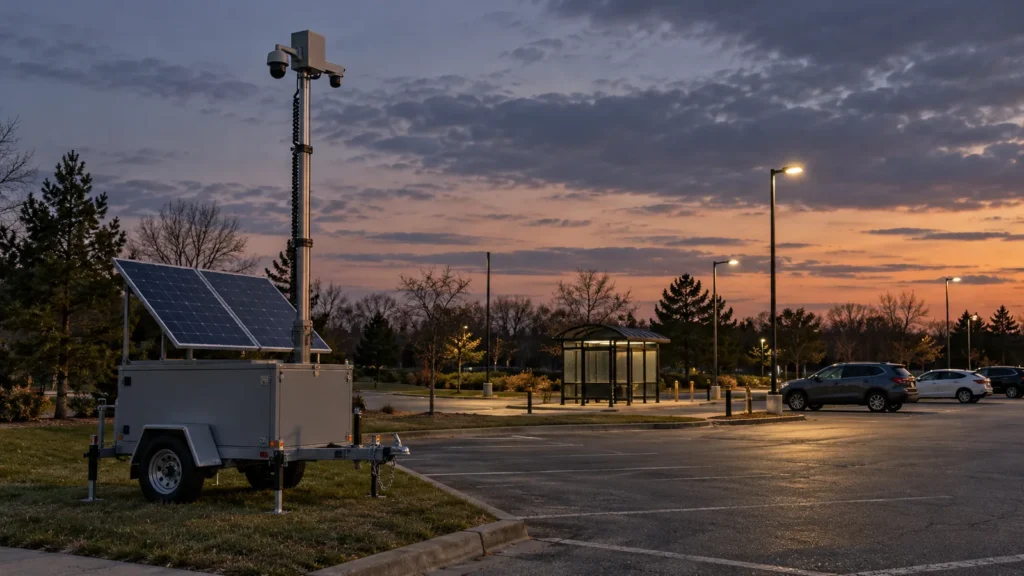
Cities, police departments and public agencies use mobile surveillance trailers to cover parking lots, parks, transit hubs and yards, and the trailers can move as problem locations shift. Choose between professional monitoring through a monitoring partner and streaming into the city’s own security operations center, or SOC. The choice should identify who reviews alarms, gives voice-down warnings and follows the escalation plan. Start placement planning with the area you need to see, then address power, connectivity and clear video-monitoring signage. Keep camera views directed toward the intended public facilities and away from private residential windows or sensitive areas. Hawk Surveillance offers rentals for short-term deployments and pilots across Northern California.
Why cities use mobile trailers instead of fixed cameras for problem spots
A municipal surveillance trailer adds coverage that can move when a problem location changes. For a short-term concern or pilot, that flexibility lets an agency test a location and monitoring arrangement before deciding whether to continue there. The practical starting point is a defined area and a clear reason to cover it.
For example, frame the request around a parking entrance, a park shelter or a yard’s material storage area. These are planning examples, not reports of completed deployments. Specify what the camera should show and what should trigger review. A request to cover a particular entrance gives the survey a clearer target than a request to watch an entire property.
Use the pilot to review placement as well as monitoring. If the priority changes, discuss repositioning the trailer and revising the camera views. The municipal and government security page describes this movement between lots, parks and other public facilities.
Where trailers fit on public sites
Match the trailer to the site, then choose who will monitor it. Downtown parking, parks and plazas, and remote yards call for different placement discussions. Use the table as a survey checklist: the concerns are examples to assess, and the product choices reflect the municipal page’s stated applications.
| Site type | Common concern | Placement note | Trailer type | Monitoring choice |
|---|---|---|---|---|
| City parking lots and garages | Vehicle break-ins or nuisance activity. | Review entrances and problem corners, with views of drive lanes, pay stations and pedestrian paths. | Compact urban: small footprint suited to downtown lots and garages. | Partner review or city SOC; define the areas and activity to review. |
| Parks and plazas | Graffiti or damage around fixtures and public facilities. | Discuss views around shelters and public-use areas while excluding sensitive areas. | Confirm at survey; no park-specific model is prescribed. | Partner review or city SOC; agree on warning and escalation instructions. |
| Transit hubs | Concerns around stops, shelters or pedestrian crossings; name the specific one at survey. | Separate the intended stop or crossing view from adjacent parking coverage. | Compact urban for transit-adjacent parking; solar for remote park-and-ride lots. | Partner review or city SOC; identify the responsible agency contact. |
| Public works or city yards | Trespassing or concerns around fuel, equipment and stored materials. | Prioritize the storage areas that need coverage and assess available power. | Solar for city yards or facilities with limited power. | Partner review or city SOC; document the yard’s escalation contacts. |
Source: Municipal and government security. Placement and monitoring prompts are planning recommendations, not claims about a specific deployment.
The compact urban surveillance trailer is the stated fit for tight city settings. The solar surveillance trailer is the stated fit for remote sites and facilities with limited power. Ask the survey team to confirm the proposed position and configuration.
Two ways to monitor
Professional monitoring through a partner and monitoring by the city’s own SOC are the two models described for municipal deployments. In the partner model, operators review alarms, issue live voice-down warnings and follow agreed escalation paths. In the city model, the internal team handles review and dispatch under city procedures.
Professional monitoring through a partner
For 24/7 remote video monitoring, ask the proposal to identify the coverage selected, alarm rules and contact order. Confirm whether voice-down equipment is included and what operators should say. Put the escalation instructions in writing so the monitoring partner has an agreed procedure for the site.
Streaming into the city’s own SOC
A city or police department can receive trailer feeds in its existing monitoring workflow. Confirm integration with the proposed platform before deployment, then request a demonstration. Name who will review alerts, handle warnings and dispatch assistance. Do not leave those responsibilities implied by the presence of a camera feed.
Signage, privacy and placement
Plan clear video-monitoring signage and camera views together. The municipal guidance calls for coverage aligned with streets, lots and public facilities, rather than private residential windows or sensitive areas. Final sign-off rests with the city’s legal and public safety teams, so include their review in the placement process.
Ask reviewers to check the intended views and signage before the pilot begins. If the trailer moves, request another review of the proposed views. For background, see are surveillance trailers legal in California. The final decision on each site belongs to the agency’s legal and public safety teams.
Running a pilot
Start a pilot with a defined site, a coverage objective and an agreed monitoring model. Request a written proposal that addresses the site survey, power, connectivity and signage. Set a review date and decide what your team wants to learn before extending the rental or moving the trailer.
- Site survey: Which entrance, path or storage area should each camera show?
- Power: Is solar appropriate here, and what power arrangement is proposed?
- Connectivity: Can the supplier demonstrate the connection at the intended position and explain connection-loss behavior?
- Monitoring: Who receives alarms, reviews video and follows the escalation instructions?
- Signage: Who approves the signs and camera views before use?
Also request a demonstration of footage retrieval for authorized staff. At the review date, compare the delivered views and workflow with the written proposal. Record any changes needed. Use the guide to specifying mobile surveillance units to prepare the equipment and service questions.
How we help
At Hawk Surveillance, we offer Northern California municipal rentals for short-term deployments and pilots. We help with site assessments, placement design and deployment logistics. Bring the site layout, coverage priorities and preferred monitoring model so we can discuss a configuration and a plan for any expected moves.
Frequently asked questions
The key decisions are where the trailer should look, who handles an alarm and how the agency approves placement. These answers summarize the municipal rental options. Use them to prepare a site-specific proposal, with equipment, monitoring responsibilities and signage reviewed before the pilot starts.
Do cities use mobile surveillance trailers?
Cities, police departments and public agencies use mobile surveillance trailers for parking lots, parks, transit hubs and yards. Their mobility supports moving coverage as problem locations shift. For a proposed rental, identify the particular area and concern first, then choose the monitoring arrangement. Treat that as a planning decision for your site, rather than assuming another location’s layout or operating procedures will fit.
Where should a city place a surveillance trailer?
A city should plan placement around the specific public area it needs to cover. Municipal examples include parking entrances, problem corners, shelters, pedestrian crossings and yard storage areas. Ask the site survey to confirm camera views and the proposed trailer position. Include clear signage and keep views away from private residential windows or sensitive areas, with final review by the city’s legal and public safety teams.
Who monitors a city surveillance trailer?
A city surveillance trailer can be monitored through a monitoring partner or by the city’s own SOC. Partner operators review alarms, issue live voice-down warnings and follow agreed escalation paths. With city monitoring, the internal team handles review, talk-down and dispatch under its procedures. The proposal should identify the selected model, coverage, supported warning equipment and responsible contacts before the trailer goes into use.
Can a trailer stream into a police department's existing system?
Streaming into a city or police SOC is an available municipal monitoring model. Confirm integration with the department’s specific platform and workflow before deployment rather than assuming universal compatibility. Request a demonstration of the proposed connection and identify who will handle alarm review, warnings and dispatch. Include the responsible staff in that review so the monitoring arrangement is clear before the pilot begins.
Do public surveillance cameras need signs?
The municipal guidance calls for clear signage indicating that video monitoring is in use. It also calls for camera placement aligned with streets, lots and public facilities, away from private residential windows or sensitive areas. Final sign-off rests with the city’s legal and public safety teams. For background, read are surveillance trailers legal in California; have those teams review the signs and views for the proposed site.
Can a city rent a trailer for a short pilot?
Short-term municipal deployments and pilots are available as rentals in Northern California. Start with the site location, intended camera views and preferred monitoring model. Ask the proposal to address the survey, power arrangement, connectivity and signage. Agree on a review date and the questions the pilot should answer, then use that review to decide whether the placement or monitoring instructions need adjustment.
This article is not legal advice.
Discuss your municipal rental or pilot with Hawk Surveillance. Call (530) 593-4295, email sales@hawksurveillancesystem.com or contact Hawk with your site location, coverage priorities and proposed pilot dates.