
By Hawk Surveillance Systems. California construction site security Last updated: June 7, 2026
Editorial disclosure: This article is educational and intended for general guidance only. It is not legal advice. Hawk Surveillance Systems is not a law firm and does not provide legal services. California privacy law, audio recording statutes, and municipal permitting rules are complex and fact-specific. Always confirm specific legal requirements, signage standards, retention periods, and permit obligations with qualified California counsel and your local jurisdiction before deploying surveillance equipment.
📋 Table of Contents
- TLDR: Key Takeaways at a Glance
- The Short Answer: Generally Yes, with Conditions
- The Five Legal Frameworks That Apply
- Where You Can and Cannot Place a Trailer
- Audio Recording: The Single Biggest Issue
- Signage: What “Conspicuous Notice” Means
- Permits and Local Approvals
- City-Level Permit Notes
- What’s Allowed vs. Prohibited (Quick Reference)
- Penalties and Civil Exposure
- CCPA and CPRA: When Footage Becomes Personal Information
- Employee Monitoring and Cal/OSHA
- Facial Recognition and Biometric Identification
- Five Legal Questions to Ask Before Deployment
- How Hawk Supports Compliance Documentation
- Frequently Asked Questions
TLDR: California Surveillance Trailer Legality at a Glance
Short answer: Yes. Surveillance trailers are generally legal in California for legitimate business use on property you own or control, provided you follow five rules:
- Audio off by default. California is a two-party consent state under Penal Code §632.
- Conspicuous signage at every entry point (operator name + contact).
- Avoid private spaces (restrooms, locker rooms; Labor Code §435).
- Permits for public right-of-way placements only; private sites usually don’t need them.
- CCPA/CPRA may apply if footage identifies people and your business meets the thresholds.
This article explains each framework, outlines a five-question compliance checklist, and shows how Hawk supports internal legal review.
This is the most-asked legal question in our category. Below is a defensible summary you can take to your counsel.
The Short Answer: Generally Yes, with Real Conditions
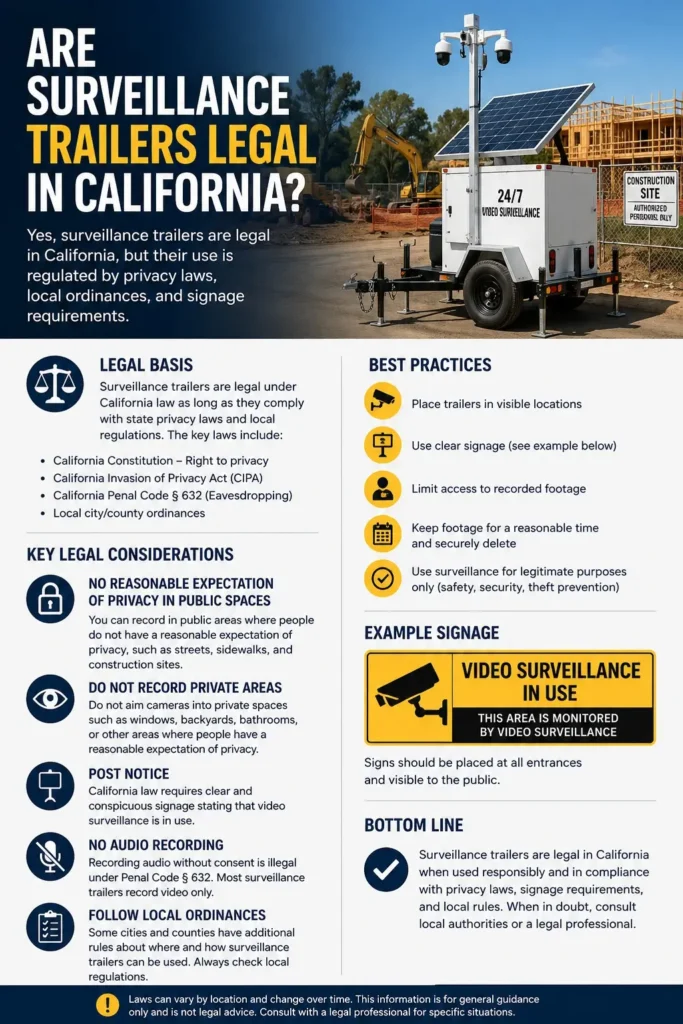
Surveillance trailers are generally permitted in California for legitimate business purposes, but the conditions are not optional.
Deployments are typically acceptable when used for a lawful purpose, placed on property you own or control, supported by clear signage, configured correctly for audio, aligned with applicable data privacy rules, and compliant with local permitting requirements where applicable.
The trailer itself is rarely the legal issue. The context, placement, configuration, and use determine whether a deployment aligns with California law. This is where most compliance reviews focus.
The Five Legal Frameworks That Apply
Constitutional and Common-Law Privacy
California recognizes a constitutional right to privacy under Article I, §1 of the California Constitution. The general test is whether a person has a reasonable expectation of privacy in the location and circumstances at issue.
On open commercial property such as construction sites, parking lots, and equipment yards, that expectation is typically low. In restrooms, locker rooms, and similar spaces, the expectation is essentially absolute and these areas are off-limits.
For surveillance deployments, this framework shapes where cameras are pointed and what areas are excluded. Counsel should review site-specific placement when there is any ambiguity.
California Penal Code § 632 (Audio Recording)
California Penal Code § 632 generally prohibits recording confidential communications without the consent of all parties. The statute defines a confidential communication as one carried on in circumstances that reasonably indicate an expectation of privacy.
This is the most significant legal risk in surveillance deployments. Video recording is evaluated differently, but audio recording is directly regulated under this statute and violations can carry both civil damages and criminal penalties.
The practical takeaway is simple: audio requires careful legal review. Many businesses avoid the issue entirely by disabling audio.
CCPA and CPRA (Consumer Data Privacy)
The California Consumer Privacy Act and the California Privacy Rights Act regulate how businesses collect and use personal information. See CCPA guidance from the California Attorney General and CPPA regulations.
Surveillance footage that identifies individuals is generally treated as personal information. These laws apply to businesses that meet certain thresholds related to annual revenue, number of California consumers whose data is processed, or revenue from selling consumer data.
The takeaway is that surveillance is not just a security tool. It is also a data collection system. Businesses that fall under these laws generally need to provide notice, define purposes, and manage retention.
Labor Code and Workplace Monitoring
California Labor Code § 435 addresses surveillance in sensitive workplace areas.
Monitoring employee activity in work areas is generally permitted with disclosure. Recording in restrooms, locker rooms, and similar private areas is prohibited under Labor Code §435.
Employers typically rely on written policies and posted notices to support compliance. Counsel should review workplace-specific deployments before installation.
Local Zoning, Permitting, and HOA Rules
Local jurisdictions may regulate trailer placement, signage, and temporary equipment. HOA rules and lease agreements can also impose restrictions.
Most issues arise when trailers are placed in public areas or visible shared spaces. Local planning departments or property owners can confirm requirements specific to your site.
Where You Can and Cannot Place a Surveillance Trailer
Generally Acceptable: Business Premises and Common Areas
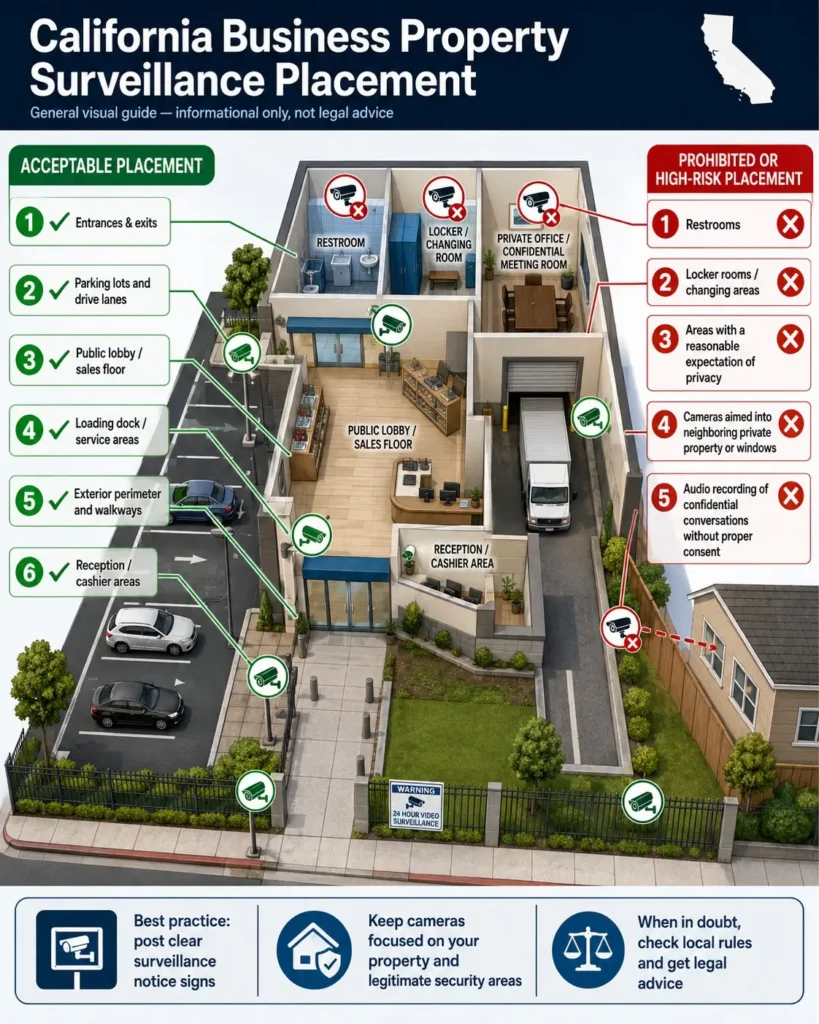
Surveillance trailers are typically placed on construction sites, parking lots, logistics yards, and commercial properties controlled by the operator. Entry and exit points are common placements.
These areas generally have lower expectations of privacy, especially when signage is present.
Off-Limits: Areas with a Reasonable Expectation of Privacy
Areas such as restrooms, locker rooms, and changing spaces are off-limits. Cameras aimed into neighboring residential interiors or private spaces can also create exposure under intrusion-into-seclusion claims.
Even on private property, the expectation of privacy can override ownership rights. This is one of the more common compliance pitfalls.
The Public Right-of-Way Question
Placing a trailer on a sidewalk, street, or public easement typically requires an encroachment permit from the local jurisdiction.
Cameras aimed toward public areas from private property are generally acceptable as a starting point, but specific aiming choices may trigger notice obligations or privacy concerns if individuals are identifiable in non-public spaces visible from the camera’s viewpoint.
💬 Hawk Insight: The most expensive mistakes often involve camera angles, not equipment. A quick placement review can prevent major issues later. We map every camera’s field of view as part of the deployment plan and flag any angle that could create exposure.
Audio Recording: Why It Is the Single Biggest Issue
What California’s Two-Party Consent Rule Actually Says
California Penal Code § 632 generally requires all parties to consent before recording a confidential communication. This applies when individuals reasonably expect privacy in their conversation.
The statute carries both civil damages and criminal penalties, which is why it receives close scrutiny during compliance reviews. Statutory damages and attorney’s fees provisions can make even single-incident violations financially significant.
When Audio May Be Allowed (And When It Generally Is Not)
Audio recording may be permitted when all parties have clearly consented, or in some narrow circumstances where there is no reasonable expectation of privacy in the conversation. Determining whether a particular setting meets the “no reasonable expectation” test is highly fact-specific and has produced significant case law.
In most surveillance scenarios, that threshold is difficult to establish without legal review. This is why many deployments avoid audio entirely unless there is a clear operational need that has been reviewed by counsel.
Why Most Hawk Deployments Disable Audio by Default
Most commercial surveillance use cases rely on video, not audio. License plate capture, perimeter alerts, and incident documentation generally do not require sound.
Disabling audio reduces legal exposure while maintaining operational effectiveness. If audio is required for a specific use case, it is typically configured only after counsel review and supported by clear, documented disclosure.
💬 Hawk Insight: When clients ask whether audio can be enabled, the question is not “can the equipment do it.” The equipment can. The question is whether the use case is worth the legal review and ongoing exposure. For most deployments, the answer is no.
Signage Requirements: What “Conspicuous Notice” Means in Practice
The Default Standard for California Businesses
California does not prescribe a single universal sign format, but conspicuous notice is generally expected. Notice helps address privacy expectations and supports transparency.
What Compliant Signage Looks Like
Typical signage includes the fact of surveillance, the operator’s identity, and a contact method.
Example signage text: “This area is under 24-hour video surveillance for security purposes. Operated by [Company Name]. Contact [Phone Number].”
Where to Place Signage
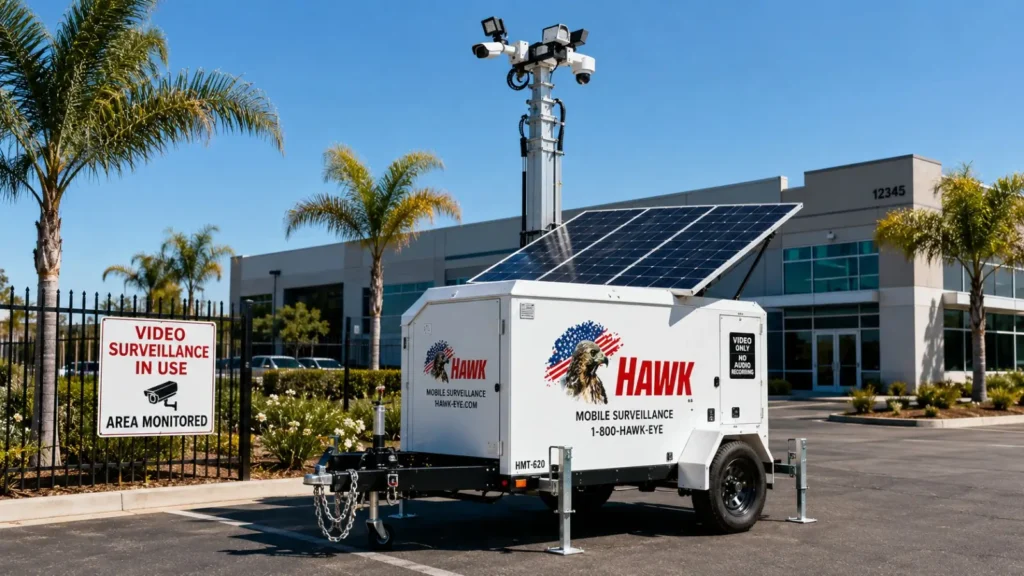
Signs are generally placed at entry points and in visible locations within the monitored area. For trailers, signage is often installed on the unit itself and at site entrances.
Permits and Local Approvals
Most Private Property Deployments Do Not Require a Permit
Deployments on private commercial property typically do not require state-level permits. Local zoning rules may still apply.
When You Probably Need a Permit
Permits are commonly required when trailers are placed in public right-of-way areas, on public works projects, or when the deployment involves an encroachment that affects public space.
HOA, Lease, and Covenant Restrictions
Lease agreements and HOA rules can restrict visible equipment or modifications. These are contractual but still enforceable, and disputes can lead to removal demands or fines.
City-Level Permit Notes for California Deployments
Permit and encroachment requirements vary by city. Below are general starting points; always confirm with the local planning or public works department before deployment.
- San Francisco: Encroachment permits are administered by SFMTA / Public Works for any equipment in the public right-of-way; private commercial sites typically do not require a permit but must follow zoning rules.
- Los Angeles: The Bureau of Engineering issues “R-Permits” for sidewalk and street encroachments; private property deployments generally fall under standard zoning.
- San Diego: Right-of-way permits are managed through the City’s Development Services and Transportation departments.
- Sacramento: Encroachment permits are required for placements in the public right-of-way; HOA and master-planned community rules can also apply.
- Oakland & East Bay: Local jurisdictions typically defer to private-property zoning for commercial sites; check city public works for ROW work.
- San Jose: Department of Public Works oversees encroachment permits; private commercial property deployments are usually exempt from permitting.
What’s Allowed vs. Prohibited at a Glance
| Situation | Allowed | Prohibited / High Risk |
|---|---|---|
| Audio recording | With all-party consent and documented disclosure | Recording confidential conversations without consent (Penal Code §632) |
| Cameras in restrooms / locker rooms | None | Always prohibited (Labor Code §435; intrusion-into-seclusion) |
| Public right-of-way placement | With encroachment permit from local jurisdiction | Trailer on sidewalk/street without a permit |
| Employee work-area monitoring | With written policy, posted notice, and acknowledgment | Hidden recording in private workspaces |
| Facial recognition | With explicit notice, consent assessment, and CCPA/CPRA review | Default-on biometric capture without disclosure |
| Cameras aimed at neighbors | Toward common public areas | Aimed into adjacent residential interiors or private yards |
Penalties and Civil Exposure
Violations carry meaningful financial and reputational risk. Specific exposure depends on the statute and the facts; the following is general guidance, not legal advice.
- Penal Code §632 (audio): Civil damages, attorney’s fees, and potential criminal penalties under Penal Code §637.2, which authorizes recovery of the greater of statutory or actual damages plus attorney’s fees per violation.
- Labor Code §435: Civil exposure plus potential injunctive relief; pattern violations can compound across affected employees.
- CCPA / CPRA: Administrative fines enforced by the California Privacy Protection Agency, and statutory damages for certain breaches. See also the California Attorney General’s CCPA guidance.
- Common-law privacy claims: Intrusion-into-seclusion suits can produce settlements and judgments separate from statutory penalties, especially where camera angles capture private spaces.
Most exposure is preventable through good camera-angle planning, audio defaults, signage, and a written compliance brief reviewed by counsel before deployment.
Send your site details. We will return a configuration, a deployment quote, and a written compliance summary your counsel can review.
CCPA and CPRA: When Surveillance Footage Becomes Personal Information
The Threshold Test for CCPA Applicability
CCPA and CPRA generally apply to businesses that meet annual revenue thresholds, process personal information for a specified number of California consumers, or derive a defined share of revenue from selling consumer personal information. Current threshold details are maintained by the California Privacy Protection Agency (CPPA).
Notice and Disclosure Requirements
Businesses subject to CCPA / CPRA generally need to disclose categories of data collected, purposes for collection, and consumer rights. Surveillance signage often supports this requirement but does not replace the broader privacy notice obligations under the statutes.
Data Retention, Security, and Breach Notification
Businesses generally define retention periods and implement reasonable security measures for surveillance footage. Hawk maintains its own data security and privacy standards for footage we monitor or store on behalf of clients.
Employee Monitoring and Cal/OSHA Considerations
What California Generally Permits
Monitoring employees in work areas with disclosure is generally permitted. Common practice is to combine written policies, employee acknowledgment, and posted notices.
What California Prohibits
Recording in private areas such as restrooms and locker rooms is prohibited under Labor Code § 435.
Best Practice: Written Policy and Disclosure
Employers typically maintain written surveillance policies and provide clear notice to employees. Employment counsel review is generally recommended for workplace-specific deployments.
Facial Recognition and Biometric Identification
Why This Is a Separate Legal Question
Biometric data is treated as sensitive personal information under CCPA and CPRA, and additional disclosure and consent obligations may apply. Federal guidance from the Federal Trade Commission addresses general expectations around biometric data handling, though state law often imposes stricter requirements.
What Hawk’s Standard Configurations Do and Do Not Include
Standard Hawk deployments focus on video monitoring and recording. Facial recognition is optional and requires additional configuration, additional disclosure, and additional legal review before deployment.
Five Legal Questions to Ask Before Deployment
Take this checklist to your counsel before any California deployment:
- What is the lawful business purpose for this deployment?
- Is audio recording enabled, and has it been reviewed under Penal Code § 632?
- Where exactly are the cameras pointed, and are any private spaces in frame?
- Is signage compliant, clearly worded, and posted at all entry points?
- Does the deployment trigger local permits, HOA restrictions, or lease covenants?
Your counsel is the only party who can give you a binding answer for your specific deployment.
Tell us your site, your use case, and your jurisdiction. We will return a deployment plan and compliance documentation within two business days.
How Hawk Supports Compliance Documentation
The Compliance Brief We Provide with Every Quote
Hawk provides a written summary of the proposed deployment and applicable legal considerations as part of our standard quote package. This includes camera placement, audio configuration, signage plan, and references to the relevant California legal frameworks.
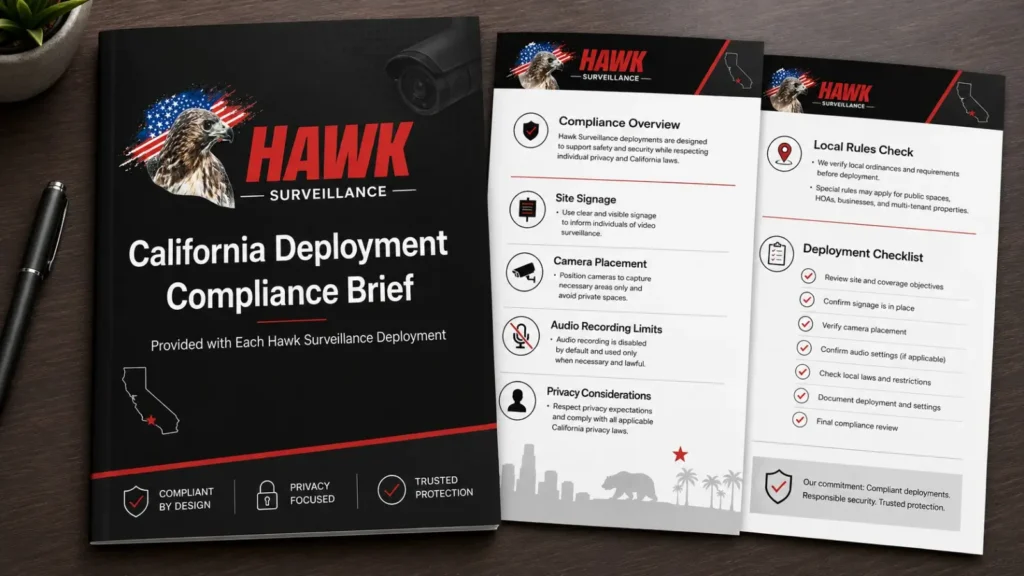
Signage, Configuration Choices, and Documentation
Standard deployments include signage, documented placement, and audio-disabled configurations unless otherwise requested. Configuration choices are documented in the brief so counsel can review the actual deployment, not just the abstract plan. Hawk works with mobile surveillance trailers and 24/7 remote monitoring configurations sized to the project.
What We Do Not Do (And Why You Still Need Counsel)
Hawk does not provide legal advice or certify compliance for any specific deployment. The compliance brief is a summary of factual configuration choices and references to legal frameworks. Counsel review is always required before deployment.
💬 Hawk Insight: A structured compliance brief typically reduces internal review time because counsel has a clear starting point. Instead of “what does this deployment do,” counsel can focus on “is this deployment compliant with the specific frameworks at issue.” That is a much faster review.
For broader operational context, see our companion guides on California construction site theft 2026 statistics and surveillance trailers and builders risk insurance.
Frequently Asked Questions
Are surveillance trailers legal in California?
Yes, generally. Surveillance trailers are permitted for legitimate business use in California when deployed on property you own or control, with proper signage, audio configured to comply with Penal Code §632, and adherence to CCPA/CPRA, Labor Code §435, and any local permitting rules. Specifics depend on the deployment context, so counsel review is recommended before installation.
Can security cameras record audio in California?
No, not without all-party consent. Under California Penal Code §632, recording confidential communications without every party’s consent can carry civil and criminal penalties. Most commercial deployments disable audio entirely, and any audio use case should be reviewed by counsel and supported by clear, documented disclosure.
Do you need a permit for a surveillance camera or trailer in California?
Usually no, for private property. Most private commercial deployments do not require state-level permits. Encroachment permits are commonly required for placements in public right-of-way, sidewalks, public works projects, or shared/visible spaces governed by HOAs or leases. Confirm with the local planning department before deployment.
What signage is required when using surveillance cameras in California?
Conspicuous notice at every entry point. California does not mandate a single sign format, but signs should clearly state that surveillance is in use, identify the operator, and provide a contact method. Place them at site entrances and within the monitored area; for trailers, add signage to the unit itself.
Does CCPA or CPRA apply to security camera footage?
It can, when thresholds are met. CCPA and CPRA generally apply to businesses meeting specific revenue, data-processing, or data-sale thresholds set by the California Privacy Protection Agency. Surveillance footage that identifies individuals is treated as personal information, triggering notice, disclosure, and retention obligations.
Can I use surveillance cameras to monitor employees in California?
Yes, in work areas, with disclosure. Employee monitoring is generally permitted in work areas when employees are notified, but recording in private spaces such as restrooms and locker rooms is prohibited under Labor Code §435. Combine written policies, signed acknowledgments, and posted notices.
Where is it illegal to place surveillance cameras in California?
Anywhere people have a reasonable expectation of privacy. Cameras are not permitted in restrooms, locker rooms, or changing areas. Cameras aimed into neighboring residential interiors or other private spaces, even from your own property, can create exposure under intrusion-into-seclusion claims.
What about facial recognition on surveillance cameras in California?
Treated as sensitive biometric data. Facial recognition involves biometric identifiers, which are sensitive personal information under CCPA and CPRA, and additional disclosure and consent obligations may apply. Standard Hawk deployments do not include facial recognition; it requires separate configuration and legal review before activation.
How long can security camera footage be kept in California?
No fixed statutory limit. California does not set a single retention period for surveillance footage. Businesses define reasonable retention based on operational purpose, contractual obligations (insurance, lease, project terms), and applicable privacy laws. Counsel can advise on appropriate retention for a specific use case.
Does Hawk Surveillance help with compliance documentation?
Yes, with every quote. Hawk provides a written compliance brief outlining proposed camera placement, audio configuration, signage, retention assumptions, and references to the applicable California legal frameworks. The brief is informational; it does not replace legal advice, and counsel review is required before deployment.
Key Takeaways
- Surveillance trailers are generally legal in California with real conditions
- Five legal frameworks apply to most deployments
- Audio recording under Penal Code § 632 is the primary legal risk
- Signage is simple but expected at entry points and within monitored areas
- Most private deployments do not require permits, but public right-of-way placements often do
- CCPA and CPRA may apply to footage that identifies individuals
- Private areas such as restrooms and locker rooms are off-limits under Labor Code § 435
- Facial recognition requires separate review and additional disclosure
- A five-question checklist simplifies the compliance conversation with counsel
- A compliance brief from your security vendor accelerates internal approval
Get a Quote with a California Compliance Brief
Send us your site details and the use case. Hawk will return a configuration recommendation, a deployment quote, and a written compliance brief your counsel can review. Hawk does not provide legal advice. We provide a defensible summary that shortens internal legal review.
This guide is educational. It is not legal advice, a substitute for counsel review, or a warranty of compliance for any specific deployment. California privacy and surveillance law is complex and fact-specific. Always confirm specific legal requirements, signage standards, retention periods, and permit obligations with qualified California counsel and your local jurisdiction before deployment.