

By Hawk Surveillance Systems — California construction and logistics security Last updated: [05/12/2026]
Editorial note: Peak sun hour ranges, irradiance data, and runtime calculations in this article reflect NREL NSRDB regional averages and typical Hawk solar trailer configurations as of early 2026. Actual performance for any specific deployment depends on site location, panel orientation, shading, surveillance load configuration, and seasonal variability. Always confirm runtime expectations through a site-specific survey before relying on any general estimate in this article.
TLDR: California Winter Solar Runtime in One Glance
Solar surveillance trailers do run reliably through California winter when they are engineered for winter irradiance conditions rather than summer averages. The performance question is not “does solar work in winter,” but “is the system sized for reduced peak sun hours, shorter daylight windows, and multi-day cloud cover events.”
Across most of California, winter peak sun hours (PSH) range roughly from 3.0 to 5.0 depending on region, based on NREL National Solar Radiation Database (NSRDB) datasets. That is lower than summer, but still sufficient for properly sized photovoltaic systems to maintain net-positive energy in most deployment zones.
The system’s real stability comes from three engineered buffers:
- Winter-adjusted solar generation based on regional PSH
- Battery storage sized in usable watt-hours (Wh) with controlled depth of discharge
- Design autonomy measured in full no-sun days of operation
A correctly configured Hawk solar surveillance trailer is designed to maintain operation through typical California winter variability, including multi-day cloud cover and fog events. In marginal locations or high-load configurations, hybrid solar plus generator support provides additional resilience.
This article breaks down the actual math behind winter runtime using California-specific irradiance data and real-world deployment scenarios so you can verify performance for your site before committing.
If you want a runtime plan for your specific location and configuration, send the site address and we will calculate it. No cost.
The Honest Answer: Yes, with Engineering
Solar surveillance trailers operate successfully through California winters when the system is engineered around winter conditions instead of summer averages. The failure cases most people hear about generally come from undersized systems, not from solar technology itself.
The key distinction is this: winter in California does not eliminate solar production. It reduces it. That reduction is predictable, regionally mapped, and already modeled in professional system design using NREL irradiance data.
Where systems fail is when:
- They are sized for peak summer production
- Battery capacity is minimized to reduce upfront cost
- Load assumptions ignore winter night-time power draw (lighting, IR illumination, LTE transmission)
A properly designed system reverses that logic. It is sized for December, not July. That means lower average daily generation is already accounted for in the battery and panel configuration.
There are legitimate edge cases. Coastal fog zones, heavily shaded sites, and high-consumption surveillance configurations can push systems toward hybrid support. The goal is not to claim universal solar independence. The goal is to ensure predictable uptime through quantified engineering margins.
This article shows exactly how that margin is calculated so you can validate whether solar alone is sufficient for your site.
💬 Hawk Insight: Most “solar doesn’t work in winter” claims trace back to systems sized for summer production and rented out without winter-specific engineering review. The technology is fine. The sizing decision is where reliability is won or lost.
The Three Variables That Determine Winter Runtime
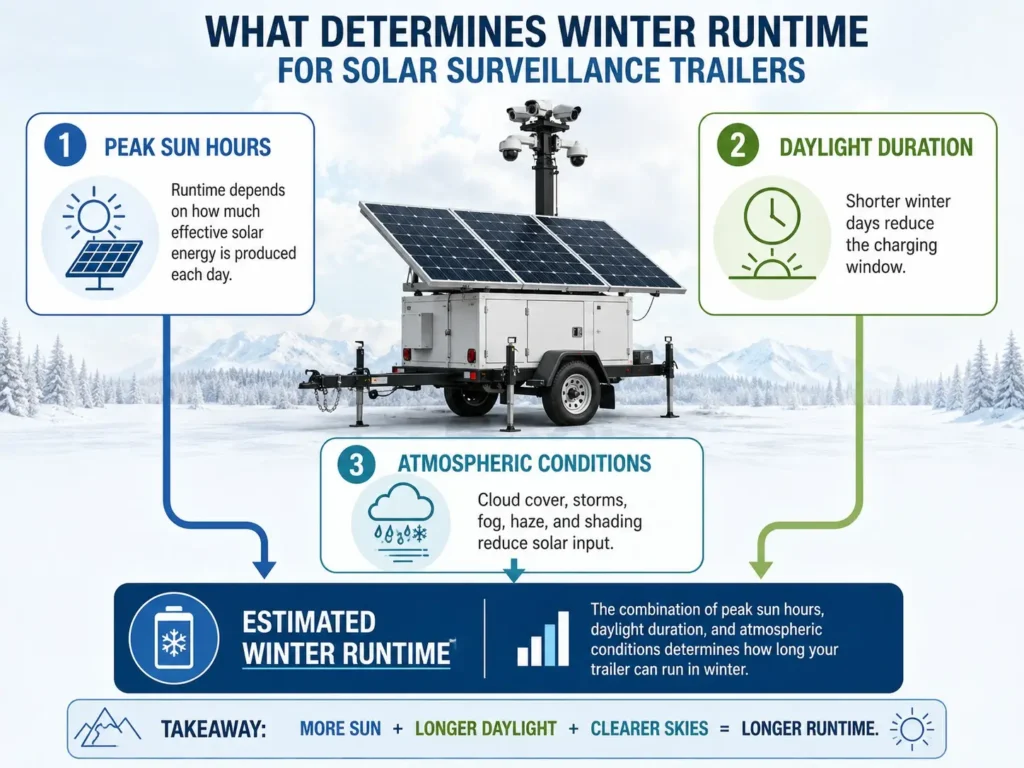
Winter runtime in California is not determined by a single factor. It is the interaction of three measurable variables: peak sun hours, daylight duration, and atmospheric conditions.
Variable 1: Peak Sun Hours (PSH)
Peak sun hours represent the equivalent number of hours per day where solar irradiance averages 1,000 W/m². It is a normalized way to express solar energy availability.
According to NREL NSRDB datasets, California winter PSH typically falls within:
- Bay Area: approximately 3.5 to 4.0 PSH
- Central Valley: approximately 3.0 to 4.5 PSH
- Southern California deserts: approximately 5.0 or higher PSH
This matters because solar output is directly proportional to PSH. A system producing 2 kWh/day in summer may drop to 1.2 to 1.6 kWh/day in winter depending on location.
The key engineering insight is this: systems are not evaluated on peak output. They are evaluated on whether winter PSH still exceeds the minimum energy balance threshold required by the load.
Variable 2: Daylight Hours
California’s shortest daylight period occurs around December 21. Depending on latitude:
- Northern California: approximately 9.5 hours daylight
- Central California: approximately 9.8 hours daylight
- Southern California: approximately 10 hours daylight
It is important to separate daylight from PSH. Daylight is simply sun above the horizon. PSH accounts for sun angle, atmospheric scattering, and intensity.
For surveillance systems, daylight matters indirectly because:
- Night-time loads dominate energy consumption
- Winter nights are longer, increasing total discharge time
So while daylight does not directly determine solar output, it increases the importance of battery autonomy.
Variable 3: Atmospheric Conditions (Marine Layer, Tule Fog, Storms)
California winter performance variability is dominated by atmospheric conditions.
Key impacts include:
- Marine layer (coastal and Bay Area): reduces irradiance during overcast events
- Tule fog (Central Valley): can reduce solar output for multi-day periods
- Pacific storm systems: short-duration but high cloud density events
Under full overcast conditions, solar irradiance can drop to 10 to 25 percent of clear-sky output based on atmospheric modeling. However, these conditions are typically intermittent rather than continuous over long seasonal periods.
Send the site address. We will return a written runtime plan with NREL irradiance data, load math, and design margin specific to your location. Two business days, no cost.
California Winter Solar Irradiance: The NREL Data
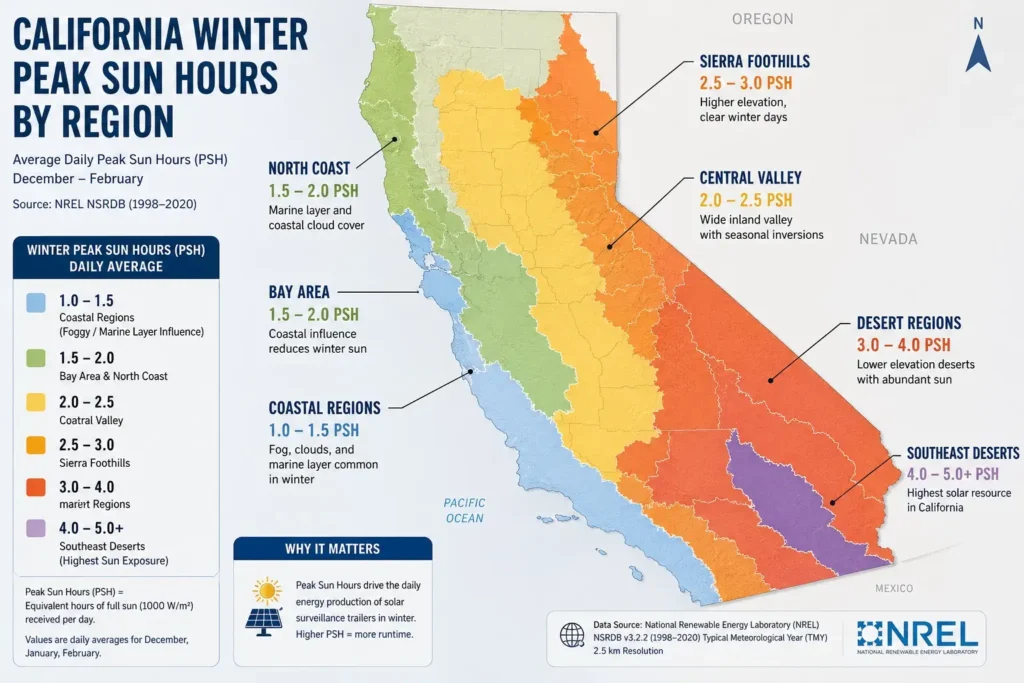
California is not a uniform solar environment. Winter irradiance varies significantly across short geographic distances due to fog patterns, elevation, and coastal influence.
Bay Area and the Marine Layer Effect
Winter PSH: approximately 3.5 to 4.0 (NREL NSRDB regional averages)
The Bay Area experiences moderate winter solar performance with variability driven by cloud cover and intermittent marine influence. Eastern Bay locations often outperform coastal zones due to reduced fog exposure.
Implication: solar trailers remain viable, but margin planning must account for multi-day reduced output periods.
Sacramento Valley and the I-80 Corridor
Winter PSH: approximately 3.5 to 4.5
Sacramento generally benefits from relatively clearer winter skies compared to coastal regions. Tule fog events can still reduce output temporarily.
Implication: strong candidate region for solar-only surveillance deployments with standard battery sizing.
Central Valley and the Tule Fog Belt
Winter PSH: approximately 3.0 to 4.0 depending on microclimate (NSRDB)
The Central Valley is generally the most operationally sensitive region in California for solar surveillance. Tule fog events can persist for multiple days, reducing irradiance substantially.
Implication: this region is where battery autonomy and system design margin become critical engineering constraints.
Sierra Foothills and Higher-Elevation Sites
Winter PSH: approximately 4.0 to 5.0
Elevation generally reduces fog persistence and improves irradiance consistency. Snow accumulation can introduce mechanical considerations, but solar exposure is generally stronger than valley floors.
Implication: strong solar performance with occasional maintenance considerations.
Coastal and Desert California Reference Points
- Central Coast: approximately 4.0 to 4.5 PSH
- Mojave Desert: approximately 5.0 to 6.0 PSH
Desert deployments typically exceed winter design thresholds with significant margin.
The Battery Math: How Hawk’s Solar Trailers Are Sized
Battery and solar systems are not evaluated on peak capability. They are evaluated on energy balance over time.
Daily Energy Generation
Generation is calculated as:
Panel wattage × PSH × system efficiency
Representative configuration (specific Hawk specifications vary by trailer model — verify with Hawk engineering for your deployment):
- 600 W solar array
- 4.0 PSH winter average (Central California reference)
- 0.85 system efficiency factor
Calculation:
600 × 4.0 × 0.85 = 2,040 Wh/day
This represents usable winter generation under typical Central Valley conditions.
Daily Energy Load
A standard surveillance trailer load includes:
- Cameras (fixed and PTZ)
- IR illumination at night
- LTE or satellite transmission
- Edge processing unit
Representative average load:
- 50 W continuous draw
Calculation:
50 × 24 = 1,200 Wh/day
This excludes peak spikes but reflects operational average. Actual load varies by camera count, IR cycling, and transmission frequency.
Battery Capacity, Depth of Discharge, and Autonomy
Definitions:
- Battery capacity: total stored energy (Wh)
- Depth of discharge (DoD): usable percentage of battery (LiFePO4 typically approximately 80%)
- Autonomy: number of days system runs without solar input
Representative battery (specific Hawk specifications vary by trailer model):
5,000 Wh × 0.8 DoD = 4,000 Wh usable
Autonomy:
4,000 ÷ 1,200 = approximately 3.3 days
This means a system at this representative configuration can operate for approximately three days without any solar input.
The Design Margin
In real winter conditions:
- One cloudy day is routine
- Two to three consecutive low-sun days are expected in some regions
- Five or more days without meaningful solar input is rare but possible in fog-heavy zones
The engineering question is whether the system maintains balance across typical conditions plus reserve autonomy. That margin is what determines reliability.
💬 Hawk Insight: The 3-day autonomy figure is the design margin, not the failure point. Under partial-sun conditions (which is the typical California winter case, even during fog events), the battery only partially discharges before the next solar contribution. Real-world depletion to zero is rare even during multi-day fog periods.
Send your site details and we will model winter runtime using NREL irradiance data and your actual load profile.
What Happens During Extended Cloud Cover or Fog
Three Days of Full Overcast
Solar generation drops significantly, often to 10 to 25 percent of clear-sky output depending on cloud density. The battery bridges the gap.
Outcome:
- System remains fully operational
- No manual intervention required
- Battery reserve decreases but remains within design range
Five to Seven Days of Marine Layer or Tule Fog
In sustained low-irradiance conditions, the system approaches its lower reserve threshold.
Outcome:
- Battery enters controlled depletion zone
- Monitoring system triggers low-energy alerts
- Optional load reduction or hybrid support activation depending on configuration
When the System Approaches Its Reserve Threshold
Modern deployments include layered safeguards:
- Remote monitoring alerts
- Threshold-based notifications
- Optional generator integration for hybrid units
The key engineering feature is that intervention occurs before downtime, not after.
The Honest Edge Cases: When Solar Alone Is Not Enough
Marginal Irradiance Sites
Dense fog regions, heavy shading, or poor orientation can reduce effective PSH below design assumptions.
High-Power-Demand Configurations
Thermal imaging, dense PTZ cycling, or high-bandwidth transmission significantly increase daily load.
Multi-Week Forecasted Storm Patterns
Atmospheric river events can temporarily reduce solar production for extended periods.
These are not failures of solar technology. They are configuration constraints that require hybrid design.
The Hybrid Solution: Solar + Generator Backup
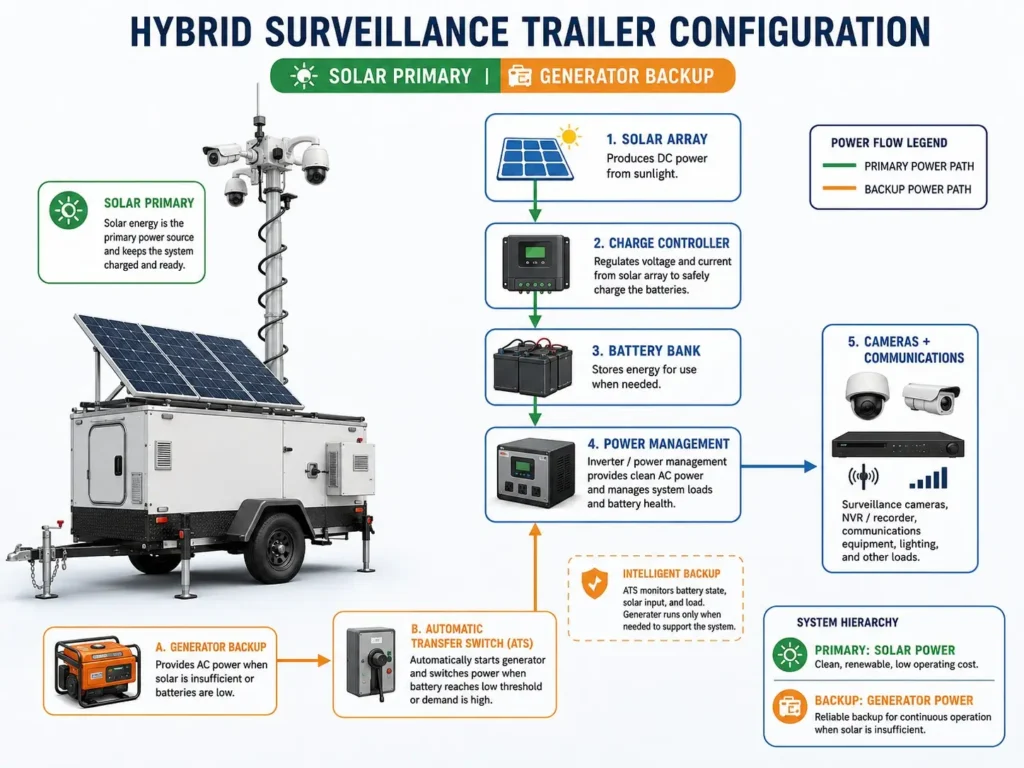
When to Choose Hybrid Configuration
Hybrid is generally appropriate when:
- Site is in a persistent low-irradiance zone (heavy fog, dense shading)
- Load exceeds solar-only balance margin (thermal cameras, high transmission rates)
- Zero-downtime requirement exists for contractual reasons
How a Hawk Hybrid Configuration Works
Solar remains the primary energy source. Generator activates only when battery thresholds are reached.
For California air quality regulations on off-road generator equipment, see the California Air Resources Board off-road regulations for current emissions standards applicable to construction generators.
Generator Runtime Math and Fuel Logistics
Unlike generator-primary systems:
- Generator runs only during low-solar events
- Typical runtime: 2 to 8 hours per multi-day event
- Significantly reduced fuel logistics compared to continuous operation
💬 Hawk Insight: Hybrid is not “solar with a backup generator.” It is solar engineered as the default, with generator support sized for the small percentage of hours per year when solar margin is exceeded. Total fuel use across a year is generally a fraction of generator-primary deployments.
Three California Winter Scenarios
The following are illustrative scenarios drawn from typical Hawk solar configurations and California winter PSH ranges. Specific runtime for any individual deployment depends on site conditions, configuration, and seasonal variability.
Scenario 1: Bay Area Construction Site, December to February
- Location: Concord region
- Winter PSH: approximately 4.0
- Generation: approximately 2,040 Wh/day
- Load: approximately 1,200 Wh/day
- Result: net positive energy balance
Outcome: stable solar-only operation with reserve margin
Scenario 2: Central Valley Solar Farm Construction, October to April
- Location: Stockton region
- Winter PSH: approximately 3.5
- Generation: approximately 1,785 Wh/day
- Load: approximately 1,500 Wh/day (higher due to thermal systems)
- Outcome: marginal balance
Recommended: hybrid configuration
Scenario 3: Sacramento Valley Logistics Yard, Year-Round
- Location: Sacramento region
- Winter PSH: approximately 4.2
- Generation: approximately 2,142 Wh/day
- Load: approximately 1,200 Wh/day
- Outcome: strong surplus margin year-round
For more on logistics yard deployments, see our NorCal logistics yard security guide.
Site Survey: How to Know Before You Deploy
What a Hawk Site Survey Includes
- Location-based NREL irradiance analysis
- Load estimation based on surveillance configuration
- Shading and orientation evaluation
- Battery autonomy modeling
Hawk’s deployment team handles survey, placement, and configuration as part of deployment and project services.
Tools You Can Use to Pre-Check Your Site
For preliminary feasibility checks before requesting a formal survey, NREL provides free public tools:
- PVWatts Calculator — quick irradiance and production estimates by zip code
- NSRDB Data Viewer — detailed historical solar data for specific locations
What to Send Hawk to Get a Custom Runtime Plan
- Site address or coordinates
- Deployment dates
- Camera and monitoring configuration
- Known shading conditions
For the related operational sizing question, see our coverage math guide for jobsites, yards, and lots.
Frequently Asked Questions
Do solar surveillance trailers work in winter in California?
Yes. Solar surveillance trailers work in California winter when designed using winter-specific irradiance data and sufficient battery storage. According to NREL NSRDB data, winter peak sun hours across California range from approximately 3.0 to 5.0 depending on region, which is generally sufficient for properly sized systems. Performance depends on correct system sizing for winter conditions, not summer averages.
How many cloudy days can a solar surveillance trailer run without sun?
A properly sized system at typical Hawk configurations is designed to maintain operation for approximately 3 days without solar input using battery storage alone, based on LiFePO4 usable capacity and average surveillance load assumptions. Actual runtime depends on configuration, battery size, and energy consumption profile.
What are peak sun hours and why do they matter for solar surveillance?
Peak sun hours represent the equivalent hours per day of full solar irradiance (1,000 W/m²). They matter because solar output is directly proportional to PSH. Lower winter PSH reduces daily energy generation and must be accounted for in system sizing to ensure battery balance.
How does Bay Area marine layer affect solar surveillance trailer runtime?
The Bay Area winter typically averages approximately 3.5 to 4.0 PSH based on NREL NSRDB data. Marine layer and cloud events reduce short-term output but are usually intermittent. Properly sized systems generally maintain operation through these periods using stored battery energy.
What about Central Valley tule fog?
Central Valley winter PSH ranges roughly from 3.0 to 4.0 depending on location. Tule fog can persist for multiple days and is generally the most significant winter constraint in California. Systems in this region require careful autonomy planning and may benefit from hybrid configurations.
What battery type do solar surveillance trailers use?
Most modern systems use lithium iron phosphate (LiFePO4) batteries due to high cycle life and deep discharge capability. Industry-standard usable depth of discharge is approximately 80%, allowing predictable autonomy calculations and stable performance in off-grid conditions.
When should I choose a hybrid solar plus generator configuration?
Hybrid systems are generally recommended for marginal irradiance sites, high-power surveillance loads, or deployments requiring guaranteed uptime through extended low-sun weather events. Hybrid systems reduce fuel use compared to generator-only solutions while maintaining operational continuity.
How do I know if my site has enough sun for a solar surveillance trailer?
You can evaluate preliminary feasibility using NREL PVWatts and NSRDB irradiance data for your location. A formal site survey provides a more accurate model incorporating shading, seasonal variation, and actual load requirements for your surveillance configuration.
What happens if the battery runs low?
When battery levels approach a predefined threshold, the system triggers remote alerts and optional load management protocols. In hybrid configurations, backup generation can activate automatically. These safeguards are designed to maintain operational continuity before complete depletion occurs.
Does Hawk Surveillance provide a runtime plan for my specific site?
Yes. Hawk provides a custom runtime plan based on site location, NREL irradiance data, and your surveillance configuration. The plan includes energy generation modeling, load analysis, and recommended system configuration with expected autonomy and any hybrid requirements.
Key Takeaways
- Solar surveillance trailers can operate reliably through California winter when engineered for winter irradiance conditions
- Peak sun hours in California winter typically range from 3.0 to 5.0 depending on region
- Battery autonomy of approximately 3 days at typical configurations provides buffer for short-term cloud or fog events
- Central Valley tule fog generally represents the most significant winter performance constraint
- System reliability depends on energy balance, not peak summer performance
- Hybrid solar plus generator systems are appropriate for marginal or high-load deployments
- Proper site survey using NREL data ensures correct configuration before deployment
- Design margin is the key factor that determines real-world uptime
Get a Runtime Plan for My Site
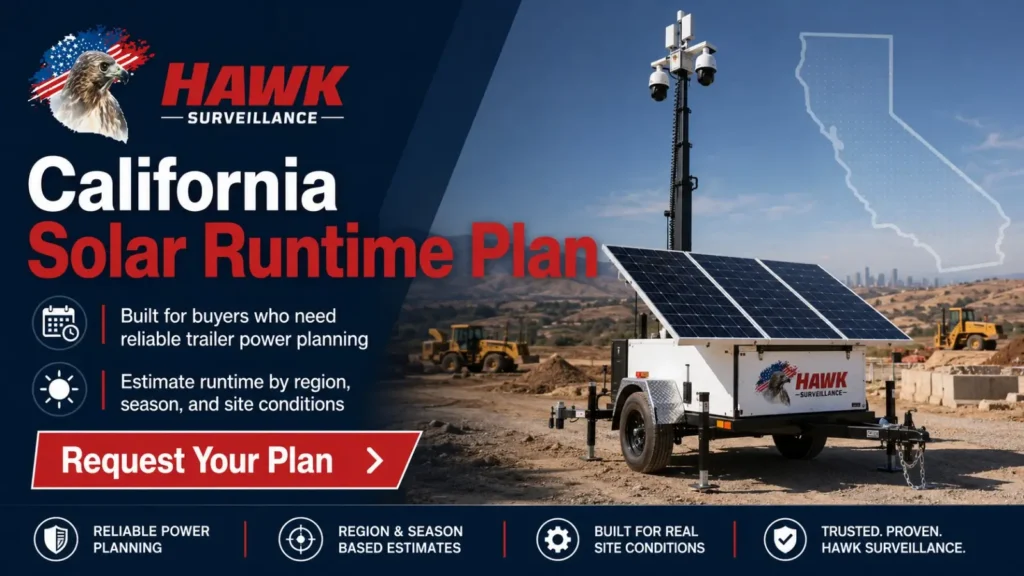
Send the site address, target deployment dates, and your planned monitoring configuration. Hawk returns a written runtime plan within two business days, including NREL irradiance data for your specific location, full load calculations, and a recommended configuration with any hybrid trigger thresholds.
NREL irradiance data, full load math, and configuration recommendation tailored to your California site.
This guide is educational and intended for general engineering guidance. It is not a guarantee of runtime, performance, or uptime for any specific deployment. Solar generation, battery autonomy, and atmospheric conditions vary by site and season. Always confirm specific runtime expectations through a site-specific survey by a qualified installer or vendor before relying on any general estimate in this article.