
Last updated: June 2026
Reviewed by the Hawk Surveillance Systems security team
- 1Why California EV charging stations are theft targets in 2026
- 2What ChargePoint, EVgo & Tesla anti-vandalism features cover
- 3What mobile surveillance trailers add at an EV site
- 4Deployment scenarios that fit EV infrastructure
- 5Insurance, warranty & incident-evidence value
- 6Deployment workflow for EV charging sites
- 7Frequently asked questions
California EV charging stations face cord theft, copper cable cuts, and vandalism. For operators, property managers, retailers, fleet hubs, and corridor-site owners, the practical issue is uptime: one cut cable can remove a charger from service until replacement, warranty review, or insurance documentation is complete. California now has more than 200,000 public and shared EV charging ports, plus a large home-charging base, so EV charging station security in California has become an infrastructure operations issue. See the California Energy Commission’s Sept. 24, 2025 charger update. A surveillance trailer rental gives site owners rapid, flexible coverage without permanent installs, where risk areas, perimeter gaps, and after-hours exposure change.
Why California EV charging stations are theft targets in 2026
California reported 201,180 fully public and shared EV charging ports in September 2025, a scale that creates more exposed parking-lot and corridor assets to protect in 2026. See the California Energy Commission’s Sept. 24, 2025 charger update.
💡
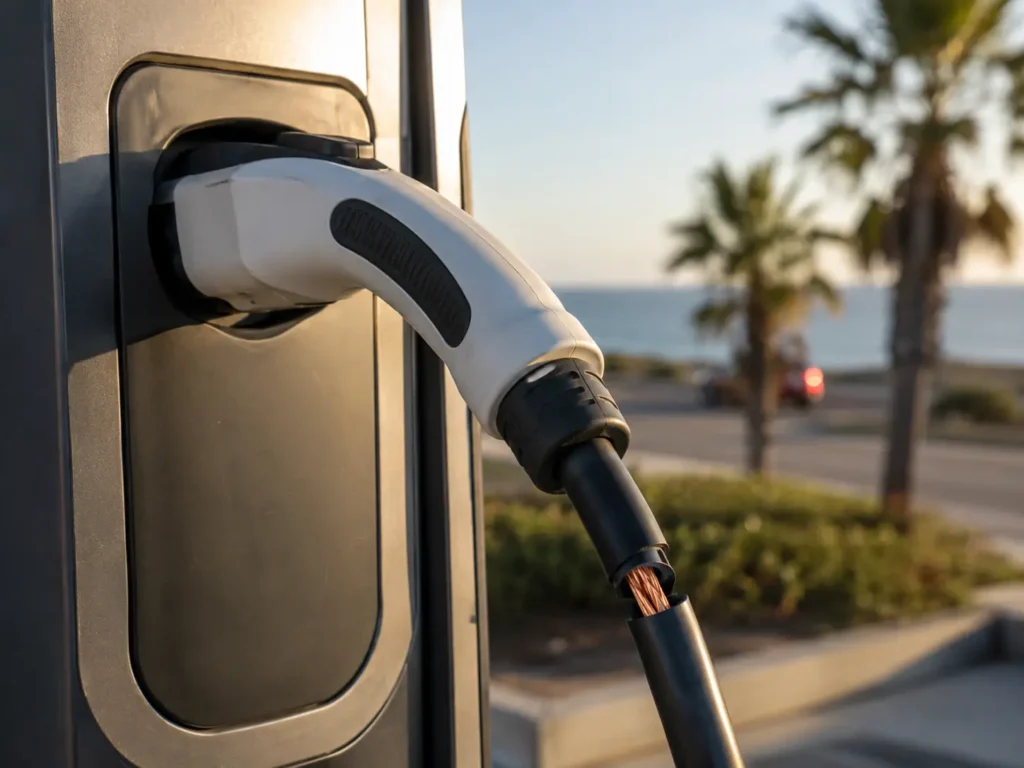
Charging cable theft is not only a scrap-metal problem. It is an uptime problem. CEC’s 2025 RFI states that theft-driven vandalism can especially affect cables, while the recycler value is modest compared with repair and prevention costs for station owners. See CEC’s Request for Information on EV charger vandalism and cable theft. When a cable is cut, the affected charger can stay unavailable until replacement parts, service scheduling, warranty review, and site access all align.
The highest-risk layouts are usually not the most technically complex. They are accessible. Grocery-store lots, retail centers, park and ride locations, gas-station conversions, workplace parking, apartments, and sports facilities are all part of California’s public and shared charging footprint, according to CEC’s description of where chargers are being deployed. See the California Energy Commission’s Sept. 24, 2025 charger update. Those sites often have strong daytime traffic but weaker after-hours visibility.
Retail parking and fleet hubs face different patterns. Retail sites need customer-facing protection that does not block stalls or create a bad driver experience. Fleet hubs need asset protection around chargers, vehicles, gates, storage, and service bays. Both settings benefit from retail and parking lot security planning because charger incidents often overlap with broader parking-lot risk. For related parking-lot theft context, Hawk’s guide to car dealership lot surveillance applies similar site-design logic: cover access routes, dwell time, blind zones, and evidence needs.
What ChargePoint, EVgo, and Tesla anti-vandalism features cover
ChargePoint publicly announced cut-resistant cables and ChargePoint Protect on Jan. 16, 2025, including real-time cable-tamper detection, charger alarms, and SMS or email notifications for select models. See ChargePoint’s anti-vandalism solutions release.
💡
EV charging networks and hardware manufacturers are moving in the right direction. Cable hardening, cable lock-down behavior, tamper alerts, alarm functions, charger-status data, and host-site cameras all help reduce exposure. These features matter because they make the individual charger harder to damage, faster to diagnose, or easier to document after an incident.
Built-in charger protection is equipment security. Mobile surveillance is site security.
The distinction is operational. A charger alarm may tell an owner that a cable is being disturbed. A built-in camera, where present, may show the charger face, connector, or stall. But cord cutting often starts before contact with the charger: a vehicle enters after-hours, a person loiters near the island, tools are staged, or a second person watches access routes. Those behaviors sit outside the charger’s immediate field of view.
A strong EV charging security plan should treat ChargePoint, EVgo, Tesla, and other network features as the first layer. The second layer is the property layer: lighting, sightlines, access control, active monitoring, and documented response procedures. The third layer is evidence management for warranty, insurance, lease, and maintenance conversations.
What mobile surveillance trailers add at an EV charging site
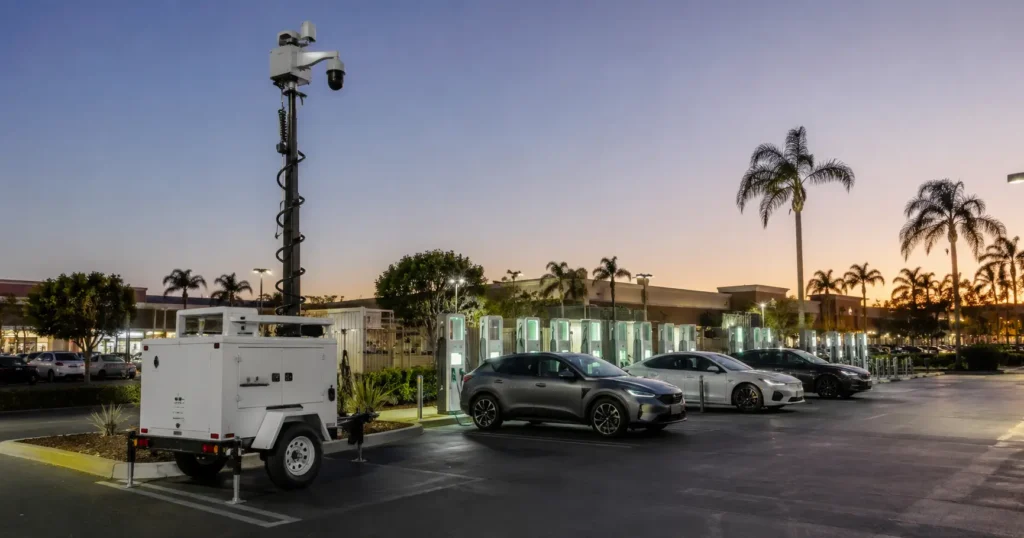
A mobile surveillance trailer is a temporary, elevated camera and monitoring platform that watches a defined risk area without requiring a permanent pole, trench, conduit run, or building-mounted camera system. At EV charging sites, it extends visibility beyond the charger face to the stalls, access lanes, perimeter gaps, and adjacent parking.
The core advantage is height and mobility. An elevated mast can see across a charger island, the travel lane behind it, nearby vehicle staging, and pedestrian approaches. For tight retail centers, mixed-use parking, urban lots, and compact fast-charge sites, a compact urban surveillance trailer can provide coverage without taking over the site.
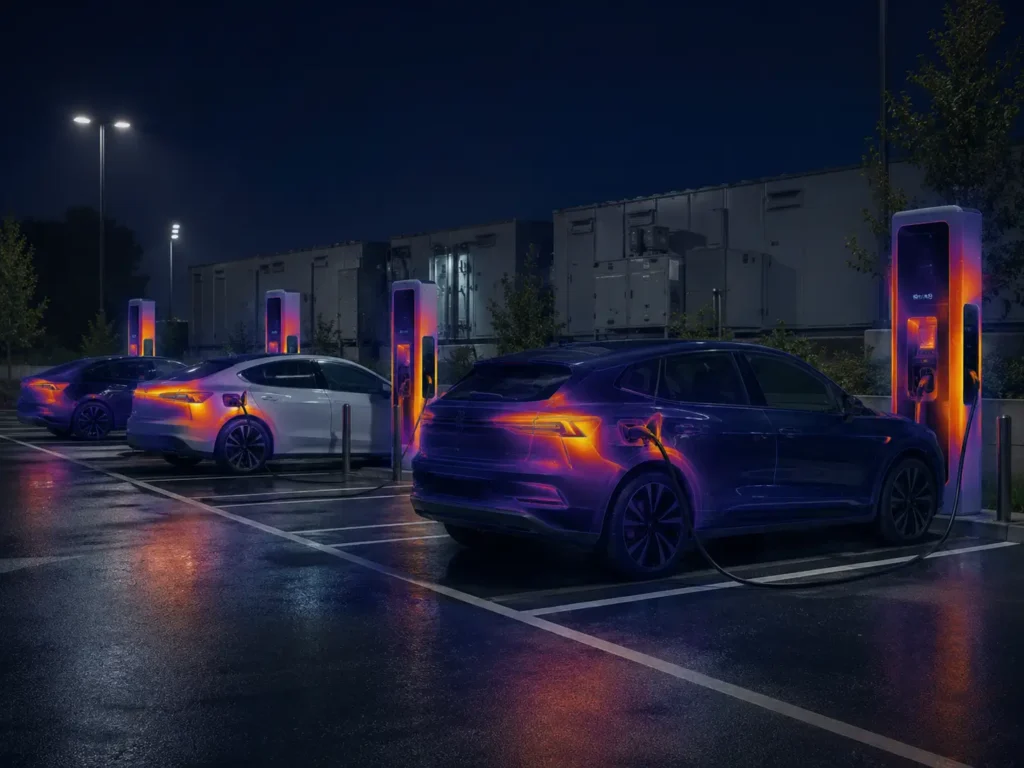
Thermal cameras improve after-hours detection because they can identify activity when light is poor or when movement occurs near landscaped edges, service alleys, or the back side of a charging island. Operators do not need archived footage only; they need detections that can be reviewed while the incident is forming.
With 24/7 remote monitoring, detections can route to trained operators who verify activity, issue audio warnings where appropriate, and coordinate escalation based on site instructions. This is where trailers separate from passive cameras. A fixed camera may record the loss. A monitored trailer is designed to create an intervention path.
Compared with national surveillance providers such as WCCTV, Pelco, SentraCam, and Joint Power Security, Hawk’s wedge is California-focused deployment for high-tempo sites where operators are weighing trailers vs. guards vs. fixed cameras. Guards can patrol, fixed cameras can record, and trailers sit between the two: rapid, flexible, and repositionable.
Security option | Best fit | Operational gap | Where Hawk trailers fit |
|---|---|---|---|
Guard patrol | Human presence and periodic checks | Limited continuous visibility unless staffed full time | Use trailers to watch the charging area between patrols |
Fixed camera | Permanent buildings, poles, and mature sites | Slower install and less flexible if the site layout changes | Use trailers during rollout, construction, or risk spikes |
Charger built-ins | Cable-level alerts and equipment diagnostics | Limited field of view and limited full-site context | Use trailers to see approaches, loitering, and perimeter gaps |
Mobile surveillance trailer | Temporary, multi-angle coverage with monitoring | Requires placement planning and clear response rules | Use as the active site-security layer for EV charger assets |
Deployment scenarios that fit EV infrastructure
CEC announced more than $55 million in May 2026 to expand public EV fast charging, including funding windows for DC fast chargers that can support eligible installation costs up to stated per-port caps. See the California Energy Commission’s May 2026 public EV fast-charging funding announcement.
Retail center parking with multiple charger islands: A trailer can watch the charging island, pedestrian path, storefront approach, and vehicle entrance without disrupting customers. This is useful where chargers sit at the edge of a large parking field, far from tenant cameras.
Fleet hub or depot: Fleet sites need coverage for chargers, parked vehicles, gate approaches, battery-electric trucks or vans, and service lanes. The security problem is wider than cord theft and includes after-hours access, staged tools, and damage to equipment cabinets.
Highway corridor fast-charge sites: California’s NEVI resources identify Alternative Fuel Corridors and planned charging infrastructure areas, which means many sites are built for long operating hours and public accessibility. See the California Energy Commission’s California NEVI program page. These chargers need security that works when the host business is closed but drivers can still access the site.
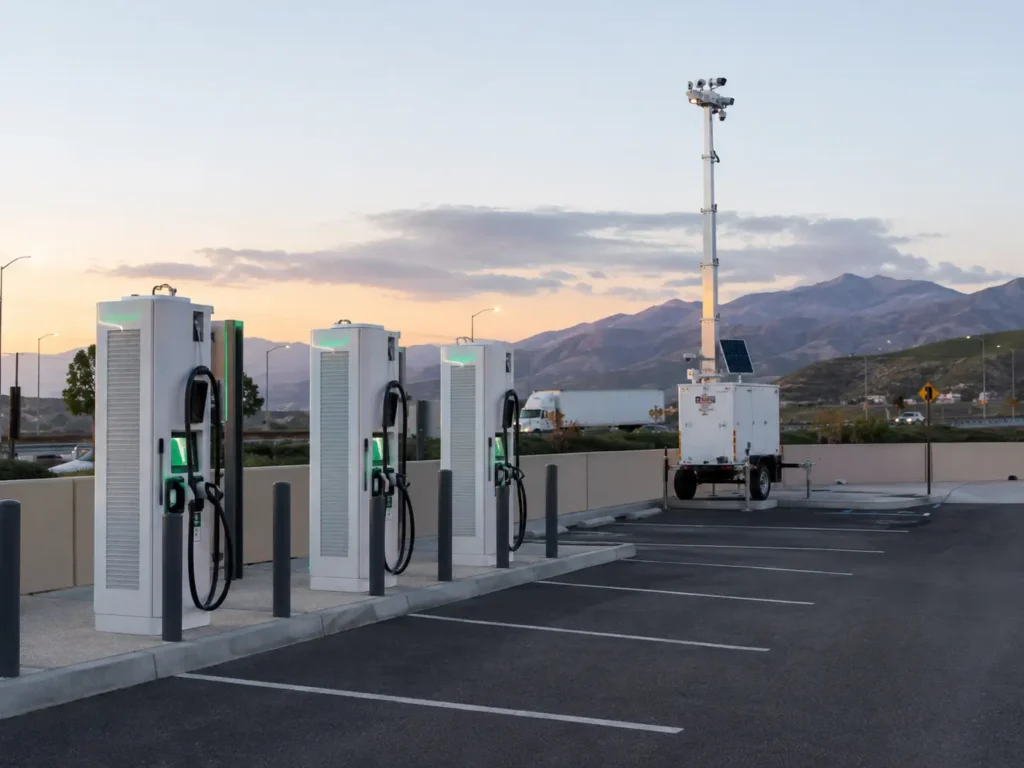
Construction-phase before permanent infrastructure: A charging project becomes vulnerable before the grand opening. Wire, cabinets, conduit, switchgear, and partially commissioned chargers can sit on-site before the permanent camera plan is live. Hawk’s deployment and project services fit these transitional windows because the trailer can move as construction zones, access routes, and risk areas shift.
Insurance, manufacturer-warranty, and incident-evidence value
CEC’s 2025 RFI states that the extent and severity of charger vandalism are not yet well understood at a systemwide level, so operators should avoid unsupported incident-count claims and track their own loss data. See CEC’s Request for Information on EV charger vandalism and cable theft.
A good incident file should answer basic questions quickly: when activity began, which vehicle or person entered, which cable or cabinet was touched, whether an alarm triggered, whether an audio warning was issued, and what happened after escalation. Without video, operators often have only a damaged cable, a driver complaint, and a maintenance ticket.
For warranty conversations, video can help distinguish malicious damage from ordinary wear, vehicle contact, weather exposure, or connector misuse. For insurance, documented active surveillance can show that the site owner is treating cord theft and vandalism as managed property risks.
California’s reliability rules add another reason to document downtime clearly. CEC states that applicable publicly funded DC fast chargers must meet a 97 percent uptime standard, with defined exclusions and reporting requirements. See the California Energy Commission’s EV Charger Data and Reliability Standards. A surveillance record can support the timeline around vandalism-related downtime, repair dispatch, and site-access constraints.
Deployment workflow for EV charging sites
For a prepared site, Hawk plans EV charging trailer deployment around a typical 24-48 hour window, while multi-site California portfolios are phased by site access, trailer availability, and monitoring instructions.
The workflow starts with a site walk and placement plan. Hawk identifies priority chargers, likely approach routes, after-hours zones, lighting gaps, and places where a trailer will not block charging, ADA access, fire lanes, or circulation. The plan also identifies whether one trailer is enough or overlapping coverage is needed.
Commissioning includes trailer placement, camera aiming, thermal or analytic zones, monitoring hours, audio-warning rules, contact trees, and dispatch instructions. For multi-site portfolios, Hawk can phase work by incident history, charger value, public exposure, and project timeline.
The best operators create a simple escalation matrix before activation. Who gets the first call? When should monitoring issue an audio warning? When does the site want police dispatch coordination? Who receives clips for maintenance, warranty, or insurance files? Hawk’s how we deploy process makes those instructions clear before the first alert.
Monitoring tier selection depends on risk. Some sites need overnight monitoring only. Others need 24/7 active review because chargers are open around the clock or under construction. High-tempo sites should revisit coverage after the first several weeks because incident patterns often reveal new perimeter gaps.
Frequently asked questions
Related California security coverage: See our guide to preventing copper wire theft at Bay Area construction sites, the latest California construction site theft statistics and prevention strategies, and how mobile trailers support substation security in Northern California.
What is the biggest security threat to EV charging stations in California?
Charging-cable theft and cord cutting are the dominant threats at California EV charging stations in 2026, with copper inside the cable as the high-value target and a single incident taking a charger offline until replacement. Vandalism and after-hours intrusion compound the risk at retail and highway-corridor sites.
Don’t ChargePoint and EVgo chargers have built-in cameras?
Some do, with limited field of view focused on the charger itself. Built-in cameras and tamper alerts cover individual chargers, but they do not provide wide-area perimeter coverage, after-hours response coordination, or the kind of video evidence that supports insurance and warranty claims for full-site incidents.
How do mobile surveillance trailers protect EV chargers from cord cutting?
Trailers provide elevated, wide-angle coverage of the entire charging area, with thermal cameras that detect activity at night before any incident occurs. Active video monitoring routes detections to trained operators who can initiate response, including siren warnings and dispatch coordination, before damage happens.
Can a mobile surveillance trailer cover multiple chargers at one site?
Yes, one mobile trailer with an elevated camera mast can cover an entire charging island and surrounding parking. Larger sites, including retail centers with multiple islands and fleet depots, typically use multi-trailer placements with overlapping coverage.
How fast can a mobile surveillance trailer be deployed at an EV site?
Typical deployment is 24-48 hours on a prepared site. Multi-site portfolio rollouts across a California operator’s charging network phase over 1-2 weeks. Site access, including gated lots and after-hours rules, is the main variable.
Does mobile surveillance reduce EV charging operator insurance premiums?
Documented active surveillance can favorably influence general liability and property-damage terms with some insurers, particularly where active video evidence supports claims and detection records reduce incident frequency. Provide your security plan during underwriting conversations.
Don’t let one cut cable take a charger offline.
EV charging station security in California is now part of charger uptime, property operations, and customer experience. If your site has after-hours exposure, perimeter gaps, or repeated cord-cutting risk, Hawk’s mobile surveillance trailers add the active site-security layer that built-in charger features can’t.