
Warehouse Perimeter Security in the Bay Area: How Logistics Operators Cover Multi-Acre Yards in 2026
Last updated: June 2026
Reviewed by Noah Williams, Security Systems Specialist, Hawk Surveillance Systems
The Port of Oakland handled 2,253,976 TEUs in 2025, and CargoNet reported nearly $725 million in estimated 2025 cargo-theft losses across the United States and Canada. For Bay Area logistics operators, warehouse perimeter security is now a multi-acre visibility problem, not just a guard staffing problem. Long fence-lines, stacked trailer rows, after-hours dock activity, and shifting yard layouts create perimeter gaps that fixed cameras and patrol routes do not always cover. Mobile trailers extend coverage without permanent installs by putting elevated cameras, off-grid power, detection, and monitoring directly where risk areas change. Hawk’s surveillance trailer rental model is built for rapid coverage on high-tempo sites where yards, inventory, and access patterns move faster than capital security projects. (Port of Oakland)
Why Bay Area warehouse perimeter security is harder than it looks in 2026
In brief: Bay Area warehouse perimeter security is difficult because the region combines port-adjacent freight, multi-gate yards, long fence-lines, and dense truck corridors with changing after-hours risk.
The Bay Area is one of California’s four cargo-theft impact regions identified by CHP, along with Los Angeles, Inland Empire, and San Diego. CHP describes these regions as complex distribution centers with harbors, airports, warehouses, rail systems, major freeway networks, and high merchandise flow. (chp.ca.gov)
Warehouse perimeter security is the practice of detecting, deterring, verifying, and escalating activity along the outside edge of a logistics property. In Bay Area distribution environments, that edge usually includes fence-line, gates, truck courts, dock approaches, trailer parking, container stacks, employee lots, and back-lot access lanes. The goal is not simply to record incidents. The goal is to maintain useful visibility across risk areas before activity reaches cargo, equipment, or dock doors.
Bay Area yards are rarely simple rectangles. Operators may be managing a port-adjacent Oakland facility, an East Bay carrier hub near Hayward, a Fremont or Newark industrial yard, or a Tracy and Stockton fringe site where trailer parking expands beyond the original camera plan. The common pattern is operational density: more trailers, more short dwell windows, more gate movement, and more after-hours activity than a static security plan can easily absorb.
That is why logistics and warehouse security has to be planned around coverage zones, not just devices. A good plan asks where a person or vehicle could cross the perimeter, where trailers block sightlines, where dock equipment is exposed, where copper or fuel could be targeted, and where incident verification would be delayed. Dense urban yards face the same copper and equipment theft pressure that infill job sites do, a problem we break down in construction site security in San Francisco.
The I-880 and I-580 corridors matter because they shape truck movement and local access patterns around Oakland, San Leandro, Hayward, and nearby industrial areas. Caltrans’ I-580 Truck Access Study specifically examines traffic patterns and impacts across the I-580 and I-880 corridors, including Oakland and neighboring communities. (Caltrans) For security teams, those corridors translate into a practical question: which edges of the property face the highest vehicle approach, staging, and escape-path risk?
Where guards and fixed cameras fall short on multi-acre yards
In brief: Guards and fixed cameras still have roles, but their coverage weakens when a yard has long fence-lines, trailer-row gaps, and changing inventory positions.
A single guard can only observe a small fraction of a multi-acre perimeter at one time, while fixed cameras only see what their installed angle allows. On a high-tempo logistics yard, both controls can miss the same problem: the risk area moved, but the coverage did not.
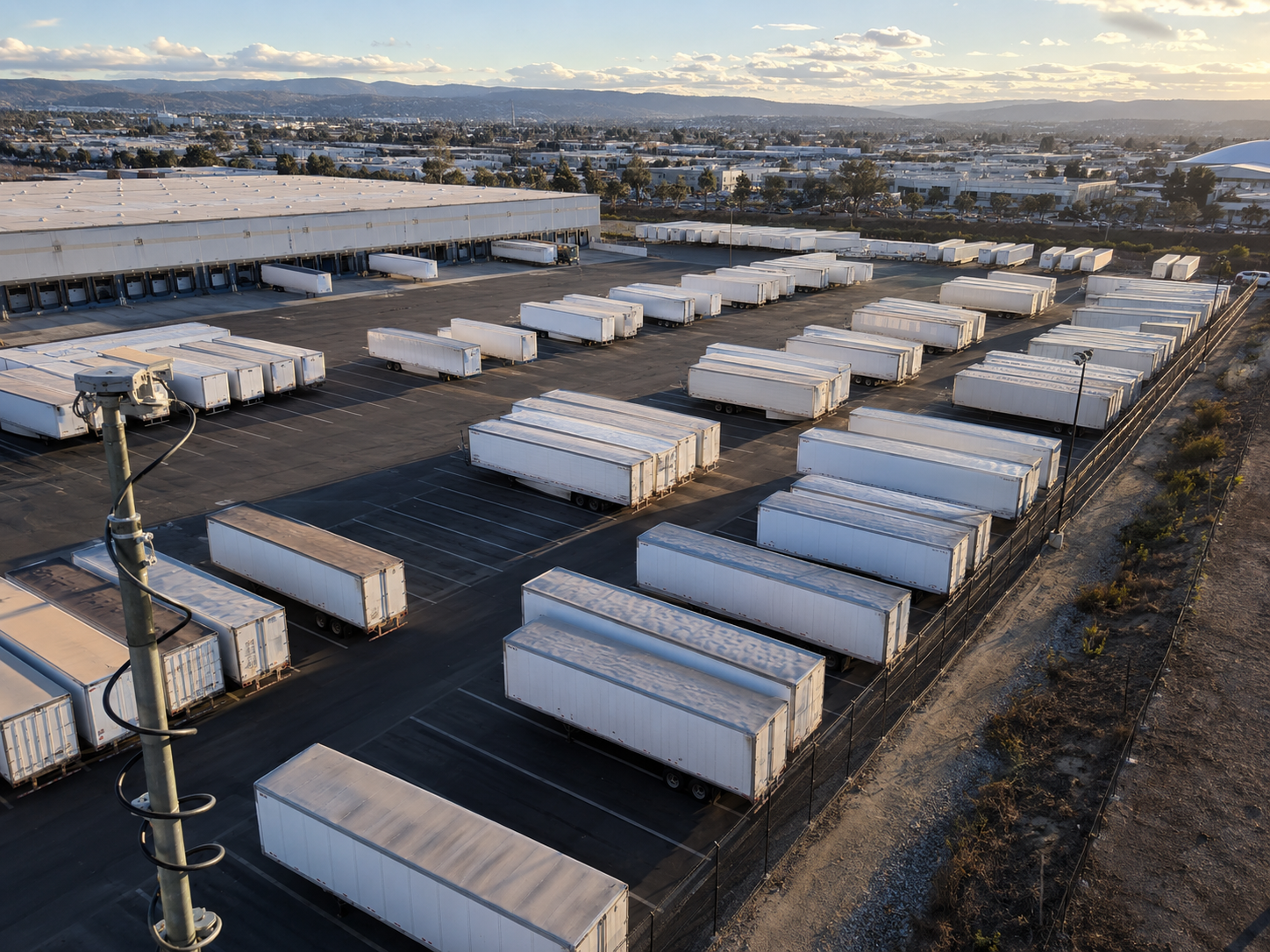
The issue is not whether a guard or camera works. The issue is whether the control covers the risk area when the yard changes.
Guards are strongest at judgment, access control, visitor handling, and incident response. They are weaker as continuous wide-area sensors because patrol routes create time gaps. A person can cross a fence-line, move between trailers, or enter a back-lot equipment area between patrol passes.
Fixed cameras are strongest at stable chokepoints: gates, dock doors, lobbies, fuel islands, and known traffic lanes. They are weaker where trailer rows, containers, temporary fencing, or parked trucks create blind spots. Adding more fixed cameras helps, but each new camera may require mounting, power, network, trenching, lift work, landlord approval, and IT coordination.
| Security method | Best use on a warehouse yard | Where it falls short | Cost and scaling behavior |
|---|---|---|---|
| Guard patrol | Gate support, incident response, visitor control, visible presence | Covers only one route or zone at a time | Usually scales by hours, posts, and shifts |
| Fixed cameras | Docks, gates, building corners, stable chokepoints | Trailer rows and back lots change faster than camera angles | Scales through installation, cabling, VMS licenses, and maintenance |
| Mobile surveillance trailer | Wide-area yard, fence-line, back lot, temporary risk zones | Requires placement planning and clear response workflow | Scales by movable coverage zones rather than permanent construction |
| Hybrid program | Fixed gates and docks, trailer coverage in yards, selected guard support | Needs clear ownership between ops, SOC, and vendor | Best fit for multi-acre sites with changing layouts |
Compared with larger national providers and platform categories such as WCCTV, Pelco, and SentraCam, Hawk’s Bay Area wedge is practical and local: trailers that move with the yard, monitoring that matches after-hours risk, and deployment planning focused on trailers vs. guards vs. fixed cameras rather than one-size procurement. WCCTV markets mobile video surveillance systems, Pelco provides VMS and camera platforms, and SentraCam markets live monitoring, but a NorCal logistics operator often needs the middle ground: local trailer placement, rapid repositioning, and clear escalation. (wcctv.com)
What a mobile surveillance trailer covers on a Bay Area yard
In brief: A mobile surveillance trailer covers the changing parts of the yard: fence-line, trailer rows, back lots, temporary staging zones, and after-hours dock approaches.
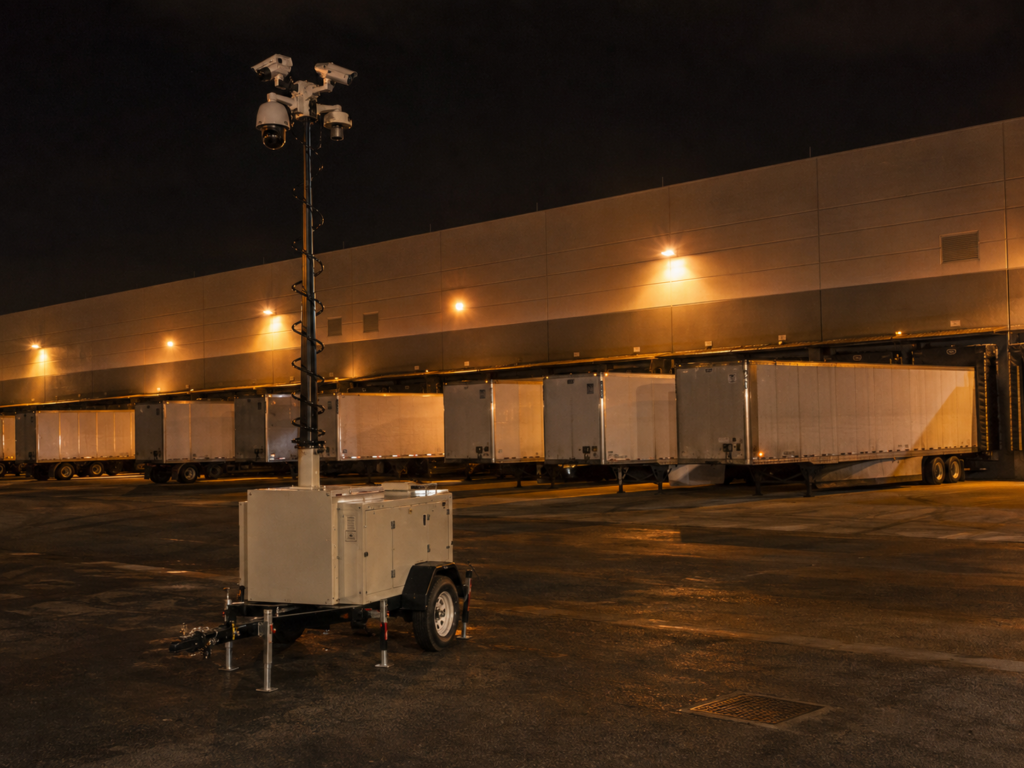
A mobile surveillance trailer is a portable security platform that places cameras, power, communications, and deterrence equipment on a towable base. On a warehouse yard, it functions as a movable observation point for perimeter gaps and risk areas that permanent cameras do not reach. The elevated mast is the difference: it gives the system a higher vantage point over trailer rows, containers, fencing, and parked equipment.
Hawk’s heavy-duty industrial surveillance trailer is the right product frame for logistics operators because yard conditions are harsher than office parking lots. The unit may need to operate near truck movement, dust, vibration, uneven surfaces, low-light fence-lines, and exposed back-lot areas.
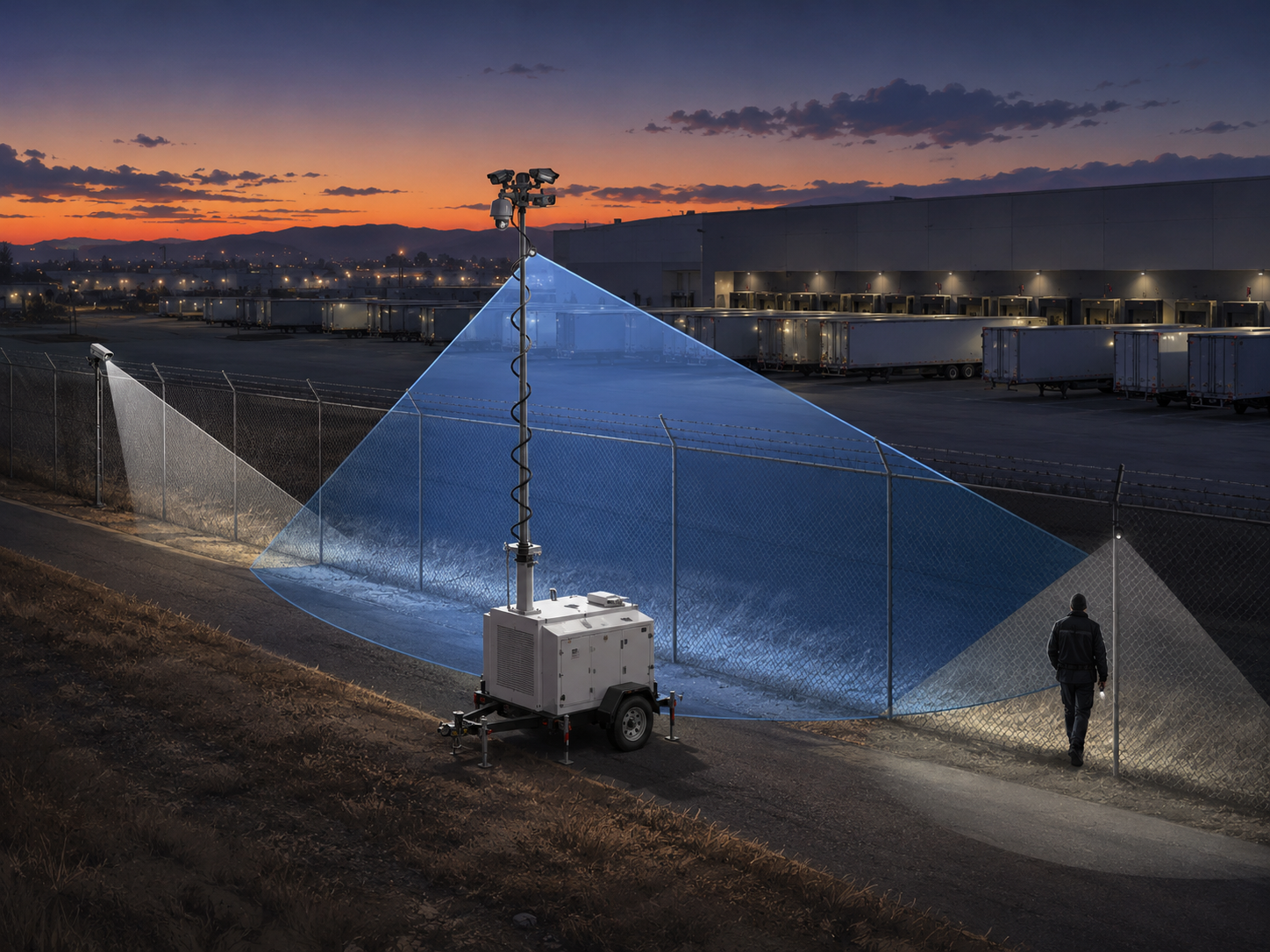
The coverage value comes from four attributes.
First, the mast helps cameras see across rows instead of only along one lane. That does not remove the need for careful placement, but it reduces blind spots created by box trailers, stacked containers, and parked tractors.
Second, off-grid power makes the trailer useful where permanent infrastructure is slow or unavailable. A back fence, remote corner, overflow lot, or temporary trailer yard may not have convenient power and network drops. A trailer avoids waiting for trenching or permanent installs.
Third, monitoring turns the unit from a recorder into an operational control. A camera that records quietly may help after an incident, but monitored detection can support live verification, voice-down, site-contact escalation, or dispatch coordination.
Fourth, trailers can be repositioned. As inventory shifts, a dock expansion opens, or a carrier changes staging patterns, coverage can move with the risk. Hawk’s rental process specifically describes delivery, positioning, mast setup, camera configuration, power and connectivity verification, plus later placement or camera-setting adjustments as sites change. (Hawk Surveillance Systems)
Cargo theft and dock-area risk, what video coverage adds
In brief: Video coverage adds value when it verifies activity fast enough for a response, especially around docks, trailer rows, and unattended cargo dwell areas.
CargoNet reported 3,594 supply chain crime events across the United States and Canada in 2025, with confirmed cargo-theft incidents rising 18 percent year over year and California remaining the most impacted state with 1,218 incidents. (CargoNet)
The FBI defines cargo theft broadly as theft of goods, chattel, money, or baggage that is part of a commercial freight shipment moving in commerce, and lists warehouses, freight distribution facilities, trailers, containers, wharves, rail yards, and truck stops among relevant locations and assets. (fbi.gov) That definition fits the practical exposure Bay Area operators manage every day: freight is vulnerable not only in transit, but also when staged, parked, cross-docked, or awaiting pickup.
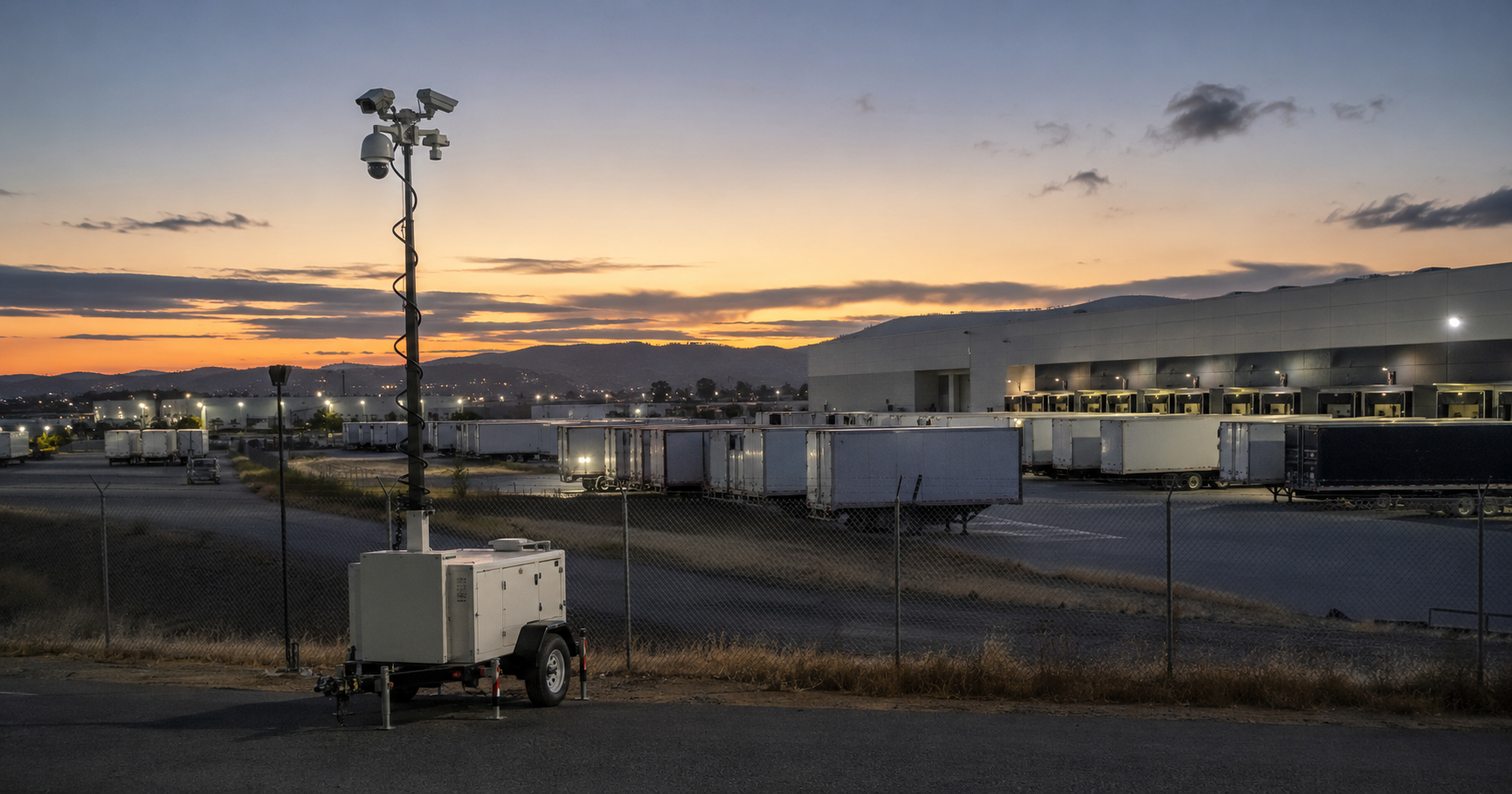
For dock areas, video coverage adds three things. It provides visibility into movement near doors, staged pallets, parked trailers, and yard tractors. It gives the SOC or monitoring team a live view for verification. It creates usable incident footage if a site contact, guard, carrier, or law enforcement partner needs to understand what happened.
This is where 24/7 remote monitoring matters. The work is not just camera uptime. It is detection logic, event review, site-specific escalation, and communication with the right person or agency. Hawk’s process page describes monitored workflows that can include escalation paths, alarm logic, reporting cadence, live verification, point-of-contact alerts, and dispatch coordination depending on the chosen monitoring tier. (Hawk Surveillance Systems)
For operators comparing coverage models, Hawk’s related guide on NorCal logistics yard security is the natural next read. The operating principle is the same: fixed cameras belong at stable chokepoints, mobile trailers belong where risk moves, and guards should be assigned to the parts of the process that require human judgment.
Integration also matters. Most modern trailer programs can work with warehouse security teams through VMS or SOC workflows. ONVIF Profile S is designed for IP-based video systems, including devices that send video over an IP network and clients such as VMS platforms that configure, request, and control video streaming. (ONVIF) For a warehouse operator, the practical question is simple: can the trailer feed, alerts, user permissions, retention policy, and response path fit the current SOC stack?
Bay Area logistics corridor, placement considerations by area
In brief: Placement should follow local yard geometry, approach roads, fence exposure, and dock activity, not just a generic camera-count formula.
Oakland-area logistics sites sit near a port and airport environment with dense industrial traffic. The Port of Oakland reported 179,580 TEUs handled in December 2025 and 2,253,976 TEUs for the full calendar year, which reinforces the scale of freight movement around the region. (Port of Oakland) For an Oakland warehouse, trailer placement should prioritize fence-line approaches, empty chassis zones, yard tractor parking, and back-lot corners that are not visible from gate cameras. Operators looking at local coverage can start with Oakland surveillance trailer rental for site-specific planning.
Hayward and Union City yards often have long industrial parcels, multiple tenant neighbors, and truck courts that wrap around buildings. Placement should account for property-line exposure, shared drives, side-lot trailer staging, and dock areas where lighting is uneven after hours.
Fremont and Newark sites often mix logistics, manufacturing, tech supply chain, and contractor traffic. That creates a different placement issue: the yard may not look like a classic freight terminal, but high-value inventory, equipment, and vehicles may still move through exterior staging zones. A mobile trailer can watch temporary overflow areas without waiting for permanent camera construction. South Bay operators facing the same contractor traffic and material-theft exposure can compare jobsite tactics in our guide to construction site security in San Jose.
Tracy and Stockton fringe sites may have more land, larger yards, and longer dark perimeters. Coverage planning should focus on distance, line of sight, trailer movement, cellular signal, access-road conditions, and whether multiple trailers are needed to create overlapping visibility.
The common rule across all four areas is to place trailers by activity and sightline, not by map symmetry. A beautiful overhead layout can still fail if the mast view is blocked by parked trailers, if the camera is pointed at a low-risk edge, or if the response path is unclear.
Deployment workflow for multi-acre Bay Area yards
In brief: A strong deployment workflow starts with a site walk, assigns each trailer to a risk area, confirms monitoring workflow, and phases rollout around live operations.
Single-unit commissioning is often a rapid process when access, placement, power, connectivity, and monitoring scope are already prepared; for larger rollouts, the right standard is phased coverage, not rushed placement. Hawk’s process notes that lead time depends on trailer availability, site location, and deployment complexity, and that standard Northern California rentals can often move quickly once scope and access are confirmed. (Hawk Surveillance Systems)
The workflow starts with a site walk. This can be physical or remote, but it has to map real conditions: gate flow, dock activity, trailer rows, fencing, lighting, camera obstructions, cellular conditions, and access limitations. For multi-acre yards, the output should be a placement plan that assigns each trailer to a specific risk area.
Next comes commissioning. Hawk’s rental process describes delivery, trailer positioning, mast raise, camera configuration, and power and connectivity verification. (Hawk Surveillance Systems) That is the minimum baseline before monitoring can be trusted.
For multi-trailer rollouts, phasing matters. Do not drop units only where parking is easy. Start with the highest-risk perimeter gaps, then add dock-adjacent angles, trailer-row views, and remote back-lot coverage. As operations shift, adjust the placement rather than letting the trailer become a fixed camera by habit.
Monitoring tier selection should happen before the trailer goes live. Decide whether the warehouse wants self-monitored alerts, active video monitoring, voice-down, site-contact escalation, dispatch coordination, reporting cadence, or a hybrid. The right answer depends on site hours, guard presence, SOC staffing, and how quickly an on-site contact can respond after hours.
Hawk’s how we deploy process gives operations teams a structured way to move from site risk to trailer placement, and deployment & project services are the practical fit when a yard has multiple risk areas, multiple units, or changing logistics phases.
Frequently asked questions
In brief: The strongest Bay Area warehouse perimeter security plans combine fixed cameras, mobile trailers, monitoring, and selected guard presence by risk area.