

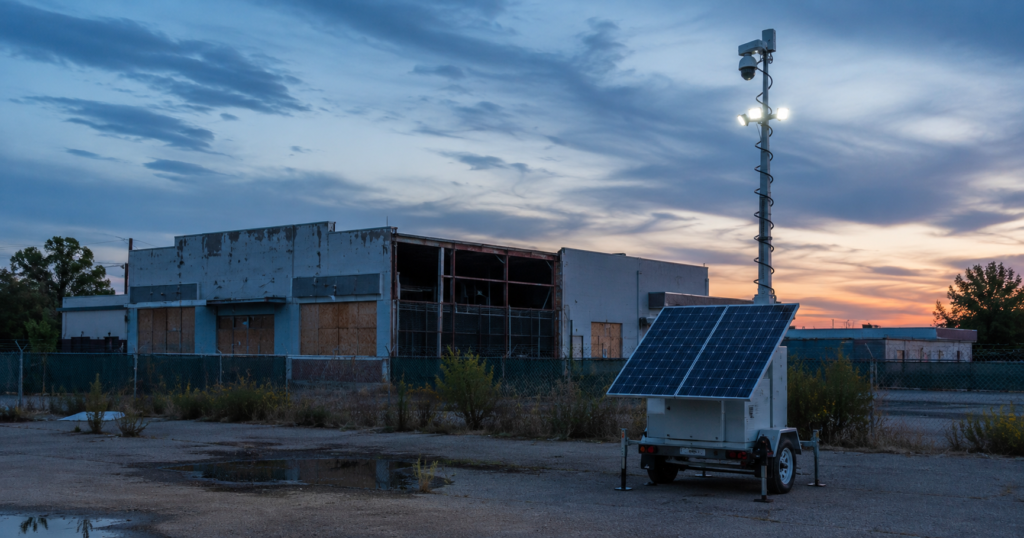
Vacant Property and Demolition Site Surveillance in Northern California: Stopping Theft, Squatting, and Liability in 2026
Last updated: July 2026 | Reviewed by: Noah Williams, Security Solutions Specialist, Hawk Surveillance Systems
Vacant properties and demolition sites in Northern California face three recurring operational risks: unauthorized entry, material theft, and liability exposure. For developers, asset managers, lenders, and property owners, the challenge is maintaining visibility over a non-operational site without maintaining a permanent security presence. Mobile surveillance systems offer a rapid, flexible option that can be deployed without permanent installs, operate without utility service, and create documented monitoring records that support insurance, code-enforcement, and incident-response efforts. For many sites, a properly positioned surveillance trailer fills the gap between expensive guard coverage and fixed-camera systems that require infrastructure.
Why vacant property and demolition sites are 2026 NorCal liability magnets
In brief: Vacant sites create exposure because activity continues even when operations stop. Theft, trespassing, vandalism, and liability claims can occur long before an owner becomes aware of the issue.
Vacant properties often remain attractive targets because they contain valuable materials, have reduced oversight, and frequently experience perimeter degradation during extended inactive periods.
For stalled construction projects, copper wiring, HVAC equipment, fixtures, electrical components, fencing materials, and stored construction supplies may remain on-site for weeks or months. These conditions mirror many of the risks discussed in Hawk’s guide to construction jobsite security (https://hawksurveillancesystem.com/industries/construction-jobsite-security/) and the growing concerns surrounding Bay Area copper-wire theft (https://hawksurveillancesystem.com/blog/copper-wire-theft-bay-area-construction-sites-2026/).
Stalled-site theft exposure
Common theft targets include:
Copper wiring and conduit
Electrical panels
HVAC components
Plumbing fixtures
Temporary generators
Fuel storage
Construction materials
Unlike active projects where crews arrive daily, vacant sites may go days before anyone notices missing materials.
Squatting and encampment concerns
Vacant commercial buildings, former industrial facilities, and multi-family redevelopment properties can attract unauthorized occupants. The longer an intrusion remains undetected, the more complex property management, cleanup, and legal coordination become.
The operational concern is not simply occupancy. Property owners often face:
Property damage
Fire hazards
Sanitation issues
Insurance complications
Neighbor complaints
Code-enforcement attention
Liability during inactive periods
Even when no theft occurs, liability exposure remains.
Visitors, trespassers, contractors, inspectors, or members of the public can access unsecured areas through perimeter gaps, damaged fencing, or open structures. Municipalities throughout California continue to maintain nuisance-abatement and property-maintenance enforcement programs for vacant buildings and lots. (Santa Rosa)
Insurance reality for vacant assets
Many property policies include vacancy-related limitations or exclusions after a defined period of non-occupancy. The Insurance Information Institute notes that vacancy clauses commonly limit or exclude coverage after 30 to 60 consecutive days because vacant properties face elevated theft, vandalism, and liability risks. (Triple-I Blog)
For owners carrying vacant-property or specialty coverage, documented security measures become increasingly important.
What insurance carriers actually require for vacant-property security
In brief: Insurance carriers generally want evidence that a vacant property remains actively managed, inspected, and secured throughout the vacancy period.
Many owners discover that insurance expectations change significantly once a property becomes vacant.
A useful distinction exists between standard property coverage, vacant-property coverage, demolition-phase coverage, and builders-risk policies.
Insurance providers commonly evaluate:
Site security measures
Inspection frequency
Property maintenance
Vacancy duration
Documentation quality
Incident-response procedures
Standard vacant-property exclusions
The Insurance Information Institute and vacancy-insurance guidance consistently identify theft, vandalism, unauthorized occupancy, and undetected damage as primary concerns for vacant properties. (Triple-I Blog)
Many policies include vacancy thresholds that trigger additional requirements or reduced coverage.
Monitoring and inspection expectations
Property owners are frequently expected to demonstrate:
Regular site inspections
Secured access points
Perimeter maintenance
Prompt response to incidents
Ongoing property oversight
Documentation matters
When an incident occurs, documentation can become as important as the security system itself.
Video records, detection logs, inspection reports, maintenance records, and monitoring activity can help establish that a property remained actively managed rather than abandoned.
Vacant-property coverage versus demolition coverage
Properties awaiting redevelopment often transition between multiple insurance categories.
Owners should coordinate closely with their broker regarding vacancy status, demolition activity, and redevelopment timelines. Hawk’s article on builders-risk insurance (https://hawksurveillancesystem.com/blog/surveillance-trailers-builders-risk-insurance-california/) provides additional context regarding project-phase risk management.

“The objective is not simply recording incidents. The objective is maintaining documented oversight of a property during periods when nobody is physically present.”
How mobile surveillance reduces vacant-property liability
In brief: Mobile surveillance provides visibility, documentation, deterrence, and response capability without requiring permanent infrastructure.
A properly deployed surveillance system addresses multiple operational challenges simultaneously.
The most important benefit is often not the camera itself. It is the combination of detection, documentation, and response.
Active monitoring documentation
Video monitoring creates records showing that a property owner maintained active oversight.
These records may include:
- Detection events
- Operator activity logs
- Video clips
- Response records
- Maintenance records
For owners managing multiple properties, this documentation can support discussions with insurers, municipalities, and lenders.
Trespass deterrence and early intervention
Visible camera masts create a deterrent effect before an incident escalates.
When paired with 24/7 remote monitoring (https://hawksurveillancesystem.com/solutions/remote-monitoring/), suspicious activity can be identified during the earliest stages of intrusion.
This matters because early intervention is usually less disruptive than addressing an established encampment or large-scale theft loss.
Evidence for code enforcement and law enforcement
Video evidence supports:
- Incident verification
- Timeline reconstruction
- Property-damage investigations
- Trespass documentation
- Enforcement coordination
For long-duration vacant properties, maintaining accurate records can simplify communications with local authorities.
No utility account required
One of the strongest advantages for vacant-property deployments is the ability to operate without grid infrastructure.
An off-grid solar surveillance trailer (https://hawksurveillancesystem.com/products/solar-surveillance-trailer/) carries its own power generation and battery storage, allowing deployment where utilities have been disconnected or were never available.
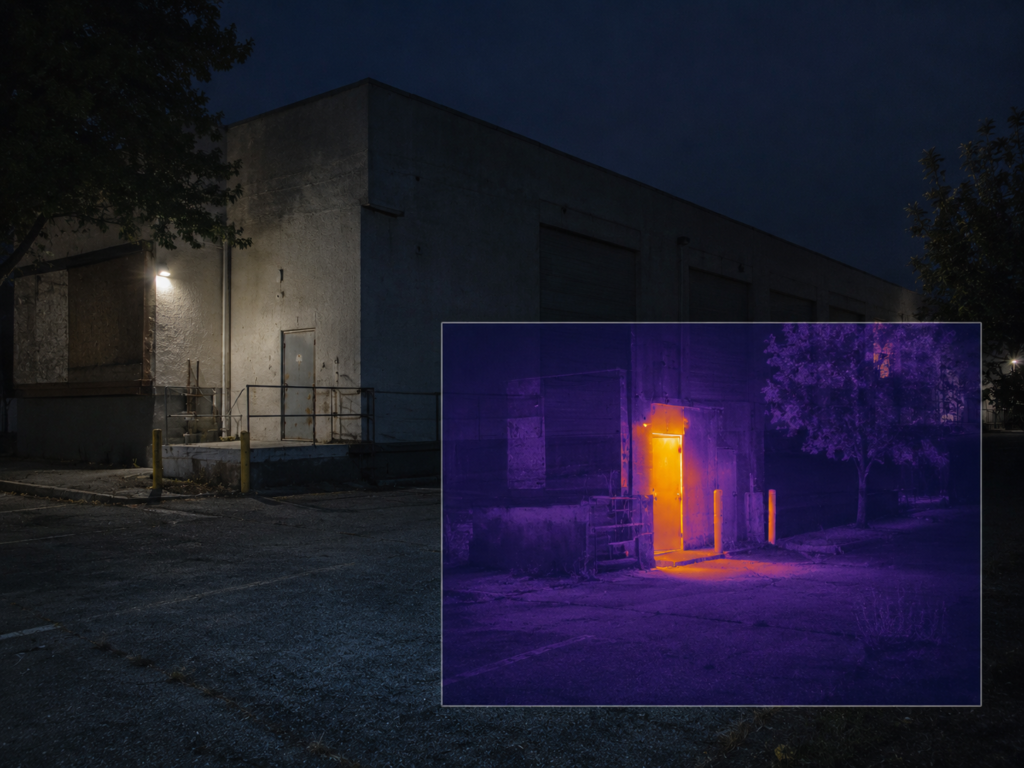
Compared with fixed-camera systems that require permanent installation and utility service, mobile systems can be relocated as risk areas change.
Compared with guards, they provide continuous visibility without staffing a post around the clock.
That flexibility is one reason many owners choose mobile deployment over national providers that focus primarily on standardized fixed deployments. Hawk’s Northern California focus emphasizes rapid deployment, local support, and practical trailer-versus-guard-versus-fixed-camera solutions for vacant assets.
Three deployment scenarios for vacant and demolition properties
In brief: Different property types create different surveillance priorities, but all benefit from visibility over perimeter gaps and after-hours activity.
Scenario A: Stalled construction site
Common concerns include:
- Copper theft
- Material theft
- Equipment tampering
- Fence breaches
- Weekend intrusion
Surveillance placement typically focuses on access points, material staging areas, and perimeter vulnerabilities.
Scenario B: Post-demolition holding period
Following demolition, a property often remains inactive while permits, financing, environmental review, or redevelopment planning continues.
Risk priorities include:
- Illegal dumping
- Unauthorized access
- Equipment theft
- Property damage
- Liability claims
Open lots frequently require broad visibility across large areas rather than detailed monitoring of individual structures.
Scenario C: Vacant commercial or multi-family redevelopment property
For redevelopment projects, owners often need visibility over:
- Entrances
- Parking areas
- Rear service corridors
- Loading areas
- Building access points
Monitoring helps identify activity before property conditions deteriorate or neighborhood complaints increase.
Code enforcement coordination and neighbor relationships
In brief: Successful vacant-property management depends on communication as much as technology.
Many Northern California jurisdictions maintain programs addressing vacant buildings, nuisance properties, abandoned structures, or maintenance concerns. Examples include registration and inspection programs adopted by cities such as Santa Rosa and Alameda. (Santa Rosa)
Working with code enforcement
Property owners benefit from proactive communication.
Recommended practices include:
- Maintaining current contact information
- Responding quickly to notices
- Documenting inspections
- Addressing perimeter issues promptly
- Demonstrating active site management
Municipal code-enforcement programs generally focus on public safety, nuisance prevention, and property maintenance standards. (El Dorado County)
Neighbor coordination
Neighbors frequently become the first source of incident reporting.
Simple outreach can help establish:
- Reporting channels
- Emergency contacts
- Property-management contacts
- Awareness of active monitoring
This approach often improves incident reporting without creating unnecessary alarm.
Deployment workflow for vacant-property placements
In brief: Effective deployment begins with site assessment, followed by strategic placement and ongoing monitoring tailored to the property’s risk profile.
A successful deployment is typically straightforward.
Site walk and placement plan
The process starts with identifying:
- Access points
- Perimeter gaps
- Blind spots
- Asset concentrations
- High-risk areas
The objective is maximizing visibility rather than simply maximizing camera count.
Less than 24-hour commissioning
Mobile systems can often be positioned and commissioned rapidly because they avoid trenching, utility coordination, and permanent construction.
This makes them particularly useful for properties that become vacant unexpectedly.
Long-duration deployment options
Many vacant-property projects remain inactive for months.
Long-term deployments commonly include:
- Preventive maintenance visits
- System health checks
- Battery verification
- Camera inspections
- Connectivity testing
Self-monitor versus active monitoring
Self-monitoring routes alerts directly to the owner or manager.
Active monitoring routes alerts to trained operators who can evaluate events and coordinate response when needed.
For high-value assets, large redevelopment projects, or sites with recurring after-hours activity, 24/7 remote monitoring (https://hawksurveillancesystem.com/solutions/remote-monitoring/) often provides faster response and more complete incident documentation.
Property owners interested in a surveillance trailer rental (https://hawksurveillancesystem.com/solutions/surveillance-trailer-rental/) can also review how we deploy (https://hawksurveillancesystem.com/company/process/) to understand site assessment, placement planning, commissioning, and ongoing support.

Frequently asked questions
What is the biggest risk at a vacant property in Northern California?
Copper and fixture theft, squatting, and liability exposure are the three dominant risks at NorCal vacant properties in 2026. Stalled construction sites with material left on-site are particularly vulnerable to copper theft. Vacant commercial and multi-family buildings face squatting and after-hours intrusion that creates legal and insurance complications.
Does insurance require security at vacant properties?
Most vacant-property insurance policies in California have specific monitoring, inspection, and maintenance requirements, and many include reduced coverage or exclusions for losses that occur after a property has been vacant beyond a defined threshold, commonly 60 to 90 days. Active video monitoring with documented detection records can support claim eligibility.
Can mobile surveillance trailers be deployed at a property with no power?
Yes, off-grid solar surveillance trailers carry their own solar panels and battery storage, requiring no grid connection and no utility account. This is one of the main reasons they fit vacant-property deployments where grid power has been disconnected or never existed.
How do mobile surveillance trailers help with squatting prevention?
Trailers provide visible deterrence through an elevated camera mast and 24/7 active monitoring that detects intrusion before squatters become established. Active video monitoring routes detections to operators who can initiate response, including warnings and coordination with authorities, before costly legal removal processes become necessary.
How long can a mobile surveillance trailer be deployed at a vacant property?
Do I need 24/7 monitoring or can I self-monitor my vacant property?
Both options work, depending on your situation. Self-monitoring routes detection alerts to your mobile device for review, resulting in lower monthly cost but potentially slower response. Active monitoring uses trained operators who can initiate response quickly, providing real-time intervention for vandalism, theft, and unauthorized entry.
Vacant properties and demolition sites do not need to remain unmanaged simply because operations have paused. With rapid deployment, flexible placement, and operation without permanent installs, mobile surveillance gives owners visibility across high-risk areas while supporting insurance, compliance, and redevelopment objectives. To discuss a deployment strategy for your property, Request a quote or Talk to a Security Specialist.
Request a quote or Talk to a Security Specialist to discuss logistics hub security requirements for your Central Valley facility.