
Reviewed by Noah Williams, Security Systems Specialist
Central Valley logistics hubs continue to expand along the Sacramento, Stockton, Tracy, Lathrop, and Manteca corridor, creating larger yard footprints, more trailer inventory, and greater demand for after-hours visibility. For logistics operators managing multi-acre facilities, mobile surveillance has become a practical way to address perimeter gaps, trailer-row visibility challenges, and changing yard layouts without permanent installs.
Organizations evaluating a surveillance trailer rental program are increasingly comparing mobile systems against traditional guard-only coverage and fixed-camera deployments. In many Central Valley environments, the most effective approach combines all three.
Why the Central Valley logistics corridor faces 2026 cargo theft risk
In brief: The Central Valley’s rapid logistics expansion has created larger facilities, longer perimeters, and more trailer inventory that must be monitored after hours.
The Sacramento-Stockton-Tracy logistics corridor is one of the most important freight distribution regions in Northern California. Positioned between Bay Area ports, inland warehousing networks, interstate freight routes, and major population centers, the corridor supports a substantial volume of goods movement throughout the western United States.
Several factors continue driving growth:
- Expansion of distribution facilities near I-5
- Continued warehouse development in Tracy and Lathrop
- Regional growth around Stockton logistics parks
- Increased freight movement connecting Northern California markets
- Greater demand for large-format trailer storage yards
According to the California Department of Transportation, the I-5 corridor remains one of California’s most critical freight movement routes. Logistics operators benefit from transportation access, but the same accessibility can also create operational security challenges.
Large yards frequently contain:
- Loaded trailers
- Empty trailer inventory
- Containers awaiting transfer
- Equipment staging areas
- Fleet vehicles
- Temporary storage zones
These environments differ significantly from smaller warehouse facilities. Security teams must monitor extensive fence lines, multiple access points, trailer rows, and operational areas simultaneously.
For many operators, this is where specialized logistics and warehouse security becomes necessary:
Cargo theft patterns and access corridors
Cargo theft does not always involve large-scale theft events. In many cases, operational losses stem from:
- Unauthorized yard entry
- Trailer tampering
- Equipment theft
- Fuel theft
- Fence-line breaches
- Opportunistic after-hours activity
The Central Valley’s transportation network creates numerous ingress and egress routes connecting distribution facilities to regional highways. Facilities positioned near interstate connectors often require broader situational awareness than fixed gate cameras alone can provide.
How Central Valley logistics security differs from Bay Area facilities
Bay Area distribution environments often face urban constraints, tighter footprints, and more established camera infrastructure.
Central Valley facilities frequently present different conditions:
- Larger acreage
- Longer trailer rows
- Fewer permanent surveillance assets
- Ongoing yard reconfiguration
- Expansion phases occurring during active operations
These characteristics create coverage challenges that cannot always be solved with additional fixed cameras alone.
Where guards and fixed cameras leave gaps at Central Valley yards
In brief: Guards and fixed cameras remain important, but both have limitations when applied across large logistics yards with changing layouts.
A single guard cannot continuously observe every corner of a multi-acre distribution facility.
Likewise, a fixed-camera system can only see where cameras have been installed.
This creates the operational challenge many logistics managers face: maintaining visibility across expansive yard environments while controlling security costs and preserving flexibility.
The question is rarely guards versus cameras. The real question is how to maintain visibility across large trailer yards where neither solution alone can see everything.
Guard coverage limitations
Guards provide valuable functions such as:
- Access control
- Visitor management
- Patrol response
- Incident verification
However, even highly capable guard programs encounter physical limitations.
A single officer can only observe a small percentage of a large yard at any given time. Trailer rows, equipment stacks, and long fence lines can quickly reduce line-of-sight visibility.
As facilities grow, maintaining full visual coverage through patrols alone becomes increasingly difficult.
Fixed-camera limitations
Fixed systems remain essential for:
- Gate monitoring
- Dock surveillance
- Building entrances
- Access control points
Yet fixed infrastructure faces challenges in logistics environments because yard layouts evolve.
Common issues include:
- New trailer storage areas
- Temporary overflow lots
- Construction activity
- Seasonal inventory changes
- Expanded fleet parking
When operations shift, camera coverage may no longer align with risk areas.
Comparison of common logistics security approaches
Security Method | Primary Strength | Primary Limitation | Best Use Case |
Guards | Human response and verification | Limited visual coverage | Gates, patrols, visitor management |
Fixed Cameras | Consistent monitoring of known locations | Cannot move with yard changes | Buildings, docks, entry points |
Mobile Surveillance Trailers | Flexible elevated coverage | Requires placement planning | Trailer rows, perimeter gaps |
Hybrid Program | Broadest visibility and response capability | Requires coordination | Large logistics facilities |
National providers such as WCCTV, Pelco, SentraCam, and Joint Power Security offer mobile solutions, but Central Valley operators often prefer regional support models that understand local logistics environments and can respond quickly as yard conditions change.
For Northern California facilities, the value proposition centers on flexibility, rapid deployment, and coverage of perimeter gaps without permanent installs.
What mobile surveillance trailers cover at a Central Valley logistics hub
In brief: Mobile surveillance trailers provide elevated visibility over trailer rows, perimeter areas, and changing yard layouts that fixed systems may not cover efficiently.
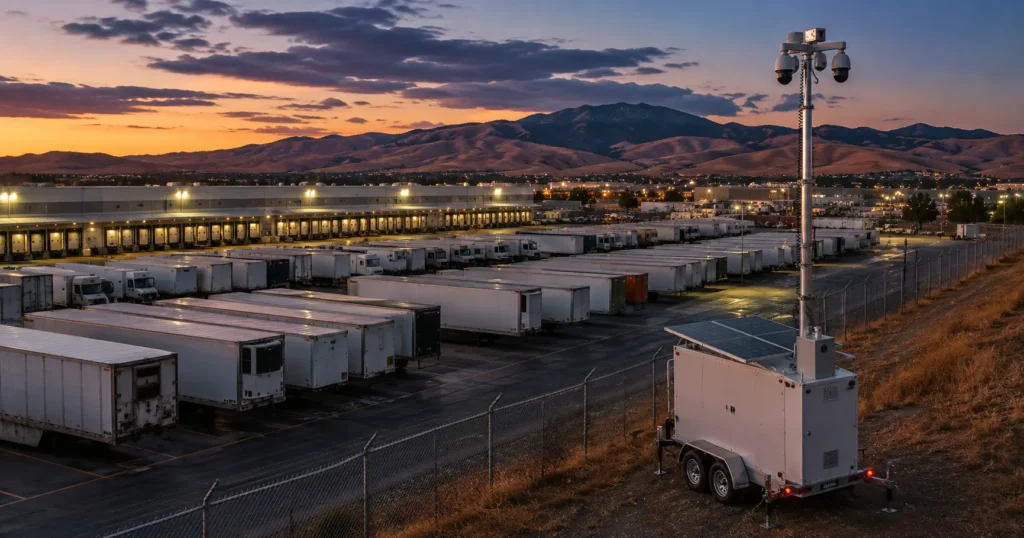
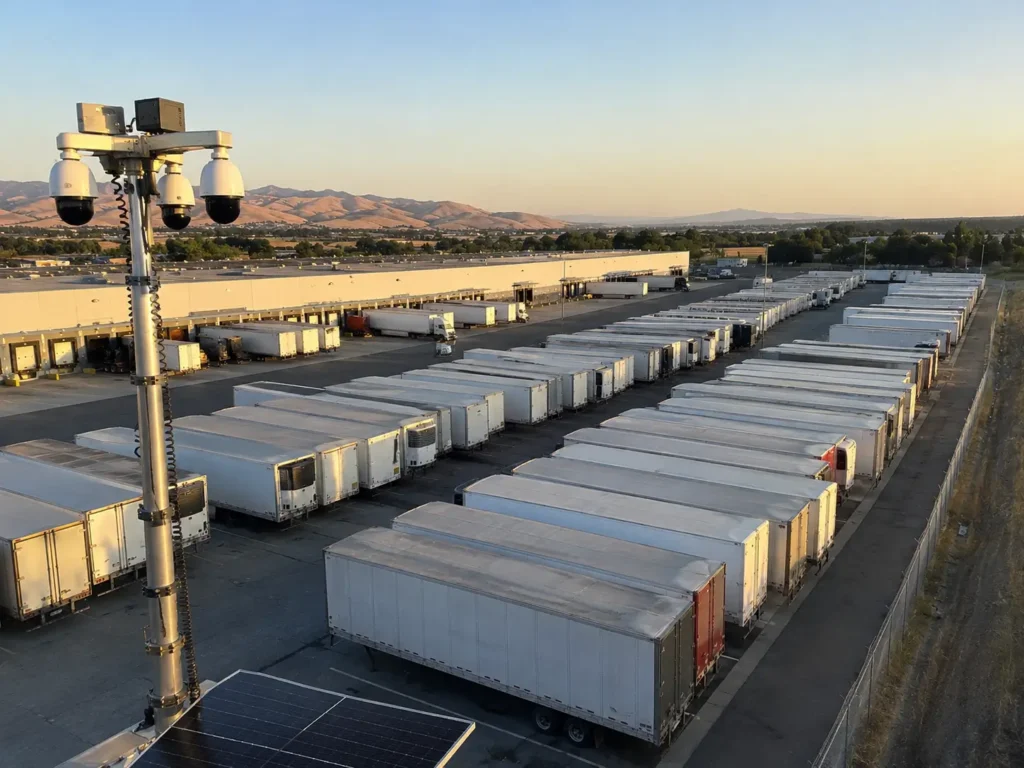
A properly positioned mobile surveillance trailer can significantly improve visibility across a distribution yard.
Unlike fixed infrastructure, mobile units can be repositioned as operations evolve.
The core objective is simple: create better visibility into areas where traditional surveillance approaches struggle.
Elevated mast visibility
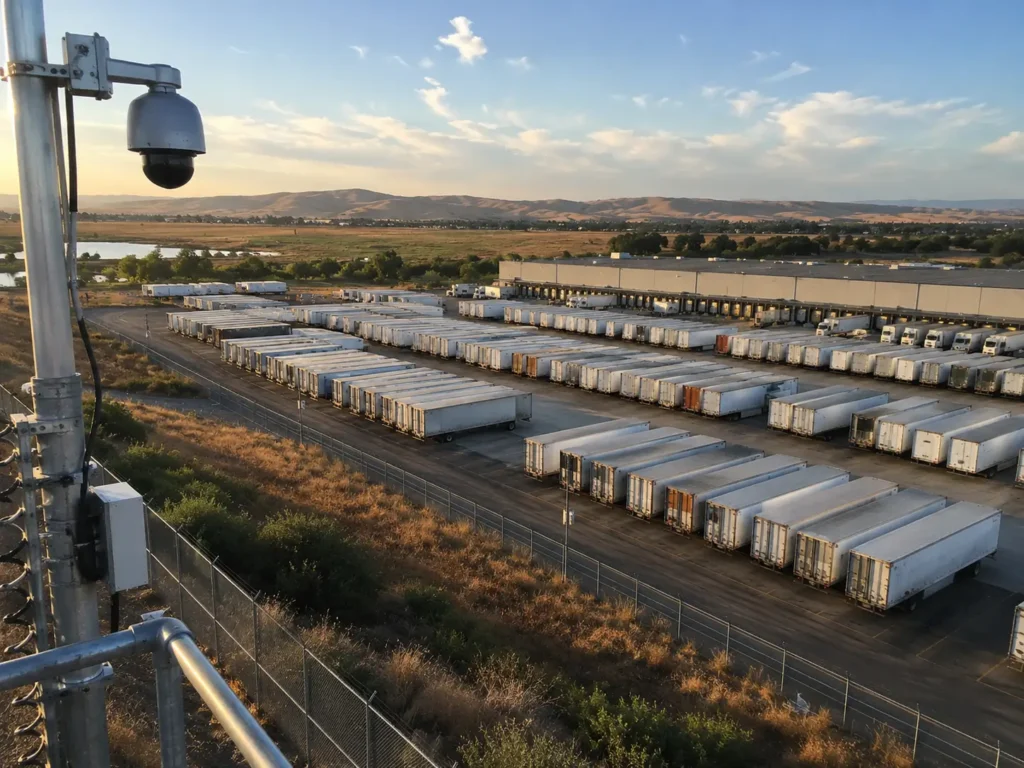
The primary advantage of a mobile trailer is elevation.
An elevated mast can see:
- Over trailer rows
- Across storage zones
- Along fence lines
- Into staging areas
- Across large open yards
This additional viewing angle often reveals areas hidden from conventional camera installations.
Off-grid operation
Many Central Valley logistics environments include areas where utility access is limited or impractical.
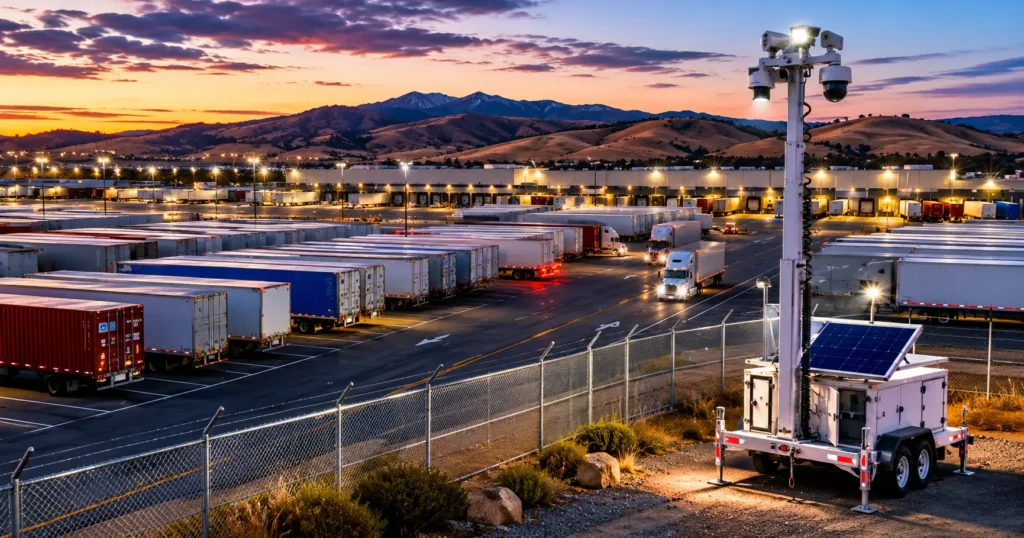
A heavy-duty industrial surveillance trailer can be deployed in locations where permanent infrastructure would require substantial installation work:
Off-grid capability allows operators to protect temporary or expanding operational areas without waiting for construction or utility upgrades.
24/7 monitoring and awareness
Many logistics operators supplement on-site security with 24/7 remote monitoring:
Remote monitoring teams can review alerts, assess activity, and escalate according to site-specific procedures.
This approach helps maintain visibility after hours while reducing dependence on continuous physical patrol coverage.
Repositioning as yard layouts change
One of the most practical benefits of mobile systems is adaptability.
When:
- Trailer inventory expands
- Construction begins
- Storage areas move
- Seasonal operations shift
The surveillance asset can move with the operation.
That flexibility is difficult to achieve with permanent camera infrastructure alone.
Specific Central Valley city patterns
In brief: Each logistics submarket presents different operational conditions, but all require scalable visibility across large outdoor environments.
The Central Valley logistics corridor is not a single market. Sacramento, Stockton, Tracy, Lathrop, and Manteca each have distinct development patterns, freight flows, and yard configurations.
Understanding those differences helps security teams deploy resources more effectively.
Sacramento area
Sacramento logistics facilities often combine:
- Regional distribution operations
- Government supply chains
- Food and beverage distribution
- Last-mile fulfillment
- Industrial warehousing
Many facilities feature multiple structures connected by extensive outdoor yard space. Security teams frequently need visibility across parking areas, trailer storage zones, and perimeter fencing spread across large footprints.
Organizations evaluating a Sacramento surveillance trailer rental program often focus on rapid deployment around expansion projects, temporary storage zones, and changing operational layouts.
Stockton and Lathrop
Stockton and Lathrop continue to attract major warehouse and distribution investment because of their strategic location between Bay Area ports and inland markets.
Common operational characteristics include:
- Large trailer storage areas
- High trailer turnover
- Cross-docking operations
- Fleet staging yards
- Multi-building campuses
These facilities often require visibility beyond gate entrances.
Trailer rows can extend hundreds of feet, creating blind spots that become difficult to monitor using traditional fixed-camera layouts.
Operators looking at Stockton surveillance trailer rental options typically prioritize flexible deployment that can move with seasonal inventory and changing yard utilization.
https://hawksurveillancesystem.com/locations/stockton-surveillance-trailer-rental/
Tracy and Manteca
Tracy and Manteca continue to serve as critical logistics gateways connecting Northern California distribution operations with major interstate routes.
Many facilities experience:
- High-tempo operations
- Frequent yard reconfiguration
- Rapid expansion phases
- Temporary overflow storage
- Mixed-use industrial campuses
These conditions favor security programs that can adapt quickly without requiring new trenching, utility work, or permanent infrastructure installation.
For a broader discussion of cargo-theft exposure and logistics-yard visibility challenges, see Hawk’s related article on NorCal logistics yard security:
Integration with logistics VMS / SOC programs
In brief: Modern surveillance trailers are designed to work alongside existing security operations centers rather than operate as isolated systems.
The most effective logistics security programs combine multiple technologies within a single operational framework.
A surveillance trailer should not create another silo.
Instead, it should feed into existing workflows and support established security processes.
RTSP and ONVIF compatibility
Most modern enterprise video systems support:
- RTSP streaming
- ONVIF interoperability
- Centralized recording
- Multi-site viewing
- Event management workflows
This allows mobile surveillance assets to become part of a broader security ecosystem.
Operators can often view trailer cameras alongside:
- Gate cameras
- Dock cameras
- Building cameras
- Access-control systems
from a single interface.
Custom operational workflows
Every logistics operation has different requirements.
Examples include:
- Escalation procedures
- Dispatch protocols
- SOC review workflows
- Incident verification requirements
- Guard notification procedures
Mobile surveillance deployments can be aligned with those workflows so alerts are routed according to established operational practices.
Coordination with on-site guard programs
The strongest programs usually combine:
- Fixed cameras
- Mobile surveillance trailers
- Remote monitoring
- Targeted guard presence
Rather than replacing guards, mobile surveillance helps direct attention toward areas requiring investigation.
This creates a more efficient allocation of resources across large facilities.
Deployment workflow for multi-acre Central Valley yards
In brief: Most deployments begin with a site assessment, followed by strategic placement planning and phased rollout based on operational priorities.
Single-unit deployment is typically 24-48 hours on a prepared site, while larger multi-trailer programs may be phased across multiple operational areas.
Successful deployments generally follow a structured process.
Site walk and placement planning
The first step is identifying:
- Perimeter gaps
- Trailer-row visibility challenges
- Access-road exposure
- High-value storage zones
- Temporary operational areas
The objective is to place equipment where it provides the greatest visibility improvement.
Rapid commissioning
Once placement locations are finalized, deployment can occur quickly.
Because mobile systems operate without permanent installs, organizations avoid many of the delays associated with traditional infrastructure projects.
This supports rapid response to:
- Seasonal demand
- Expansion projects
- Temporary facilities
- Construction activity
- Operational changes
Multi-trailer rollout strategy
Large logistics campuses frequently deploy multiple units.
A phased rollout may include:
Phase 1:
- Main perimeter coverage
- Primary trailer rows
Phase 2:
- Secondary storage areas
- Fleet parking zones
Phase 3:
- Temporary expansion areas
- Additional risk areas
This phased approach allows security coverage to scale alongside operations.
Monitoring tier selection
Monitoring requirements vary significantly between organizations.
Some facilities prefer:
- Local recording only
Others require:
- Live monitoring
- Escalation workflows
- SOC integration
- Guard coordination
Hawk’s deployment & project services team works with operators to determine appropriate deployment models for specific site conditions.
Frequently asked questions
What is the biggest security threat at Central Valley logistics hubs?
Cargo theft and trailer-row intrusion are the dominant threats at Central Valley logistics hubs in 2026, particularly along the I-5 / I-205 / I-580 corridor. Multi-acre yards with long perimeters and high-value trailer inventory create the largest single attack surface in NorCal logistics. Effective programs focus on visibility across trailer rows, perimeter fencing, access roads, and staging areas rather than relying exclusively on gate monitoring.
Why is the Central Valley becoming a logistics security hot zone?
Distribution-center expansion along the I-5/I-205/I-580 corridor (Sacramento, Stockton, Tracy, Lathrop, Manteca) has made the Central Valley one of the fastest-growing logistics regions in the western US. Volume growth has outpaced security infrastructure expansion at many sites, creating coverage gaps that organized cargo theft groups have targeted. Security planning increasingly centers on scalable solutions that can adapt as facilities grow.
Can mobile surveillance trailers cover an entire Central Valley distribution yard?
With proper placement, yes. A single trailer covers a significant arc of perimeter; multi-trailer rollouts on large Central Valley distribution centers can cover full fence-line plus dock and trailer-row areas. Elevated camera masts see into the blind spots fixed cameras miss. Coverage effectiveness depends on yard size, trailer density, layout complexity, and operational requirements.
How do mobile surveillance trailers integrate with existing logistics VMS?
Most modern trailers stream video via standard RTSP or ONVIF protocols and integrate with major VMS platforms. Specifics depend on your SOC stack; Hawk works with operators to confirm compatibility before deployment. This allows security teams to view mobile surveillance feeds alongside fixed cameras and other enterprise security systems through a unified interface.
How fast can a mobile surveillance trailer be deployed at a Central Valley yard?
Single-unit deployment is typically 24-48 hours on a prepared site. Multi-trailer rollouts across a large Sacramento, Stockton, Tracy, or Lathrop facility phase over 1-2 weeks. Site access and existing infrastructure such as gates, traffic routes, and placement locations are the main variables that influence deployment schedules.
Do mobile surveillance trailers replace existing logistics security programs?
No, they complement them. Mobile trailers fill perimeter and trailer-row gaps where fixed cameras don’t reach and where guards can’t cover continuously. Most Central Valley hubs operate a hybrid model consisting of fixed cameras at gates and docks, mobile trailers covering yards and trailer rows, plus selected guard presence where operationally appropriate.
Final thoughts
Central Valley logistics facilities continue to expand across Sacramento, Stockton, Tracy, Lathrop, and Manteca, creating larger yards, longer perimeters, and more complex security requirements. For many operators, the most effective strategy is not choosing between guards, fixed cameras, or mobile surveillance.
Instead, it is building a coordinated program where each solution covers the areas it handles best.
Mobile surveillance trailers provide rapid, flexible visibility for trailer rows, perimeter gaps, and after-hours monitoring without permanent installs, making them a practical addition to modern logistics security operations.
Request a quote or Talk to a Security Specialist to discuss logistics hub security requirements for your Central Valley facility.