

Last updated: August 14, 2026
TL;DR: Live video monitoring means trained operators plus AI analytics watching your cameras in real time, intervening with talk-down audio and strobe lights, and escalating verified incidents to dispatch, unlike record-only cameras that document a crime after it has already happened. Pricing arrives in one of three shapes: a rate per camera, a rate tied to hours watched, or a bundled rate for a monitored trailer rental. Almost no provider publishes rates, so expect a site-specific quote. Hawk bundles concierge-level monitoring with surveillance trailer rentals across Northern California, set up in hours. See how live professional monitoring works.
What live video monitoring actually is (and what it is not)
In brief: Live video monitoring is a service, not hardware: trained operators watch camera feeds in real time and act on what they see, which puts it in a different category from recording cameras that only produce evidence after the fact and from alarm response that reacts to a sensor with no visual confirmation.
Record-only cameras. Cameras write to a recorder or the cloud. Nobody is watching. You find out what happened when you review footage the next morning. That is documentation, and for low-risk sites it is often enough.
Alarm response. A sensor trips and someone calls a contact list or dispatch. There is no picture, so nobody knows whether the trip was a person, a cat, or wind on a gate. False dispatches are this model’s well-known failure mode.
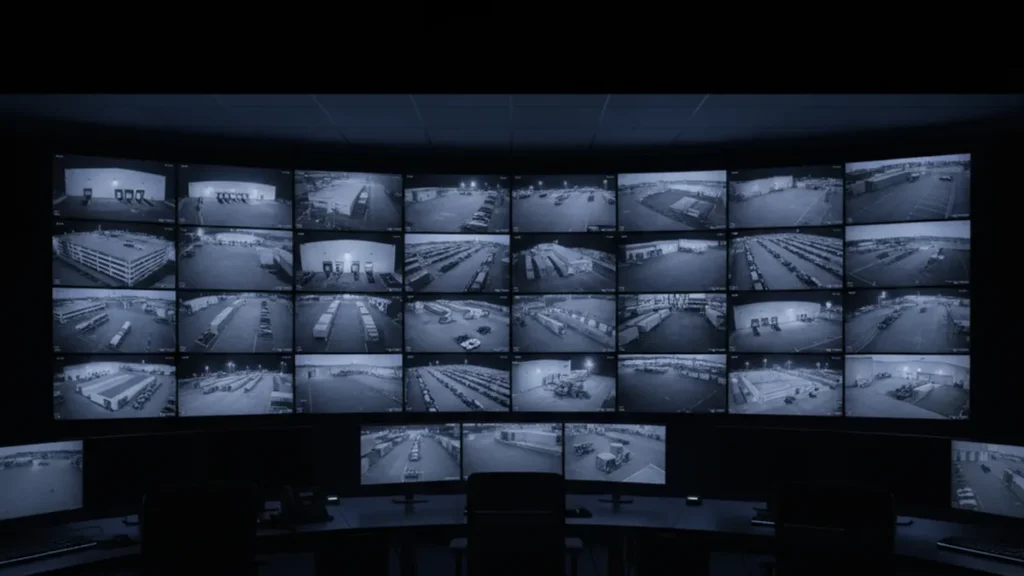
Live video monitoring. Analytics flag an event, a human looks at the actual video, confirms what is on the property, and then acts. That act is the whole point. Jatagan, a Northern California provider, states on its mobile trailer page that its units are monitored from a UL-listed monitoring center in the U.S. and that AI operates as an additional sensor layer while trained human agents actively monitor live video. Machine detection plus human verification is the pattern serious operators describe.
One legal note explains a design choice you will see across the industry. California Penal Code Section 632 makes it an offence to use an electronic recording device to record a confidential communication without the consent of all parties. Because California is an all-party consent state, most site systems run video-first, with one-way warning audio out to the speaker rather than two-way conversation recording.
How it works, step by step
In brief: A monitored event follows the same five-step chain at every competent provider, and understanding that chain is the fastest way to tell a real monitoring service from a company that is quietly reselling motion alerts to your phone and calling it monitoring.
- Analytics flag the event. After hours, AI classifies motion as a person, a vehicle, or neither, inside zones drawn for your site. Wind, animals, and passing headlights are filtered out before a human sees them.
- An operator verifies it visually. A trained agent opens the live feed and confirms what is there. This is what distinguishes monitoring from alerting, and what prevents the false-dispatch problem.
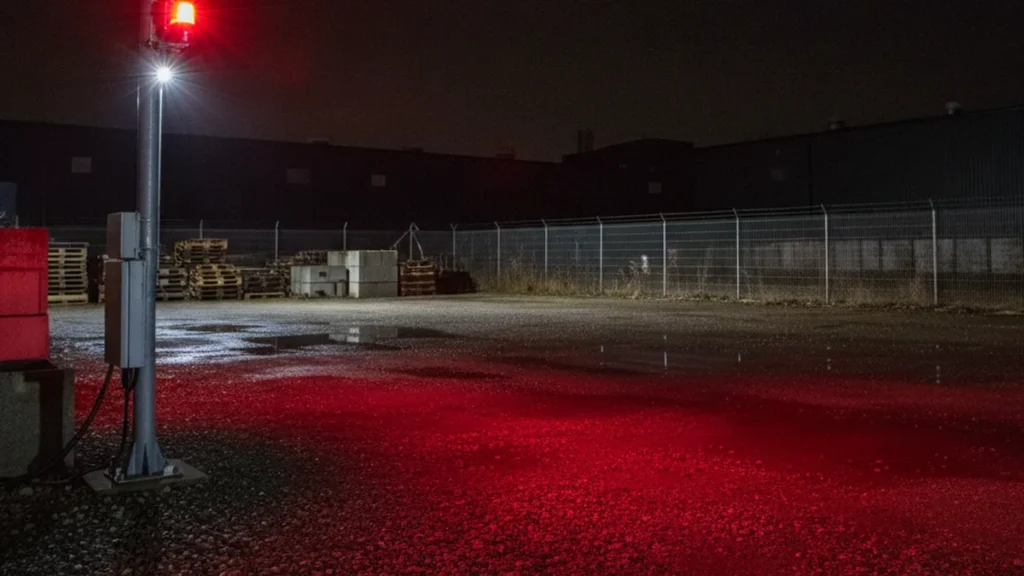
- Talk-down and strobe. The operator speaks over the on-site speaker, describes the person, and tells them police are being called. LED strobes fire. Most incidents end here, which is the economic argument for the service.
- Escalation to dispatch. If the person does not leave, the operator calls law enforcement dispatch and describes the scene live: how many people, what they are doing, where they are on the site.
- Incident report with clips. You get a written record and the video, which is what your insurer, your general contractor, and any claim will want.
None of this needs grid power or a wired network. On a mobile deployment the cameras, analytics, radio, speaker, and strobes run off a solar array and battery bank, with video going out over LTE. That is why a monitored setup can go live on a bare dirt lot in hours.
How live video monitoring pricing works in 2026
In brief: Almost nobody in this industry publishes rates, so the useful thing to understand is not a number but the three pricing models providers actually use, because knowing which model a quote is built on is what lets you compare two proposals that look nothing alike on paper.
Model 1: per camera, per month
A monthly fee for each camera under monitoring. Easy to compare between vendors, and it punishes wide sites, because covering a large yard takes more cameras. Ask what the fee includes: monitored hours, talk-down, video retention, maintenance.
Model 2: per hour of monitored coverage
You pay for watched time rather than devices. Overnight-only coverage costs materially less than 24/7, and for most commercial sites overnight is where nearly all the risk sits anyway. It rewards sites that are staffed during the day.
Model 3: bundled with a trailer rental
One monthly rate covers hardware, power, connectivity, and monitoring. No capital purchase, no installation project, one number on the invoice. This is the model most mobile deployments use, and it is Hawk’s.
Published rates are rare in this market, and where a provider does post one it is quoting its own packaging rather than a market average.
What genuinely moves your quote: camera count, monitored hours, how far the response escalates, site conditions, and contract term. Jatagan states that its mobile trailer contract terms run from three months to long-term agreements, which is typical here. Hawk quotes site by site, usually the same day.
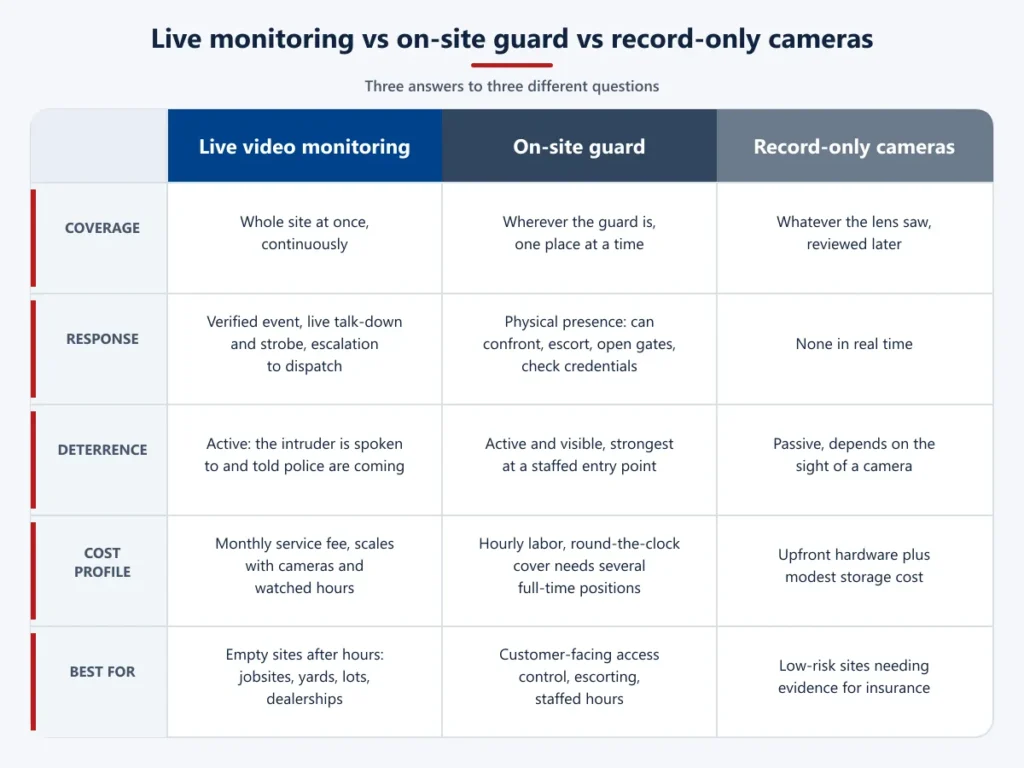
Live monitoring vs on-site guard vs record-only cameras
In brief: The three options are not competitors so much as answers to different questions, and the honest comparison is that a guard wins anywhere a human presence has to touch something physical, record-only wins on low-risk documentation, and live monitoring wins on covering an entire empty site after hours for the money.
| Live video monitoring | On-site guard | Record-only cameras | |
|---|---|---|---|
| Coverage | Whole site at once, continuously | Wherever the guard is, one place at a time | Whatever the lens saw, reviewed later |
| Response | Verified event, live talk-down and strobe, escalation to dispatch | Physical presence: can confront, escort, open gates, check credentials | None in real time |
| Deterrence | Active: the intruder is spoken to and told police are coming | Active and visible, strongest at a staffed entry point | Passive, depends on the sight of a camera |
| Cost profile | Monthly service fee, scales with cameras and watched hours | Hourly labor, round-the-clock cover needs several full-time positions | Upfront hardware plus modest storage cost |
| Best for | Empty sites after hours: jobsites, yards, lots, dealerships | Customer-facing access control, escorting, staffed hours | Low-risk sites needing evidence for insurance |
On cost, arithmetic beats a quoted figure. Covering a site around the clock is 168 hours a week, more than four full-time positions before relief, overtime, benefits, agency overhead, and margin. The U.S. Bureau of Labor Statistics reports a median annual wage of $38,370 for security guards as of May 2024, and an agency bill rate sits above the wage, not at it. That is why a monthly monitoring fee and a round-the-clock guard post are rarely the same order of magnitude, and why many sites use a guard during staffed hours and monitoring overnight. Before you settle that split, it is worth knowing what a virtual guard actually does on shift, because the patrol tours, talk-downs, and escalation calls are what you are buying in place of a posted officer.
Does monitored deterrence actually work?
In brief: The strongest published evidence on this question comes from a systematic review of forty years of CCTV evaluations, and its finding is specific and useful: it is active monitoring, not the presence of cameras, that produces a measurable crime reduction, which is exactly the distinction this article has been drawing.
Piza, Welsh, Farrington and Thomas published “CCTV Surveillance for Crime Prevention: A 40-Year Systematic Review with Meta-Analysis” in Criminology & Public Policy in 2019. Two findings matter for anyone deciding between recording and monitoring. First, actively monitored systems were associated with an approximate 15 percent reduction in crime, while no significant effects were observed for passive systems. Second, the largest effects were in car parks, where CCTV areas saw a crime reduction of roughly 37 percent compared with control areas.
Be careful how far that travels. The review covers public-area CCTV schemes, mostly municipal, not commercial jobsites with talk-down speakers, and there is no good published dataset on monitored mobile trailers. The honest read: the evidence supports the mechanism. An operator who speaks to someone seconds after they cross a fence line interrupts an incident. A recording lets you watch it afterwards.
What monitored coverage looks like on a rented trailer
In brief: On a mobile deployment everything described above arrives as one delivered unit rather than a construction project, which is what makes monitored coverage practical for sites that have a start date, an end date, and no power at the gate.
It starts with a site walk to find where the exposure actually is: the gate, the laydown yard, the fuel and copper, the blind corner behind the stacked materials. Hawk then places a rented surveillance trailer with a telescoping mast carrying PTZ and fixed cameras, running on solar and battery with LTE backhaul. Speaker and strobes go on the mast, and 24/7 remote monitoring and response runs the escalation chain above.
Configuration follows the site. The Mobile Command primary solar trailer suits open jobsites and yards where mast height and camera count matter. The compact urban trailer fits tight lots and infill sites. Both go up in hours. We do the same on construction jobsites, logistics yards, and dealership lots across Northern California, including Sacramento and San Jose.
“The first sixty seconds decide the whole night. Our operator has already looked at the video and knows whether it is a person or a coyote before anyone picks up a phone. Then we talk to them. Nine times out of ten, hearing a live human describe what they are wearing is the end of it.” Paul Wittner, Hawk Surveillance Systems
Still weighing a mobile deployment against permanent cameras? Our comparison of mobile surveillance trailers versus fixed security cameras covers that decision in detail.
Frequently asked questions
What is live video monitoring?
Live video monitoring means trained operators watch your camera feeds in real time, supported by AI analytics that flag motion, people, and vehicles, and then act on what they see. That usually starts with a live voice warning over an on-site speaker and a strobe, and escalates to a call to law enforcement dispatch if the person does not leave. It is different from recording, which only gives you footage to review afterwards.
How much does live video monitoring cost?
Most providers do not publish rates, so pricing arrives as a quote built on one of three models: a monthly fee per camera, a rate tied to how many hours a day the site is watched, or a bundled monthly rate covering a rented trailer plus its monitoring. What moves the number is camera count, monitored hours, how far the response escalates, site conditions, and contract length. Hawk quotes site by site, usually the same day.
Is live video monitoring better than hiring a security guard?
Neither is better in general, they solve different problems. A guard is the right answer when someone has to check credentials, escort staff, open gates, or physically intervene. Live monitoring is the right answer when every corner of an empty site needs watching after hours, because operators cover the whole property at once and one guard cannot. Plenty of sites use a guard by day and monitoring overnight.
How fast do monitoring operators respond to an alert?
AI analytics flag an event within seconds, and an operator then verifies visually before acting, so the honest answer is seconds to minutes depending on what the camera shows. Verification takes time and it is the step that matters, because it separates a person climbing a fence from a raccoon or a shifting shadow. Ask a provider how they verify and how many operators are on shift rather than for a guaranteed response time.
Is live video monitoring worth it?
It pays off fastest on sites with valuable assets sitting outdoors overnight and nobody present: construction sites, equipment yards, logistics lots, dealerships, and utility infrastructure. If your site is low risk and you mainly need footage for insurance, record-only cameras may be all you need, and paying for operators would be waste. The real question is whether you need someone to interrupt an incident or only to document it.
Do video monitoring operators call the police?
Yes, escalation to law enforcement dispatch is a standard part of a monitored service, and it happens after an operator has visually confirmed an actual person or vehicle on the property. The operator can describe what is happening live while the call is in progress: how many people, what they are doing, where they are on the site. Most incidents end before that step, because the voice warning and strobe are enough.
Can live monitoring work with rented cameras?
Yes. A monitored trailer rental is exactly that: hardware, power, connectivity, and monitoring arrive as one service on one monthly rate, with no capital purchase and no permanent installation. Hawk delivers mast-mounted cameras on a solar and LTE trailer, sets it up in hours, and monitors it around the clock. It suits projects with an end date, seasonal exposure, or a site with no permanent infrastructure yet.
Live video monitoring means trained operators watch your camera feeds in real time, supported by AI analytics that flag motion, people, and vehicles, and then act on what they see. That usually starts with a live voice warning over an on-site speaker and a strobe, and escalates to a call to law enforcement dispatch if the person does not leave. It is different from recording, which only gives you footage to review afterwards.
Most providers do not publish rates, so pricing arrives as a quote built on one of three models: a monthly fee per camera, a rate tied to how many hours a day the site is watched, or a bundled monthly rate covering a rented trailer plus its monitoring. What moves the number is camera count, monitored hours, how far the response escalates, site conditions, and contract length. Hawk quotes site by site, usually the same day.
Neither is better in general, they solve different problems. A guard is the right answer when someone has to check credentials, escort staff, open gates, or physically intervene. Live monitoring is the right answer when every corner of an empty site needs watching after hours, because operators cover the whole property at once and one guard cannot. Plenty of sites use a guard by day and monitoring overnight.
AI analytics flag an event within seconds, and an operator then verifies visually before acting, so the honest answer is seconds to minutes depending on what the camera shows. Verification takes time and it is the step that matters, because it separates a person climbing a fence from a raccoon or a shifting shadow. Ask a provider how they verify and how many operators are on shift rather than for a guaranteed response time.
It pays off fastest on sites with valuable assets sitting outdoors overnight and nobody present: construction sites, equipment yards, logistics lots, dealerships, and utility infrastructure. If your site is low risk and you mainly need footage for insurance, record-only cameras may be all you need, and paying for operators would be waste. The real question is whether you need someone to interrupt an incident or only to document it.
Yes, escalation to law enforcement dispatch is a standard part of a monitored service, and it happens after an operator has visually confirmed an actual person or vehicle on the property. The operator can describe what is happening live while the call is in progress: how many people, what they are doing, where they are on the site. Most incidents end before that step, because the voice warning and strobe are enough.
Yes. A monitored trailer rental is exactly that: hardware, power, connectivity, and monitoring arrive as one service on one monthly rate, with no capital purchase and no permanent installation. Hawk delivers mast-mounted cameras on a solar and LTE trailer, sets it up in hours, and monitors it around the clock. It suits projects with an end date, seasonal exposure, or a site with no permanent infrastructure yet.
Talk to a monitoring specialist
If you have a site sitting empty overnight and you are weighing cameras, operators, or a guard, the fastest way through it is a short conversation. We will tell you honestly if record-only would do the job.
Or read the detail on live professional monitored systems, which covers what operators do, what is included, and how monitoring fits an existing security operations center.