
At a glance: California contractors prevent construction equipment and tool theft most effectively with concentric layers: asset marking and registration, tracking, controlled access, secure lockup, lighting, and an active outer layer that can detect and interrupt after-hours activity. Jobsites expose portable tools, small equipment, heavy machinery, trailers, fuel, copper, and staged materials as layouts and work phases change. Guards are strongest at customer-facing access points, while fixed cameras fit permanent indoor or long-term coverage. A monitored mobile trailer fills the changing perimeter gap with elevated views, strobes, speakers, and remote operators. Hawk deploys solar and compact trailers across California, and each unit sets up in hours without permanent installs. Talk to a Hawk Security Specialist for a site-specific plan and California rental pricing.
By Noah Williams | Last updated July 24, 2026
What jobsite theft actually costs California contractors
In brief: California contractors need to budget for more than the replacement price because jobsite theft can remove tools, compact equipment, trailers, fuel, copper, and other materials, then create crew downtime, rental needs, rework, claim administration, and schedule disruption that can outweigh the visible loss.
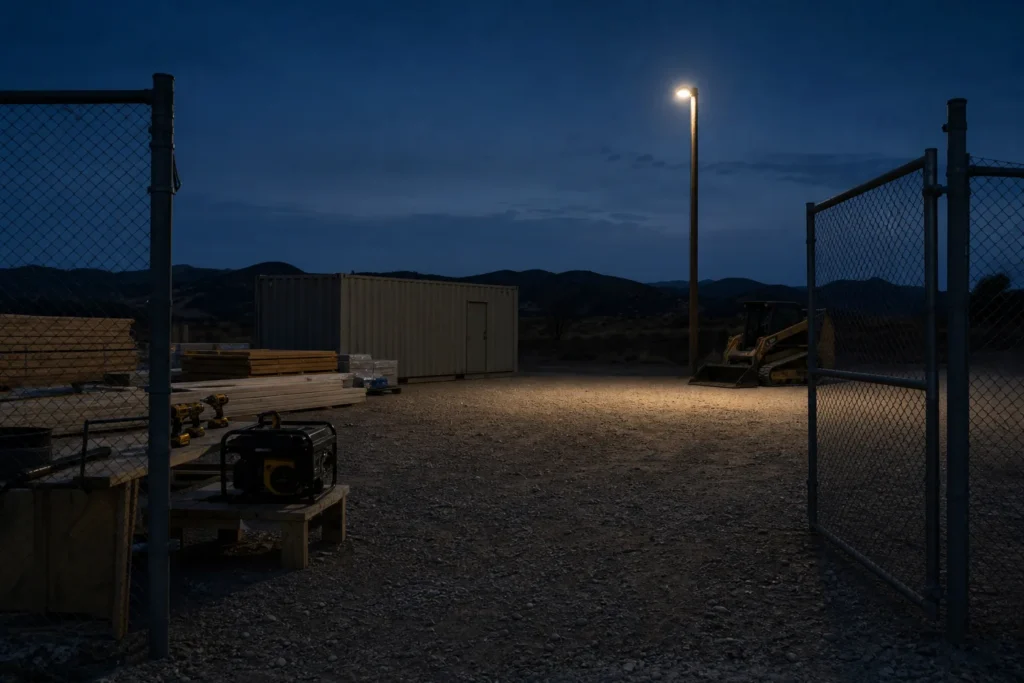
The exposure changes with the project. Early phases may leave skid steers, generators, fuel tanks, and trailers in open areas. Interior work brings cordless tools, wire, pipe, fixtures, and finish materials into concentrated staging zones. The Town of Atherton Police Department says local construction burglaries commonly target tools and copper, and advises contractors to remove valuables when practical, secure and light the site, and use active monitoring when cameras are intended for prevention rather than evidence alone. See the department’s construction burglary prevention guidance.
California data: The California Highway Patrol reported 202,893 stolen vehicles statewide in 2023. Its broad “other vehicles” category, which includes recreational vehicles, construction and farm equipment, and special construction vehicles, accounted for 4.7 percent. CHP also identified Bobcat as the most frequently stolen construction-equipment brand that year. These are statewide vehicle records, not a count of jobsite incidents. Source: CHP 2023 California Vehicle Theft Facts.
Trailer exposure: The same CHP report recorded 9,579 trailer thefts across all uses in California during 2023, with a 55.3 percent recovery rate. The category is broader than construction trailers, but it supports treating towable assets as a separate control point rather than assuming the fence protects them.
Material exposure: California’s Department of Justice reported that, from June through December 2024, the telecom industry logged nearly 6,000 copper-theft and infrastructure-vandalism incidents nationwide, including 1,805 in California. The figure is not jobsite-specific, but it confirms that copper remains an operational asset-protection issue in the state. Source: California DOJ copper wire theft roundtable.
For a deeper breakdown of equipment, tool, fuel, and material exposures, review Hawk’s California construction theft stats. Keep an asset register with serial numbers, photographs, assigned locations, and responsible supervisors. The National Equipment Register theft-reporting guidance says owners should notify law enforcement quickly and can report missing equipment to NER even before receiving a police report number.
Why guards and fixed cameras leave gaps at a jobsite
In brief: Guards and fixed cameras are useful layers, but one guard can work only one post or patrol route at a time, while a permanent camera sees only its installed angles, so a changing jobsite can create perimeter gaps, new obstructions, and uncovered staging zones between security reviews.
A guard genuinely wins where a site needs identity checks, delivery coordination, badge control, visitor assistance, or a visible person at a customer-facing entrance. The tradeoff is a labor-based cost profile and limited simultaneous visibility. A guard at the gate cannot also watch the far laydown yard, fuel island, and back fence at the same moment.
A properly placed trailer can maintain 24/7 remote visibility without guard fatigue.
Fixed cameras win inside a permanent building, at a stable gate, or on a long-term site with reliable power, network paths, and known sight lines. They can provide continuous views without occupying ground space. On a high-tempo jobsite, however, new walls, containers, equipment rows, and material stacks can block an angle. Unmonitored cameras also document an event without initiating a response, a limitation noted in the Atherton Police guidance cited above.
“One guard can manage a gate or patrol route, but an elevated mobile system gives the monitoring team context across the entrance, laydown area, equipment row, and perimeter gaps. That broader view helps us verify activity and apply the right response without treating every movement as an incident.”
Paul Wittner, Hawk Surveillance Systems
How a mobile surveillance trailer protects a jobsite
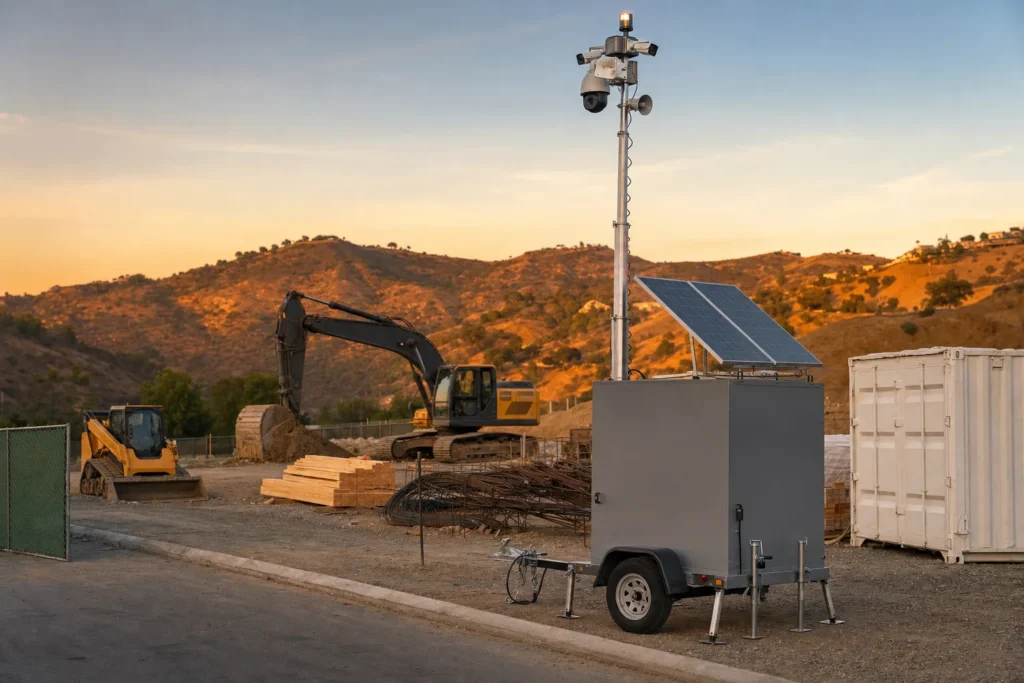
In brief: A monitored mobile surveillance trailer protects a changing jobsite by combining elevated PTZ and fixed-camera views, off-grid solar power, event detection, live operator review, and visible strobe-and-speaker intervention on a platform that can move as entrances, work zones, materials, and perimeter gaps shift.
The trailer works best as the active outer layer in a concentric plan, not as a substitute for basic controls. Start at the asset: mark tools, register heavy equipment, retain serial numbers, and assign custody. Add tracking to selected mobile assets. Lock tools and components in containers or job boxes, secure keys separately, immobilize equipment where appropriate, and maintain gates, fencing, lighting, and access records.
Place the mobile layer outside those controls. An elevated mast can watch an entrance while fixed cameras hold continuous views on equipment or material clusters. Detection rules focus on after-hours movement in defined risk areas. With 24/7 remote monitoring, an operator can review an alert, use a speaker warning or strobe when the situation meets the site’s playbook, notify designated personnel, and escalate for dispatch when required.
National providers such as WCCTV and LVT also document solar power, cellular connectivity, monitoring, and audio-visual deterrence on their mobile units. Hawk’s distinction is operational and local: Northern California placement, site-specific rental support, and concierge-level monitoring aligned with the contractor’s escalation plan. Compare that local fit through Hawk’s construction jobsite security program.
Which Hawk trailer fits
In brief: Hawk’s solar platform is the practical fit for large, open, or power-limited construction sites, while the compact urban platform fits infill projects, narrow access lanes, and space-constrained city jobsites where maneuverability and a smaller ground footprint matter as much as camera reach.
Solar Surveillance Trailer
The solar surveillance trailer pairs a telescoping mast, PTZ and fixed-camera options, solar generation, battery storage, and cellular connectivity. It suits open jobsites, remote access roads, large laydown areas, and early phases without permanent power. Stabilizers support field placement, while the off-grid design avoids trenching and permanent cabling.
Compact Urban Surveillance Trailer
The compact urban surveillance trailer uses a smaller footprint for dense city work, street projects, and sites where fire lanes, traffic paths, neighbors, and limited staging space constrain placement. It retains mobile camera coverage and monitoring options without putting a large chassis in the middle of daily operations.
For regional planning, Hawk also supports Sacramento surveillance trailer rentals for construction, logistics, municipal, and commercial sites across the Sacramento Valley.
Trailer vs guard vs fixed cameras (cost and coverage)
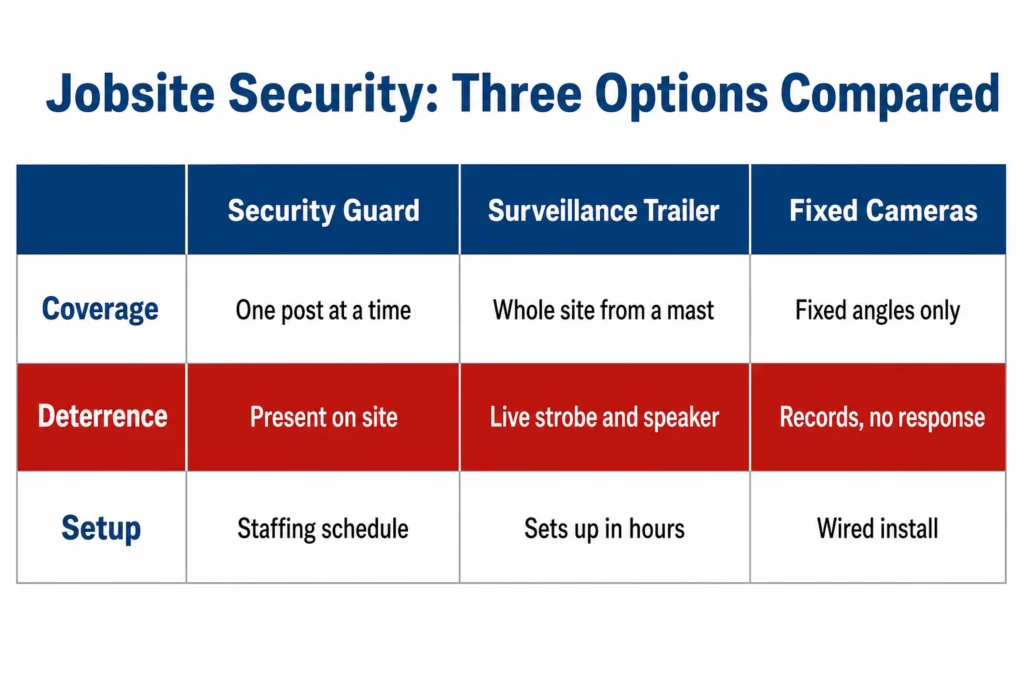
In brief: A monitored trailer is the operational middle path for many changing jobsites because it adds visible, live deterrence across multiple risk areas with a mid-range cost profile, while guards provide the strongest human access control and fixed cameras provide the simplest long-term coverage for stable, powered locations.
| Factor | Mobile surveillance trailer | Physical guard | Fixed cameras |
|---|---|---|---|
| Coverage | Elevated, wide-area views that can move with the job | One post or patrol route at a time | Continuous coverage at installed angles |
| Deterrence | Visible mast, strobe, speaker, and monitored intervention | Strong human presence and direct interaction | Visible recording; no response unless monitoring is added |
| Cost profile | Mid-range rental and monitoring profile | Highest ongoing profile because coverage is staffed | Lowest camera-only upfront profile; installation costs vary |
| Deployment speed | Sets up in hours without permanent installs | Depends on staffing and schedule availability | Requires design, mounting, power, network, and commissioning |
| After-hours | Remote operators can verify and escalate events | Direct response during staffed hours | Records events unless a monitoring service is added |
| Best for | Changing perimeters, open sites, temporary phases, and off-grid areas | Customer-facing access control, visitor management, and staffed gates | Permanent indoor areas, stable entrances, and long-term sites |
The table uses qualitative cost profiles because actual pricing depends on coverage hours, site count, hardware, infrastructure, monitoring, and contract scope. A trailer’s advantage is not that it replaces every guard or camera. It adds guard-like live intervention to a camera platform that can move, which can reduce the number of uncovered zones on a changing site.
Deployment and monitoring
In brief: A sound deployment begins with a site walk and a current plan, then places the trailer where entrances, perimeter gaps, equipment rows, and material storage intersect, verifies views after dark, and connects detection and response rules to named contacts before the system enters after-hours service.
- Map assets and movement. Mark the gate, delivery route, worker parking, laydown zones, fuel, containers, equipment rows, and current obstructions.
- Prioritize risk areas. Decide where identification matters, where detection is sufficient, and which zones change as construction advances.
- Place and stabilize. Position the trailer for useful sight lines without blocking fire access, haul routes, pedestrian paths, or active work.
- Configure and test. Raise the mast, aim PTZ presets and fixed views, confirm solar, battery, connectivity, recording, strobe, speaker, and alert delivery. Standard Hawk units set up in hours, a capability also stated on Hawk’s Northern California utility deployment page.
- Run a night check. Verify lighting, glare, shadow, obstructions, and the detail available at the gate and priority assets.
Hawk’s concierge-level workflow pairs technology with a written escalation tree. Analytics or scheduled patrols surface after-hours activity, an operator verifies the event, and the response follows approved rules: observe, use a strobe or speaker warning where appropriate, contact the site supervisor or guard team, and request dispatch when the defined threshold is met. The trailer can then be repositioned as the job moves from grading to structure, enclosure, interiors, and closeout.
Frequently asked questions
In brief: California contractors most often ask how to combine mobile surveillance and remote monitoring, how trailer cost compares with guard staffing, how much area one unit can cover, whether visible intervention changes behavior, how quickly Hawk can deploy, and when a permanent camera system is the better long-term choice.
How do construction jobsites stop tool, small-equipment, and heavy-machinery theft plus fuel and material theft on jobsites in California?
California jobsites reduce tool, small-equipment, heavy-machinery, fuel, and material theft by combining a monitored mobile surveillance trailer with asset marking, registration, tracking, locked storage, controlled keys, lighting, fencing, and a written response plan that assigns each layer to a responsible person. The trailer supplies the active outer layer, while the other controls make assets harder to remove and easier to identify or recover.
Is a surveillance trailer cheaper than hiring security guards for a jobsite?
A surveillance trailer is usually the lower ongoing-cost option for wide after-hours coverage because one monitored platform can observe several risk areas without staffing every hour, but a quote must compare equal hours, response duties, site conditions, and access-control needs. Guards remain the better fit when a project needs face-to-face screening, credential checks, delivery handling, or customer-facing assistance at a controlled entrance.
Can one mobile trailer cover a jobsite?
One mobile trailer can cover many small or open jobsites when its mast has clear sight lines to the entrance and priority assets, but buildings, earthwork, containers, tall material stacks, long fence lines, and separate gates can require a second position or unit. Hawk confirms coverage through a site plan, field placement, camera aiming, and a night check rather than promising a fixed acreage for every layout.
Do surveillance trailers actually deter tool theft?
A monitored surveillance trailer can deter tool theft by making observation visible and enabling a live response through lighting, a strobe, or a speaker after an operator verifies activity, but it should be paired with locked storage, asset records, and controlled keys. An unmonitored recorder provides evidence, while active monitoring creates the opportunity to interrupt behavior before tools or materials leave the site.
How fast can Hawk deploy a trailer in California?
Hawk’s standard mobile surveillance trailers set up in hours once the unit is on site, access is clear, placement is approved, and the camera, power, connectivity, and response configuration are confirmed, with delivery timing dependent on location, availability, and site complexity. The process avoids permanent poles, trenching, and wired installation, then verifies the system before after-hours monitoring begins across California.
Trailer or fixed cameras for a jobsite: which is better?
A trailer is usually better for a temporary, off-grid, or changing jobsite because it can move with the work and support visible monitored response, while fixed cameras are usually better for a permanent indoor area or stable long-term entrance with reliable power and network service. For a live comparison of how mobile coverage complements permanent systems, review Hawk’s guide to mobile trailers and fixed cameras across a changing perimeter.
Get jobsite theft-prevention pricing
In brief: To price jobsite theft prevention accurately, Hawk needs the site address, current construction phase, approximate footprint, access points, operating hours, priority assets, available power, recent layout, monitoring expectations, and desired start date, then recommends the trailer type, position, response plan, and rental term for the actual site.
Start with Hawk’s mobile surveillance trailer rental options, then send a site plan or address for placement review. You will receive a configuration based on risk areas and perimeter gaps, not a generic camera count.
Talk to a Security Specialist or get California rental pricing for a solar or compact trailer that sets up in hours and moves with the project.