

Last updated: June 2026
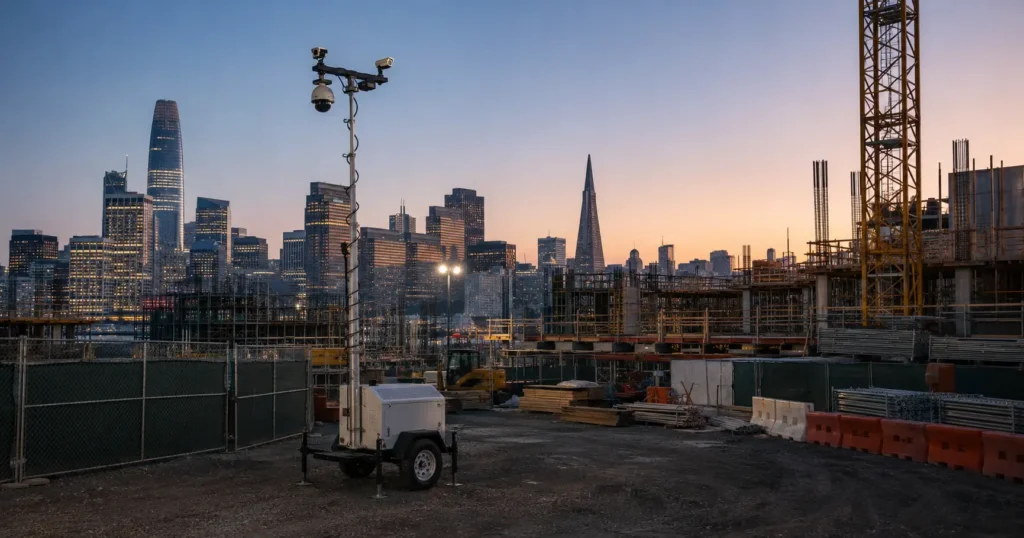
San Francisco construction sites face copper theft, equipment vandalism, and after-hours intrusion. The practical answer is not guards or cameras in isolation. For tight urban lots, security planning for San Francisco construction sites should combine selective guard presence, elevated mobile video coverage, clear incident documentation, and permit-aware placement. A compact trailer can monitor perimeter gaps, laydown zones, sidewalk-adjacent fence lines, and after-hours access points without permanent installs. For GCs, developers, and risk managers, the value is operational control: fewer blind spots, faster evidence capture, and a flexible setup that can move as the project changes. Start with a site walk, identify risk areas by phase, then match guard coverage and surveillance trailer rental to the actual exposure.
- Why San Francisco construction sites face unique 2026 threats
- Why guards alone can’t cover an SF urban site
- What a compact urban surveillance trailer does in San Francisco
- SF-specific deployment considerations
- Insurance & builders-risk: the SF urban angle
- Deployment workflow for urban SF sites
- Frequently asked questions
Why San Francisco construction sites face unique 2026 threats
SF construction security is shaped by dense blocks, limited laydown space, public-facing perimeters, and copper-rich building systems. The risk is not citywide panic, it is predictable exposure around after-hours access, stored materials, and tight sidewalk interfaces.
San Francisco’s larceny rate in the first half of 2025 was 27 percent lower than the first half of 2024, but larceny remained the city’s highest-volume property-crime category in the Council on Criminal Justice analysis. (Council on Criminal Justice) That matters for construction because many jobsite losses are not dramatic break-ins. They are opportunistic thefts of wire, tools, fixtures, copper-rich electrical components, fuel, and portable equipment left visible after the crew leaves.
The SFPD Crime Dashboard lets users compare Part I crimes, including burglary, larceny, motor vehicle theft, and arson, by period. (San Francisco Police Department) For construction teams, those broad categories need to be translated into site controls: who can approach the fence, what can be reached from the sidewalk, where the gate is visible, and which areas are dark or hidden after-hours.
Copper remains a specific concern in Northern California. In August 2025, the California DOJ said telecom companies reported nearly 6,000 copper theft and infrastructure-vandalism incidents nationwide between June and December 2024, with 1,805 in California. (oag.ca.gov) That statewide pattern does not mean every SF project faces the same threat, but it explains why electrical rooms, risers, conduit staging, temp power, and copper conductor storage deserve specific coverage in a site plan. For a deeper regional view, see Hawk’s guide to Bay Area copper-wire theft.
Construction teams weighing exposure across nearby Bay Area markets can also review Hawk’s guides to San Jose construction site security and Oakland construction site security, since theft patterns and site constraints often carry across the region.
Scenario card 1: SoMa mixed-use infill
A SoMa infill project may have a narrow frontage, a busy sidewalk, multiple trades arriving early, and limited room for a large trailer. The risk areas are gate access, copper staging, temporary power, and sidewalk-adjacent fence panels. A compact unit can watch over the fence line without requiring a permanent camera pole.
Scenario card 2: Mission corridor renovation
A Mission renovation may combine scaffolding, storefront adjacency, and intermittent street-space constraints. The concern is not just theft. It is after-hours entry, unauthorized access to scaffold areas, and documentation when the site sits close to foot traffic.
Scenario card 3: Bayview industrial buildout
A Bayview project may have more yard space, but it may also store equipment, pipe, cable, and generators in larger laydown zones. The plan should identify trailer sight lines, lighting angles, and camera views that cover material clusters without blocking construction flow.
Scenario card 4: Western Addition rebuild
A Western Addition rebuild may be tight, residentially visible, and sensitive to noise, lighting, and neighbor concerns. The security posture should be visible enough to deter, but measured enough to fit the block. Positioning and communication matter.
Scenario card 5: Stalled or phased project
A paused phase changes the risk profile. Fewer workers means fewer natural observers. Stored fixtures, mechanical components, and copper become more exposed. A trailer that can be repositioned between phases is often more practical than fixed cameras installed for an old layout.
Why guards alone can’t cover an SF urban site
Guards are useful for access control and physical presence, but one guard cannot see every side of a dense urban jobsite at once. Trailers fill perimeter gaps, provide elevated visibility, and document after-hours incidents without replacing every guard function.
A single 24/7 guard post provides continuous scheduled presence at one route, gate, or patrol pattern, while an elevated trailer can watch multiple risk areas at the same time. That comparison is the core value question for SF: which parts of the site need a person, and which parts need persistent visibility?
Guards still have a role. They can check credentials, interact with workers, escort an unauthorized person away from an access point, and respond to site-superintendent instructions. But guards scale linearly. Add more gates, blind corners, laydown zones, or floors, and you often need more people or more patrol time.
San Francisco also creates a visibility paradox. Sidewalk-adjacent fencing makes a project visible to the public, but it also makes tools, deliveries, temp wiring, and open access points easier to study. A guard walking one side of the site may not see the opposite fence line. A fixed camera mounted too low can be blocked by hoarding, scaffolding, equipment, or a new phase of framing.
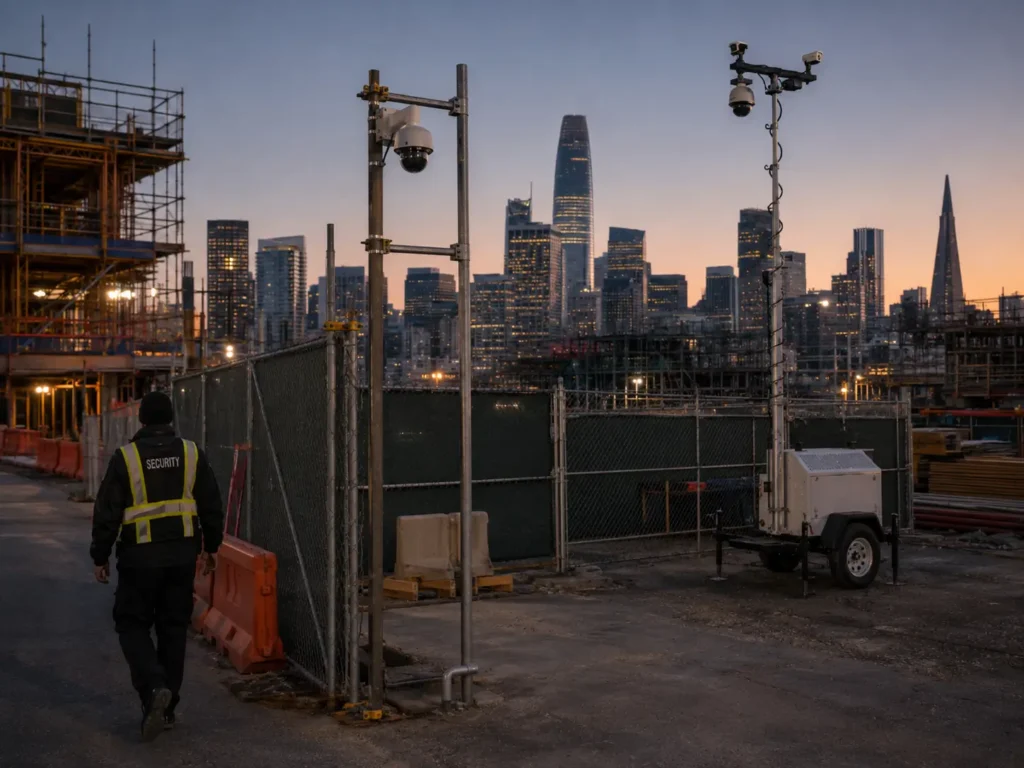
The strongest urban site programs usually use guards for controlled interaction and mobile surveillance for wide-area visibility, documentation, and after-hours consistency.
Security option | Best use on SF sites | Main limitation | Practical fit |
Guard-only coverage | Access control, escorts, gate checks, immediate human presence | Limited simultaneous coverage and higher scaling pressure | Good for active gates and sensitive shifts |
Fixed cameras | Long-term views from stable buildings or poles | Requires install points, power, network, and a stable layout | Good when the site will not change much |
Compact mobile trailer | Elevated views, perimeter gaps, temporary yards, changing phases | Needs proper placement, line of sight, and monitoring plan | Strong fit for tight urban lots |
Hybrid program | Guards plus monitored trailer coverage | Requires coordination between field team and monitoring team | Best fit for complex city projects |
National surveillance providers such as WCCTV, Pelco, SentraCam, and Joint Power Security may serve broad markets, but Hawk’s wedge for San Francisco is narrower: compact urban units, NorCal field familiarity, and a trailers-vs-guards-vs-fixed-cameras planning model built around actual SF perimeter constraints.
What a Compact Urban Surveillance Trailer does in San Francisco
A compact urban trailer is a mobile surveillance unit designed for tight lots, narrow staging areas, and temporary sites where permanent installs are not practical. It gives the superintendent elevated visibility over risk areas without locking the project into one camera layout.
A compact urban surveillance trailer is a mobile, small-footprint security platform that combines cameras, mast elevation, power, connectivity, and monitoring options in one deployable unit. In San Francisco, it is most useful where a project needs temporary visibility over fencing, gates, laydown areas, and after-hours access points without permanent installs. The unit’s job is to create repeatable observation and evidence capture around the parts of the site most likely to change.
Hawk’s compact urban surveillance trailer is the hero product for this use case because SF lots often do not have open acres, easy pole locations, or extra staging space. A smaller footprint matters when the trailer must fit inside a fence line, near a gate, or along a constrained edge without interrupting truck movement.
The elevated mast is the functional difference. A sidewalk-level camera sees what the fence, truck, dumpster, or scaffold allows it to see. A raised mast can look over fencing and into key areas, including electrical staging, access gates, material stacks, portable offices, and equipment parking.
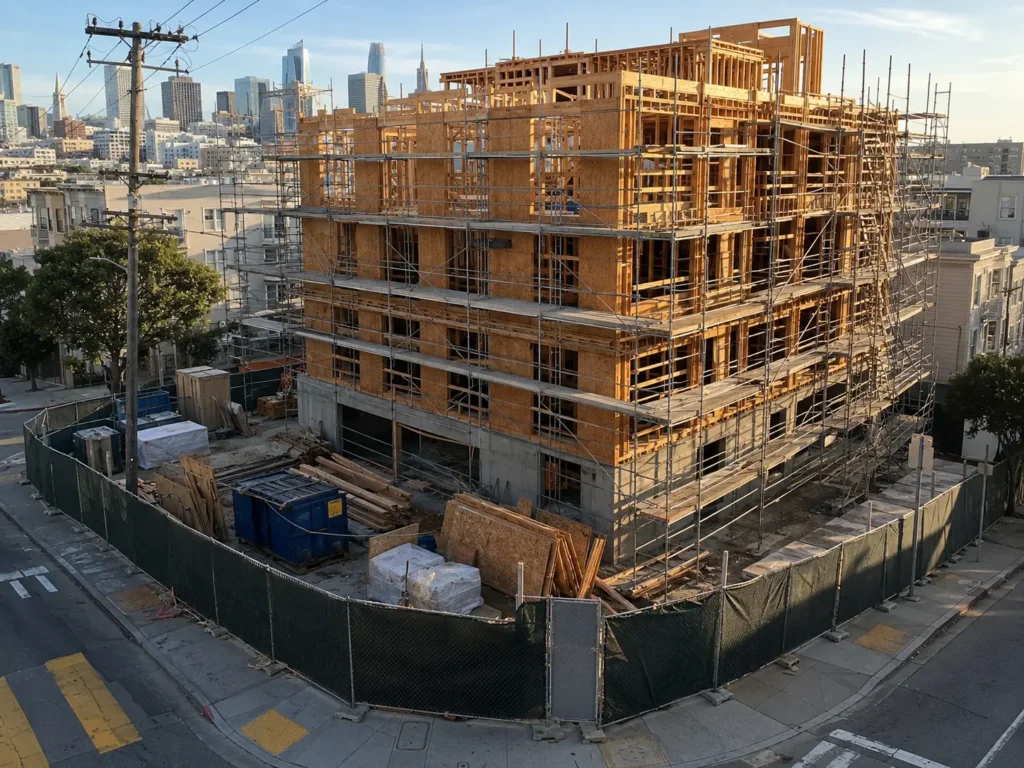
For construction teams, trailer coverage should be mapped to the same operational plan used for construction jobsite security: entrances, high-value materials, dark corners, fuel, generators, temp power, and perimeter gaps. Pairing that visibility with 24/7 remote monitoring turns the trailer from passive recording into an active after-hours tool.
The trailer does not remove the need for site rules. Contractors still need lockup routines, delivery controls, lighting, fence checks, and clear responsibility for who receives incident notices. The trailer supports those routines by making gaps visible and by giving the team a documented record when something happens.
SF-specific deployment considerations
San Francisco deployment is not just a camera decision. It is a placement, right-of-way, sidewalk, neighbor, and footprint decision that should be made before the trailer arrives.
San Francisco Public Works states that a street space permit grants permission to temporarily occupy part of a public roadway or sidewalk for construction-related work, and it limits material and equipment occupancy unless additional approval is granted through the Street Space permit process. (sfpublicworks.org) That is directly relevant when a trailer, equipment, debris box, or construction support item could cross from private property into the public right-of-way.
The first question is placement. Can the trailer sit fully inside the project fence? Can it see over the fence without blocking ingress, egress, crane swing, deliveries, fire access, or pedestrian flow? Does the mast view cover the actual risk areas, or only the most convenient corner?
The second question is sidewalk visibility. An SF trailer may be visible to neighbors, pedestrians, and nearby businesses. That visibility can help deterrence, but the setup should be professional, measured, and documented. Signage, lighting direction, camera angle, and monitoring protocol should be reviewed so the program fits the block, not just the site.
The third question is footprint. Tight urban lots may not support a standard heavy-duty trailer without disrupting operations. That is why compact units matter. A superintendent should be able to keep concrete, steel, mechanical, and delivery movement running while the security system stays in position.
Hawk’s San Francisco surveillance trailer rental page supports city-specific planning for contractors that need a permit-aware conversation before deployment. The best time to have that conversation is before the jobsite is fully exposed, not after materials are staged and the site team is already reacting.
Insurance + builders-risk: SF urban angle
Builders-risk insurance is not a substitute for security, and security is not a guarantee of premium savings. But documented monitoring can support underwriting conversations, incident review, and claims documentation on high-value SF projects.
Builder’s risk insurance can cover structures, work in progress, materials, and equipment against theft, vandalism, fire, and certain other covered causes, according to Desjardins business guidance and Insureon’s builder’s risk overview. (Desjardins.com) The security takeaway is simple: if theft and vandalism are covered exposures, insurers and risk managers will care how those exposures are controlled.
For SF urban projects, the builders-risk conversation often centers on value at risk. Copper, finished fixtures, temp power, mechanical equipment, and staged materials can sit in dense public-facing environments before the structure is fully secured. A monitoring program gives the risk officer more than a statement that the site is fenced. It can provide a written plan, camera positions, monitoring tier, incident logs, and video evidence.
That does not mean every insurer will reduce the premium. Premium decisions depend on carrier, project value, loss history, deductible, coverage form, site controls, construction type, and underwriting appetite. A better way to frame the value is that monitored security gives the project team evidence and discipline. It can help support a builders-risk insurance conversation, and it can help resolve what happened after an incident.
The operational move is to prepare a concise security exhibit for underwriting. Include site plan, fence plan, access-control process, lighting plan, trailer locations, monitoring hours, incident escalation contacts, and phase-change review dates. That package helps the broker or risk manager explain the controls without overstating the outcome.
Deployment workflow for urban SF sites
Urban deployment should move from site walk to placement plan to monitoring selection to phase review. The trailer should fit the construction sequence, not force the construction sequence to fit the trailer.
Hawk describes its process as moving from site assessment to trailer mix, scheduling, delivery, positioning, live monitoring, and ongoing adjustment through how we deploy. That workflow matters in SF because the site will change: demo, excavation, vertical work, enclosure, interiors, and punch list each create different risk areas.
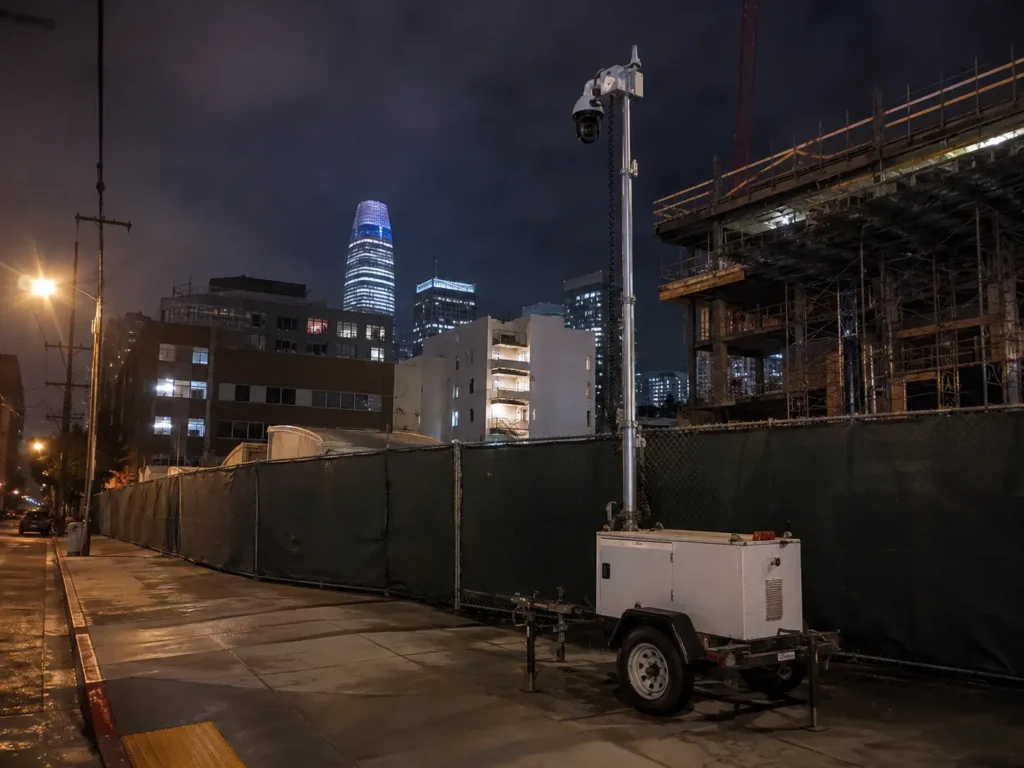
Step 1: Site walk and placement plan
The site walk should identify entry points, pedestrian-adjacent fence lines, material storage, temp power, scaffold access, blind corners, and camera obstructions. It should also confirm whether the trailer can remain inside private limits or whether right-of-way coordination may be needed.
Step 2: Permit-aware positioning
If the trailer or supporting equipment touches public space, the project team should review SF Public Works requirements before placement. Public Works states that certain temporary occupancies require insurance documentation and that parking-lane uses may require no-parking signs to be registered at least 72 hours in advance for towing privileges through the Temporary Occupancy process. (sfpublicworks.org) Night work can also trigger added coordination because Public Works notes a night noise permit may be required for work between 8:00 p.m. and 7:00 a.m. (sfpublicworks.org)
Step 3: Commissioning and monitoring tier
Commissioning should confirm power, connectivity, mast height, camera views, detection zones, notifications, escalation contacts, and recording access. On a prepared site, commissioning typically takes place on the day of delivery, so the unit is verified and live before the next shift begins. Monitoring tier should match the actual risk: passive recording, scheduled after-hours review, active alerts, voice-down response, or a hybrid program with a guard.
Step 4: Phase changes and repositioning
A trailer that was perfect during framing may be wrong during interiors. As walls close, materials shift, and trades rotate, the site should review camera views and reposition if needed. High-tempo sites should treat security coverage like logistics: adjust it when the work changes.
Step 5: Incident review and reporting
After any incident, the field team should capture the timeline, video clips, guard notes, police report status, photos, and material list. That record supports internal controls, subcontractor communication, and insurance documentation. The goal is not paperwork for its own sake. It is a cleaner decision trail when the project has to respond.
Frequently asked questions
SF construction security usually works best as a hybrid plan. Use cameras and trailers for coverage, guards for human interaction, and documentation for insurance and incident response.
What is the biggest security threat at San Francisco construction sites?
Material theft dominates SF construction site security in 2026, with copper conductor at the top, followed by tools, fixtures, and high-value electrical equipment. After-hours intrusion and occasional squatting on stalled sites add to the risk. Urban density and sidewalk-adjacent perimeters make SF sites uniquely accessible to opportunistic theft.
Do San Francisco construction sites need guards or can cameras alone protect them?
Hybrid is standard. A single guard covers a small fraction of the perimeter at any moment. Combining mobile surveillance trailers, especially compact urban units sized for tight SF lots, with selective guard presence and 24/7 monitoring gives wide-area coverage at lower total cost than guards alone.
How much does construction site security in San Francisco cost?
Cost depends on site size, perimeter complexity, monitoring tier, and contract length. A monthly trailer plus monitoring package is usually less than equivalent 24/7 guard coverage at the same site. Exact figures vary by site, so the most accurate next step is a quick scoped quote.
What kind of surveillance trailer fits a tight San Francisco lot?
Compact urban surveillance trailers are designed for the smaller footprint and sidewalk-adjacent placement that SF lots require. They still carry elevated camera masts and off-grid power, but in packaging optimized for urban deployment. Standard heavy-duty trailers can also be used on larger SF lots.
How fast can a mobile surveillance trailer deploy in San Francisco?
A single trailer can typically be deployed quickly on a prepared site, plus any city right-of-way coordination if the trailer crosses sidewalk space. Multi-trailer rollouts on large SF mixed-use projects are phased to match the construction schedule.
Can SF construction site surveillance reduce my builders-risk insurance premium?
Documented active security monitoring can favorably influence builders-risk terms with some insurers, particularly on high-value SF projects where active video evidence is part of the program. Provide your security plan during underwriting conversations, but avoid assuming a guaranteed premium reduction before the carrier reviews the full risk.
For San Francisco projects, the best security plan is practical, phased, and permit-aware. Use guards where human control is required. Use compact trailers where visibility, documentation, and after-hours consistency matter most. The right time to plan is before the next phase exposes new perimeter gaps.