

Last updated: June 2026
TL;DR: AT A GLANCE
Sacramento construction sites face copper theft, tool loss, and after-hours vandalism. In 2026, the practical answer is not guard-only coverage or passive cameras alone. The capital region has active housing, commercial, roadway, and infrastructure work, which means more temporary perimeters, more staging zones, and more material sitting exposed between shifts. A better Sacramento construction site security plan combines visible mobile surveillance, selective guard use, active monitoring, and phase-by-phase repositioning. For many high-tempo sites, surveillance trailer rental gives project teams flexible coverage without permanent installs, especially where power, internet, and fixed camera mounting points are not ready.
Why Sacramento construction sites are getting hit in 2026
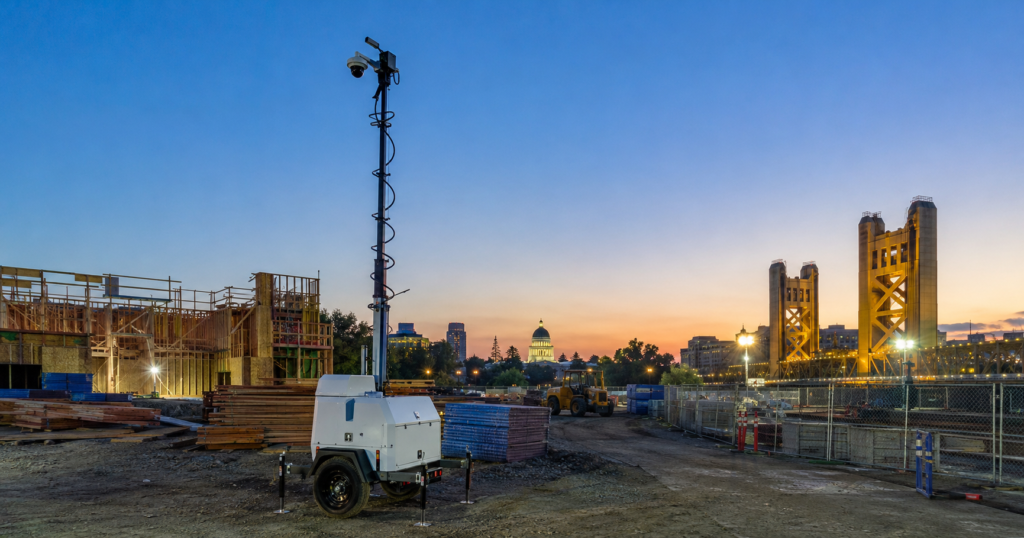
Sacramento has active building, road, and infrastructure work in 2026, creating more temporary perimeters, laydown yards, and after-hours risk areas across the capital region.
In brief: Construction activity does not automatically mean a site is unsafe. It means there are more unsecured materials, changing access points, and perimeter gaps that need active coverage.
Construction site security in Sacramento starts with the local build environment. The City of Sacramento publishes applied and issued building permit data through its open data system for citywide building permit activity, which gives contractors and owners a clear signal that project volume is trackable across the city. (City of Sacramento) Sacramento County also says transportation projects are underway on a continuous basis, ranging from interchange construction and modification to major roadway improvements and neighborhood traffic management work. (SacDOT)
Infrastructure work adds another layer. Caltrans describes the US 50 Multimodal Corridor Enhancement and Rehabilitation Project as a corridor effort that will construct HOV lanes and rehabilitate pavement from the US 50 and I-5 interchange to Watt Avenue, covering 14 lane miles. (Caltrans) Statewide, Caltrans reported in March 2026 that the California Transportation Commission approved a 2026 SHOPP plan investing $17.9 billion over four years in the state highway system. (Caltrans)
That activity creates normal construction risk: copper conductor waiting for install, tools in gang boxes, lumber in staging zones, fixtures in partially enclosed structures, and equipment left near access points. The issue is not that Sacramento is uniquely dangerous. The issue is that active construction produces temporary assets in temporary spaces.
For contractors comparing local exposure, Hawk’s California construction theft statistics guide supports the broader prevention framework. The Sacramento takeaway is operational: map what can be removed quickly, then cover those points before the first weekend shutdown.
Sacramento sits inside a wider California exposure pattern. Contractors comparing capital-region risk with the Bay Area can review our guides to construction site security in San Jose and construction site security in Oakland to plan coverage across multiple job sites.
Why guards alone don’t cover a Sacramento job site
A 24/7 guard-only program requires 168 scheduled guard-hours per week before supervision, breaks, relief, overtime, and patrol vehicles are considered.
In brief: Guards still matter, but they are strongest when paired with cameras, alerts, and monitoring. A single person cannot watch every gate, blind side, material stack, and access road at the same time.
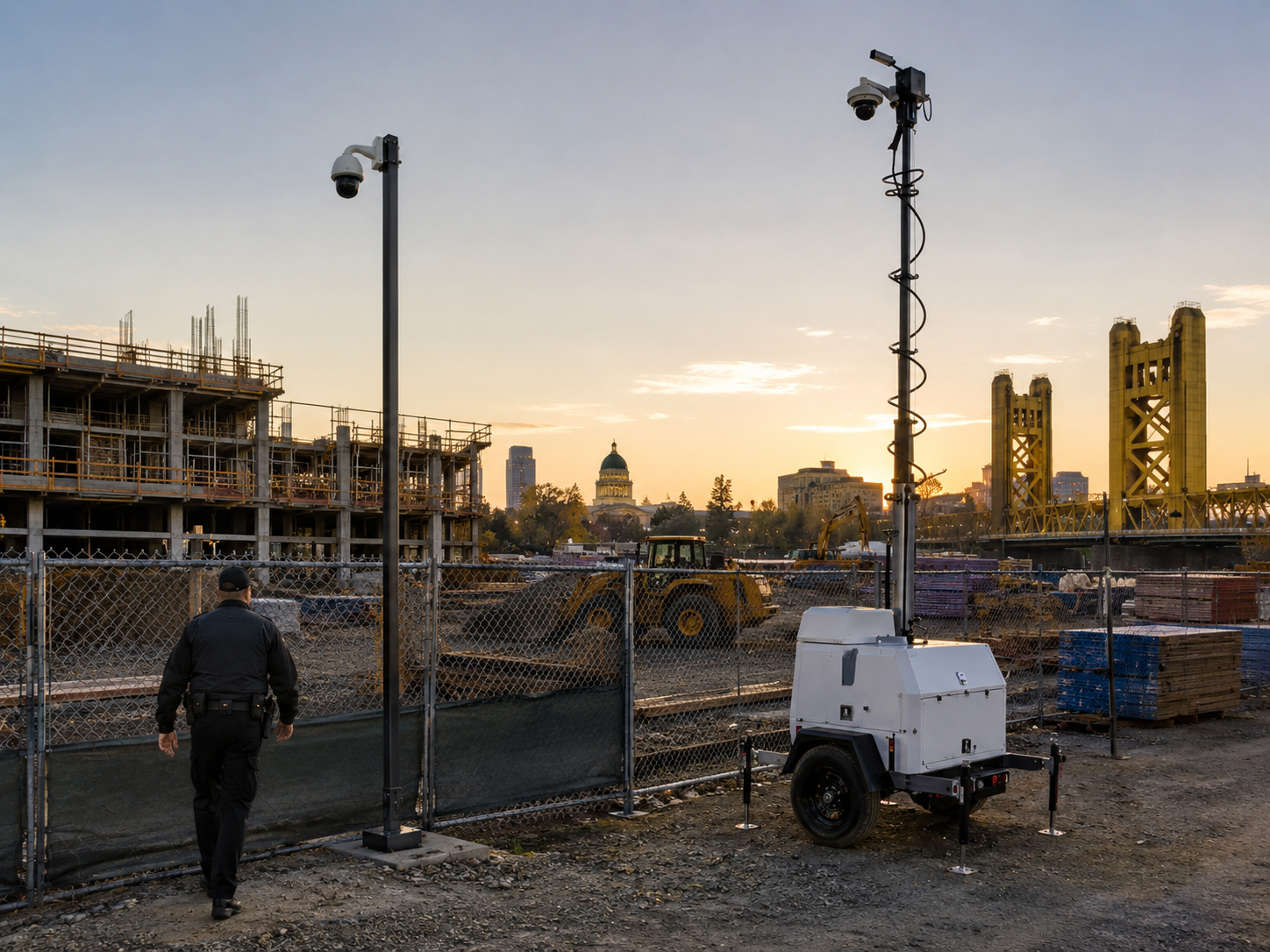
A guard is a human patrol resource. That is useful for controlled entrances, contractor check-ins, escorting, and incident response. The gap is geometry. A Sacramento jobsite can include fencing, multiple street frontages, dark corners, delivery gates, temporary power zones, and material staging that shifts weekly.
Guard-only programs also scale in a straight line. More hours require more people. More gates require more posts. More acreage requires more patrol time. That is why guard coverage often becomes either expensive enough to cut back or thin enough to miss the exact theft window it was meant to prevent.
Guard coverage is strongest when it is directed by camera alerts, not when one person is expected to watch every gate, laydown yard, and blind corner alone.
Security option | What it covers well | Common gap | Best Sacramento use case |
|---|---|---|---|
Guard-only patrol | Access control, visible presence, human response | Patrol gaps, limited sightline, linear labor cost | Gatehouse, active shift changes, high-value delivery days |
Fixed cameras | Stable views on finished structures or long-term facilities | Needs power, mounting, network, and installation time | Later phases with permanent power and stable layouts |
Mobile surveillance trailer | Wide-area visibility, deterrence, off-grid coverage, repositioning | Needs correct placement and monitoring plan | Temporary perimeters, laydown yards, phased projects |
Hybrid program | Cameras detect, monitors verify, guards respond selectively | Requires coordination and escalation rules | Multi-acre, high-tempo, or insurance-sensitive sites |
National providers such as WCCTV and Pelco publish construction security camera and solar trailer options, which can fit standardized programs. (wcctv.com) Hawk’s Sacramento wedge is local field planning: trailers vs. guards vs. fixed cameras, placed around the capital-region site conditions that actually change during the build.
What mobile surveillance does on a Sacramento site
Mobile surveillance is a temporary, self-contained jobsite security system that places cameras, power, communications, and visible deterrence on a movable trailer. On construction sites, it is used to monitor gates, perimeters, equipment zones, material staging, and after-hours access without permanent installs.
In brief: Mobile surveillance gives Sacramento contractors flexible camera coverage before the site has permanent power, walls, lighting, or finished network infrastructure.
A mobile trailer supports construction jobsite security by solving the early-phase problem. Many thefts happen when a site is valuable but not yet hardened. Fencing is up, deliveries are arriving, copper and tools are staged, but permanent cameras are not installed. That is exactly where an elevated mast and off-grid operation matter.
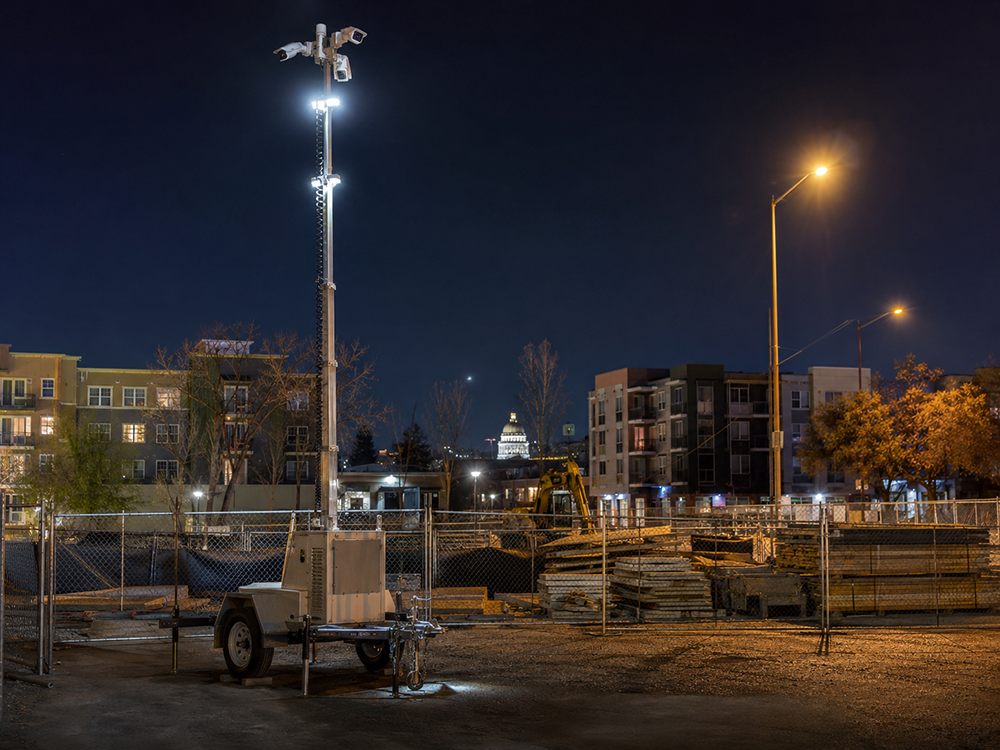
A solar surveillance trailer can watch over risk areas from above normal fence height. The goal is not just recording footage for the next morning. With 24/7 remote monitoring, the system can support detection, verification, voice-down deterrence, and escalation when an after-hours event is in progress.
The operational benefits are straightforward:
Elevated mast views cover more ground than low wall-mounted cameras.
Solar and battery operation reduce dependency on site power.
Cellular connectivity reduces dependency on unfinished internet.
Repositioning lets coverage follow the build sequence.
Visible trailer presence tells trespassers the site is actively watched.
For Sacramento projects, the repositioning point is critical. A trailer may start near a gate and laydown yard, then move to a newly framed building, then shift again to cover fixtures, copper, HVAC equipment, or parking-lot work. Fixed cameras can become less useful when the project layout changes. A mobile trailer is built for that change.
Sacramento-specific risk patterns
Sacramento Police provides public crime mapping that lets users query and map selected crimes by neighborhood, which makes site-specific risk review more useful than citywide assumptions. (City of Sacramento)
In brief: The right Sacramento security plan is not a generic citywide plan. It should match the site’s frontage, staging, access pattern, and construction phase.
Hawk supports capital-region contractors through Sacramento surveillance trailer rental for projects that need rapid and flexible coverage. The planning conversation should start with the site map, not a fear-based crime narrative.
Scenario card 1: Downtown and Midtown infill
Urban infill sites often have tight lots, shared alleys, sidewalks, limited parking, and public-facing frontage. Risk areas may include pedestrian-accessible fencing, dumpster zones, temporary power, and deliveries staged close to the street. Camera placement should prioritize gates, sidewalk-facing fence lines, and material movement after crews leave.
Scenario card 2: South Sacramento commercial and industrial work
Commercial and light-industrial sites often have larger footprints, truck movement, and multiple access points. The main issue is not just fence entry. It is the combination of wide perimeter, parked equipment, and materials that may be difficult to see from one fixed post. Trailer placement should cover gates, staging, and blind approaches.
Scenario card 3: North suburbs, including Roseville and Citrus Heights
Suburban projects can look lower risk because they are less dense, but larger parking fields, open pads, and weekend quiet periods can create after-hours exposure. Mobile surveillance works well when the site needs visible deterrence without installing fixed infrastructure too early.
Scenario card 4: Elk Grove and Folsom growth corridors
Residential, mixed-use, and commercial pads in growth corridors often move in phases. The risk shifts from grading equipment to framing materials to interior fixtures. A good plan moves the trailer as the site value moves.
Scenario card 5: Highway and infrastructure frontage
Roadway and utility-adjacent work can include exposed copper, traffic-control assets, equipment, and materials spread along linear work zones. These sites need placement that watches the most valuable zones, not just the most convenient parking spot.
Insurance + builders-risk: Sacramento angle
Builders-risk and contractors equipment insurance can help cover theft or vandalism, but US Assure warns that insurance is not a substitute for jobsite security steps. (usassure.com)
In brief: Active monitoring helps Sacramento teams document what security was in place, what happened, and how the site responded.
Insurance does not replace prevention. For builders, developers, and risk officers, the stronger question is: can we show the carrier that the site had a practical security program before the loss? That is where documented camera coverage, monitoring logs, incident clips, gate procedures, and escalation protocols can matter.
Hawk’s builders-risk insurance resource supports that conversation. The goal is not to promise a premium discount. The effect varies by carrier, project type, loss history, deductible, and policy terms. The more realistic value is documentation. A monitored program can show where coverage existed, when an alert occurred, who reviewed it, and whether action was taken.
For Sacramento projects with copper, tools, fixtures, or staged equipment, that documentation can support underwriting discussions and claim handling. It also gives project managers a cleaner record than relying on next-morning discovery alone.
Deployment workflow
A prepared Sacramento site can often move from placement plan to active monitoring in 24 to 48 hours, while larger multi-trailer Central Valley rollouts may phase over 3 to 7 days based on access, layout, and commissioning needs.
In brief: Deployment should be treated like a construction control, with a site walk, trailer placement plan, monitoring tier, and repositioning schedule.
Hawk’s how we deploy workflow starts with the field conditions. The right question is not “How many cameras?” It is “Which risk areas need visibility this week, and which ones will change next week?”
A practical Sacramento deployment includes:
Site walk and map review.
Gate, laydown, and blind-corner identification.
Trailer placement based on line of sight and deterrence.
Cellular signal and solar exposure check.
Monitoring tier selection.
Voice-down and escalation rules.
Phase repositioning schedule.

For high-tempo sites, phase repositioning is not a nice extra. It is the difference between yesterday’s coverage and today’s risk. A trailer placed for grading may not cover the best location once lumber, copper, fixtures, or HVAC equipment arrive. The site plan should be reviewed after major phase changes, large deliveries, and schedule pauses.
The best guard programs also benefit from this workflow. Instead of asking guards to patrol everything equally, monitoring can direct attention to verified activity. That keeps human response focused where it matters and helps avoid paying for broad, low-visibility patrol time.