
TL;DR: Truck yard security breaks into four separate problems: controlled entry, the open lot, the fuel and equipment area, and the after-hours window. Gate control plus license plate recognition handles who comes in. Elevated, lot-wide camera coverage shows what happens between the rows. Live monitoring handles the hours when nobody is there. Fixed cameras still belong at permanent points such as the gate, shop, office, and fuel island. Because yards reconfigure constantly, coverage that can be repositioned is often more useful over the open lot than coverage aimed at last quarter’s layout. Start with a site map, then talk to a security specialist about the gaps fixed cameras do not reach.
Last updated: August 25, 2026.
What actually gets stolen from a truck yard
In brief: Truck yard losses do not fit one pattern: diesel disappears from saddle or bulk tanks, components come off parked equipment, loaded freight or whole trailers leave the property, shop supplies walk away, and an unauthorized pickup can look legitimate until the load fails to arrive.
The exposure list is practical, not predictive:
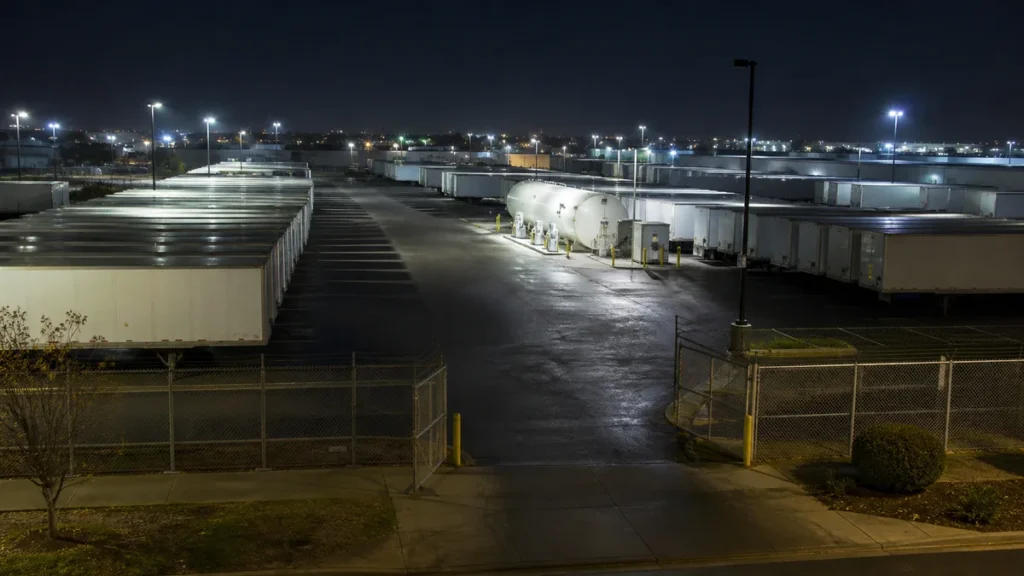
- Diesel and DEF: Fuel may leave saddle or bulk tanks. Locks help, while lighting and camera coverage document forced access and activity around the tank.
- Catalytic converters: Parked equipment exposes components underneath the chassis, the same stripping pattern behind equipment and tool theft at California work sites. The National Insurance Crime Bureau counted 64,701 theft claims in 2022, a historical benchmark rather than a 2026 yard count.
- Cargo and staged freight: Loaded trailers, containers, and staged components are targets. Verisk CargoNet documented 677 incidents and $304.6 million in estimated losses across the United States and Canada in Q2 2026.
- Trailers, chassis, and tractors: Equipment can leave whole, sometimes with cargo inside.
- Batteries, tires, tools, and shop stock: Portable parts can leave a service yard quickly.
- Unauthorized and fraudulent pickups: Plausible information may conceal an impersonated carrier. CargoNet’s Q1 2026 analysis describes carrier and broker impersonation as a central method.
California was CargoNet’s most impacted state in 2025, with 1,218 incidents and an average theft value of $273,990. The issuer’s annual analysis provides the figures. The California Highway Patrol Cargo Theft Interdiction Program coordinates cargo recovery and intelligence work with local agencies.
Exposure to countermeasure: what actually addresses each problem
In brief: Effective truck yard security pairs each exposure with a control that can actually interrupt, verify, or document it; a gate log cannot see under a parked tractor, a fence cannot validate pickup paperwork, and a passive camera cannot respond when an alert appears after hours.
| Exposure | What it looks like in practice | Countermeasure that actually addresses it | Why the obvious cheaper option falls short | Fixed or mobile |
|---|---|---|---|---|
| Fuel theft at the tanks | Siphoning or forced access at saddle or bulk tanks | Tank controls, lighting, a fixed island view, and monitored lot coverage when remote | A lock cannot document damage or bulk-tank activity | Fixed at island; mobile elsewhere |
| Catalytic converter cutting under parked trucks | Activity beneath equipment, hidden by adjacent units | Lighting, practical low views, and elevated approach and exit coverage | A high wall view loses movement behind parked equipment | Mixed |
| Cargo theft from loaded or staged trailers | Door access, seal tampering, load transfer, or mistimed movement | Seal and key procedures, elevated coverage, live monitoring, and gate records | A fence does not show which trailer opened or moved | Mixed |
| Trailer or chassis taken whole | A unit is coupled, moved, and taken through the exit | Coupling controls, LPR, driver verification, and a searchable movement record | A padlock cannot identify the vehicle removing the unit | Fixed at gate; mobile over rows |
| Fraudulent or unauthorized pickup at the gate | A plausible driver or document does not match the authorized pickup | Driver and paperwork verification, appointment controls, and LPR | LPR cannot authenticate a driver, carrier, load, or paperwork | Fixed |
| Tool, battery, tire, and DEF theft from the shop yard | Portable stock leaves a cage, apron, truck, or rack | Locked storage, inventory control, fixed shop cameras, and lighting | A distant lot view may miss the item and access point | Fixed |
| Fence line cutting and back-lot entry | Access begins at the rear boundary, away from the gate | Maintained barriers, clear fence zones, lighting, elevated coverage, and monitoring | A gate guard may not see a distant rear boundary | Mobile for changing hotspots |
| After-hours trespass with no one on site | An alert occurs with nobody present to check the lot | Live monitoring with strobe, voice-down, escalation, and dispatch steps | Passive video records later but does not evaluate now | Mixed |
| Incident with no usable footage for the claim or police report | Video is blocked, dark, mistimed, overwritten, or hard to export | Tested views, synchronized time, retention rules, and protected exports | More cameras cannot fix failed sightlines or evidence handling | Both |
The gate: LPR and driver verification
In brief: License plate recognition at a yard entrance creates a searchable, time-stamped record of vehicle movements, but it does not validate a driver’s identity or right to take a load, so the useful control is an LPR record paired with a real pickup check.
An LPR camera logs plates and timestamps at entry and exit, creating a searchable movement record. Hawk’s LPR camera guide explains placement, angles, and plate-read limits.
At pickup, compare the driver, tractor, carrier, appointment, load, seal, and release instructions with the authorization on file. The plate supports the record; the pickup check decides whether the load leaves.
A yard is also a workplace. Aim at assets, entrances, lanes, and the perimeter, not employee performance. The California Privacy Protection Agency lists employee-data rules as preliminary work, so confirm the plan with counsel. Leave audio recording off by default unless counsel approves it; Penal Code 632 restricts recording confidential communications without all parties’ consent.
Fixed cameras at fixed points, mobile coverage over the lot
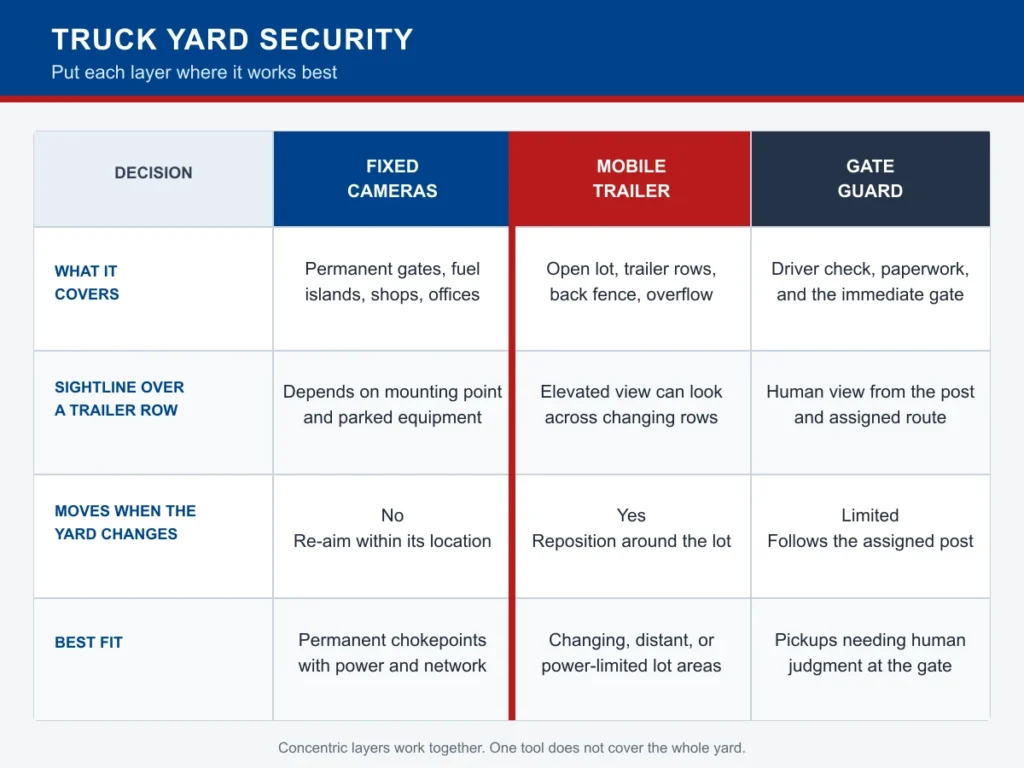
In brief: Fixed cameras are the right answer at permanent points such as the gate, fuel island, shop doors, office, and scale, while an elevated mobile unit fits the open lot, where distance, changing trailer rows, limited power, and blocked sightlines make permanent coverage difficult.
Put fixed cameras where the subject and infrastructure do not move: entry lanes, scale, fuel island, shop, and office. Existing power and network paths simplify maintenance.
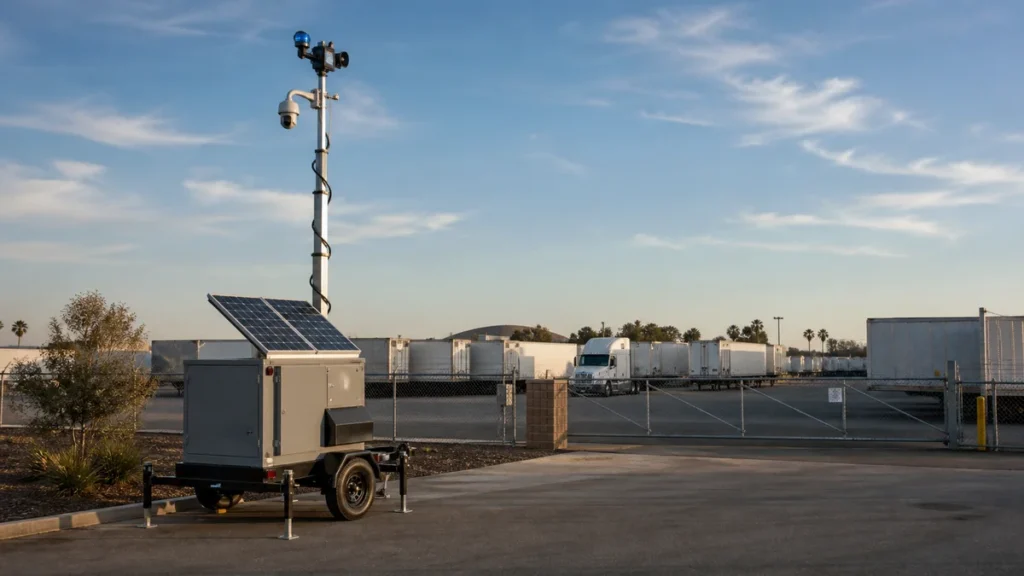
The open lot may sit hundreds of feet from conduit. New poles can require trenching, foundations, and permits, yet trailer rows still block low views. A mast roughly 20 to 30 feet high can look across rows without claiming a universal coverage radius. For a point-by-point breakdown of where each belongs, see mobile surveillance trailer versus fixed cameras.
For larger operations, see Hawk’s work with logistics yards and warehouses and industrial plants.
Gate guard, patrol, or monitored cameras after hours
In brief: A gate guard is strongest when a person must validate drivers and paperwork, patrol provides intermittent presence across a route, and monitored cameras cover the full assigned window and verify alerts, but they escalate through a response plan instead of physically intervening.
| Option | What it covers | Hours covered | Response | Cost profile | What it misses | Best fit |
|---|---|---|---|---|---|---|
| Gate guard | Gate lane, driver, paperwork, and immediate gate area | Scheduled staffed shift | Checks credentials, denies entry under post orders, and calls the response chain | Recurring labor by coverage hours | Back fence and rows outside the post’s view | Busy gates and fraud-sensitive pickups |
| Mobile patrol | Multiple checkpoints along a route | Minutes per visit at scheduled or varied intervals | Observes conditions during the visit and reports or escalates | Recurring service by visit frequency and scope | Events between visits | Visible checks where continuous staffing is not required |
| Monitored cameras | Defined camera views across the lot and perimeter | The full contracted monitoring window | Operators verify video, use strobe or voice-down when configured, and escalate under the site plan | Rental and monitoring service | Physical tasks, document checks, and any blind spot outside the camera plan | Closed yards needing continuous after-hours observation |
Ask what decision must be made and where. The live video monitoring guide explains workflow and cost drivers, and how remote guarding actually works covers the operator side. Video verification improves escalation information, while dispatch still depends on the site plan, available responders, and agency policy.
The field includes Flock Safety, LiveView Technologies, Verkada, Spot AI, Stealth Monitoring, and regional guard and patrol firms. Compare hardware, monitoring, post orders, response steps, retention, and deployment responsibility.
Yards do not hold still: the case for coverage you can move
In brief: A truck yard changes faster than permanent camera infrastructure: seasonal freight fills a new staging row, paving closes a quadrant, an overflow lot opens on a short lease, and a recurring problem moves after lighting improves, so useful coverage must be able to follow the layout.
A seasonal surge can turn the north lot into loaded staging. Repaving can close a quadrant. A customer can require an overflow yard two blocks away. A recurring issue can shift behind the shop after the front fence receives better lighting.
A mobile unit can be repositioned in an afternoon, with its views reset around new rows and paths. Hawk’s solar trailer fits power-limited lots, while the industrial trailer fits rougher yards. Hawk rents both and does not sell them.
Rental avoids a stranded asset when a short lease ends. Solar and LTE avoid trenching, and setup takes hours once placement and response are settled. Hawk serves freight corridors around Stockton and Sacramento.
What a monitored rental includes at a yard
In brief: A monitored rental should begin with a site walk and placement plan, then combine elevated sightlines, solar power, LTE connectivity, after-hours monitoring, a written escalation path, recorded evidence, and repositioning support as trailer rows, staging areas, and access points change.
Hawk maps entries, high-value rows, lighting, power, and after-hours coverage. The mast is placed for sightlines across trailers without pretending one position covers every acre. Solar and LTE support lots without permanent infrastructure.
Hawk monitors only the trailers it rents. The site plan can include strobe, live voice-down, contacts, and dispatch. Time-stamped recordings support claims and reports, while placement and alert zones can change with the yard.
Review the surveillance trailer rental and remote monitoring service pages. Pricing is a site-specific quote, usually same day.
Frequently asked questions
In brief: A secure truck yard uses layered controls instead of one product: verified entry, protected fuel and shop areas, coverage over changing trailer rows, after-hours response, and a tested evidence process, with fixed and mobile equipment assigned to the places each can cover well.
How do you secure a truck yard?
What is the best way to stop diesel theft at a yard?
Do truck yards need license plate recognition at the gate?
Are security cameras or a guard better for a trucking terminal?
How do you cover a large yard where there is no power run to the lot?
What footage do insurers and police actually need after a yard theft?
Can surveillance be moved when the yard layout changes?
Get coverage over your yard
In brief: If the gate and buildings are covered but the open lot, back fence, fuel area, or after-hours window still has a gap, Hawk can scope a rented mobile unit, a monitoring plan, and a placement strategy around the yard’s current layout.
Bring a yard map, operating hours, gate procedures, power availability, and the views your existing cameras miss. Hawk scopes truck yard security across Northern California and monitors only the trailers it rents.
Review Surveillance Trailer Rental or Talk to a Security Specialist. Pricing is a site-specific quote, usually same day.